Science Explorer Back to mapMap
Discussion
Company · Malden · United States

Queues Enforth Development (United States)

World rank, all time
#31,518
of 34,923
Rank in United States
#6,660
of 7,310
Research works
214
▼ 24% vs 2018-21
Citations
469
2.2 per fractional work
Top-10% rate
9.6%
all institutions 10.0%
vs its own fields
0.75×
1.00× is exactly expected
Open access
87%
world 40%
International
9%
world 18%
Queues Enforth Development (United States)

Which fields of science does Queues Enforth Development (United States) work in?

In all years, 55% of research at Queues Enforth Development (United States) is in Physical Sciences, 38% in Social Sciences. Its largest fields are Computer Science (43%), Social Sciences (14%), Engineering (9%). It does 1.8× the world's share of Social Sciences.

Physical Sciences: 117 fractional works · 54.5% of its workComputer Science: 92 fractional works · 42.9% of its workInformation Systems: 37 fractional works · 17.4% of its workComputer Networks and Communications: 27 fractional works · 12.7% of its workArtificial Intelligence: 10 fractional works · 4.8% of its workComputer Science Applications: 5 fractional works · 2.4% of its workHardware and Architecture: 3 fractional works · 1.3% of its workComputer Graphics and Computer-Aided Design: 3 fractional works · 1.2% of its workComputational Theory and Mathematics: 2 fractional works · 1.0% of its workSignal Processing: 2 fractional works · 0.7% of its workHuman-Computer Interaction: 1 fractional works · 0.6% of its workSoftware: 1 fractional works · 0.5% of its workEngineering: 20 fractional works · 9.3% of its workAerospace Engineering: 10 fractional works · 4.7% of its workElectrical and Electronic Engineering: 3 fractional works · 1.5% of its workIndustrial and Manufacturing Engineering: 2 fractional works · 0.9% of its workAutomotive Engineering: 1 fractional works · 0.5% of its workControl and Systems Engineering: 1 fractional works · 0.5% of its workMedia Technology: 1 fractional works · 0.5% of its workBiomedical Engineering: 1 fractional works · 0.3% of its workSmaller subfields together: 1 fractional works · 0.4% of its workPhysics and Astronomy: 2 fractional works · 0.9% of its workAstronomy and Astrophysics: 1 fractional works · 0.7% of its workSmaller subfields together: 0 fractional works · 0.2% of its workEnvironmental Science: 1 fractional works · 0.6% of its workManagement, Monitoring, Policy and Law: 1 fractional works · 0.4% of its workSmaller subfields together: 0 fractional works · 0.2% of its workMaterials Science: 1 fractional works · 0.4% of its workMaterials Chemistry: 0 fractional works · 0.2% of its workSmaller subfields together: 0 fractional works · 0.2% of its workChemical Engineering: 0 fractional works · 0.2% of its workChemistry: 0 fractional works · 0.2% of its workEarth and Planetary Sciences: 0 fractional works · 0.2% of its workMathematics: 0 fractional works · 0.1% of its workSocial Sciences: 82 fractional works · 38.3% of its workSocial Sciences: 31 fractional works · 14.4% of its workSociology and Political Science: 12 fractional works · 5.4% of its workEducation: 7 fractional works · 3.1% of its workPolitical Science and International Relations: 2 fractional works · 1.1% of its workHealth: 2 fractional works · 0.9% of its workCommunication: 1 fractional works · 0.6% of its workTransportation: 1 fractional works · 0.5% of its workGeneral Social Sciences: 1 fractional works · 0.5% of its workSafety Research: 1 fractional works · 0.5% of its workDemography: 1 fractional works · 0.3% of its workAnthropology: 1 fractional works · 0.3% of its workDevelopment: 1 fractional works · 0.3% of its workGeography, Planning and Development: 1 fractional works · 0.3% of its workLaw: 0 fractional works · 0.2% of its workSmaller subfields together: 1 fractional works · 0.5% of its workEconomics, Econometrics and Finance: 15 fractional works · 6.8% of its workEconomics and Econometrics: 14 fractional works · 6.6% of its workSmaller subfields together: 0 fractional works · 0.2% of its workArts and Humanities: 11 fractional works · 5.2% of its workHistory and Philosophy of Science: 2 fractional works · 1.1% of its workLiterature and Literary Theory: 2 fractional works · 0.9% of its workPhilosophy: 2 fractional works · 0.7% of its workHistory: 1 fractional works · 0.6% of its workMuseology: 1 fractional works · 0.5% of its workArcheology: 1 fractional works · 0.4% of its workConservation: 1 fractional works · 0.3% of its workVisual Arts and Performing Arts: 1 fractional works · 0.3% of its workSmaller subfields together: 0 fractional works · 0.2% of its workBusiness, Management and Accounting: 10 fractional works · 4.8% of its workManagement Information Systems: 6 fractional works · 2.7% of its workMarketing: 2 fractional works · 0.8% of its workAccounting: 1 fractional works · 0.5% of its workStrategy and Management: 1 fractional works · 0.5% of its workBusiness and International Management: 0 fractional works · 0.2% of its workSmaller subfields together: 0 fractional works · 0.1% of its workDecision Sciences: 8 fractional works · 3.8% of its workManagement Science and Operations Research: 4 fractional works · 1.9% of its workInformation Systems and Management: 3 fractional works · 1.5% of its workStatistics, Probability and Uncertainty: 1 fractional works · 0.5% of its workPsychology: 7 fractional works · 3.3% of its workDevelopmental and Educational Psychology: 3 fractional works · 1.4% of its workSocial Psychology: 2 fractional works · 0.9% of its workClinical Psychology: 2 fractional works · 0.7% of its workExperimental and Cognitive Psychology: 0 fractional works · 0.2% of its workSmaller subfields together: 0 fractional works · 0.0% of its workHealth Sciences: 10 fractional works · 4.8% of its workMedicine: 7 fractional works · 3.1% of its workPublic Health, Environmental and Occupational Health: 2 fractional works · 1.1% of its workReproductive Medicine: 1 fractional works · 0.5% of its workNeurology: 1 fractional works · 0.4% of its workPediatrics, Perinatology and Child Health: 1 fractional works · 0.4% of its workRadiology, Nuclear Medicine and Imaging: 0 fractional works · 0.2% of its workSmaller subfields together: 1 fractional works · 0.6% of its workHealth Professions: 3 fractional works · 1.6% of its workGeneral Health Professions: 3 fractional works · 1.2% of its workHealth Information Management: 1 fractional works · 0.4% of its workDentistry: 0 fractional works · 0.0% of its workLife Sciences: 5 fractional works · 2.4% of its workNeuroscience: 2 fractional works · 0.9% of its workCognitive Neuroscience: 1 fractional works · 0.6% of its workNeurology: 0 fractional works · 0.2% of its workBiochemistry, Genetics and Molecular Biology: 1 fractional works · 0.5% of its workMolecular Biology: 1 fractional works · 0.5% of its workImmunology and Microbiology: 1 fractional works · 0.5% of its workImmunology: 1 fractional works · 0.5% of its workPharmacology, Toxicology and Pharmaceutics: 1 fractional works · 0.3% of its workPharmacology: 1 fractional works · 0.3% of its workAgricultural and Biological Sciences: 1 fractional works · 0.2% of its workALL ITS WORKQueues EnforthDevelopment…214fractional works, all years
Life Sciences2%Physical Sciences55%Health Sciences5%Social Sciences38%

Each ring splits the one inside it: the four domains of science, their fields, their subfields. Size is fractional works in all years. Every slice is a page; the interactive view zooms down to single topics and colours each by how much more of it this institution does than the world.

Its 4 domains and 23 fields, with their numbers
    1. Computer Science9242.9%
    2. Engineering209.3%
    3. Physics and Astronomy20.9%
    4. Environmental Science10.6%
    5. Materials Science10.4%
    6. Chemical Engineering00.2%
    7. Chemistry00.2%
    8. Earth and Planetary Sciences00.2%
    9. Mathematics00.1%
    1. Social Sciences3114.4%
    2. Economics, Econometrics and Finance156.8%
    3. Arts and Humanities115.2%
    4. Business, Management and Accounting104.8%
    5. Decision Sciences83.8%
    6. Psychology73.3%
    1. Medicine73.1%
    2. Health Professions31.6%
    3. Dentistry00.0%
    1. Neuroscience20.9%
    2. Biochemistry, Genetics and Molecular Biology10.5%
    3. Immunology and Microbiology10.5%
    4. Pharmacology, Toxicology and Pharmaceutics10.3%
    5. Agricultural and Biological Sciences10.2%
All of science, and how each field's share has moved since 1950: the Science domain explorer

Field profile

Location quotient across every field it publishes in: outside the ring is more than an institution of this size would be expected to publish, inside it is less.

Agricultural and Biological Sciences: 0.51× its world share, 0 worksAgricultural and Bio…Computer Science: 0.78× its world share, 0 worksComputer ScienceEnvironmental Science: 0.31× its world share, 0 worksEnvironmental ScienceDentistry: 2.51× its world share, 0 worksDentistryHealth Professions: 2.08× its world share, 0 worksHealth ProfessionsMedicine: 0.73× its world share, 1 worksMedicineArts and Humanities: 1.26× its world share, 0 worksArts and HumanitiesEconomics, Econometrics and Finance: 0.85× its world share, 0 worksEconomics, Econometr…Psychology: 2.54× its world share, 0 worksPsychologySocial Sciences: 4.43× its world share, 3 worksSocial Sciences1×world share
more than its size predictsabout as predictedless

Rings at 0.5×, 1× and 2×. Widest outward: Social Sciences, 4.4×. Every wedge is a field page.

All 10 fields, with their numbers
  1. Social Sciences4.43×3 works
  2. Psychology2.54×0 works
  3. Dentistry2.51×0 works
  4. Health Professions2.08×0 works
  5. Arts and Humanities1.26×0 works
  6. Economics, Econometrics and Finance0.85×0 works
  7. Computer Science0.78×0 works
  8. Medicine0.73×1 works
  9. Agricultural and Biological Sciences0.51×0 works
  10. Environmental Science0.31×0 works

Who are the top researchers at Queues Enforth Development (United States)?

Ranked on the quality score, Edward Grossman, John Stanik and Charlene O'Hanlon lead among researchers whose main affiliation is Queues Enforth Development (United States).

  1. 1 Edward Grossman United States · #4,656,640 worldwide 3 citations · 39 works
  2. 2 John Stanik United States · #5,495,549 worldwide 16 citations · 51 works
  3. 3 Charlene O'Hanlon United States · #6,060,073 worldwide 200 citations · 85 works
  4. 4 Stan Kelly-Bootle United States · #6,097,110 worldwide 88 citations · 64 works
  5. 5 George V. Neville-Neil United States · #7,648,005 worldwide 501 citations · 272 works
All ranked researchers at Queues Enforth Development (United States)

What are the most cited papers from Queues Enforth Development (United States)?

The most cited paper from Queues Enforth Development (United States) is "A Dynamic Subgradient-Based Branch-and-Bound Procedure for Set Covering" (Egon Balas, Maria C. Carrera, 1996), with 175 citations. Next come "A Conversation with Werner Vogels" (73) and "Geography's impact on the success of focused local drug enforcement operations" (63).

Most cited papers
#PaperReleasedCitations
1 A Dynamic Subgradient-Based Branch-and-Bound Procedure for Set Covering Egon Balas, Maria C. Carrera · Operations Research Dec 1996 175
2 A Conversation with Werner Vogels Charlene O'Hanlon · Queue Open access May 2006 73
3 Geography's impact on the success of focused local drug enforcement operations Jonathan P. Caulkins, Richard Charles Larson, Thomas F. Rich · Socio-Economic Planning Sciences Jun 1993 63
4 A Conversation with John Hennessy and David Patterson Charlene O'Hanlon · Queue Open access Dec 2006 39
5 Understanding the Problem George V. Neville-Neil · Queue Open access Nov 2006 31
All 90 most cited papers, with filters and sorting

Which keywords describe research at Queues Enforth Development (United States)?

By fractional works in all years, weighted toward what it does more of than the world: Distributed Systems, Resource Management, Big Data, Workflow Management, Monetary Policy, High-Performance Computing, Financial Analysis and Grid Computing.

▲ more of its work than of the world's◆ about the world's share▼ less than the world's

Size is fractional works in all years in the topics tagged with each word; colour is the word's share of this institution's work against its share of the world's. The 40 words are chosen for being large and distinctive. Each links to the topic it comes from most.

All 40 words, with their numbers
  1. Distributed Systems28▲ 53×6 topics
  2. Resource Management16▲ 42×2 topics
  3. Big Data15▲ 13×9 topics
  4. Machine Learning14▲ 3.0×15 topics
  5. Workflow Management14▲ 64×2 topics
  6. Monetary Policy13▲ 22×3 topics
  7. High-Performance Computing13▲ 41×2 topics
  8. Financial Analysis12▲ 68×2 topics
  9. Grid Computing12▲ 84×1 topic
  10. Task Scheduling12▲ 84×1 topic
  11. Asset Pricing12▲ 40×1 topic
  12. Panel Data Models12▲ 113×1 topic
  13. Sustainability10▲ 2.6×12 topics
  14. Brain Activity9▲ 62×2 topics
  15. Globalization8▲ 2.2×21 topics
  16. Hypersonic Effect8▲ 164×1 topic
  17. Requirements Engineering8▲ 59×2 topics
  18. Ultrasonic Perception8▲ 164×1 topic
  19. Education8▲ 3.0×18 topics
  20. Agile Software Development8▲ 129×1 topic
  21. Empirical Studies8▲ 129×1 topic
  22. Social Media8▲ 4.6×9 topics
  23. Log Analysis6▲ 84×1 topic
  24. Performance Prediction6▲ 52×1 topic
  25. Supply Chain Management6▲ 5.8×5 topics
  26. Cloud Computing6▲ 10×4 topics
  27. Security6▲ 6.6×6 topics
  28. Virtualization6▲ 35×3 topics
  29. Internet Applications5▲ 46×2 topics
  30. STEM Education5▲ 8.1×2 topics
  31. Analytics5▲ 41×1 topic
  32. Behavioral Analysis5▲ 33×2 topics
  33. Business Intelligence5▲ 41×1 topic
  34. Student Achievement5▲ 24×2 topics
  35. Data Centers4▲ 40×1 topic
  36. MapReduce4▲ 40×1 topic
  37. Educational Leadership4▲ 21×2 topics
  38. Organizational Culture4▲ 7.0×4 topics
  39. Cultural Diversity4▲ 9.9×2 topics
  40. Semantic Web Services4▲ 20×2 topics

Which research topics does Queues Enforth Development (United States) publish most on?

By volume in 2022-now: Literacy and Educational Practices, Education and Teacher Training, European Union Policy and Governance and Aging, Health, and Disability.

  1. 1 Literacy and Educational Practices Education 1 works
  2. 2 Education and Teacher Training Education 0 works
  3. 3 European Union Policy and Governance Political Science and International Relations 0 works
  4. 4 Aging, Health, and Disability Public Health, Environmental and Occupational Health 0 works
  5. 5 Health, Nursing, Elderly Care General Health Professions 0 works
  6. 6 Social Sciences and Policies General Social Sciences 0 works
  7. 7 Education in Rural Contexts Education 0 works
  8. 8 Inclusive Education and Diversity Education 0 works
  9. 9 International Relations and Autism Urban Studies 0 works
  10. 10 Music Therapy and Health Social Psychology 0 works

How open and international is its research?

Against the world's own shares: the tick on each track. Both are shares of its output, so they sit on one scale and can be read against each other as well as against the world.

openly available87.1%not open12.9%

World: 40% of research is openly available.

with international co-authors9.2%domestic only90.8%

World: 18% is written across borders.

How has Queues Enforth Development (United States)'s research output changed?

Output in 2022-2025 was 24% lower than in 2018-2021.

still counting1990200020102020
grewheldshrank

The same series as a ribbon: one cell per year, darker for more. The line above answers how much; this answers when.

Its share of all research

Growing output can still be a shrinking share: all of science grows. This is Queues Enforth Development (United States) as a percentage of every work published that year, 0.000039% in 2023.

0.0010%0.0020%0.0030%Queues Enforth Development (United States)0.000026% in 202419801990200020102020

Fractional works of Queues Enforth Development (United States) over all fractional works that year. How the balance of science has shifted.

Other research institutions in Malden

All research institutions in Malden

Share Queues Enforth Development (United States)'s ranking
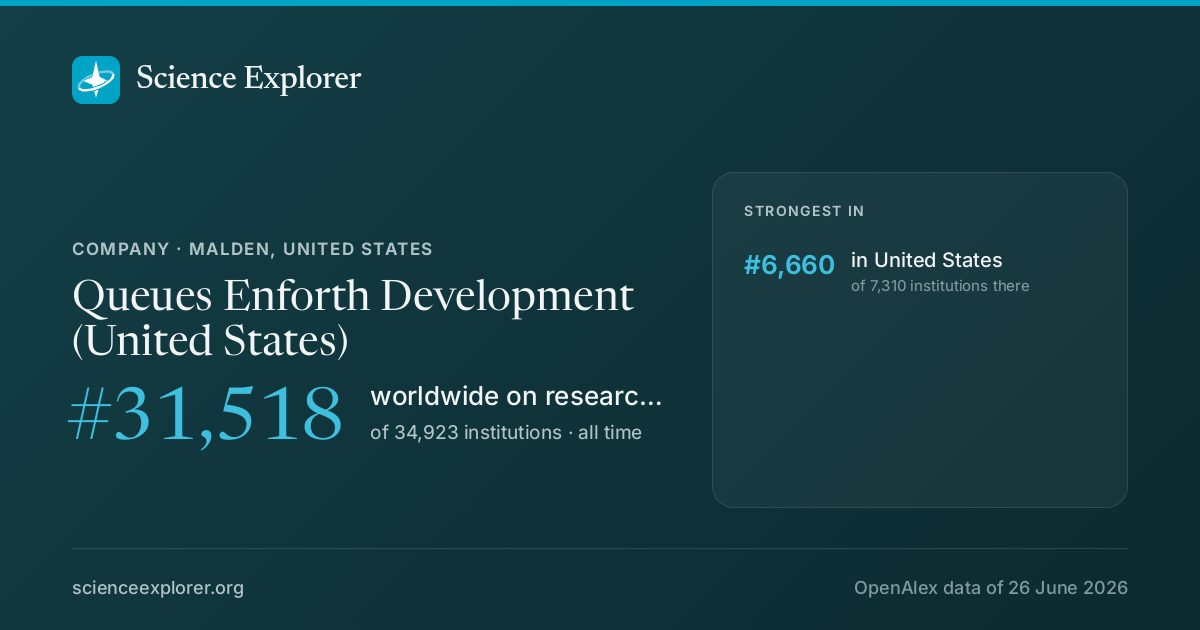
Queues Enforth Development (United States) on Science Explorer

A card with Queues Enforth Development (United States)'s standing and the fields it leads in, for a post or a slide. A link to this page previews as the same card.

Download the card

1200 × 630 PNG, sized for social posts, drawn from the latest snapshot.

Badges for a website1Each links back here and updates with every snapshot

Research measures only: rankings here say nothing about teaching, admissions or student experience. Comparable institutions and collaboration partners have tabs of their own, above.

Discussion

Ask a question or share a note about Queues Enforth Development (United States). Keep it to the research: no personal attacks, advertising or links. Any reader can report a post, which collapses it for everyone until it is opened.
