Science Explorer Back to mapMap
Discussion
University · Beirut · Lebanon

Rafik Hariri University

In research, Rafik Hariri University stands highest in Physical Sciences (#12,128 of 17,446 worldwide), over all time.

World rank, all time
#18,478
of 34,923
Rank in Lebanon
#15
of 31
Research works
308
▼ 41% vs 2018-21
Citations
4.2k
13.6 per fractional work
Top-10% rate
10.5%
all institutions 10.0%
vs its own fields
0.86×
1.00× is exactly expected
Open access
38%
world 40%
International
39%
world 18%

What is Rafik Hariri University known for in research?

The fields where it stands highest, over all time, ranked among every institution above the floor in each field.

FieldWorld rankWhere that sitsTop-10% rateWorks
Physical SciencesDomain #12,128 of 17,446 6.0%165

Each strip is that field's whole ranked pool, with the notch where Rafik Hariri University sits in it, in the colour of the band that rank falls in. The track under the rate is the rate itself: it carries no average mark, because the average differs by field (from about 6% in Dentistry to 21% in Economics).

Which fields of science does Rafik Hariri University work in?

In 2022-now, 52% of research at Rafik Hariri University is in Physical Sciences, 20% in Social Sciences. Its largest fields are Computer Science (24%), Engineering (21%), Medicine (16%). It does 1.3× the world's share of Physical Sciences.

Physical Sciences: 36 fractional works · 51.6% of its workComputer Science: 16 fractional works · 23.6% of its workComputer Vision and Pattern Recognition: 6 fractional works · 9.3% of its workArtificial Intelligence: 5 fractional works · 7.2% of its workInformation Systems: 2 fractional works · 2.7% of its workComputer Networks and Communications: 2 fractional works · 2.2% of its workComputer Science Applications: 0 fractional works · 0.6% of its workHuman-Computer Interaction: 0 fractional works · 0.5% of its workComputational Theory and Mathematics: 0 fractional works · 0.3% of its workSignal Processing: 0 fractional works · 0.3% of its workComputer Graphics and Computer-Aided Design: 0 fractional works · 0.2% of its workHardware and Architecture: 0 fractional works · 0.2% of its workEngineering: 14 fractional works · 20.7% of its workElectrical and Electronic Engineering: 4 fractional works · 5.9% of its workControl and Systems Engineering: 2 fractional works · 3.4% of its workMedia Technology: 2 fractional works · 2.2% of its workCivil and Structural Engineering: 1 fractional works · 1.8% of its workBuilding and Construction: 1 fractional works · 1.5% of its workBiomedical Engineering: 1 fractional works · 1.1% of its workAutomotive Engineering: 1 fractional works · 1.0% of its workMechanical Engineering: 1 fractional works · 0.8% of its workAerospace Engineering: 1 fractional works · 0.8% of its workArchitecture: 0 fractional works · 0.7% of its workMechanics of Materials: 0 fractional works · 0.6% of its workOcean Engineering: 0 fractional works · 0.4% of its workComputational Mechanics: 0 fractional works · 0.3% of its workIndustrial and Manufacturing Engineering: 0 fractional works · 0.2% of its workEnergy: 1 fractional works · 1.8% of its workEnergy Engineering and Power Technology: 1 fractional works · 1.0% of its workRenewable Energy, Sustainability and the Environment: 1 fractional works · 0.8% of its workEnvironmental Science: 1 fractional works · 1.7% of its workWater Science and Technology: 0 fractional works · 0.5% of its workPollution: 0 fractional works · 0.4% of its workEnvironmental Engineering: 0 fractional works · 0.3% of its workIndustrial and Manufacturing Engineering: 0 fractional works · 0.2% of its workSmaller subfields together: 0 fractional works · 0.3% of its workChemistry: 1 fractional works · 1.6% of its workOrganic Chemistry: 1 fractional works · 0.9% of its workAnalytical Chemistry: 0 fractional works · 0.6% of its workSmaller subfields together: 0 fractional works · 0.2% of its workMaterials Science: 0 fractional works · 0.6% of its workMaterials Chemistry: 0 fractional works · 0.6% of its workMathematics: 0 fractional works · 0.6% of its workModeling and Simulation: 0 fractional works · 0.2% of its workSmaller subfields together: 0 fractional works · 0.3% of its workPhysics and Astronomy: 0 fractional works · 0.5% of its workAtomic and Molecular Physics, and Optics: 0 fractional works · 0.2% of its workStatistical and Nonlinear Physics: 0 fractional works · 0.2% of its workChemical Engineering: 0 fractional works · 0.4% of its workChemical Health and Safety: 0 fractional works · 0.2% of its workSmaller subfields together: 0 fractional works · 0.1% of its workEarth and Planetary Sciences: 0 fractional works · 0.2% of its workSocial Sciences: 14 fractional works · 19.7% of its workSocial Sciences: 6 fractional works · 8.7% of its workSociology and Political Science: 3 fractional works · 4.1% of its workEducation: 2 fractional works · 3.5% of its workCommunication: 0 fractional works · 0.6% of its workSmaller subfields together: 0 fractional works · 0.4% of its workBusiness, Management and Accounting: 3 fractional works · 4.4% of its workAccounting: 1 fractional works · 1.3% of its workStrategy and Management: 1 fractional works · 1.2% of its workManagement Information Systems: 1 fractional works · 0.9% of its workOrganizational Behavior and Human Resource Management: 0 fractional works · 0.7% of its workMarketing: 0 fractional works · 0.3% of its workSmaller subfields together: 0 fractional works · 0.1% of its workPsychology: 2 fractional works · 2.5% of its workDevelopmental and Educational Psychology: 1 fractional works · 1.4% of its workExperimental and Cognitive Psychology: 0 fractional works · 0.4% of its workClinical Psychology: 0 fractional works · 0.4% of its workApplied Psychology: 0 fractional works · 0.3% of its workEconomics, Econometrics and Finance: 2 fractional works · 2.2% of its workEconomics and Econometrics: 1 fractional works · 1.2% of its workFinance: 1 fractional works · 1.0% of its workDecision Sciences: 1 fractional works · 1.0% of its workManagement Science and Operations Research: 0 fractional works · 0.7% of its workSmaller subfields together: 0 fractional works · 0.3% of its workArts and Humanities: 1 fractional works · 1.0% of its workLanguage and Linguistics: 0 fractional works · 0.5% of its workLiterature and Literary Theory: 0 fractional works · 0.5% of its workHealth Sciences: 14 fractional works · 19.5% of its workMedicine: 11 fractional works · 16.2% of its workCardiology and Cardiovascular Medicine: 2 fractional works · 2.9% of its workRadiology, Nuclear Medicine and Imaging: 2 fractional works · 2.7% of its workSurgery: 1 fractional works · 1.7% of its workPulmonary and Respiratory Medicine: 1 fractional works · 1.4% of its workOncology: 1 fractional works · 0.8% of its workEpidemiology: 0 fractional works · 0.7% of its workNeurology: 0 fractional works · 0.6% of its workPsychiatry and Mental health: 0 fractional works · 0.6% of its workEndocrinology, Diabetes and Metabolism: 0 fractional works · 0.6% of its workPediatrics, Perinatology and Child Health: 0 fractional works · 0.6% of its workHealth Informatics: 0 fractional works · 0.5% of its workPublic Health, Environmental and Occupational Health: 0 fractional works · 0.5% of its workGenetics: 0 fractional works · 0.4% of its workPhysiology: 0 fractional works · 0.3% of its workAnesthesiology and Pain Medicine: 0 fractional works · 0.2% of its workReproductive Medicine: 0 fractional works · 0.2% of its workSmaller subfields together: 1 fractional works · 1.5% of its workHealth Professions: 2 fractional works · 2.5% of its workGeneral Health Professions: 1 fractional works · 1.4% of its workHealth Information Management: 0 fractional works · 0.4% of its workOccupational Therapy: 0 fractional works · 0.3% of its workRadiological and Ultrasound Technology: 0 fractional works · 0.2% of its workSmaller subfields together: 0 fractional works · 0.3% of its workNursing: 0 fractional works · 0.5% of its workResearch and Theory: 0 fractional works · 0.3% of its workSmaller subfields together: 0 fractional works · 0.2% of its workVeterinary: 0 fractional works · 0.1% of its workDentistry: 0 fractional works · 0.1% of its workLife Sciences: 6 fractional works · 9.2% of its workNeuroscience: 5 fractional works · 6.8% of its workNeurology: 3 fractional works · 3.6% of its workCognitive Neuroscience: 2 fractional works · 3.2% of its workAgricultural and Biological Sciences: 1 fractional works · 1.5% of its workPlant Science: 1 fractional works · 0.8% of its workFood Science: 0 fractional works · 0.5% of its workAnimal Science and Zoology: 0 fractional works · 0.2% of its workBiochemistry, Genetics and Molecular Biology: 1 fractional works · 0.9% of its workMolecular Biology: 0 fractional works · 0.6% of its workSmaller subfields together: 0 fractional works · 0.4% of its workALL ITS WORKRafik HaririUniversity70fractional works, 2022-now
Life Sciences9%Physical Sciences52%Health Sciences19%Social Sciences20%

Each ring splits the one inside it: the four domains of science, their fields, their subfields. Size is fractional works in 2022-now. Every slice is a page; the interactive view zooms down to single topics and colours each by how much more of it this institution does than the world.

Its 4 domains and 24 fields, with their numbers
    1. Computer Science1623.6%
    2. Engineering1420.7%
    3. Energy11.8%
    4. Environmental Science11.7%
    5. Chemistry11.6%
    6. Materials Science00.6%
    7. Mathematics00.6%
    8. Physics and Astronomy00.5%
    9. Chemical Engineering00.4%
    10. Earth and Planetary Sciences00.2%
    1. Social Sciences68.7%
    2. Business, Management and Accounting34.4%
    3. Psychology22.5%
    4. Economics, Econometrics and Finance22.2%
    5. Decision Sciences11.0%
    6. Arts and Humanities11.0%
    1. Medicine1116.2%
    2. Health Professions22.5%
    3. Nursing00.5%
    4. Veterinary00.1%
    5. Dentistry00.1%
    1. Neuroscience56.8%
    2. Agricultural and Biological Sciences11.5%
    3. Biochemistry, Genetics and Molecular Biology10.9%
All of science, and how each field's share has moved since 1950: the Science domain explorer

Field profile

Location quotient across every field it publishes in: outside the ring is more than an institution of this size would be expected to publish, inside it is less.

Agricultural and Biological Sciences: 0.31× its world share, 1 worksAgricultural and Bio…Biochemistry, Genetics and Molecular Biology: 0.17× its world share, 1 worksBiochemistry, Geneti…Neuroscience: 4.18× its world share, 5 worksNeuroscienceChemical Engineering: 1.01× its world share, 0 worksChemical EngineeringChemistry: 1.02× its world share, 1 worksChemistryComputer Science: 3.03× its world share, 16 worksComputer ScienceEarth and Planetary Sciences: 0.13× its world share, 0 worksEarth and Planetary …Energy: 1.95× its world share, 1 worksEnergyEngineering: 1.38× its world share, 14 worksEngineeringEnvironmental Science: 0.34× its world share, 1 worksEnvironmental ScienceMaterials Science: 0.18× its world share, 0 worksMaterials ScienceMathematics: 0.47× its world share, 0 worksMathematicsPhysics and Astronomy: 0.21× its world share, 0 worksPhysics and AstronomyDentistry: 0.20× its world share, 0 worksDentistryHealth Professions: 0.97× its world share, 2 worksHealth ProfessionsMedicine: 0.84× its world share, 11 worksMedicineNursing: 1.03× its world share, 0 worksNursingVeterinary: 0.88× its world share, 0 worksVeterinaryArts and Humanities: 0.33× its world share, 1 worksArts and HumanitiesBusiness, Management and Accounting: 1.37× its world share, 3 worksBusiness, Management…Decision Sciences: 1.04× its world share, 1 worksDecision SciencesEconomics, Econometrics and Finance: 1.03× its world share, 2 worksEconomics, Econometr…Psychology: 0.81× its world share, 2 worksPsychologySocial Sciences: 0.68× its world share, 6 worksSocial Sciences1×world share
more than its size predictsabout as predictedless

Rings at 0.5×, 1× and 2×. Widest outward: Neuroscience, 4.2×. Every wedge is a field page.

All 24 fields, with their numbers
  1. Neuroscience4.18×5 works
  2. Computer Science3.03×16 works
  3. Energy1.95×1 works
  4. Engineering1.38×14 works
  5. Business, Management and Accounting1.37×3 works
  6. Decision Sciences1.04×1 works
  7. Nursing1.03×0 works
  8. Economics, Econometrics and Finance1.03×2 works
  9. Chemistry1.02×1 works
  10. Chemical Engineering1.01×0 works
  11. Health Professions0.97×2 works
  12. Veterinary0.88×0 works
  13. Medicine0.84×11 works
  14. Psychology0.81×2 works
  15. Social Sciences0.68×6 works
  16. Mathematics0.47×0 works
  17. Environmental Science0.34×1 works
  18. Arts and Humanities0.33×1 works
  19. Agricultural and Biological Sciences0.31×1 works
  20. Physics and Astronomy0.21×0 works
  21. Dentistry0.20×0 works
  22. Materials Science0.18×0 works
  23. Biochemistry, Genetics and Molecular Biology0.17×1 works
  24. Earth and Planetary Sciences0.13×0 works

Who are the top researchers at Rafik Hariri University?

Ranked on the quality score, Rima M. Bizri, Ghalia Nassreddine and Jamil Hammoud lead among researchers whose main affiliation is Rafik Hariri University.

  1. 1 Rima M. Bizri Lebanon · #822,107 worldwide 856 citations · 20 works
  2. 2 Ghalia Nassreddine Lebanon · #1,616,710 worldwide 379 citations · 51 works
  3. 3 Jamil Hammoud Lebanon · #1,742,627 worldwide 458 citations · 15 works
  4. 4 Carla M. Ghanem Lebanon · #1,762,624 worldwide 239 citations · 24 works
  5. 5 Amal El Arid Lebanon · #1,884,046 worldwide 178 citations · 24 works
  6. 6 Najib Ali Mozahem Lebanon · #1,953,365 worldwide 384 citations · 28 works
  7. 7 Nadim A. Diab Lebanon · #2,918,757 worldwide 281 citations · 26 works
  8. 8 Ali Rammal Lebanon · #3,524,212 worldwide 34 citations · 18 works
  9. 9 Mohamad Taha Lebanon · #4,526,679 worldwide 119 citations · 16 works
  10. 10 Rached Zantout Lebanon · #4,703,207 worldwide 528 citations · 64 works
All ranked researchers at Rafik Hariri University

What are the most cited papers from Rafik Hariri University?

The most cited paper from Rafik Hariri University is "Visible light photocatalytic degradation of polypropylene microplastics in a continuous water flow system" (Abdusalam Uheida, Hugo Giraldo, Mohamed Abdel‐Rehim et al., 2020), with 575 citations. Next come "Refugee-entrepreneurship: a social capital perspective" (266) and "The Impact of E-Banking Service Quality on Customer Satisfaction: Evidence From the Lebanese Banking Sector" (236).

Most cited papers
#PaperReleasedCitations
1 Visible light photocatalytic degradation of polypropylene microplastics in a continuous water flow system Abdusalam Uheida, Hugo Giraldo, Mohamed Abdel‐Rehim et al. · Journal of Hazardous Materials Open access 17 Oct 2020 575
2 Refugee-entrepreneurship: a social capital perspective Rima M. Bizri · Entrepreneurship and Regional Development 22 Aug 2017 266
3 The Impact of E-Banking Service Quality on Customer Satisfaction: Evidence From the Lebanese Banking Sector Jamil Hammoud, Rima M. Bizri, Ibrahim El Baba · SAGE Open Open access Jul 2018 236
4 Ventricular tachycardia in a young population without overt heart disease. Barbara J. Deal, S M Miller, Daniel Scagliotti et al. · Circulation Open access Jun 1986 179
5 Programmed electrical stimulation in patients with high-grade ventricular ectopy: electrophysiologic findings and prognosis for survival. J. Anthony Gomes, R I Hariman, Pritpal S. Kang et al. · Circulation Jul 1984 166
All 61 most cited papers, with filters and sorting

Which keywords describe research at Rafik Hariri University?

By fractional works in 2022-now, weighted toward what it does more of than the world: Deep Learning, Machine Learning, Convolutional Neural Networks, Image Segmentation, Neural Networks, Classification, Feature Extraction and Medical Imaging.

▲ more of its work than of the world's◆ about the world's share▼ less than the world's

Size is fractional works in 2022-now in the topics tagged with each word; colour is the word's share of this institution's work against its share of the world's. The 40 words are chosen for being large and distinctive. Each links to the topic it comes from most.

All 40 words, with their numbers
  1. Deep Learning13▲ 5.4×33 topics
  2. Machine Learning11▲ 4.6×27 topics
  3. Neural Networks5▲ 4.6×13 topics
  4. Convolutional Neural Networks4▲ 8.6×8 topics
  5. Image Segmentation4▲ 50×3 topics
  6. Renewable Energy4▲ 4.2×12 topics
  7. Classification4▲ 12×5 topics
  8. Feature Extraction3▲ 11×5 topics
  9. Internet of Things3▲ 5.6×8 topics
  10. Artificial Intelligence3▲ 3.2×9 topics
  11. Medical Imaging3▲ 8.8×4 topics
  12. Sustainability3▲ 1.69×8 topics
  13. Educational Technology3▲ 3.1×4 topics
  14. Transfer Learning3▲ 19×3 topics
  15. Convolutional Neural Network2▲ 23×2 topics
  16. Healthcare2▲ 3.2×8 topics
  17. Smart Cities2▲ 13×5 topics
  18. Big Data2▲ 3.5×6 topics
  19. Brain Tumor2▲ 51×1 topic
  20. MRI2▲ 42×1 topic
  21. Smart Grid2▲ 9.2×6 topics
  22. Governance2▲ 9.8×3 topics
  23. Online Learning2▲ 3.8×2 topics
  24. Image Classification2▲ 15×2 topics
  25. Medical Image Analysis2▲ 15×3 topics
  26. Texture Analysis2▲ 13×2 topics
  27. Image Recognition2▲ 18×1 topic
  28. Object Detection2▲ 19×1 topic
  29. Security2▲ 4.1×5 topics
  30. Google Classroom2▲ 24×1 topic
  31. Student Satisfaction2▲ 14×1 topic
  32. Technology Integration2▲ 8.3×2 topics
  33. Active Contours2▲ 67×1 topic
  34. Graph Cuts2▲ 67×1 topic
  35. Politics2▲ 8.2×2 topics
  36. Electric Vehicles1▲ 6.6×3 topics
  37. IoT Security1▲ 6.2×3 topics
  38. Magnetic Resonance Imaging1▲ 7.1×3 topics
  39. Handwriting Recognition1▲ 77×1 topic
  40. Text Detection1▲ 77×1 topic

Which research topics does Rafik Hariri University publish most on?

By volume in 2022-now: Brain Tumor Detection and Classification, Advanced Neural Network Applications, Technology-Enhanced Education Studies and Medical Image Segmentation Techniques.

  1. 1 Brain Tumor Detection and Classification Neurology 2 works
  2. 2 Advanced Neural Network Applications Computer Vision and Pattern Recognition 2 works
  3. 3 Technology-Enhanced Education Studies Education 2 works
  4. 4 Medical Image Segmentation Techniques Computer Vision and Pattern Recognition 2 works
  5. 5 Handwritten Text Recognition Techniques Computer Vision and Pattern Recognition 1 works
  6. 6 Smart Cities and Technologies Media Technology 1 works
  7. 7 Jewish and Middle Eastern Studies Sociology and Political Science 1 works
  8. 8 Middle East Politics and Society Sociology and Political Science 1 works
  9. 9 Innovative Teaching and Learning Methods Developmental and Educational Psychology 1 works
  10. 10 Energy Load and Power Forecasting Electrical and Electronic Engineering 1 works

How open and international is its research?

Against the world's own shares: the tick on each track. Both are shares of its output, so they sit on one scale and can be read against each other as well as against the world.

openly available37.8%not open62.2%

World: 40% of research is openly available.

with international co-authors38.6%domestic only61.4%

World: 18% is written across borders.

How has Rafik Hariri University's research output changed?

Output in 2022-2025 was 41% lower than in 2018-2021.

still counting1990200020102020
grewheldshrank

The same series as a ribbon: one cell per year, darker for more. The line above answers how much; this answers when.

Its share of all research

Growing output can still be a shrinking share: all of science grows. This is Rafik Hariri University as a percentage of every work published that year, 0.00020% in 2024.

still counting0.00025%0.00050%0.00075%Rafik Hariri University0.00039% in 202519801990200020102020

Fractional works of Rafik Hariri University over all fractional works that year. How the balance of science has shifted.

How much of it reaches the world top 10%

Year by year, against all institutions in the same year.

still counting5%10%15%all institutions10.0% in 2025Rafik Hariri University7.1% in 20252020

Of each year's output, the share that reached the world's 10% most cited for its field and year. Peak 12.0% in 2020.

Other research institutions in Beirut

All research institutions in Beirut

Share Rafik Hariri University's ranking
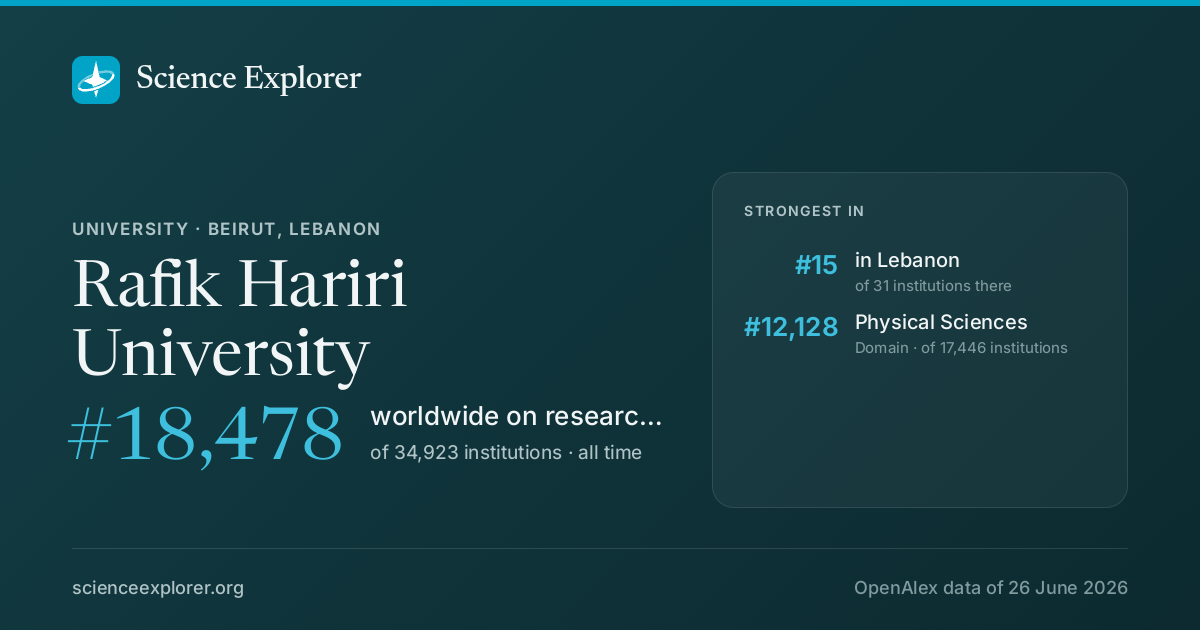
Rafik Hariri University on Science Explorer

A card with Rafik Hariri University's standing and the fields it leads in, for a post or a slide. A link to this page previews as the same card.

Download the card

1200 × 630 PNG, sized for social posts, drawn from the latest snapshot.

Badges for a website1Each links back here and updates with every snapshot

Research measures only: rankings here say nothing about teaching, admissions or student experience. Comparable institutions and collaboration partners have tabs of their own, above.

Discussion

Ask a question or share a note about Rafik Hariri University. Keep it to the research: no personal attacks, advertising or links. Any reader can report a post, which collapses it for everyone until it is opened.