Science Explorer Back to mapMap
Discussion
Government institution · Karlskrona · Sweden

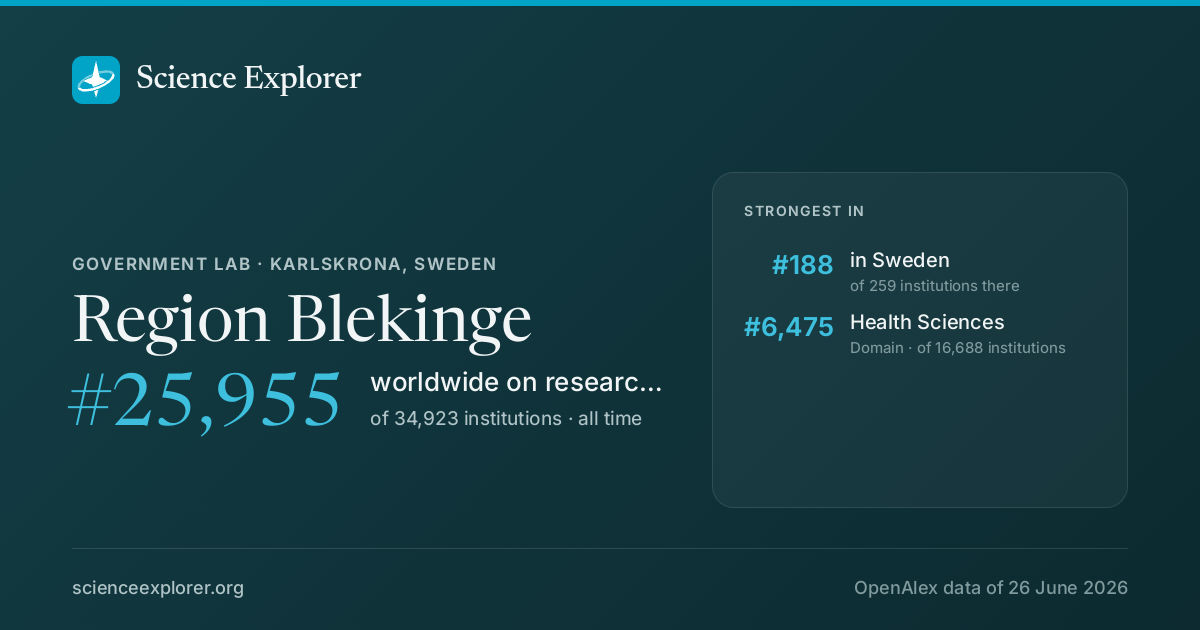
Region Blekinge

In research, Region Blekinge stands highest in Health Sciences (#6,475 of 16,688 worldwide), over all time.

World rank, all time
#25,955
of 34,923
Rank in Sweden
#188
of 259
Research works
183
▼ 44% vs 2018-21
Citations
4.5k
24.7 per fractional work
Top-10% rate
16.3%
all institutions 10.0%
vs its own fields
1.04×
1.00× is exactly expected
Open access
51%
world 40%
International
26%
world 18%

What is Region Blekinge known for in research?

The fields where it stands highest, over all time, ranked among every institution above the floor in each field.

FieldWorld rankWhere that sitsTop-10% rateWorks
Health SciencesDomain #6,475 of 16,688 13.3%123

Each strip is that field's whole ranked pool, with the notch where Region Blekinge sits in it, in the colour of the band that rank falls in. The track under the rate is the rate itself: it carries no average mark, because the average differs by field (from about 6% in Dentistry to 21% in Economics).

Which fields of science does Region Blekinge work in?

In 2022-now, 66% of research at Region Blekinge is in Health Sciences, 14% in Social Sciences. Its largest fields are Medicine (48%), Health Professions (9%), Dentistry (8%). It does 2.2× the world's share of Health Sciences.

Health Sciences: 17 fractional works · 65.7% of its workMedicine: 12 fractional works · 47.5% of its workSurgery: 2 fractional works · 8.3% of its workPulmonary and Respiratory Medicine: 2 fractional works · 7.9% of its workCardiology and Cardiovascular Medicine: 1 fractional works · 5.2% of its workPublic Health, Environmental and Occupational Health: 1 fractional works · 3.6% of its workEpidemiology: 1 fractional works · 3.3% of its workPsychiatry and Mental health: 1 fractional works · 3.0% of its workPhysiology: 1 fractional works · 2.2% of its workPharmacology: 0 fractional works · 1.4% of its workEndocrinology, Diabetes and Metabolism: 0 fractional works · 1.2% of its workRheumatology: 0 fractional works · 1.1% of its workOncology: 0 fractional works · 1.1% of its workPediatrics, Perinatology and Child Health: 0 fractional works · 1.1% of its workRehabilitation: 0 fractional works · 1.1% of its workOtorhinolaryngology: 0 fractional works · 0.8% of its workHealth Informatics: 0 fractional works · 0.8% of its workRadiology, Nuclear Medicine and Imaging: 0 fractional works · 0.8% of its workUrology: 0 fractional works · 0.8% of its workOphthalmology: 0 fractional works · 0.6% of its workCritical Care and Intensive Care Medicine: 0 fractional works · 0.6% of its workNephrology: 0 fractional works · 0.6% of its workGastroenterology: 0 fractional works · 0.4% of its workGeriatrics and Gerontology: 0 fractional works · 0.4% of its workEmergency Medicine: 0 fractional works · 0.3% of its workDermatology: 0 fractional works · 0.3% of its workComplementary and alternative medicine: 0 fractional works · 0.2% of its workOrthopedics and Sports Medicine: 0 fractional works · 0.2% of its workSmaller subfields together: 0 fractional works · 0.4% of its workHealth Professions: 2 fractional works · 9.0% of its workGeneral Health Professions: 2 fractional works · 6.3% of its workOccupational Therapy: 0 fractional works · 1.6% of its workEmergency Medical Services: 0 fractional works · 0.9% of its workComplementary and Manual Therapy: 0 fractional works · 0.3% of its workDentistry: 2 fractional works · 8.5% of its workOral Surgery: 1 fractional works · 3.7% of its workPeriodontics: 1 fractional works · 3.0% of its workOrthodontics: 0 fractional works · 1.8% of its workNursing: 0 fractional works · 0.7% of its workResearch and Theory: 0 fractional works · 0.6% of its workSmaller subfields together: 0 fractional works · 0.2% of its workSocial Sciences: 4 fractional works · 13.8% of its workPsychology: 2 fractional works · 7.4% of its workClinical Psychology: 1 fractional works · 3.3% of its workExperimental and Cognitive Psychology: 1 fractional works · 2.2% of its workApplied Psychology: 0 fractional works · 0.7% of its workDevelopmental and Educational Psychology: 0 fractional works · 0.7% of its workSocial Psychology: 0 fractional works · 0.6% of its workArts and Humanities: 1 fractional works · 3.3% of its workArcheology: 0 fractional works · 2.0% of its workHistory: 0 fractional works · 0.7% of its workMuseology: 0 fractional works · 0.7% of its workEconomics, Econometrics and Finance: 1 fractional works · 2.3% of its workEconomics and Econometrics: 0 fractional works · 1.8% of its workFinance: 0 fractional works · 0.4% of its workSocial Sciences: 0 fractional works · 0.9% of its workSociology and Political Science: 0 fractional works · 0.8% of its workSmaller subfields together: 0 fractional works · 0.1% of its workPhysical Sciences: 3 fractional works · 12.2% of its workEngineering: 1 fractional works · 5.6% of its workComputational Mechanics: 0 fractional works · 1.3% of its workMechanical Engineering: 0 fractional works · 1.3% of its workMechanics of Materials: 0 fractional works · 1.3% of its workBiomedical Engineering: 0 fractional works · 1.3% of its workAerospace Engineering: 0 fractional works · 0.4% of its workSmaller subfields together: 0 fractional works · 0.0% of its workEarth and Planetary Sciences: 1 fractional works · 2.6% of its workPaleontology: 0 fractional works · 1.3% of its workGeology: 0 fractional works · 0.7% of its workSpace and Planetary Science: 0 fractional works · 0.7% of its workEnvironmental Science: 1 fractional works · 2.1% of its workGlobal and Planetary Change: 0 fractional works · 1.1% of its workEnvironmental Chemistry: 0 fractional works · 0.7% of its workSmaller subfields together: 0 fractional works · 0.3% of its workComputer Science: 0 fractional works · 1.5% of its workComputer Vision and Pattern Recognition: 0 fractional works · 0.7% of its workArtificial Intelligence: 0 fractional works · 0.5% of its workInformation Systems: 0 fractional works · 0.3% of its workPhysics and Astronomy: 0 fractional works · 0.3% of its workRadiation: 0 fractional works · 0.3% of its workMaterials Science: 0 fractional works · 0.1% of its workLife Sciences: 2 fractional works · 8.3% of its workBiochemistry, Genetics and Molecular Biology: 1 fractional works · 3.6% of its workMolecular Biology: 1 fractional works · 2.0% of its workGenetics: 0 fractional works · 1.1% of its workCell Biology: 0 fractional works · 0.5% of its workSmaller subfields together: 0 fractional works · 0.0% of its workNeuroscience: 1 fractional works · 3.0% of its workCognitive Neuroscience: 1 fractional works · 2.1% of its workNeurology: 0 fractional works · 0.8% of its workSmaller subfields together: 0 fractional works · 0.1% of its workImmunology and Microbiology: 0 fractional works · 0.7% of its workApplied Microbiology and Biotechnology: 0 fractional works · 0.7% of its workAgricultural and Biological Sciences: 0 fractional works · 0.5% of its workInsect Science: 0 fractional works · 0.3% of its workPlant Science: 0 fractional works · 0.3% of its workPharmacology, Toxicology and Pharmaceutics: 0 fractional works · 0.4% of its workPharmaceutical Science: 0 fractional works · 0.4% of its workALL ITS WORKRegion Blekinge25fractional works, 2022-now
Life Sciences8%Physical Sciences12%Health Sciences66%Social Sciences14%

Each ring splits the one inside it: the four domains of science, their fields, their subfields. Size is fractional works in 2022-now. Every slice is a page; the interactive view zooms down to single topics and colours each by how much more of it this institution does than the world.

Its 4 domains and 19 fields, with their numbers
    1. Medicine1247.5%
    2. Health Professions29.0%
    3. Dentistry28.5%
    4. Nursing00.7%
    1. Psychology27.4%
    2. Arts and Humanities13.3%
    3. Economics, Econometrics and Finance12.3%
    4. Social Sciences00.9%
    1. Engineering15.6%
    2. Earth and Planetary Sciences12.6%
    3. Environmental Science12.1%
    4. Computer Science01.5%
    5. Physics and Astronomy00.3%
    6. Materials Science00.1%
    1. Biochemistry, Genetics and Molecular Biology13.6%
    2. Neuroscience13.0%
    3. Immunology and Microbiology00.7%
    4. Agricultural and Biological Sciences00.5%
    5. Pharmacology, Toxicology and Pharmaceutics00.4%
All of science, and how each field's share has moved since 1950: the Science domain explorer

Field profile

Location quotient across every field it publishes in: outside the ring is more than an institution of this size would be expected to publish, inside it is less.

Agricultural and Biological Sciences: 0.11× its world share, 0 worksAgricultural and Bio…Biochemistry, Genetics and Molecular Biology: 0.67× its world share, 1 worksBiochemistry, Geneti…Immunology and Microbiology: 0.76× its world share, 0 worksImmunology and Micro…Neuroscience: 1.85× its world share, 1 worksNeurosciencePharmacology, Toxicology and Pharmaceutics: 1.08× its world share, 0 worksPharmacology, Toxico…Computer Science: 0.19× its world share, 0 worksComputer ScienceEarth and Planetary Sciences: 1.67× its world share, 1 worksEarth and Planetary …Engineering: 0.37× its world share, 1 worksEngineeringEnvironmental Science: 0.42× its world share, 0 worksEnvironmental ScienceMaterials Science: 0.03× its world share, 0 worksMaterials SciencePhysics and Astronomy: 0.15× its world share, 0 worksPhysics and AstronomyDentistry: 17.52× its world share, 2 worksDentistryHealth Professions: 3.41× its world share, 2 worksHealth ProfessionsMedicine: 2.47× its world share, 12 worksMedicineNursing: 1.54× its world share, 0 worksNursingArts and Humanities: 1.13× its world share, 1 worksArts and HumanitiesEconomics, Econometrics and Finance: 1.06× its world share, 1 worksEconomics, Econometr…Psychology: 2.41× its world share, 2 worksPsychologySocial Sciences: 0.07× its world share, 0 worksSocial Sciences1×world share
more than its size predictsabout as predictedless

Rings at 0.5×, 1× and 2×. Widest outward: Dentistry, 17.5×. Every wedge is a field page.

All 19 fields, with their numbers
  1. Dentistry17.52×2 works
  2. Health Professions3.41×2 works
  3. Medicine2.47×12 works
  4. Psychology2.41×2 works
  5. Neuroscience1.85×1 works
  6. Earth and Planetary Sciences1.67×1 works
  7. Nursing1.54×0 works
  8. Arts and Humanities1.13×1 works
  9. Pharmacology, Toxicology and Pharmaceutics1.08×0 works
  10. Economics, Econometrics and Finance1.06×1 works
  11. Immunology and Microbiology0.76×0 works
  12. Biochemistry, Genetics and Molecular Biology0.67×1 works
  13. Environmental Science0.42×0 works
  14. Engineering0.37×1 works
  15. Computer Science0.19×0 works
  16. Physics and Astronomy0.15×0 works
  17. Agricultural and Biological Sciences0.11×0 works
  18. Social Sciences0.07×0 works
  19. Materials Science0.03×0 works

Who are the top researchers at Region Blekinge?

Ranked on the quality score, Clara Amato, Bo Ohlin and Henrik Forssell lead among researchers whose main affiliation is Region Blekinge.

  1. 1 Clara Amato Sweden · #2,941,319 worldwide 428 citations · 43 works
  2. 2 Bo Ohlin Sweden · #3,343,816 worldwide 586 citations · 15 works
  3. 3 Henrik Forssell Sweden · #4,902,527 worldwide 1k citations · 94 works
All ranked researchers at Region Blekinge

What are the most cited papers from Region Blekinge?

The most cited paper from Region Blekinge is "Severe Neurological Complications after Central Neuraxial Blockades in Sweden 1990–1999" (Vibeke Moen, Nils Dahlgren, L. Irestedt, 2004), with 991 citations. Next come "Suicide trends in the early months of the COVID-19 pandemic: an interrupted time-series analysis of preliminary data from 21 countries" (763) and "Abnormally invasive placenta—prevalence, risk factors and antenatal suspicion: results from a large population‐based pregnancy cohort study in the Nordic countries" (369).

Most cited papers
#PaperReleasedCitations
1 Severe Neurological Complications after Central Neuraxial Blockades in Sweden 1990–1999 Vibeke Moen, Nils Dahlgren, L. Irestedt · Anesthesiology 21 Sep 2004 991
2 Suicide trends in the early months of the COVID-19 pandemic: an interrupted time-series analysis of preliminary data from 21 countries Jane Pirkis et al. · The Lancet Psychiatry Open access 15 Apr 2021 763
3 Abnormally invasive placenta—prevalence, risk factors and antenatal suspicion: results from a large population‐based pregnancy cohort study in the Nordic countries Lars Thurn, Pelle G. Lindqvist, Maija Jakobsson et al. · BJOG An International Journal of Obstetrics & Gynaecology 29 Jul 2015 369
4 Dapagliflozin in Myocardial Infarction without Diabetes or Heart Failure Stefan Karl James et al. · NEJM Evidence 11 Nov 2023 301
5 Outcome of the Swedish Nationwide Abdominal Aortic Aneurysm Screening Program Anders Wanhainen et al. · Circulation 15 Sep 2016 292
All 60 most cited papers, with filters and sorting

Which research topics does Region Blekinge publish most on?

By volume in 2022-now: Neonatal Respiratory Health Research, Oral microbiology and periodontitis research, Dental Implant Techniques and Outcomes and Palliative Care and End-of-Life Issues.

  1. 1 Neonatal Respiratory Health Research Pulmonary and Respiratory Medicine 1 works
  2. 2 Oral microbiology and periodontitis research Periodontics 1 works
  3. 3 Dental Implant Techniques and Outcomes Oral Surgery 1 works
  4. 4 Palliative Care and End-of-Life Issues Public Health, Environmental and Occupational Health 0 works
  5. 5 Cardiac and Coronary Surgery Techniques Surgery 0 works
  6. 6 Diagnosis and Treatment of Venous Diseases Surgery 0 works
  7. 7 Sleep and related disorders Experimental and Cognitive Psychology 0 works
  8. 8 Metallurgy and Material Forming Mechanics of Materials 0 works
  9. 9 Metal Forming Simulation Techniques Mechanical Engineering 0 works
  10. 10 Laser and Thermal Forming Techniques Computational Mechanics 0 works

How open and international is its research?

Against the world's own shares: the tick on each track. Both are shares of its output, so they sit on one scale and can be read against each other as well as against the world.

openly available50.6%not open49.4%

World: 40% of research is openly available.

with international co-authors26.2%domestic only73.8%

World: 18% is written across borders.

How has Region Blekinge's research output changed?

Output in 2022-2025 was 44% lower than in 2018-2021.

still counting1990200020102020
grewheldshrank

The same series as a ribbon: one cell per year, darker for more. The line above answers how much; this answers when.

Its share of all research

Growing output can still be a shrinking share: all of science grows. This is Region Blekinge as a percentage of every work published that year, 0.00013% in 2024.

still counting0.00025%0.00050%0.00075%Region Blekinge0.00010% in 202519801990200020102020

Fractional works of Region Blekinge over all fractional works that year. How the balance of science has shifted.

Other research institutions in Karlskrona

All research institutions in Karlskrona

Share Region Blekinge's ranking

Region Blekinge on Science Explorer

A card with Region Blekinge's standing and the fields it leads in, for a post or a slide. A link to this page previews as the same card.

Download the card

1200 × 630 PNG, sized for social posts, drawn from the latest snapshot.

Badges for a website1Each links back here and updates with every snapshot

Research measures only: rankings here say nothing about teaching, admissions or student experience. Comparable institutions and collaboration partners have tabs of their own, above.

Discussion

Ask a question or share a note about Region Blekinge. Keep it to the research: no personal attacks, advertising or links. Any reader can report a post, which collapses it for everyone until it is opened.