Science Explorer Back to mapMap
Discussion
Government institution · Bellinzona · Switzerland

Repubblica e Cantone Ticino

World rank, all time
#23,812
of 34,923
Rank in Switzerland
#287
of 378
Research works
155
▲ 59% vs 2018-21
Citations
1.8k
11.7 per fractional work
Top-10% rate
12.6%
all institutions 10.0%
vs its own fields
1.05×
1.00× is exactly expected
Open access
59%
world 40%
International
37%
world 18%

Which fields of science does Repubblica e Cantone Ticino work in?

In 2022-now, 43% of research at Repubblica e Cantone Ticino is in Physical Sciences, 26% in Health Sciences. Its largest fields are Medicine (22%), Engineering (20%), Environmental Science (13%).

Physical Sciences: 19 fractional works · 42.7% of its workEngineering: 9 fractional works · 20.4% of its workCivil and Structural Engineering: 5 fractional works · 10.9% of its workArchitecture: 1 fractional works · 2.3% of its workBuilding and Construction: 1 fractional works · 2.1% of its workMechanical Engineering: 1 fractional works · 1.4% of its workMechanics of Materials: 0 fractional works · 1.1% of its workControl and Systems Engineering: 0 fractional works · 0.7% of its workOcean Engineering: 0 fractional works · 0.7% of its workSafety, Risk, Reliability and Quality: 0 fractional works · 0.6% of its workBiomedical Engineering: 0 fractional works · 0.4% of its workSmaller subfields together: 0 fractional works · 0.2% of its workEnvironmental Science: 6 fractional works · 12.7% of its workGlobal and Planetary Change: 2 fractional works · 3.7% of its workNature and Landscape Conservation: 1 fractional works · 2.3% of its workEcology: 1 fractional works · 1.6% of its workEnvironmental Engineering: 1 fractional works · 1.5% of its workHealth, Toxicology and Mutagenesis: 0 fractional works · 1.1% of its workManagement, Monitoring, Policy and Law: 0 fractional works · 0.9% of its workEnvironmental Chemistry: 0 fractional works · 0.8% of its workEcological Modeling: 0 fractional works · 0.7% of its workComputer Science: 3 fractional works · 5.7% of its workArtificial Intelligence: 2 fractional works · 4.0% of its workInformation Systems: 1 fractional works · 1.5% of its workSmaller subfields together: 0 fractional works · 0.2% of its workEarth and Planetary Sciences: 2 fractional works · 3.5% of its workGeochemistry and Petrology: 0 fractional works · 1.1% of its workAtmospheric Science: 0 fractional works · 1.0% of its workOceanography: 0 fractional works · 0.7% of its workGeology: 0 fractional works · 0.4% of its workPaleontology: 0 fractional works · 0.2% of its workPhysics and Astronomy: 0 fractional works · 0.2% of its workMathematics: 0 fractional works · 0.2% of its workChemistry: 0 fractional works · 0.1% of its workHealth Sciences: 11 fractional works · 25.6% of its workMedicine: 10 fractional works · 22.0% of its workPsychiatry and Mental health: 2 fractional works · 3.7% of its workCardiology and Cardiovascular Medicine: 1 fractional works · 1.7% of its workPulmonary and Respiratory Medicine: 1 fractional works · 1.6% of its workSurgery: 1 fractional works · 1.6% of its workPublic Health, Environmental and Occupational Health: 1 fractional works · 1.6% of its workEmergency Medicine: 1 fractional works · 1.5% of its workEpidemiology: 1 fractional works · 1.5% of its workDermatology: 0 fractional works · 1.1% of its workRadiology, Nuclear Medicine and Imaging: 0 fractional works · 1.0% of its workOncology: 0 fractional works · 0.9% of its workPediatrics, Perinatology and Child Health: 0 fractional works · 0.9% of its workObstetrics and Gynecology: 0 fractional works · 0.8% of its workNeurology: 0 fractional works · 0.6% of its workFamily Practice: 0 fractional works · 0.5% of its workCritical Care and Intensive Care Medicine: 0 fractional works · 0.5% of its workEndocrinology, Diabetes and Metabolism: 0 fractional works · 0.4% of its workComplementary and alternative medicine: 0 fractional works · 0.4% of its workRheumatology: 0 fractional works · 0.3% of its workPharmacology: 0 fractional works · 0.3% of its workMicrobiology: 0 fractional works · 0.2% of its workInfectious Diseases: 0 fractional works · 0.2% of its workSmaller subfields together: 0 fractional works · 0.6% of its workHealth Professions: 2 fractional works · 3.5% of its workGeneral Health Professions: 1 fractional works · 2.9% of its workEmergency Medical Services: 0 fractional works · 0.4% of its workSmaller subfields together: 0 fractional works · 0.2% of its workNursing: 0 fractional works · 0.2% of its workSocial Sciences: 10 fractional works · 22.1% of its workSocial Sciences: 4 fractional works · 10.1% of its workEducation: 2 fractional works · 4.1% of its workSociology and Political Science: 2 fractional works · 3.6% of its workDemography: 0 fractional works · 0.7% of its workPolitical Science and International Relations: 0 fractional works · 0.7% of its workUrban Studies: 0 fractional works · 0.4% of its workGeography, Planning and Development: 0 fractional works · 0.2% of its workSmaller subfields together: 0 fractional works · 0.2% of its workArts and Humanities: 3 fractional works · 5.9% of its workPhilosophy: 1 fractional works · 1.4% of its workClassics: 1 fractional works · 1.4% of its workLiterature and Literary Theory: 1 fractional works · 1.2% of its workLanguage and Linguistics: 0 fractional works · 1.1% of its workHistory: 0 fractional works · 0.7% of its workPsychology: 2 fractional works · 5.1% of its workClinical Psychology: 1 fractional works · 2.8% of its workSocial Psychology: 1 fractional works · 1.3% of its workApplied Psychology: 0 fractional works · 0.5% of its workExperimental and Cognitive Psychology: 0 fractional works · 0.5% of its workEconomics, Econometrics and Finance: 0 fractional works · 0.7% of its workEconomics and Econometrics: 0 fractional works · 0.7% of its workDecision Sciences: 0 fractional works · 0.2% of its workLife Sciences: 4 fractional works · 9.6% of its workAgricultural and Biological Sciences: 3 fractional works · 6.2% of its workPlant Science: 1 fractional works · 1.7% of its workEcology, Evolution, Behavior and Systematics: 1 fractional works · 1.6% of its workFood Science: 0 fractional works · 1.0% of its workInsect Science: 0 fractional works · 0.8% of its workAgronomy and Crop Science: 0 fractional works · 0.4% of its workAquatic Science: 0 fractional works · 0.3% of its workHorticulture: 0 fractional works · 0.2% of its workSmaller subfields together: 0 fractional works · 0.2% of its workBiochemistry, Genetics and Molecular Biology: 1 fractional works · 2.2% of its workGenetics: 1 fractional works · 1.4% of its workMolecular Biology: 0 fractional works · 0.4% of its workCancer Research: 0 fractional works · 0.3% of its workSmaller subfields together: 0 fractional works · 0.2% of its workNeuroscience: 0 fractional works · 0.7% of its workNeurology: 0 fractional works · 0.5% of its workSmaller subfields together: 0 fractional works · 0.3% of its workImmunology and Microbiology: 0 fractional works · 0.3% of its workMicrobiology: 0 fractional works · 0.2% of its workSmaller subfields together: 0 fractional works · 0.0% of its workPharmacology, Toxicology and Pharmaceutics: 0 fractional works · 0.2% of its workALL ITS WORKRepubblica eCantone Ticino44fractional works, 2022-now
Life Sciences10%Physical Sciences43%Health Sciences26%Social Sciences22%

Each ring splits the one inside it: the four domains of science, their fields, their subfields. Size is fractional works in 2022-now. Every slice is a page; the interactive view zooms down to single topics and colours each by how much more of it this institution does than the world.

Its 4 domains and 20 fields, with their numbers
    1. Engineering920.4%
    2. Environmental Science612.7%
    3. Computer Science35.7%
    4. Earth and Planetary Sciences23.5%
    5. Physics and Astronomy00.2%
    6. Mathematics00.2%
    7. Chemistry00.1%
    1. Medicine1022.0%
    2. Health Professions23.5%
    3. Nursing00.2%
    1. Social Sciences410.1%
    2. Arts and Humanities35.9%
    3. Psychology25.1%
    4. Economics, Econometrics and Finance00.7%
    5. Decision Sciences00.2%
    1. Agricultural and Biological Sciences36.2%
    2. Biochemistry, Genetics and Molecular Biology12.2%
    3. Neuroscience00.7%
    4. Immunology and Microbiology00.3%
    5. Pharmacology, Toxicology and Pharmaceutics00.2%
All of science, and how each field's share has moved since 1950: the Science domain explorer

Field profile

Location quotient across every field it publishes in: outside the ring is more than an institution of this size would be expected to publish, inside it is less.

Agricultural and Biological Sciences: 1.30× its world share, 3 worksAgricultural and Bio…Biochemistry, Genetics and Molecular Biology: 0.42× its world share, 1 worksBiochemistry, Geneti…Immunology and Microbiology: 0.30× its world share, 0 worksImmunology and Micro…Neuroscience: 0.45× its world share, 0 worksNeurosciencePharmacology, Toxicology and Pharmaceutics: 0.53× its world share, 0 worksPharmacology, Toxico…Chemistry: 0.05× its world share, 0 worksChemistryComputer Science: 0.73× its world share, 2 worksComputer ScienceEarth and Planetary Sciences: 2.22× its world share, 2 worksEarth and Planetary …Engineering: 1.36× its world share, 9 worksEngineeringEnvironmental Science: 2.56× its world share, 6 worksEnvironmental ScienceMathematics: 0.13× its world share, 0 worksMathematicsPhysics and Astronomy: 0.08× its world share, 0 worksPhysics and AstronomyHealth Professions: 1.33× its world share, 2 worksHealth ProfessionsMedicine: 1.14× its world share, 10 worksMedicineNursing: 0.38× its world share, 0 worksNursingArts and Humanities: 2.05× its world share, 3 worksArts and HumanitiesDecision Sciences: 0.19× its world share, 0 worksDecision SciencesEconomics, Econometrics and Finance: 0.35× its world share, 0 worksEconomics, Econometr…Psychology: 1.67× its world share, 2 worksPsychologySocial Sciences: 0.80× its world share, 4 worksSocial Sciences1×world share
more than its size predictsabout as predictedless

Rings at 0.5×, 1× and 2×. Widest outward: Environmental Science, 2.6×. Every wedge is a field page.

All 20 fields, with their numbers
  1. Environmental Science2.56×6 works
  2. Earth and Planetary Sciences2.22×2 works
  3. Arts and Humanities2.05×3 works
  4. Psychology1.67×2 works
  5. Engineering1.36×9 works
  6. Health Professions1.33×2 works
  7. Agricultural and Biological Sciences1.30×3 works
  8. Medicine1.14×10 works
  9. Social Sciences0.80×4 works
  10. Computer Science0.73×2 works
  11. Pharmacology, Toxicology and Pharmaceutics0.53×0 works
  12. Neuroscience0.45×0 works
  13. Biochemistry, Genetics and Molecular Biology0.42×1 works
  14. Nursing0.38×0 works
  15. Economics, Econometrics and Finance0.35×0 works
  16. Immunology and Microbiology0.30×0 works
  17. Decision Sciences0.19×0 works
  18. Mathematics0.13×0 works
  19. Physics and Astronomy0.08×0 works
  20. Chemistry0.05×0 works

Who are the top researchers at Repubblica e Cantone Ticino?

Ranked on the quality score, Marco Simona, Sandra Steingruber and Gianni Moor lead among researchers whose main affiliation is Repubblica e Cantone Ticino.

  1. 1 Marco Simona Switzerland · #2,590,523 worldwide 1.2k citations · 31 works
  2. 2 Sandra Steingruber Switzerland · #3,427,238 worldwide 668 citations · 43 works
  3. 3 Gianni Moor Switzerland · #5,230,930 worldwide 286 citations · 61 works
  4. 4 Colm O’Suilleabhain Switzerland · #5,644,074 worldwide 81 citations · 38 works
All ranked researchers at Repubblica e Cantone Ticino

What are the most cited papers from Repubblica e Cantone Ticino?

The most cited paper from Repubblica e Cantone Ticino is "Trichodermaspecies associated with the green mold epidemic of commercially grownAgaricus bisporus" (Gary J. Samuels, Sarah Drakopoulou Dodd, W. Gams et al., 2002), with 376 citations. Next come "The Trichoderma koningii aggregate species" (228) and "Women’s perception of the benefits of mammography screening: population-based survey in four countries" (211).

Most cited papers
#PaperReleasedCitations
1 Trichodermaspecies associated with the green mold epidemic of commercially grownAgaricus bisporus Gary J. Samuels, Sarah Drakopoulou Dodd, W. Gams et al. · Mycologia 2002 376
2 The Trichoderma koningii aggregate species Gary J. Samuels, Sarah Drakopoulou Dodd, Bing-Sheng Lu et al. · Studies in Mycology Open access 2006 228
3 Women’s perception of the benefits of mammography screening: population-based survey in four countries Gianfranco Domenighetti, Barbara D’Avanzo, Matthias Egger et al. · International Journal of Epidemiology Open access Oct 2003 211
4 Three-year trends in out-of-hospital cardiac arrest across the world: Second report from the International Liaison Committee on Resuscitation (ILCOR) Chika Nishiyama et al. · Resuscitation Mar 2023 200
5 The Trichoderma brevicompactum clade: a separate lineage with new species, new peptaibiotics, and mycotoxins Thomas Degenkolb, Ralf Dieckmann, Kristian Fog Nielsen et al. · Mycological Progress 4 Jul 2008 170
All 58 most cited papers, with filters and sorting

Which keywords describe research at Repubblica e Cantone Ticino?

By fractional works in 2022-now, weighted toward what it does more of than the world: Invasive Species, Corpora, Spoken Language, Climate Change, Defect Detection, Water Quality, Biodiversity and Civil Engineering.

▲ more of its work than of the world's◆ about the world's share▼ less than the world's

Size is fractional works in 2022-now in the topics tagged with each word; colour is the word's share of this institution's work against its share of the world's. The 26 words are chosen for being large and distinctive. Each links to the topic it comes from most.

All 26 words, with their numbers
  1. Climate Change3▲ 2.5×18 topics
  2. Invasive Species2▲ 9.9×11 topics
  3. Corpora2▲ 332×1 topic
  4. Spoken Language2▲ 332×1 topic
  5. Epidemiology2◆ 0.95×20 topics
  6. Environmental Impact2▲ 2.1×5 topics
  7. Biodiversity2▲ 4.5×6 topics
  8. Cultural Heritage1▲ 5.7×3 topics
  9. Defect Detection1▲ 24×2 topics
  10. Water Quality1▲ 7.5×4 topics
  11. Civil Engineering1▲ 51×2 topics
  12. Conservation1▲ 6.1×7 topics
  13. Structural Health Monitoring1▲ 34×2 topics
  14. Biodiversity Conservation1▲ 6.7×2 topics
  15. Deep Learning1▼ 0.73×3 topics
  16. Digital Fabrication1▲ 34×2 topics
  17. Oxidative Stress1▲ 1.52×8 topics
  18. Virtual Reality1▲ 5.0×3 topics
  19. Climate Change Impacts1▲ 19×1 topic
  20. Crack Detection1▲ 32×1 topic
  21. Forest Carbon Sequestration1▲ 111×1 topic
  22. Gender1▲ 4.2×3 topics
  23. Metabolic Syndrome1▲ 2.9×5 topics
  24. Parametricism1▲ 100×1 topic
  25. Pavement1▲ 32×1 topic
  26. Urban Morphology1▲ 54×1 topic

Which research topics does Repubblica e Cantone Ticino publish most on?

By volume in 2022-now: Linguistic Studies and Language Acquisition, Architecture and Computational Design, Forest Management and Policy and Infrastructure Maintenance and Monitoring.

  1. 1 Linguistic Studies and Language Acquisition Artificial Intelligence 2 works
  2. 2 Architecture and Computational Design Architecture 1 works
  3. 3 Forest Management and Policy Global and Planetary Change 1 works
  4. 4 Infrastructure Maintenance and Monitoring Civil and Structural Engineering 1 works
  5. 5 Schizophrenia research and treatment Psychiatry and Mental health 1 works
  6. 6 Civil and Structural Engineering Research Civil and Structural Engineering 1 works
  7. 7 Sustainable Building Design and Assessment Building and Construction 1 works
  8. 8 Structural Health Monitoring Techniques Civil and Structural Engineering 1 works
  9. 9 Historical and Environmental Studies Sociology and Political Science 1 works
  10. 10 Concrete Corrosion and Durability Civil and Structural Engineering 1 works

How open and international is its research?

Against the world's own shares: the tick on each track. Both are shares of its output, so they sit on one scale and can be read against each other as well as against the world.

openly available59.0%not open41.0%

World: 40% of research is openly available.

with international co-authors37.0%domestic only63.0%

World: 18% is written across borders.

How has Repubblica e Cantone Ticino's research output changed?

Output in 2022-2025 was 59% higher than in 2018-2021.

still counting1990200020102020
grewheldshrank

The same series as a ribbon: one cell per year, darker for more. The line above answers how much; this answers when.

Its share of all research

Growing output can still be a shrinking share: all of science grows. This is Repubblica e Cantone Ticino as a percentage of every work published that year, 0.00014% in 2024.

still counting0.00020%0.00040%0.00060%Repubblica e Cantone Ticino0.00026% in 202519801990200020102020

Fractional works of Repubblica e Cantone Ticino over all fractional works that year. How the balance of science has shifted.

Other research institutions in Bellinzona

All research institutions in Bellinzona

Share Repubblica e Cantone Ticino's ranking
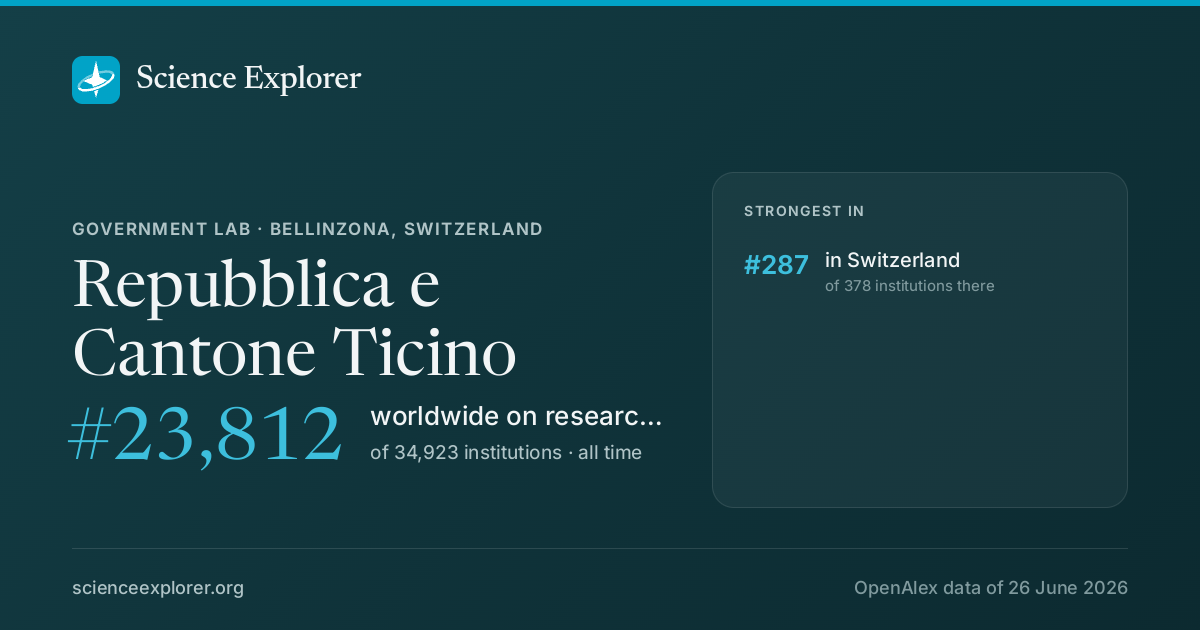
Repubblica e Cantone Ticino on Science Explorer

A card with Repubblica e Cantone Ticino's standing and the fields it leads in, for a post or a slide. A link to this page previews as the same card.

Download the card

1200 × 630 PNG, sized for social posts, drawn from the latest snapshot.

Badges for a website1Each links back here and updates with every snapshot

Research measures only: rankings here say nothing about teaching, admissions or student experience. Comparable institutions and collaboration partners have tabs of their own, above.

Discussion

Ask a question or share a note about Repubblica e Cantone Ticino. Posts are plain text and can be reported.
