Science Explorer Back to mapMap
Discussion
University · Riverside · United States

Riverside City College

World rank, all time
#23,718
of 34,923
Rank in United States
#4,933
of 7,310
Research works
144
▲ 94% vs 2018-21
Citations
3.5k
24.4 per fractional work
Top-10% rate
9.8%
all institutions 10.0%
vs its own fields
0.98×
1.00× is exactly expected
Open access
33%
world 40%
International
14%
world 18%

Which fields of science does Riverside City College work in?

In 2022-now, 45% of research at Riverside City College is in Physical Sciences, 21% in Social Sciences. Its largest fields are Medicine (17%), Engineering (16%), Social Sciences (14%).

Physical Sciences: 14 fractional works · 45.0% of its workEngineering: 5 fractional works · 15.7% of its workControl and Systems Engineering: 1 fractional works · 3.5% of its workAutomotive Engineering: 1 fractional works · 3.0% of its workElectrical and Electronic Engineering: 1 fractional works · 2.9% of its workAerospace Engineering: 1 fractional works · 2.2% of its workBiomedical Engineering: 0 fractional works · 1.5% of its workBuilding and Construction: 0 fractional works · 0.8% of its workSafety, Risk, Reliability and Quality: 0 fractional works · 0.6% of its workMedia Technology: 0 fractional works · 0.6% of its workIndustrial and Manufacturing Engineering: 0 fractional works · 0.3% of its workComputational Mechanics: 0 fractional works · 0.2% of its workSmaller subfields together: 0 fractional works · 0.1% of its workComputer Science: 3 fractional works · 11.4% of its workArtificial Intelligence: 2 fractional works · 5.4% of its workInformation Systems: 1 fractional works · 1.9% of its workComputer Science Applications: 0 fractional works · 1.6% of its workComputer Vision and Pattern Recognition: 0 fractional works · 1.5% of its workComputational Theory and Mathematics: 0 fractional works · 0.6% of its workComputer Networks and Communications: 0 fractional works · 0.4% of its workEnvironmental Science: 1 fractional works · 4.4% of its workEnvironmental Engineering: 0 fractional works · 1.5% of its workGlobal and Planetary Change: 0 fractional works · 1.2% of its workHealth, Toxicology and Mutagenesis: 0 fractional works · 0.9% of its workWater Science and Technology: 0 fractional works · 0.6% of its workManagement, Monitoring, Policy and Law: 0 fractional works · 0.4% of its workEarth and Planetary Sciences: 1 fractional works · 4.3% of its workAtmospheric Science: 1 fractional works · 1.9% of its workGeophysics: 0 fractional works · 0.8% of its workEarth-Surface Processes: 0 fractional works · 0.6% of its workGeochemistry and Petrology: 0 fractional works · 0.4% of its workGeology: 0 fractional works · 0.4% of its workSmaller subfields together: 0 fractional works · 0.3% of its workMathematics: 1 fractional works · 2.6% of its workStatistics and Probability: 1 fractional works · 2.2% of its workModeling and Simulation: 0 fractional works · 0.4% of its workMaterials Science: 1 fractional works · 2.4% of its workElectronic, Optical and Magnetic Materials: 0 fractional works · 0.8% of its workBiomaterials: 0 fractional works · 0.6% of its workMaterials Chemistry: 0 fractional works · 0.6% of its workPolymers and Plastics: 0 fractional works · 0.5% of its workChemistry: 1 fractional works · 1.7% of its workPhysical and Theoretical Chemistry: 0 fractional works · 0.9% of its workSpectroscopy: 0 fractional works · 0.6% of its workSmaller subfields together: 0 fractional works · 0.2% of its workEnergy: 0 fractional works · 1.4% of its workRenewable Energy, Sustainability and the Environment: 0 fractional works · 1.4% of its workChemical Engineering: 0 fractional works · 1.1% of its workFluid Flow and Transfer Processes: 0 fractional works · 1.0% of its workSmaller subfields together: 0 fractional works · 0.1% of its workSocial Sciences: 7 fractional works · 21.4% of its workSocial Sciences: 4 fractional works · 13.8% of its workSociology and Political Science: 1 fractional works · 4.1% of its workEducation: 1 fractional works · 3.0% of its workCultural Studies: 1 fractional works · 2.2% of its workCommunication: 1 fractional works · 2.1% of its workTransportation: 0 fractional works · 0.9% of its workPolitical Science and International Relations: 0 fractional works · 0.5% of its workSafety Research: 0 fractional works · 0.4% of its workGeography, Planning and Development: 0 fractional works · 0.4% of its workSmaller subfields together: 0 fractional works · 0.2% of its workPsychology: 1 fractional works · 3.7% of its workClinical Psychology: 1 fractional works · 2.0% of its workSocial Psychology: 0 fractional works · 0.7% of its workDevelopmental and Educational Psychology: 0 fractional works · 0.6% of its workExperimental and Cognitive Psychology: 0 fractional works · 0.4% of its workArts and Humanities: 1 fractional works · 2.6% of its workLiterature and Literary Theory: 0 fractional works · 0.7% of its workLanguage and Linguistics: 0 fractional works · 0.6% of its workReligious studies: 0 fractional works · 0.6% of its workMuseology: 0 fractional works · 0.4% of its workVisual Arts and Performing Arts: 0 fractional works · 0.4% of its workBusiness, Management and Accounting: 0 fractional works · 0.8% of its workManagement Information Systems: 0 fractional works · 0.8% of its workEconomics, Econometrics and Finance: 0 fractional works · 0.6% of its workEconomics and Econometrics: 0 fractional works · 0.6% of its workHealth Sciences: 5 fractional works · 17.3% of its workMedicine: 5 fractional works · 16.5% of its workPublic Health, Environmental and Occupational Health: 1 fractional works · 2.9% of its workRadiology, Nuclear Medicine and Imaging: 1 fractional works · 2.2% of its workCardiology and Cardiovascular Medicine: 1 fractional works · 2.0% of its workOncology: 1 fractional works · 2.0% of its workPulmonary and Respiratory Medicine: 0 fractional works · 1.4% of its workEpidemiology: 0 fractional works · 1.3% of its workGastroenterology: 0 fractional works · 0.8% of its workOphthalmology: 0 fractional works · 0.6% of its workSurgery: 0 fractional works · 0.6% of its workEmergency Medicine: 0 fractional works · 0.4% of its workPhysiology: 0 fractional works · 0.4% of its workEndocrinology, Diabetes and Metabolism: 0 fractional works · 0.4% of its workUrology: 0 fractional works · 0.4% of its workPsychiatry and Mental health: 0 fractional works · 0.3% of its workCritical Care and Intensive Care Medicine: 0 fractional works · 0.2% of its workDermatology: 0 fractional works · 0.2% of its workHematology: 0 fractional works · 0.2% of its workSmaller subfields together: 0 fractional works · 0.1% of its workNursing: 0 fractional works · 0.4% of its workIssues, ethics and legal aspects: 0 fractional works · 0.2% of its workResearch and Theory: 0 fractional works · 0.2% of its workHealth Professions: 0 fractional works · 0.3% of its workEmergency Medical Services: 0 fractional works · 0.2% of its workSmaller subfields together: 0 fractional works · 0.1% of its workLife Sciences: 5 fractional works · 16.2% of its workAgricultural and Biological Sciences: 2 fractional works · 7.0% of its workPlant Science: 1 fractional works · 3.6% of its workEcology, Evolution, Behavior and Systematics: 1 fractional works · 2.7% of its workAquatic Science: 0 fractional works · 0.6% of its workSmaller subfields together: 0 fractional works · 0.2% of its workBiochemistry, Genetics and Molecular Biology: 2 fractional works · 5.7% of its workMolecular Biology: 1 fractional works · 2.2% of its workCell Biology: 1 fractional works · 1.9% of its workDevelopmental Biology: 0 fractional works · 1.1% of its workCancer Research: 0 fractional works · 0.3% of its workGenetics: 0 fractional works · 0.2% of its workSmaller subfields together: 0 fractional works · 0.0% of its workNeuroscience: 1 fractional works · 2.7% of its workCognitive Neuroscience: 1 fractional works · 1.7% of its workBehavioral Neuroscience: 0 fractional works · 0.6% of its workCellular and Molecular Neuroscience: 0 fractional works · 0.5% of its workImmunology and Microbiology: 0 fractional works · 0.8% of its workImmunology: 0 fractional works · 0.8% of its workPharmacology, Toxicology and Pharmaceutics: 0 fractional works · 0.1% of its workALL ITS WORKRiverside CityCollege30fractional works, 2022-now
Life Sciences16%Physical Sciences45%Health Sciences17%Social Sciences21%

Each ring splits the one inside it: the four domains of science, their fields, their subfields. Size is fractional works in 2022-now. Every slice is a page; the interactive view zooms down to single topics and colours each by how much more of it this institution does than the world.

Its 4 domains and 22 fields, with their numbers
    1. Engineering515.7%
    2. Computer Science311.4%
    3. Environmental Science14.4%
    4. Earth and Planetary Sciences14.3%
    5. Mathematics12.6%
    6. Materials Science12.4%
    7. Chemistry11.7%
    8. Energy01.4%
    9. Chemical Engineering01.1%
    1. Social Sciences413.8%
    2. Psychology13.7%
    3. Arts and Humanities12.6%
    4. Business, Management and Accounting00.8%
    5. Economics, Econometrics and Finance00.6%
    1. Medicine516.5%
    2. Nursing00.4%
    3. Health Professions00.3%
    1. Agricultural and Biological Sciences27.0%
    2. Biochemistry, Genetics and Molecular Biology25.7%
    3. Neuroscience12.7%
    4. Immunology and Microbiology00.8%
    5. Pharmacology, Toxicology and Pharmaceutics00.1%
All of science, and how each field's share has moved since 1950: the Science domain explorer

Field profile

Location quotient across every field it publishes in: outside the ring is more than an institution of this size would be expected to publish, inside it is less.

Agricultural and Biological Sciences: 1.48× its world share, 2 worksAgricultural and Bio…Biochemistry, Genetics and Molecular Biology: 1.06× its world share, 2 worksBiochemistry, Geneti…Immunology and Microbiology: 0.76× its world share, 0 worksImmunology and Micro…Neuroscience: 1.68× its world share, 1 worksNeurosciencePharmacology, Toxicology and Pharmaceutics: 0.16× its world share, 0 worksPharmacology, Toxico…Chemical Engineering: 3.07× its world share, 0 worksChemical EngineeringChemistry: 1.06× its world share, 0 worksChemistryComputer Science: 1.47× its world share, 4 worksComputer ScienceEarth and Planetary Sciences: 2.76× its world share, 1 worksEarth and Planetary …Energy: 1.49× its world share, 0 worksEnergyEngineering: 1.05× its world share, 5 worksEngineeringEnvironmental Science: 0.89× its world share, 1 worksEnvironmental ScienceMaterials Science: 0.70× its world share, 1 worksMaterials ScienceMathematics: 2.18× its world share, 1 worksMathematicsHealth Professions: 0.13× its world share, 0 worksHealth ProfessionsMedicine: 0.86× its world share, 5 worksMedicineNursing: 0.90× its world share, 0 worksNursingArts and Humanities: 0.89× its world share, 1 worksArts and HumanitiesBusiness, Management and Accounting: 0.26× its world share, 0 worksBusiness, Management…Economics, Econometrics and Finance: 0.26× its world share, 0 worksEconomics, Econometr…Psychology: 1.20× its world share, 1 worksPsychologySocial Sciences: 1.09× its world share, 4 worksSocial Sciences1×world share
more than its size predictsabout as predictedless

Rings at 0.5×, 1× and 2×. Widest outward: Chemical Engineering, 3.1×. Every wedge is a field page.

All 22 fields, with their numbers
  1. Chemical Engineering3.07×0 works
  2. Earth and Planetary Sciences2.76×1 works
  3. Mathematics2.18×1 works
  4. Neuroscience1.68×1 works
  5. Energy1.49×0 works
  6. Agricultural and Biological Sciences1.48×2 works
  7. Computer Science1.47×4 works
  8. Psychology1.20×1 works
  9. Social Sciences1.09×4 works
  10. Biochemistry, Genetics and Molecular Biology1.06×2 works
  11. Chemistry1.06×0 works
  12. Engineering1.05×5 works
  13. Nursing0.90×0 works
  14. Environmental Science0.89×1 works
  15. Arts and Humanities0.89×1 works
  16. Medicine0.86×5 works
  17. Immunology and Microbiology0.76×0 works
  18. Materials Science0.70×1 works
  19. Business, Management and Accounting0.26×0 works
  20. Economics, Econometrics and Finance0.26×0 works
  21. Pharmacology, Toxicology and Pharmaceutics0.16×0 works
  22. Health Professions0.13×0 works

Who are the top researchers at Riverside City College?

Ranked on the quality score, Edmund C. Jaeger, George A. Linhart and Uyless Black lead among researchers whose main affiliation is Riverside City College.

  1. 1 Edmund C. Jaeger United States · #1,831,693 worldwide 450 citations · 97 works
  2. 2 George A. Linhart United States · #2,507,231 worldwide 142 citations · 28 works
  3. 3 Uyless Black United States · #2,534,614 worldwide 795 citations · 59 works
  4. 4 Bryan C. Keene United States · #2,680,773 worldwide 21 citations · 44 works
  5. 5 David V. Baker United States · #3,737,714 worldwide 156 citations · 22 works
  6. 6 Joseph J. Waddell United States · #3,772,386 worldwide 93 citations · 15 works
  7. 7 Gloria Leifer United States · #3,860,495 worldwide 88 citations · 18 works
  8. 8 Fred A. Thompson United States · #4,053,034 worldwide 44 citations · 18 works
All ranked researchers at Riverside City College

What are the most cited papers from Riverside City College?

The most cited paper from Riverside City College is "Magnetic Resonance Imaging of the Lumbar Spine in People without Back Pain" (Maureen C. Jensen, Michael N Brant-Zawadzki, Nancy A. Obuchowski et al., 1994), with 2,421 citations. Next come "Supportless Pt and PtPd Nanotubes as Electrocatalysts for Oxygen‐Reduction Reactions" (835) and "Zero skew clock routing with minimum wirelength" (351).

Most cited papers
#PaperReleasedCitations
1 Magnetic Resonance Imaging of the Lumbar Spine in People without Back Pain Maureen C. Jensen, Michael N Brant-Zawadzki, Nancy A. Obuchowski et al. · New England Journal of Medicine Open access 14 Jul 1994 2,421
2 Supportless Pt and PtPd Nanotubes as Electrocatalysts for Oxygen‐Reduction Reactions Zhongwei Chen, Mahesh M. Waje, Wenzhen Li et al. · Angewandte Chemie International Edition 2 May 2007 835
3 Zero skew clock routing with minimum wirelength Ting-Hai Chao, Yu-Chin Hsu, Jan-Ming Ho et al. · IEEE Transactions on Circuits and Systems II Analog and Digital Signal Processing 1992 351
4 Transverse momentum spectra for charged particles at the CERN proton-antiproton collider G.T.J. Arnison et al. · Physics Letters B 126 authors Dec 1982 294
5 Emission Rates of Particulate Matter and Elemental and Organic Carbon from In-Use Diesel Engines Sandip D. Shah, David R. Cocker, John W. Miller et al. · Environmental Science & Technology 10 Mar 2004 271
All 61 most cited papers, with filters and sorting

Which research topics does Riverside City College publish most on?

By volume in 2022-now: Radio, Podcasts, and Digital Media, Cellular Mechanics and Interactions, Online Learning and Analytics and Insect Pest Control Strategies.

  1. 1 Radio, Podcasts, and Digital Media Communication 0 works
  2. 2 Cellular Mechanics and Interactions Cell Biology 0 works
  3. 3 Online Learning and Analytics Computer Science Applications 0 works
  4. 4 Insect Pest Control Strategies Plant Science 0 works
  5. 5 Electric Vehicles and Infrastructure Electrical and Electronic Engineering 0 works
  6. 6 Vehicle emissions and performance Automotive Engineering 0 works
  7. 7 Malaria Research and Control Public Health, Environmental and Occupational Health 0 works
  8. 8 Insect Resistance and Genetics Molecular Biology 0 works
  9. 9 Plant and animal studies Ecology, Evolution, Behavior and Systematics 0 works
  10. 10 Animal Vocal Communication and Behavior Developmental Biology 0 works

How open and international is its research?

Against the world's own shares: the tick on each track. Both are shares of its output, so they sit on one scale and can be read against each other as well as against the world.

openly available33.4%not open66.6%

World: 40% of research is openly available.

with international co-authors13.9%domestic only86.1%

World: 18% is written across borders.

How has Riverside City College's research output changed?

Output in 2022-2025 was 94% higher than in 2018-2021.

still counting1990200020102020
grewheldshrank

The same series as a ribbon: one cell per year, darker for more. The line above answers how much; this answers when.

Its share of all research

Growing output can still be a shrinking share: all of science grows. This is Riverside City College as a percentage of every work published that year, 0.00012% in 2024.

still counting0.00050%0.0010%0.0015%Riverside City College0.00022% in 202519801990200020102020

Fractional works of Riverside City College over all fractional works that year. How the balance of science has shifted.

Other research institutions in Riverside

All research institutions in Riverside

Share Riverside City College's ranking
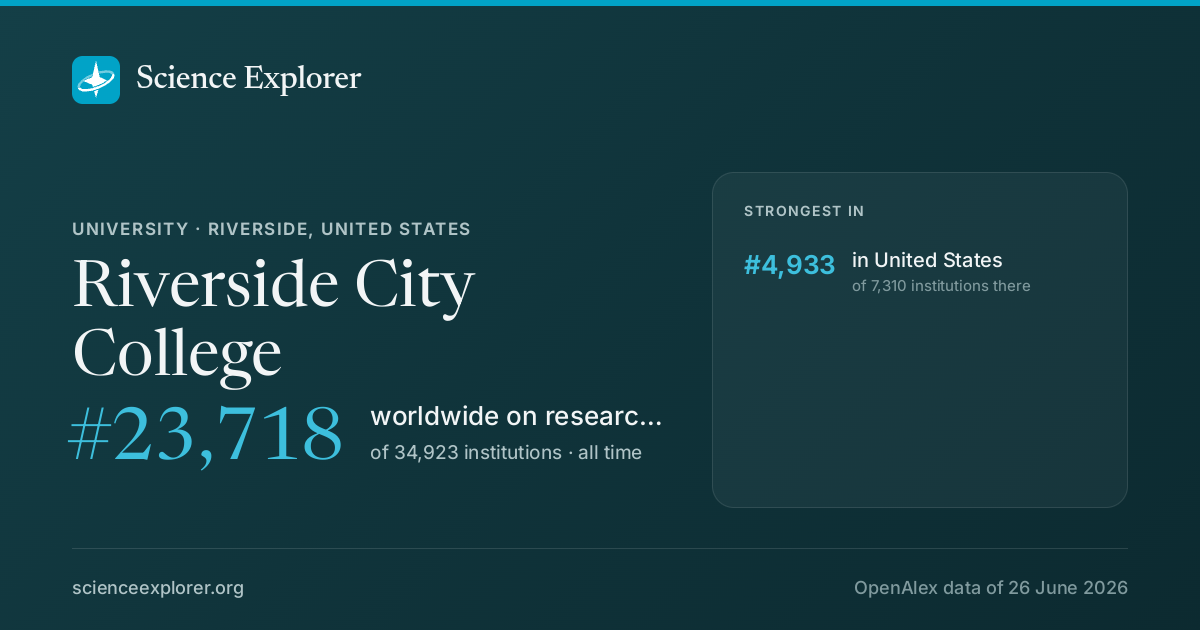
Riverside City College on Science Explorer

A card with Riverside City College's standing and the fields it leads in, for a post or a slide. A link to this page previews as the same card.

Download the card

1200 × 630 PNG, sized for social posts, drawn from the latest snapshot.

Badges for a website1Each links back here and updates with every snapshot

Research measures only: rankings here say nothing about teaching, admissions or student experience. Comparable institutions and collaboration partners have tabs of their own, above.

Discussion

Ask a question or share a note about Riverside City College. Posts are plain text and can be reported.
