Science Explorer Back to mapMap
Discussion
Hospital / health system · Ravenna · United States

Robinson Memorial Hospital

World rank, all time
#29,034
of 34,923
Rank in United States
#6,111
of 7,310
Research works
140
▼ 41% vs 2018-21
Citations
3.4k
24.4 per fractional work
Top-10% rate
15.0%
all institutions 10.0%
vs its own fields
0.93×
1.00× is exactly expected
Open access
25%
world 40%
International
22%
world 18%

Which fields of science does Robinson Memorial Hospital work in?

In all years, 47% of research at Robinson Memorial Hospital is in Health Sciences, 28% in Social Sciences. Its largest fields are Medicine (35%), Health Professions (9%), Social Sciences (8%). It does 1.9× the world's share of Health Sciences.

Health Sciences: 66 fractional works · 46.9% of its workMedicine: 49 fractional works · 35.3% of its workPublic Health, Environmental and Occupational Health: 7 fractional works · 5.2% of its workSurgery: 6 fractional works · 4.0% of its workCardiology and Cardiovascular Medicine: 4 fractional works · 2.9% of its workEpidemiology: 4 fractional works · 2.9% of its workPulmonary and Respiratory Medicine: 3 fractional works · 2.4% of its workRehabilitation: 2 fractional works · 1.8% of its workEmergency Medicine: 2 fractional works · 1.7% of its workRadiology, Nuclear Medicine and Imaging: 2 fractional works · 1.5% of its workOncology: 2 fractional works · 1.3% of its workObstetrics and Gynecology: 2 fractional works · 1.1% of its workReproductive Medicine: 1 fractional works · 1.0% of its workPsychiatry and Mental health: 1 fractional works · 1.0% of its workPhysiology: 1 fractional works · 0.9% of its workInfectious Diseases: 1 fractional works · 0.8% of its workPediatrics, Perinatology and Child Health: 1 fractional works · 0.8% of its workEndocrinology, Diabetes and Metabolism: 1 fractional works · 0.8% of its workOrthopedics and Sports Medicine: 1 fractional works · 0.6% of its workDermatology: 1 fractional works · 0.5% of its workNeurology: 1 fractional works · 0.4% of its workGastroenterology: 1 fractional works · 0.4% of its workComplementary and alternative medicine: 1 fractional works · 0.4% of its workGeriatrics and Gerontology: 0 fractional works · 0.3% of its workPharmacology: 0 fractional works · 0.3% of its workRheumatology: 0 fractional works · 0.3% of its workInternal Medicine: 0 fractional works · 0.2% of its workOphthalmology: 0 fractional works · 0.2% of its workCritical Care and Intensive Care Medicine: 0 fractional works · 0.2% of its workSmaller subfields together: 2 fractional works · 1.3% of its workHealth Professions: 12 fractional works · 8.7% of its workGeneral Health Professions: 6 fractional works · 4.5% of its workSpeech and Hearing: 2 fractional works · 1.4% of its workHealth Information Management: 2 fractional works · 1.1% of its workRadiological and Ultrasound Technology: 1 fractional works · 0.7% of its workPharmacy: 1 fractional works · 0.4% of its workMedical Laboratory Technology: 0 fractional works · 0.2% of its workSmaller subfields together: 1 fractional works · 0.4% of its workNursing: 3 fractional works · 2.0% of its workNutrition and Dietetics: 2 fractional works · 1.5% of its workIssues, ethics and legal aspects: 0 fractional works · 0.4% of its workSmaller subfields together: 0 fractional works · 0.2% of its workVeterinary: 1 fractional works · 0.6% of its workSmall Animals: 1 fractional works · 0.6% of its workDentistry: 1 fractional works · 0.4% of its workSocial Sciences: 39 fractional works · 28.1% of its workSocial Sciences: 11 fractional works · 8.0% of its workEducation: 4 fractional works · 2.5% of its workSociology and Political Science: 3 fractional works · 2.0% of its workHealth: 1 fractional works · 0.7% of its workPolitical Science and International Relations: 1 fractional works · 0.7% of its workGender Studies: 1 fractional works · 0.7% of its workAnthropology: 0 fractional works · 0.2% of its workArcheology: 0 fractional works · 0.2% of its workCommunication: 0 fractional works · 0.2% of its workTransportation: 0 fractional works · 0.2% of its workSmaller subfields together: 1 fractional works · 0.4% of its workArts and Humanities: 10 fractional works · 7.0% of its workLiterature and Literary Theory: 3 fractional works · 2.1% of its workMuseology: 2 fractional works · 1.4% of its workVisual Arts and Performing Arts: 2 fractional works · 1.2% of its workHistory: 2 fractional works · 1.1% of its workLanguage and Linguistics: 0 fractional works · 0.4% of its workClassics: 0 fractional works · 0.2% of its workMusic: 0 fractional works · 0.2% of its workSmaller subfields together: 0 fractional works · 0.3% of its workPsychology: 8 fractional works · 5.9% of its workClinical Psychology: 3 fractional works · 1.9% of its workSocial Psychology: 2 fractional works · 1.5% of its workExperimental and Cognitive Psychology: 1 fractional works · 1.0% of its workApplied Psychology: 1 fractional works · 0.9% of its workDevelopmental and Educational Psychology: 1 fractional works · 0.4% of its workSmaller subfields together: 0 fractional works · 0.1% of its workBusiness, Management and Accounting: 8 fractional works · 5.6% of its workStrategy and Management: 2 fractional works · 1.7% of its workOrganizational Behavior and Human Resource Management: 2 fractional works · 1.2% of its workManagement of Technology and Innovation: 2 fractional works · 1.1% of its workTourism, Leisure and Hospitality Management: 2 fractional works · 1.1% of its workAccounting: 0 fractional works · 0.4% of its workMarketing: 0 fractional works · 0.2% of its workEconomics, Econometrics and Finance: 2 fractional works · 1.2% of its workEconomics and Econometrics: 1 fractional works · 1.0% of its workSmaller subfields together: 0 fractional works · 0.2% of its workDecision Sciences: 1 fractional works · 0.4% of its workStatistics, Probability and Uncertainty: 0 fractional works · 0.3% of its workSmaller subfields together: 0 fractional works · 0.1% of its workPhysical Sciences: 27 fractional works · 19.3% of its workEngineering: 10 fractional works · 7.1% of its workCivil and Structural Engineering: 3 fractional works · 1.8% of its workAerospace Engineering: 2 fractional works · 1.2% of its workElectrical and Electronic Engineering: 1 fractional works · 1.0% of its workBiomedical Engineering: 1 fractional works · 0.8% of its workControl and Systems Engineering: 1 fractional works · 0.8% of its workSafety, Risk, Reliability and Quality: 1 fractional works · 0.7% of its workMechanical Engineering: 0 fractional works · 0.2% of its workSmaller subfields together: 1 fractional works · 0.6% of its workComputer Science: 7 fractional works · 4.7% of its workInformation Systems: 3 fractional works · 1.8% of its workComputer Science Applications: 2 fractional works · 1.1% of its workArtificial Intelligence: 1 fractional works · 0.9% of its workComputational Theory and Mathematics: 1 fractional works · 0.7% of its workSmaller subfields together: 0 fractional works · 0.1% of its workChemistry: 4 fractional works · 3.2% of its workInorganic Chemistry: 3 fractional works · 1.9% of its workOrganic Chemistry: 2 fractional works · 1.1% of its workSmaller subfields together: 0 fractional works · 0.2% of its workEnvironmental Science: 2 fractional works · 1.4% of its workHealth, Toxicology and Mutagenesis: 1 fractional works · 0.6% of its workEnvironmental Chemistry: 0 fractional works · 0.4% of its workEcology: 0 fractional works · 0.2% of its workIndustrial and Manufacturing Engineering: 0 fractional works · 0.2% of its workPhysics and Astronomy: 2 fractional works · 1.3% of its workRadiation: 1 fractional works · 0.8% of its workAtomic and Molecular Physics, and Optics: 0 fractional works · 0.3% of its workSmaller subfields together: 0 fractional works · 0.2% of its workMaterials Science: 1 fractional works · 0.7% of its workMaterials Chemistry: 1 fractional works · 0.4% of its workSmaller subfields together: 0 fractional works · 0.3% of its workEarth and Planetary Sciences: 1 fractional works · 0.7% of its workGeochemistry and Petrology: 1 fractional works · 0.5% of its workSmaller subfields together: 0 fractional works · 0.2% of its workMathematics: 0 fractional works · 0.2% of its workChemical Engineering: 0 fractional works · 0.1% of its workLife Sciences: 8 fractional works · 5.7% of its workBiochemistry, Genetics and Molecular Biology: 4 fractional works · 2.7% of its workMolecular Biology: 2 fractional works · 1.8% of its workGenetics: 1 fractional works · 0.5% of its workSmaller subfields together: 1 fractional works · 0.5% of its workAgricultural and Biological Sciences: 2 fractional works · 1.4% of its workFood Science: 0 fractional works · 0.3% of its workAgronomy and Crop Science: 0 fractional works · 0.2% of its workEcology, Evolution, Behavior and Systematics: 0 fractional works · 0.2% of its workForestry: 0 fractional works · 0.2% of its workPlant Science: 0 fractional works · 0.2% of its workSmaller subfields together: 0 fractional works · 0.1% of its workImmunology and Microbiology: 1 fractional works · 0.8% of its workImmunology: 1 fractional works · 0.4% of its workParasitology: 0 fractional works · 0.2% of its workSmaller subfields together: 0 fractional works · 0.1% of its workNeuroscience: 1 fractional works · 0.8% of its workCognitive Neuroscience: 1 fractional works · 0.5% of its workNeurology: 0 fractional works · 0.2% of its workSmaller subfields together: 0 fractional works · 0.1% of its workPharmacology, Toxicology and Pharmaceutics: 0 fractional works · 0.0% of its workALL ITS WORKRobinson MemorialHospital140fractional works, all years
Life Sciences6%Physical Sciences19%Health Sciences47%Social Sciences28%

Each ring splits the one inside it: the four domains of science, their fields, their subfields. Size is fractional works in all years. Every slice is a page; the interactive view zooms down to single topics and colours each by how much more of it this institution does than the world.

Its 4 domains and 25 fields, with their numbers
    1. Medicine4935.3%
    2. Health Professions128.7%
    3. Nursing32.0%
    4. Veterinary10.6%
    5. Dentistry10.4%
    1. Social Sciences118.0%
    2. Arts and Humanities107.0%
    3. Psychology85.9%
    4. Business, Management and Accounting85.6%
    5. Economics, Econometrics and Finance21.2%
    6. Decision Sciences10.4%
    1. Engineering107.1%
    2. Computer Science74.7%
    3. Chemistry43.2%
    4. Environmental Science21.4%
    5. Physics and Astronomy21.3%
    6. Materials Science10.7%
    7. Earth and Planetary Sciences10.7%
    8. Mathematics00.2%
    9. Chemical Engineering00.1%
    1. Biochemistry, Genetics and Molecular Biology42.7%
    2. Agricultural and Biological Sciences21.4%
    3. Immunology and Microbiology10.8%
    4. Neuroscience10.8%
    5. Pharmacology, Toxicology and Pharmaceutics00.0%
All of science, and how each field's share has moved since 1950: the Science domain explorer

Field profile

Location quotient across every field it publishes in: outside the ring is more than an institution of this size would be expected to publish, inside it is less.

Agricultural and Biological Sciences: 0.43× its world share, 0 worksAgricultural and Bio…Biochemistry, Genetics and Molecular Biology: 1.25× its world share, 1 worksBiochemistry, Geneti…Immunology and Microbiology: 1.35× its world share, 0 worksImmunology and Micro…Chemistry: 1.59× its world share, 0 worksChemistryEarth and Planetary Sciences: 0.43× its world share, 0 worksEarth and Planetary …Engineering: 1.10× its world share, 2 worksEngineeringEnvironmental Science: 0.27× its world share, 0 worksEnvironmental ScienceMaterials Science: 1.71× its world share, 1 worksMaterials SciencePhysics and Astronomy: 0.84× its world share, 0 worksPhysics and AstronomyHealth Professions: 1.25× its world share, 0 worksHealth ProfessionsMedicine: 1.99× its world share, 5 worksMedicineNursing: 2.32× its world share, 0 worksNursingArts and Humanities: 4.72× its world share, 2 worksArts and HumanitiesEconomics, Econometrics and Finance: 0.25× its world share, 0 worksEconomics, Econometr…Social Sciences: 0.33× its world share, 0 worksSocial Sciences1×world share
more than its size predictsabout as predictedless

Rings at 0.5×, 1× and 2×. Widest outward: Arts and Humanities, 4.7×. Every wedge is a field page.

All 15 fields, with their numbers
  1. Arts and Humanities4.72×2 works
  2. Nursing2.32×0 works
  3. Medicine1.99×5 works
  4. Materials Science1.71×1 works
  5. Chemistry1.59×0 works
  6. Immunology and Microbiology1.35×0 works
  7. Biochemistry, Genetics and Molecular Biology1.25×1 works
  8. Health Professions1.25×0 works
  9. Engineering1.10×2 works
  10. Physics and Astronomy0.84×0 works
  11. Agricultural and Biological Sciences0.43×0 works
  12. Earth and Planetary Sciences0.43×0 works
  13. Social Sciences0.33×0 works
  14. Environmental Science0.27×0 works
  15. Economics, Econometrics and Finance0.25×0 works

Who are the top researchers at Robinson Memorial Hospital?

Ranked on the quality score, Kathy Mirakovits, Reid Jd and Rudolph Keller lead among researchers whose main affiliation is Robinson Memorial Hospital.

  1. 1 Kathy Mirakovits United States · #2,551,584 worldwide 63 citations · 30 works
  2. 2 Reid Jd United States · #3,806,979 worldwide 297 citations · 36 works
  3. 3 Rudolph Keller United States · #4,414,579 worldwide 115 citations · 21 works
All ranked researchers at Robinson Memorial Hospital

What are the most cited papers from Robinson Memorial Hospital?

The most cited paper from Robinson Memorial Hospital is "European Position Paper on Rhinosinusitis and Nasal Polyps" (W.J. Fokkens et al., 2014), with 1,334 citations. Next come "Reproductive Technologies and the Risk of Birth Defects" (829) and "Post-stroke depressive disorders: a follow-up study of 103 patients." (564).

Most cited papers
#PaperReleasedCitations
1 European Position Paper on Rhinosinusitis and Nasal Polyps W.J. Fokkens et al. Book chapterOpen access154 authors 2014 1,334
2 Reproductive Technologies and the Risk of Birth Defects Michael J. Davies, Vivienne Moore, Kristyn J. Willson et al. · New England Journal of Medicine Open access 5 May 2012 829
3 Post-stroke depressive disorders: a follow-up study of 103 patients. R G Robinson, T R Price · Stroke Open access Sep 1982 564
4 A two-year longitudinal study of post-stroke mood disorders: findings during the initial evaluation. Robert G. Robinson, Lyn Book Starr, Kenneth L. Kubos et al. · Stroke Open access Sep 1983 440
5 Impact of obesity on male fertility, sperm function and molecular composition Nicole O. Palmer, Hassan W. Bakos, Tod Fullston et al. · Spermatogenesis Open access Oct 2012 401
All 60 most cited papers, with filters and sorting

Which keywords describe research at Robinson Memorial Hospital?

By fractional works in all years, weighted toward what it does more of than the world: Epidemiology, Technology Integration, Primary Care, Digital Literacy, Media Literacy, Risk Factors, Global Burden and Multimodal Literacy.

▲ more of its work than of the world's◆ about the world's share▼ less than the world's

Size is fractional works in all years in the topics tagged with each word; colour is the word's share of this institution's work against its share of the world's. The 40 words are chosen for being large and distinctive. Each links to the topic it comes from most.

All 40 words, with their numbers
  1. Epidemiology11▲ 1.92×49 topics
  2. Risk Factors5▲ 3.3×13 topics
  3. Technology Integration4▲ 15×3 topics
  4. Primary Care4▲ 6.8×8 topics
  5. Global Burden4▲ 5.0×5 topics
  6. Treatment4▲ 2.0×16 topics
  7. Digital Literacy4▲ 8.4×2 topics
  8. Educational Technology4▲ 3.7×5 topics
  9. Media Literacy4▲ 11×2 topics
  10. Diagnosis3▲ 2.4×12 topics
  11. Cardiovascular Disease3▲ 2.1×14 topics
  12. Public Health3▲ 1.73×13 topics
  13. Management3▲ 2.9×13 topics
  14. Metabolic Syndrome3▲ 2.6×12 topics
  15. Multimodal Literacy3▲ 158×1 topic
  16. New Literacies3▲ 158×1 topic
  17. Cultural Studies3▲ 5.5×5 topics
  18. Chronic Disease Management3▲ 14×4 topics
  19. Meta-Analysis3▲ 3.3×8 topics
  20. Quality Improvement3▲ 8.9×4 topics
  21. Learning Outcomes2▲ 7.9×2 topics
  22. Student Engagement2▲ 6.9×2 topics
  23. Injury Prevention2▲ 15×3 topics
  24. Motor Recovery2▲ 25×1 topic
  25. Neural Plasticity2▲ 7.2×1 topic
  26. Psychological Impact2▲ 6.4×5 topics
  27. Intensive Care Unit2▲ 12×4 topics
  28. Child Injury2▲ 41×1 topic
  29. Continuity of Care2▲ 20×2 topics
  30. Nursing Education2▲ 10×3 topics
  31. Performance Improvement2▲ 38×2 topics
  32. Reflective Practice2▲ 6.8×5 topics
  33. Unintentional Injuries2▲ 41×1 topic
  34. Ischemic Stroke2▲ 8.3×2 topics
  35. Patient-Centered Medical Home2▲ 23×1 topic
  36. Pay for Performance2▲ 23×1 topic
  37. Resuscitation2▲ 9.0×3 topics
  38. Experiential Learning2▲ 17×1 topic
  39. Learning Analytics2▲ 16×2 topics
  40. Marketing Education2▲ 80×1 topic

Which research topics does Robinson Memorial Hospital publish most on?

By volume in 2022-now: Fashion and Cultural Textiles, Crafts, Textile, and Design, Geotechnical Engineering and Underground Structures and Acute Ischemic Stroke Management.

  1. 1 Fashion and Cultural Textiles Museology 1 works
  2. 2 Crafts, Textile, and Design Museology 1 works
  3. 3 Geotechnical Engineering and Underground Structures Civil and Structural Engineering 0 works
  4. 4 Acute Ischemic Stroke Management Epidemiology 0 works
  5. 5 Gender, Feminism, and Media Gender Studies 0 works
  6. 6 Visual Culture and Art Theory Visual Arts and Performing Arts 0 works
  7. 7 Geotechnical Engineering and Soil Stabilization Civil and Structural Engineering 0 works
  8. 8 Cardiovascular Health and Risk Factors Cardiology and Cardiovascular Medicine 0 works
  9. 9 Cardiac Structural Anomalies and Repair Surgery 0 works
  10. 10 Perovskite Materials and Applications Electrical and Electronic Engineering 0 works

How open and international is its research?

Against the world's own shares: the tick on each track. Both are shares of its output, so they sit on one scale and can be read against each other as well as against the world.

openly available24.6%not open75.4%

World: 40% of research is openly available.

with international co-authors21.8%domestic only78.2%

World: 18% is written across borders.

How has Robinson Memorial Hospital's research output changed?

Output in 2022-2025 was 41% lower than in 2018-2021.

still counting1990200020102020
grewheldshrank

The same series as a ribbon: one cell per year, darker for more. The line above answers how much; this answers when.

Its share of all research

Growing output can still be a shrinking share: all of science grows. This is Robinson Memorial Hospital as a percentage of every work published that year, 0.000050% in 2024.

still counting0.00050%0.0010%0.0015%Robinson Memorial Hospital0.000043% in 202519801990200020102020

Fractional works of Robinson Memorial Hospital over all fractional works that year. How the balance of science has shifted.

Other research institutions in Ravenna

All research institutions in Ravenna

Share Robinson Memorial Hospital's ranking
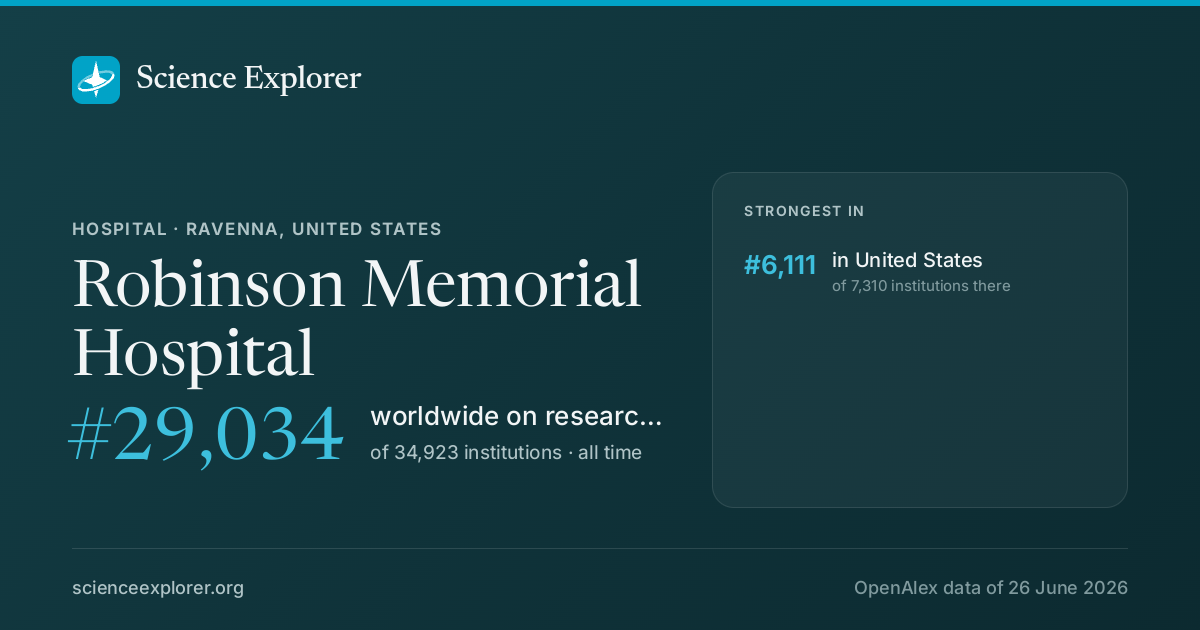
Robinson Memorial Hospital on Science Explorer

A card with Robinson Memorial Hospital's standing and the fields it leads in, for a post or a slide. A link to this page previews as the same card.

Download the card

1200 × 630 PNG, sized for social posts, drawn from the latest snapshot.

Badges for a website1Each links back here and updates with every snapshot

Research measures only: rankings here say nothing about teaching, admissions or student experience. Comparable institutions and collaboration partners have tabs of their own, above.

Discussion

Ask a question or share a note about Robinson Memorial Hospital. Keep it to the research: no personal attacks, advertising or links. Any reader can report a post, which collapses it for everyone until it is opened.
