Science Explorer Back to mapMap
Discussion

Robust Chip (United States)

World rank, all time
#29,825
of 34,923
Rank in United States
#6,277
of 7,310
Research works
132
▼ 5% vs 2018-21
Citations
1.5k
11.0 per fractional work
Top-10% rate
9.7%
all institutions 10.0%
vs its own fields
0.94×
1.00× is exactly expected
Open access
32%
world 40%
International
25%
world 18%

Which fields of science does Robust Chip (United States) work in?

In 2022-now, 67% of research at Robust Chip (United States) is in Physical Sciences, 22% in Social Sciences. Its largest fields are Engineering (43%), Computer Science (13%), Psychology (6%). It does 1.6× the world's share of Physical Sciences.

Physical Sciences: 20 fractional works · 66.9% of its workEngineering: 13 fractional works · 43.3% of its workElectrical and Electronic Engineering: 5 fractional works · 16.2% of its workAerospace Engineering: 4 fractional works · 13.1% of its workControl and Systems Engineering: 2 fractional works · 7.5% of its workBiomedical Engineering: 1 fractional works · 2.2% of its workIndustrial and Manufacturing Engineering: 0 fractional works · 1.7% of its workBuilding and Construction: 0 fractional works · 1.1% of its workMechanical Engineering: 0 fractional works · 0.6% of its workComputational Mechanics: 0 fractional works · 0.4% of its workMechanics of Materials: 0 fractional works · 0.4% of its workSafety, Risk, Reliability and Quality: 0 fractional works · 0.3% of its workComputer Science: 4 fractional works · 12.5% of its workArtificial Intelligence: 2 fractional works · 5.1% of its workSignal Processing: 1 fractional works · 2.7% of its workComputer Networks and Communications: 1 fractional works · 2.3% of its workInformation Systems: 0 fractional works · 1.4% of its workComputational Theory and Mathematics: 0 fractional works · 0.6% of its workHardware and Architecture: 0 fractional works · 0.4% of its workSmaller subfields together: 0 fractional works · 0.1% of its workPhysics and Astronomy: 2 fractional works · 6.0% of its workAstronomy and Astrophysics: 1 fractional works · 2.9% of its workStatistical and Nonlinear Physics: 0 fractional works · 1.4% of its workAtomic and Molecular Physics, and Optics: 0 fractional works · 1.1% of its workCondensed Matter Physics: 0 fractional works · 0.6% of its workEnvironmental Science: 1 fractional works · 2.0% of its workGlobal and Planetary Change: 0 fractional works · 1.1% of its workManagement, Monitoring, Policy and Law: 0 fractional works · 0.7% of its workSmaller subfields together: 0 fractional works · 0.2% of its workChemistry: 1 fractional works · 1.9% of its workPhysical and Theoretical Chemistry: 0 fractional works · 1.7% of its workOrganic Chemistry: 0 fractional works · 0.2% of its workEarth and Planetary Sciences: 0 fractional works · 0.6% of its workOceanography: 0 fractional works · 0.6% of its workMathematics: 0 fractional works · 0.6% of its workGeometry and Topology: 0 fractional works · 0.6% of its workSocial Sciences: 7 fractional works · 22.5% of its workPsychology: 2 fractional works · 6.2% of its workSocial Psychology: 1 fractional works · 3.4% of its workClinical Psychology: 0 fractional works · 1.1% of its workDevelopmental and Educational Psychology: 0 fractional works · 1.1% of its workExperimental and Cognitive Psychology: 0 fractional works · 0.6% of its workSocial Sciences: 1 fractional works · 4.9% of its workPolitical Science and International Relations: 1 fractional works · 3.0% of its workDemography: 0 fractional works · 1.1% of its workLaw: 0 fractional works · 0.3% of its workSmaller subfields together: 0 fractional works · 0.5% of its workDecision Sciences: 1 fractional works · 4.0% of its workInformation Systems and Management: 1 fractional works · 1.8% of its workStatistics, Probability and Uncertainty: 0 fractional works · 1.5% of its workGeneral Decision Sciences: 0 fractional works · 0.4% of its workManagement Science and Operations Research: 0 fractional works · 0.4% of its workSmaller subfields together: 0 fractional works · 0.0% of its workArts and Humanities: 1 fractional works · 2.9% of its workPhilosophy: 0 fractional works · 1.7% of its workLanguage and Linguistics: 0 fractional works · 1.1% of its workSmaller subfields together: 0 fractional works · 0.2% of its workEconomics, Econometrics and Finance: 1 fractional works · 2.6% of its workFinance: 1 fractional works · 2.2% of its workEconomics and Econometrics: 0 fractional works · 0.4% of its workBusiness, Management and Accounting: 1 fractional works · 1.9% of its workAccounting: 0 fractional works · 1.1% of its workStrategy and Management: 0 fractional works · 0.8% of its workLife Sciences: 2 fractional works · 8.1% of its workNeuroscience: 1 fractional works · 3.2% of its workCognitive Neuroscience: 1 fractional works · 3.2% of its workAgricultural and Biological Sciences: 1 fractional works · 2.4% of its workGeneral Agricultural and Biological Sciences: 1 fractional works · 1.9% of its workFood Science: 0 fractional works · 0.2% of its workPlant Science: 0 fractional works · 0.2% of its workBiochemistry, Genetics and Molecular Biology: 0 fractional works · 1.7% of its workEndocrinology: 0 fractional works · 0.6% of its workGenetics: 0 fractional works · 0.6% of its workMolecular Biology: 0 fractional works · 0.6% of its workPharmacology, Toxicology and Pharmaceutics: 0 fractional works · 0.8% of its workPharmaceutical Science: 0 fractional works · 0.6% of its workToxicology: 0 fractional works · 0.3% of its workHealth Sciences: 1 fractional works · 2.6% of its workMedicine: 0 fractional works · 1.5% of its workDermatology: 0 fractional works · 1.1% of its workPhysiology: 0 fractional works · 0.4% of its workHealth Professions: 0 fractional works · 1.1% of its workGeneral Health Professions: 0 fractional works · 1.1% of its workALL ITS WORKRobust Chip(United States)30fractional works, 2022-now
Life Sciences8%Physical Sciences67%Health Sciences3%Social Sciences22%

Each ring splits the one inside it: the four domains of science, their fields, their subfields. Size is fractional works in 2022-now. Every slice is a page; the interactive view zooms down to single topics and colours each by how much more of it this institution does than the world.

Its 4 domains and 19 fields, with their numbers
    1. Engineering1343.3%
    2. Computer Science412.5%
    3. Physics and Astronomy26.0%
    4. Environmental Science12.0%
    5. Chemistry11.9%
    6. Earth and Planetary Sciences00.6%
    7. Mathematics00.6%
    1. Psychology26.2%
    2. Social Sciences14.9%
    3. Decision Sciences14.0%
    4. Arts and Humanities12.9%
    5. Economics, Econometrics and Finance12.6%
    6. Business, Management and Accounting11.9%
    1. Neuroscience13.2%
    2. Agricultural and Biological Sciences12.4%
    3. Biochemistry, Genetics and Molecular Biology01.7%
    4. Pharmacology, Toxicology and Pharmaceutics00.8%
    1. Medicine01.5%
    2. Health Professions01.1%
All of science, and how each field's share has moved since 1950: the Science domain explorer

Field profile

Location quotient across every field it publishes in: outside the ring is more than an institution of this size would be expected to publish, inside it is less.

Agricultural and Biological Sciences: 0.50× its world share, 1 worksAgricultural and Bio…Biochemistry, Genetics and Molecular Biology: 0.31× its world share, 0 worksBiochemistry, Geneti…Neuroscience: 1.99× its world share, 1 worksNeurosciencePharmacology, Toxicology and Pharmaceutics: 2.35× its world share, 0 worksPharmacology, Toxico…Chemistry: 1.20× its world share, 1 worksChemistryComputer Science: 1.61× its world share, 4 worksComputer ScienceEarth and Planetary Sciences: 0.35× its world share, 0 worksEarth and Planetary …Engineering: 2.88× its world share, 13 worksEngineeringEnvironmental Science: 0.41× its world share, 1 worksEnvironmental ScienceMathematics: 0.47× its world share, 0 worksMathematicsPhysics and Astronomy: 2.72× its world share, 2 worksPhysics and AstronomyHealth Professions: 0.42× its world share, 0 worksHealth ProfessionsMedicine: 0.08× its world share, 0 worksMedicineArts and Humanities: 1.01× its world share, 1 worksArts and HumanitiesBusiness, Management and Accounting: 0.60× its world share, 1 worksBusiness, Management…Decision Sciences: 4.12× its world share, 1 worksDecision SciencesEconomics, Econometrics and Finance: 1.20× its world share, 1 worksEconomics, Econometr…Psychology: 2.02× its world share, 2 worksPsychologySocial Sciences: 0.39× its world share, 2 worksSocial Sciences1×world share
more than its size predictsabout as predictedless

Rings at 0.5×, 1× and 2×. Widest outward: Decision Sciences, 4.1×. Every wedge is a field page.

All 19 fields, with their numbers
  1. Decision Sciences4.12×1 works
  2. Engineering2.88×13 works
  3. Physics and Astronomy2.72×2 works
  4. Pharmacology, Toxicology and Pharmaceutics2.35×0 works
  5. Psychology2.02×2 works
  6. Neuroscience1.99×1 works
  7. Computer Science1.61×4 works
  8. Chemistry1.20×1 works
  9. Economics, Econometrics and Finance1.20×1 works
  10. Arts and Humanities1.01×1 works
  11. Business, Management and Accounting0.60×1 works
  12. Agricultural and Biological Sciences0.50×1 works
  13. Mathematics0.47×0 works
  14. Health Professions0.42×0 works
  15. Environmental Science0.41×1 works
  16. Social Sciences0.39×2 works
  17. Earth and Planetary Sciences0.35×0 works
  18. Biochemistry, Genetics and Molecular Biology0.31×0 works
  19. Medicine0.08×0 works

Who are the top researchers at Robust Chip (United States)?

Ranked on the quality score, K. Lilja, Peter F. Kostiuk and Young J. Chiang lead among researchers whose main affiliation is Robust Chip (United States).

  1. 1 K. Lilja United States · #1,546,205 worldwide 906 citations · 43 works
  2. 2 Peter F. Kostiuk United States · #3,263,009 worldwide 488 citations · 33 works
  3. 3 Young J. Chiang United States · #4,187,720 worldwide 86 citations · 15 works
  4. 4 Shreyas Vathul Subramanian United States · #4,421,501 worldwide 54 citations · 16 works
  5. 5 Paul G. Bremner United States · #5,665,895 worldwide 165 citations · 28 works
All ranked researchers at Robust Chip (United States)

What are the most cited papers from Robust Chip (United States)?

The most cited paper from Robust Chip (United States) is "GNNExplainer: Generating Explanations for Graph Neural Networks." (Rex Ying, Dylan Bourgeois, Jiaxuan You et al., 2019), with 435 citations. Next come "EXPERIMENTAL ANALYSIS OF DESICCATION CRACK PROPAGATION IN CLAY LINERS1" (282) and "LEAP: Layout Design through Error-Aware Transistor Positioning for soft-error resilient sequential cell design" (168).

Most cited papers
#PaperReleasedCitations
1 GNNExplainer: Generating Explanations for Graph Neural Networks. Rex Ying, Dylan Bourgeois, Jiaxuan You et al. · PubMed Open access Dec 2019 435
2 EXPERIMENTAL ANALYSIS OF DESICCATION CRACK PROPAGATION IN CLAY LINERS1 Carol J. Miller, Hong Xue Mi, Nazlı Yeşiller · JAWRA Journal of the American Water Resources Association Jun 1998 282
3 LEAP: Layout Design through Error-Aware Transistor Positioning for soft-error resilient sequential cell design Hsiao-Heng Kelin Lee, K. Lilja, Bounasser Mounaim et al. Conference paper May 2010 168
4 Geoinformatics: Transforming data to knowledge for geosciences Alok Krishna Sinha, Zaki Malik, Abdelmounaam Rezgui et al. · GSA Today 18 Nov 2010 120
5 Poisoning Web-Scale Training Datasets is Practical Nicholas Carlini, Matthew Jagielski, Christopher A. Choquette-Choo et al. Conference paper 19 May 2024 119
All 60 most cited papers, with filters and sorting

Which keywords describe research at Robust Chip (United States)?

By fractional works in 2022-now, weighted toward what it does more of than the world: Antenna Measurement, Reverberation Chambers, Neural Networks, Risk Assessment, Collision Avoidance, Air Traffic Management, Conflict Resolution and Power Electronics.

▲ more of its work than of the world's◆ about the world's share▼ less than the world's

Size is fractional works in 2022-now in the topics tagged with each word; colour is the word's share of this institution's work against its share of the world's. The 14 words are chosen for being large and distinctive. Each links to the topic it comes from most.

All 14 words, with their numbers
  1. Neural Networks2▲ 4.5×8 topics
  2. Deep Learning2▲ 1.95×10 topics
  3. Machine Learning2▲ 1.81×10 topics
  4. Antenna Measurement2▲ 542×1 topic
  5. Reverberation Chambers2▲ 542×1 topic
  6. Risk Assessment2▲ 8.2×2 topics
  7. Air Traffic Management1▲ 224×1 topic
  8. Collision Avoidance1▲ 26×2 topics
  9. Conflict Resolution1▲ 112×1 topic
  10. Supply Chain Management1▲ 4.9×4 topics
  11. Power Electronics1▲ 13×2 topics
  12. EMI1▲ 185×1 topic
  13. Electromagnetic Compatibility1▲ 185×1 topic
  14. Metamaterial1▲ 37×2 topics

Which research topics does Robust Chip (United States) publish most on?

By volume in 2022-now: Electromagnetic Compatibility and Measurements, Air Traffic Management and Optimization, Electromagnetic Compatibility and Noise Suppression and Lightning and Electromagnetic Phenomena.

  1. 1 Electromagnetic Compatibility and Measurements Electrical and Electronic Engineering 2 works
  2. 2 Air Traffic Management and Optimization Aerospace Engineering 1 works
  3. 3 Electromagnetic Compatibility and Noise Suppression Electrical and Electronic Engineering 1 works
  4. 4 Lightning and Electromagnetic Phenomena Astronomy and Astrophysics 1 works
  5. 5 Human-Automation Interaction and Safety Social Psychology 1 works
  6. 6 Aerospace and Aviation Technology Aerospace Engineering 1 works
  7. 7 Various Chemistry Research Topics Physical and Theoretical Chemistry 0 works
  8. 8 International Law and Aviation Political Science and International Relations 0 works
  9. 9 Microwave and Dielectric Measurement Techniques Electrical and Electronic Engineering 0 works
  10. 10 Antenna Design and Analysis Aerospace Engineering 0 works

How open and international is its research?

Against the world's own shares: the tick on each track. Both are shares of its output, so they sit on one scale and can be read against each other as well as against the world.

openly available32.2%not open67.8%

World: 40% of research is openly available.

with international co-authors25.4%domestic only74.6%

World: 18% is written across borders.

How has Robust Chip (United States)'s research output changed?

Output in 2022-2025 was 5% lower than in 2018-2021.

still counting1990200020102020
grewheldshrank

The same series as a ribbon: one cell per year, darker for more. The line above answers how much; this answers when.

Its share of all research

Growing output can still be a shrinking share: all of science grows. This is Robust Chip (United States) as a percentage of every work published that year, 0.00020% in 2024.

still counting0.00020%0.00040%Robust Chip (United States)0.000086% in 202519801990200020102020

Fractional works of Robust Chip (United States) over all fractional works that year. How the balance of science has shifted.

Other research institutions in Pleasanton

All research institutions in Pleasanton

Share Robust Chip (United States)'s ranking
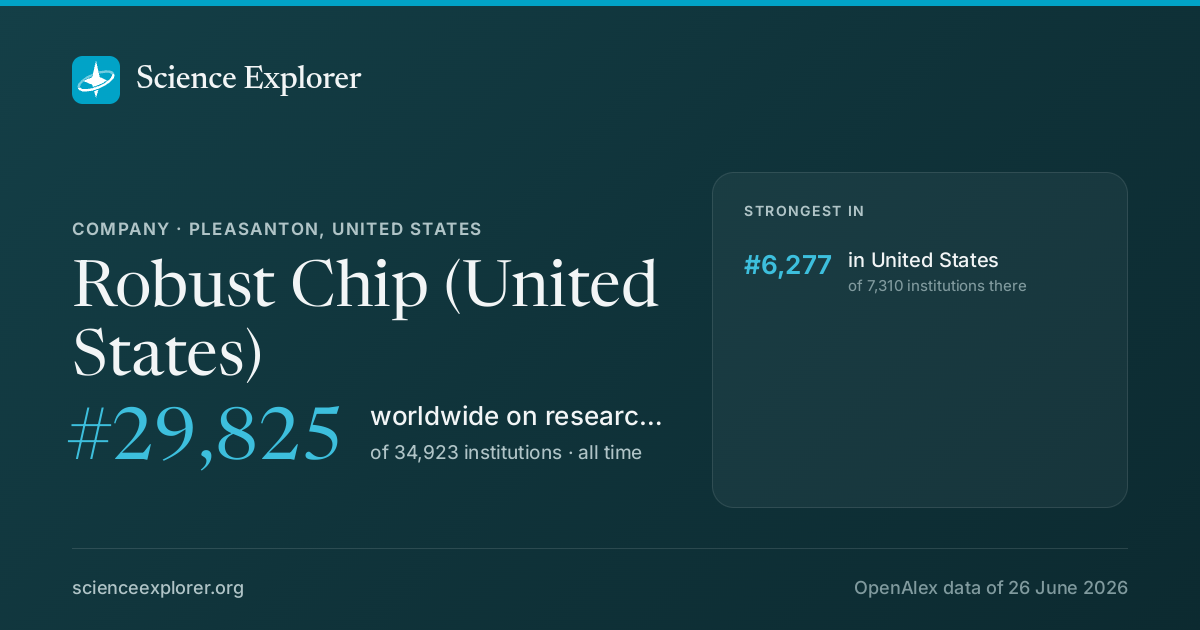
Robust Chip (United States) on Science Explorer

A card with Robust Chip (United States)'s standing and the fields it leads in, for a post or a slide. A link to this page previews as the same card.

Download the card

1200 × 630 PNG, sized for social posts, drawn from the latest snapshot.

Badges for a website1Each links back here and updates with every snapshot

Research measures only: rankings here say nothing about teaching, admissions or student experience. Comparable institutions and collaboration partners have tabs of their own, above.

Discussion

Ask a question or share a note about Robust Chip (United States). Keep it to the research: no personal attacks, advertising or links. Any reader can report a post, which collapses it for everyone until it is opened.
