Science Explorer Back to mapMap
University · Uijeongbu-si · South Korea

Shinhan University

In research, Shinhan University stands highest in Health Sciences (#9,229 of 9,902 worldwide), 2022-now.

World rank, 2022-now
#11,575
of 22,385 · #17,894 all time
Rank in South Korea
#190
of 343
Research works
477
▲ 36% vs 2018-21
Citations
2.7k
5.7 per fractional work
Top-10% rate
8.0%
all institutions 10.0%
vs its own fields
0.82×
1.00× is exactly expected
Open access
72%
world 40%
International
14%
world 18%

What is Shinhan University known for in research?

The fields where it stands highest, 2022-now, ranked among every institution above the floor in each field.

FieldWorld rankWhere that sitsTop-10% rateWorksAll time
Health SciencesDomain #9,229 of 9,902 4.9%70 #14477

Each strip is that field's whole ranked pool, with the notch where Shinhan University sits in it, in the colour of the band that rank falls in. The track under the rate is the rate itself: it carries no average mark, because the average differs by field (from about 6% in Dentistry to 21% in Economics).

Which fields of science does Shinhan University work in?

In 2022-now, 40% of research at Shinhan University is in Health Sciences, 29% in Social Sciences. Its largest fields are Medicine (18%), Social Sciences (12%), Engineering (10%). It does 1.7× the world's share of Health Sciences.

Health Sciences: 87 fractional works · 39.5% of its workMedicine: 40 fractional works · 18.0% of its workPublic Health, Environmental and Occupational Health: 7 fractional works · 3.3% of its workPhysiology: 6 fractional works · 2.5% of its workPharmacology: 4 fractional works · 1.7% of its workRadiology, Nuclear Medicine and Imaging: 4 fractional works · 1.6% of its workOrthopedics and Sports Medicine: 4 fractional works · 1.6% of its workPulmonary and Respiratory Medicine: 3 fractional works · 1.4% of its workComplementary and alternative medicine: 1 fractional works · 0.7% of its workPsychiatry and Mental health: 1 fractional works · 0.5% of its workEpidemiology: 1 fractional works · 0.5% of its workRehabilitation: 1 fractional works · 0.5% of its workOncology: 1 fractional works · 0.4% of its workEndocrinology, Diabetes and Metabolism: 1 fractional works · 0.3% of its workSurgery: 1 fractional works · 0.3% of its workGeriatrics and Gerontology: 1 fractional works · 0.3% of its workDermatology: 1 fractional works · 0.3% of its workHematology: 1 fractional works · 0.2% of its workInfectious Diseases: 0 fractional works · 0.2% of its workBiochemistry: 0 fractional works · 0.2% of its workNephrology: 0 fractional works · 0.2% of its workSmaller subfields together: 3 fractional works · 1.2% of its workHealth Professions: 21 fractional works · 9.4% of its workGeneral Health Professions: 11 fractional works · 5.1% of its workPhysical Therapy, Sports Therapy and Rehabilitation: 3 fractional works · 1.4% of its workSpeech and Hearing: 2 fractional works · 0.9% of its workHealth Information Management: 1 fractional works · 0.5% of its workOccupational Therapy: 1 fractional works · 0.3% of its workComplementary and Manual Therapy: 1 fractional works · 0.3% of its workEmergency Medical Services: 1 fractional works · 0.3% of its workMedical Laboratory Technology: 1 fractional works · 0.3% of its workRadiological and Ultrasound Technology: 0 fractional works · 0.2% of its workSmaller subfields together: 0 fractional works · 0.1% of its workDentistry: 15 fractional works · 6.8% of its workOrthodontics: 5 fractional works · 2.2% of its workPeriodontics: 4 fractional works · 1.9% of its workGeneral Dentistry: 3 fractional works · 1.4% of its workOral Surgery: 3 fractional works · 1.2% of its workNursing: 12 fractional works · 5.3% of its workLeadership and Management: 6 fractional works · 2.9% of its workNutrition and Dietetics: 4 fractional works · 2.0% of its workResearch and Theory: 1 fractional works · 0.3% of its workSmaller subfields together: 0 fractional works · 0.1% of its workSocial Sciences: 63 fractional works · 28.6% of its workSocial Sciences: 26 fractional works · 11.6% of its workEducation: 6 fractional works · 2.7% of its workCultural Studies: 6 fractional works · 2.6% of its workSociology and Political Science: 5 fractional works · 2.4% of its workDemography: 2 fractional works · 1.0% of its workSafety Research: 2 fractional works · 0.9% of its workGender Studies: 1 fractional works · 0.5% of its workTransportation: 1 fractional works · 0.5% of its workHealth: 1 fractional works · 0.4% of its workPolitical Science and International Relations: 1 fractional works · 0.4% of its workSmaller subfields together: 1 fractional works · 0.3% of its workBusiness, Management and Accounting: 16 fractional works · 7.2% of its workMarketing: 8 fractional works · 3.5% of its workStrategy and Management: 4 fractional works · 1.6% of its workOrganizational Behavior and Human Resource Management: 2 fractional works · 0.9% of its workAccounting: 1 fractional works · 0.6% of its workManagement Information Systems: 1 fractional works · 0.5% of its workSmaller subfields together: 0 fractional works · 0.2% of its workPsychology: 11 fractional works · 4.8% of its workSocial Psychology: 4 fractional works · 1.9% of its workDevelopmental and Educational Psychology: 2 fractional works · 1.0% of its workExperimental and Cognitive Psychology: 2 fractional works · 0.9% of its workClinical Psychology: 2 fractional works · 0.8% of its workSmaller subfields together: 0 fractional works · 0.2% of its workArts and Humanities: 4 fractional works · 2.0% of its workLiterature and Literary Theory: 2 fractional works · 0.7% of its workVisual Arts and Performing Arts: 1 fractional works · 0.4% of its workPhilosophy: 1 fractional works · 0.3% of its workArcheology: 1 fractional works · 0.3% of its workSmaller subfields together: 1 fractional works · 0.3% of its workEconomics, Econometrics and Finance: 4 fractional works · 1.9% of its workEconomics and Econometrics: 3 fractional works · 1.5% of its workFinance: 1 fractional works · 0.4% of its workDecision Sciences: 2 fractional works · 1.1% of its workManagement Science and Operations Research: 1 fractional works · 0.7% of its workInformation Systems and Management: 1 fractional works · 0.3% of its workSmaller subfields together: 0 fractional works · 0.1% of its workPhysical Sciences: 59 fractional works · 26.8% of its workEngineering: 22 fractional works · 10.0% of its workBiomedical Engineering: 5 fractional works · 2.2% of its workAutomotive Engineering: 5 fractional works · 2.1% of its workIndustrial and Manufacturing Engineering: 2 fractional works · 1.1% of its workBuilding and Construction: 2 fractional works · 1.0% of its workElectrical and Electronic Engineering: 2 fractional works · 0.9% of its workCivil and Structural Engineering: 2 fractional works · 0.9% of its workMechanical Engineering: 1 fractional works · 0.5% of its workAerospace Engineering: 1 fractional works · 0.4% of its workOcean Engineering: 1 fractional works · 0.3% of its workSafety, Risk, Reliability and Quality: 0 fractional works · 0.2% of its workSmaller subfields together: 1 fractional works · 0.4% of its workComputer Science: 15 fractional works · 6.9% of its workInformation Systems: 8 fractional works · 3.4% of its workArtificial Intelligence: 4 fractional works · 1.9% of its workComputer Vision and Pattern Recognition: 1 fractional works · 0.5% of its workHuman-Computer Interaction: 1 fractional works · 0.4% of its workComputer Networks and Communications: 1 fractional works · 0.4% of its workSmaller subfields together: 1 fractional works · 0.4% of its workEnvironmental Science: 8 fractional works · 3.8% of its workHealth, Toxicology and Mutagenesis: 5 fractional works · 2.0% of its workEnvironmental Engineering: 2 fractional works · 0.9% of its workWater Science and Technology: 1 fractional works · 0.4% of its workManagement, Monitoring, Policy and Law: 0 fractional works · 0.2% of its workSmaller subfields together: 1 fractional works · 0.2% of its workMaterials Science: 8 fractional works · 3.6% of its workMaterials Chemistry: 3 fractional works · 1.4% of its workPolymers and Plastics: 2 fractional works · 0.8% of its workGeneral Materials Science: 1 fractional works · 0.5% of its workBiomaterials: 1 fractional works · 0.4% of its workElectronic, Optical and Magnetic Materials: 1 fractional works · 0.3% of its workSurfaces, Coatings and Films: 0 fractional works · 0.2% of its workSmaller subfields together: 0 fractional works · 0.0% of its workChemistry: 2 fractional works · 1.1% of its workOrganic Chemistry: 1 fractional works · 0.6% of its workSpectroscopy: 0 fractional works · 0.2% of its workSmaller subfields together: 0 fractional works · 0.2% of its workPhysics and Astronomy: 1 fractional works · 0.5% of its workRadiation: 1 fractional works · 0.3% of its workSmaller subfields together: 0 fractional works · 0.2% of its workEnergy: 1 fractional works · 0.5% of its workRenewable Energy, Sustainability and the Environment: 1 fractional works · 0.5% of its workChemical Engineering: 1 fractional works · 0.4% of its workLife Sciences: 11 fractional works · 5.1% of its workAgricultural and Biological Sciences: 5 fractional works · 2.3% of its workFood Science: 3 fractional works · 1.2% of its workAnimal Science and Zoology: 1 fractional works · 0.4% of its workPlant Science: 1 fractional works · 0.3% of its workSmaller subfields together: 1 fractional works · 0.3% of its workBiochemistry, Genetics and Molecular Biology: 4 fractional works · 2.0% of its workMolecular Biology: 2 fractional works · 0.9% of its workCancer Research: 1 fractional works · 0.4% of its workSmaller subfields together: 2 fractional works · 0.7% of its workNeuroscience: 1 fractional works · 0.6% of its workCognitive Neuroscience: 1 fractional works · 0.2% of its workSmaller subfields together: 1 fractional works · 0.3% of its workImmunology and Microbiology: 0 fractional works · 0.2% of its workPharmacology, Toxicology and Pharmaceutics: 0 fractional works · 0.1% of its workALL ITS WORKShinhanUniversity221fractional works, 2022-now
Life Sciences5%Physical Sciences27%Health Sciences40%Social Sciences29%

Each ring splits the one inside it: the four domains of science, their fields, their subfields. Size is fractional works in 2022-now. Every slice is a page; the interactive view zooms down to single topics and colours each by how much more of it this institution does than the world.

Its 4 domains and 24 fields, with their numbers
    1. Medicine4018.0%
    2. Health Professions219.4%
    3. Dentistry156.8%
    4. Nursing125.3%
    1. Social Sciences2611.6%
    2. Business, Management and Accounting167.2%
    3. Psychology114.8%
    4. Arts and Humanities42.0%
    5. Economics, Econometrics and Finance41.9%
    6. Decision Sciences21.1%
    1. Engineering2210.0%
    2. Computer Science156.9%
    3. Environmental Science83.8%
    4. Materials Science83.6%
    5. Chemistry21.1%
    6. Physics and Astronomy10.5%
    7. Energy10.5%
    8. Chemical Engineering10.4%
    9. Mathematics00.0%
    1. Agricultural and Biological Sciences52.3%
    2. Biochemistry, Genetics and Molecular Biology42.0%
    3. Neuroscience10.6%
    4. Immunology and Microbiology00.2%
    5. Pharmacology, Toxicology and Pharmaceutics00.1%
All of science, and how each field's share has moved since 1950: the Science domain explorer

Field profile

Location quotient across every field it publishes in: outside the ring is more than an institution of this size would be expected to publish, inside it is less.

Agricultural and Biological Sciences: 0.48× its world share, 5 worksAgricultural and Bio…Biochemistry, Genetics and Molecular Biology: 0.37× its world share, 4 worksBiochemistry, Geneti…Immunology and Microbiology: 0.21× its world share, 0 worksImmunology and Micro…Neuroscience: 0.34× its world share, 1 worksNeurosciencePharmacology, Toxicology and Pharmaceutics: 0.37× its world share, 0 worksPharmacology, Toxico…Chemical Engineering: 1.08× its world share, 1 worksChemical EngineeringChemistry: 0.67× its world share, 2 worksChemistryComputer Science: 0.89× its world share, 15 worksComputer ScienceEnergy: 0.57× its world share, 1 worksEnergyEngineering: 0.67× its world share, 22 worksEngineeringEnvironmental Science: 0.76× its world share, 8 worksEnvironmental ScienceMaterials Science: 1.02× its world share, 8 worksMaterials ScienceMathematics: 0.02× its world share, 0 worksMathematicsPhysics and Astronomy: 0.24× its world share, 1 worksPhysics and AstronomyDentistry: 13.97× its world share, 15 worksDentistryHealth Professions: 3.57× its world share, 21 worksHealth ProfessionsMedicine: 0.94× its world share, 40 worksMedicineNursing: 10.74× its world share, 12 worksNursingArts and Humanities: 0.68× its world share, 4 worksArts and HumanitiesBusiness, Management and Accounting: 2.24× its world share, 16 worksBusiness, Management…Decision Sciences: 1.12× its world share, 2 worksDecision SciencesEconomics, Econometrics and Finance: 0.88× its world share, 4 worksEconomics, Econometr…Psychology: 1.58× its world share, 11 worksPsychologySocial Sciences: 0.92× its world share, 26 worksSocial Sciences1×world share
more than its size predictsabout as predictedless

Rings at 0.5×, 1× and 2×. Widest outward: Dentistry, 14.0×. Every wedge is a field page.

All 24 fields, with their numbers
  1. Dentistry13.97×15 works
  2. Nursing10.74×12 works
  3. Health Professions3.57×21 works
  4. Business, Management and Accounting2.24×16 works
  5. Psychology1.58×11 works
  6. Decision Sciences1.12×2 works
  7. Chemical Engineering1.08×1 works
  8. Materials Science1.02×8 works
  9. Medicine0.94×40 works
  10. Social Sciences0.92×26 works
  11. Computer Science0.89×15 works
  12. Economics, Econometrics and Finance0.88×4 works
  13. Environmental Science0.76×8 works
  14. Arts and Humanities0.68×4 works
  15. Chemistry0.67×2 works
  16. Engineering0.67×22 works
  17. Energy0.57×1 works
  18. Agricultural and Biological Sciences0.48×5 works
  19. Biochemistry, Genetics and Molecular Biology0.37×4 works
  20. Pharmacology, Toxicology and Pharmaceutics0.37×0 works
  21. Neuroscience0.34×1 works
  22. Physics and Astronomy0.24×1 works
  23. Immunology and Microbiology0.21×0 works
  24. Mathematics0.02×0 works

Who are the top researchers at Shinhan University?

Ranked on the quality score, Myoung-Joo Lee, Esther Choi and Yeong-Gil Kim lead among researchers whose main affiliation is Shinhan University.

  1. 1 Myoung-Joo Lee South Korea · #3,296,328 worldwide 224 citations · 25 works
  2. 2 Esther Choi South Korea · #3,595,710 worldwide 84 citations · 34 works
  3. 3 Yeong-Gil Kim South Korea · #4,008,655 worldwide 18 citations · 16 works
  4. 4 Esther Y. Choi South Korea · #4,241,327 worldwide 65 citations · 38 works
  5. 5 Hanyong Choi South Korea · #4,280,881 worldwide 30 citations · 16 works
  6. 6 Hyeon Suk Kim South Korea · #4,322,742 worldwide 202 citations · 24 works
  7. 7 Yoon Young Choi South Korea · #4,397,920 worldwide 586 citations · 48 works
  8. 8 Kyu Bong Cho South Korea · #4,502,008 worldwide 154 citations · 23 works
  9. 9 Eun‐Seo Jung South Korea · #4,725,423 worldwide 226 citations · 27 works
  10. 10 EunJu Chang South Korea · #4,863,481 worldwide 0 citations · 15 works
All ranked researchers at Shinhan University

What are the most cited papers from Shinhan University?

The most cited paper from Shinhan University is "Nature-Based Tourism: Motivation and Subjective Well-Being" (Hyelin Lina Kim, Seungwoo John Lee, Muzaffer Uysal et al., 2015), with 285 citations. Next come "Solid-state fermentation of black rice bran with Aspergillus awamori and Aspergillus oryzae: Effects on phenolic acid composition and antioxidant activity of bran extracts" (168) and "Study on physical and mechanical properties of the biopolymer/silver based active nanocomposite films with antimicrobial activity" (131).

Most cited papers
#PaperReleasedCitations
1 Nature-Based Tourism: Motivation and Subjective Well-Being Hyelin Lina Kim, Seungwoo John Lee, Muzaffer Uysal et al. · Journal of Travel & Tourism Marketing 3 Jul 2015 285
2 Solid-state fermentation of black rice bran with Aspergillus awamori and Aspergillus oryzae: Effects on phenolic acid composition and antioxidant activity of bran extracts Hye‐Young Shin, Sung‐Min Kim, Ju Hun Lee et al. · Food Chemistry 30 Jul 2018 168
3 Study on physical and mechanical properties of the biopolymer/silver based active nanocomposite films with antimicrobial activity Ju Hun Lee, Duyun Jeong, Paulraj Kanmani · Carbohydrate Polymers 10 Aug 2019 131
4 Studies on structural properties and immune-enhancing activities of glycomannans from Schizophyllum commune Khamphone Yelithao, Utoomporn Surayot, Changsheng Lee et al. · Carbohydrate Polymers 24 Apr 2019 85
5 Evaluation of silica nanoparticle toxicity after topical exposure for 90 days Seong Soo A. An, Hwa Jung Ryu, Nak-Won Seong et al. · International Journal of Nanomedicine Open access Dec 2014 83
All 60 most cited papers, with filters and sorting

Which keywords describe research at Shinhan University?

By fractional works in 2022-now, weighted toward what it does more of than the world: Self-Efficacy, Lifestyle, Virtual Reality, Quality of Life, Fashion, Job Satisfaction, Elderly Population and Text Mining.

▲ more of its work than of the world's◆ about the world's share▼ less than the world's

Size is fractional works in 2022-now in the topics tagged with each word; colour is the word's share of this institution's work against its share of the world's. The 40 words are chosen for being large and distinctive. Each links to the topic it comes from most.

All 40 words, with their numbers
  1. Self-Efficacy15▲ 27×4 topics
  2. Quality of Life14▲ 4.2×22 topics
  3. Epidemiology13▲ 1.45×27 topics
  4. Lifestyle12▲ 187×3 topics
  5. Virtual Reality11▲ 10×6 topics
  6. Fashion9▲ 111×2 topics
  7. Artificial Intelligence9▲ 2.9×13 topics
  8. Social Media8▲ 2.7×9 topics
  9. Social Support8▲ 7.1×9 topics
  10. Elderly Population8▲ 97×2 topics
  11. Job Satisfaction8▲ 8.4×6 topics
  12. Clinical Trials8▲ 5.5×4 topics
  13. Text Mining8▲ 27×4 topics
  14. Consumer Behavior8▲ 5.7×6 topics
  15. Obesity7▲ 3.9×9 topics
  16. 3D Printing6▲ 13×3 topics
  17. Corporate Social Responsibility6▲ 18×3 topics
  18. Global Burden6▲ 5.4×5 topics
  19. Stress Management6▲ 28×3 topics
  20. Clinical Competence6▲ 200×1 topic
  21. Nursing Professionalism6▲ 200×1 topic
  22. Additive Manufacturing6▲ 8.7×4 topics
  23. Body Image6▲ 36×2 topics
  24. Health Effects6▲ 4.2×8 topics
  25. Health Locus of Control6▲ 85×1 topic
  26. Health-Promoting Behaviors6▲ 85×1 topic
  27. Self-Esteem6▲ 42×2 topics
  28. Social Norms6▲ 25×2 topics
  29. Cosmetics5▲ 244×1 topic
  30. Sociocultural Attitudes5▲ 244×1 topic
  31. Biomedical Engineering5▲ 17×2 topics
  32. Psychological Factors5▲ 12×5 topics
  33. Applications5▲ 8.2×4 topics
  34. Ethical Consumption5▲ 21×2 topics
  35. Muscle Strength5▲ 20×3 topics
  36. Polymer Composites5▲ 8.1×3 topics
  37. Consumer Perception5▲ 9.0×5 topics
  38. Challenges4▲ 17×1 topic
  39. Materials4▲ 8.4×1 topic
  40. Dental Caries4▲ 19×2 topics

Which research topics does Shinhan University publish most on?

By volume in 2022-now: Healthcare Education and Workforce Issues, Health and Wellbeing Research, Consumer Perception and Purchasing Behavior and Additive Manufacturing and 3D Printing Technologies.

  1. 1 Healthcare Education and Workforce Issues Leadership and Management 6 works
  2. 2 Health and Wellbeing Research General Health Professions 6 works
  3. 3 Consumer Perception and Purchasing Behavior Marketing 5 works
  4. 4 Additive Manufacturing and 3D Printing Technologies Automotive Engineering 4 works
  5. 5 Diverse Topics in Contemporary Research Cultural Studies 4 works
  6. 6 Dental materials and restorations Orthodontics 4 works
  7. 7 Dental Research and COVID-19 General Dentistry 3 works
  8. 8 Dental Health and Care Utilization Periodontics 3 works
  9. 9 Nutrition, Health and Food Behavior Nutrition and Dietetics 3 works
  10. 10 Musculoskeletal pain and rehabilitation Pharmacology 3 works

How open and international is its research?

Against the world's own shares: the tick on each track. Both are shares of its output, so they sit on one scale and can be read against each other as well as against the world.

openly available71.7%not open28.3%

World: 40% of research is openly available.

with international co-authors13.5%domestic only86.5%

World: 18% is written across borders.

How has Shinhan University's research output changed?

Output in 2022-2025 was 36% higher than in 2018-2021.

still counting200020102020
grewheldshrank

The same series as a ribbon: one cell per year, darker for more. The line above answers how much; this answers when.

Its share of all research

Growing output can still be a shrinking share: all of science grows. This is Shinhan University as a percentage of every work published that year, 0.00081% in 2024.

still counting0.00050%0.0010%Shinhan University0.00098% in 202519801990200020102020

Fractional works of Shinhan University over all fractional works that year. How the balance of science has shifted.

How much of it reaches the world top 10%

Year by year, against all institutions in the same year.

still counting5%10%15%all institutions10.0% in 2025Shinhan University6.4% in 20252020

Of each year's output, the share that reached the world's 10% most cited for its field and year. Peak 9.2% in 2022.

Other research institutions in Uijeongbu-si

All research institutions in Uijeongbu-si

Share Shinhan University's ranking
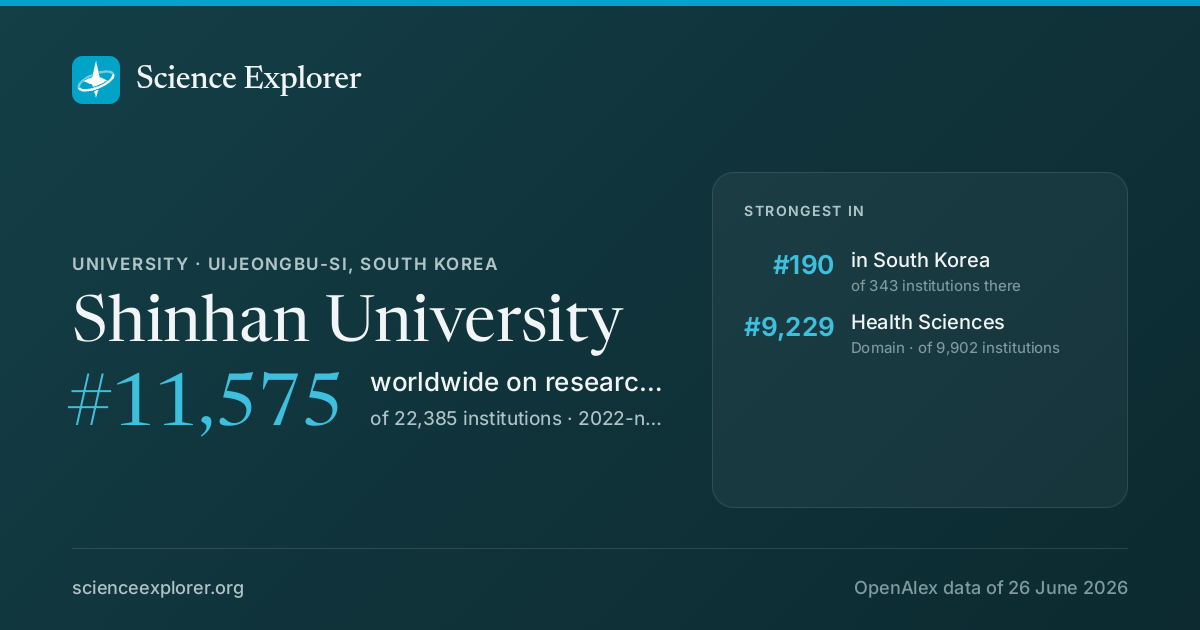
Shinhan University on Science Explorer

A card with Shinhan University's standing and the fields it leads in, for a post or a slide. A link to this page previews as the same card.

Download the card

1200 × 630 PNG, sized for social posts, drawn from the latest snapshot.

Badges for a website1Each links back here and updates with every snapshot

Research measures only: rankings here say nothing about teaching, admissions or student experience. Comparable institutions and collaboration partners have tabs of their own, above.

Discussion

Ask a question or share a note about Shinhan University. Keep it to the research: no personal attacks, advertising or links. Any reader can report a post, which collapses it for everyone until it is opened.