Simcyp (United Kingdom)
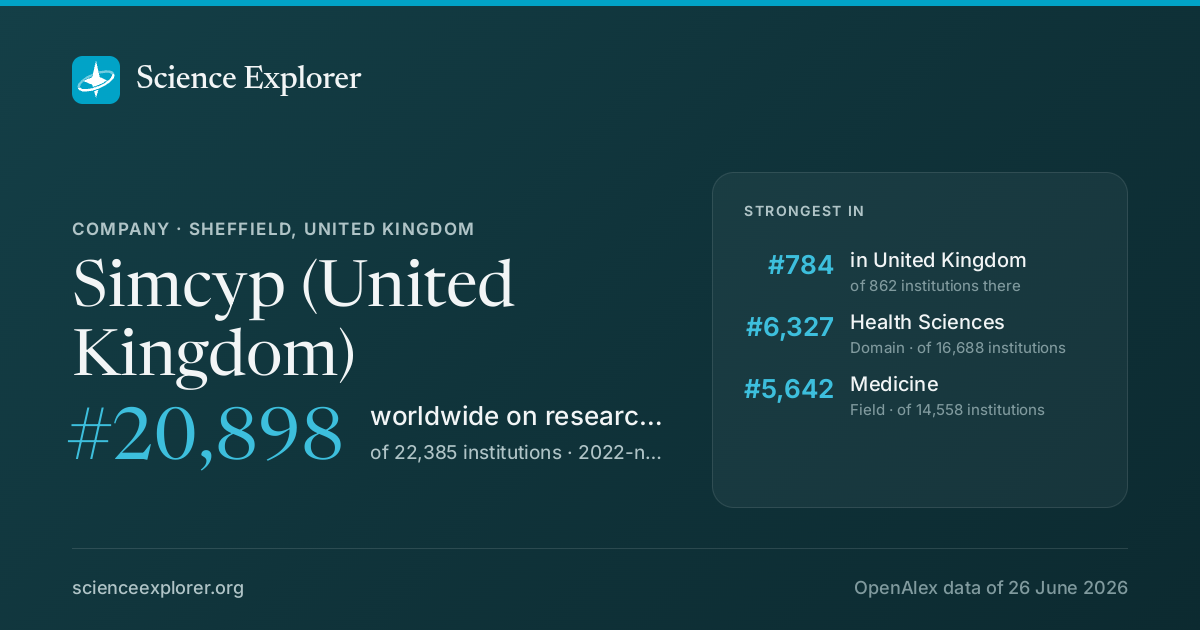
In research, Simcyp (United Kingdom) stands highest in Health Sciences (#6,327 of 16,688 worldwide) and Medicine (#5,642 of 14,558 worldwide), over all time.
- World rank, 2022-now
- #20,898 of 22,385 · #19,139 all time
- Rank in United Kingdom
- #784 of 862
- Research works
- 256 ▼ 6% vs 2018-21
- Citations
- 9.6k 37.4 per fractional work
- Top-10% rate
- 18.2% all institutions 10.0%
- vs its own fields
- 1.14× 1.00× is exactly expected
- Open access
- 61% world 40%
- International
- 53% world 18%
What is Simcyp (United Kingdom) known for in research?
The fields where it stands highest, over all time, ranked among every institution above the floor in each field.
| Field | World rank | Where that sits | Top-10% rate | Works |
|---|---|---|---|---|
| Health SciencesDomain | #6,327 of 16,688 | 24.0% | 125 | |
| MedicineField | #5,642 of 14,558 | 24.4% | 122 |
Each strip is that field's whole ranked pool, with the notch where Simcyp (United Kingdom) sits in it, in the colour of the band that rank falls in. The track under the rate is the rate itself: it carries no average mark, because the average differs by field (from about 6% in Dentistry to 21% in Economics).
Which fields of science does Simcyp (United Kingdom) work in?
In 2022-now, 51% of research at Simcyp (United Kingdom) is in Health Sciences, 33% in Life Sciences. Its largest fields are Medicine (49%), Pharmacology, Toxicology and Pharmaceutics (16%), Biochemistry, Genetics and Molecular Biology (14%). It does 2.2× the world's share of Life Sciences.
Each ring splits the one inside it: the four domains of science, their fields, their subfields. Size is fractional works in 2022-now. Every slice is a page; the interactive view zooms down to single topics and colours each by how much more of it this institution does than the world.
Its 4 domains and 17 fields, with their numbers
- Health Sciences3951.2%
- Medicine3748.7%
- Veterinary11.8%
- Nursing00.7%
- Life Sciences2533.0%
- Physical Sciences1113.7%
- Mathematics34.3%
- Chemistry23.3%
- Computer Science22.9%
- Engineering11.7%
- Environmental Science11.5%
- Materials Science00.0%
- Social Sciences22.2%
Field profile
Location quotient across every field it publishes in: outside the ring is more than an institution of this size would be expected to publish, inside it is less.
Rings at 0.5×, 1× and 2×. Widest outward: Pharmacology, Toxicology and Pharmaceutics, 44.0×. Every wedge is a field page.
All 17 fields, with their numbers
- Pharmacology, Toxicology and Pharmaceutics44.01×12 works
- Veterinary13.22×1 works
- Mathematics3.67×3 works
- Biochemistry, Genetics and Molecular Biology2.70×11 works
- Medicine2.53×38 works
- Chemistry2.07×2 works
- Decision Sciences1.35×1 works
- Nursing1.33×0 works
- Immunology and Microbiology1.16×1 works
- Computer Science0.38×2 works
- Neuroscience0.36×0 works
- Economics, Econometrics and Finance0.32×0 works
- Environmental Science0.30×1 works
- Agricultural and Biological Sciences0.27×1 works
- Engineering0.11×1 works
- Psychology0.06×0 works
- Materials Science0.01×0 works
- Pharmacology, Toxicology and Pharmaceutics 44.0×
- Veterinary 13.2×
- Mathematics 3.7×
- Biochemistry, Genetics and Molecular Biology 2.7×
- Medicine 2.5×
- Chemistry 2.1×
- Decision Sciences 1.4×
- Nursing 1.3×
- Immunology and Microbiology 1.2×
- Computer Science 0.4×
- Neuroscience 0.4×
- Economics, Econometrics and Finance 0.3×
- Environmental Science 0.3×
- Agricultural and Biological Sciences 0.3×
- Engineering 0.1×
- Psychology 0.1×
- Materials Science 0.0×
Who are the top researchers at Simcyp (United Kingdom)?
Ranked on the quality score, Trevor N. Johnson, Masoud Jamei and Khaled Abduljalil lead among researchers whose main affiliation is Simcyp (United Kingdom).
- 1
Trevor N. Johnson
 United Kingdom · #210,049 worldwide
5.2k citations · 119 works
- 2
Masoud Jamei
United Kingdom · #444,032 worldwide
9.1k citations · 193 works
- 3
Khaled Abduljalil
United Kingdom · #540,928 worldwide
2.4k citations · 66 works
- 4
Amita Pansari
United Kingdom · #649,467 worldwide
496 citations · 21 works
- 5
Lisa M. Almond
United Kingdom · #803,547 worldwide
1.6k citations · 45 works
- 6
Sibylle Neuhoff
United Kingdom · #803,631 worldwide
4.3k citations · 115 works
- 7
Karen Rowland Yeo
United Kingdom · #845,505 worldwide
3.1k citations · 83 works
- 8
K Rowland‐Yeo
United Kingdom · #913,346 worldwide
2.1k citations · 39 works
- 9
Jiansong Yang
United Kingdom · #1,264,298 worldwide
2.1k citations · 26 works
- 10
Peter J. Kilford
United Kingdom · #1,411,329 worldwide
760 citations · 16 works
Which keywords describe research at Simcyp (United Kingdom)?
By fractional works in 2022-now, weighted toward what it does more of than the world: Pharmacokinetics, Cytochrome P450, Genetic Variation, Drug Metabolism, Pharmacogenetics, Teratogenicity, Inflammatory Bowel Disease and Adverse Drug Reactions.
- NASH
- Prenatal Exposure
- Neurodevelopmental Disorders
- Fetal Development
- Virtual Screening
- False Discovery Rate
- Medicinal Chemistry
- Therapeutic Antibodies
- Metabolic Syndrome
- Birth Outcomes
- Pregnancy
- Multidrug Resistance
- Pediatric Pharmacokinetics
- Biomarkers
- Medication Adherence
- Clinical Trials
- Oxidative Stress
- Teratogenicity
- Drug Metabolism
- Cytochrome P450
- Pharmacokinetics
- Genetic Variation
- Pharmacogenetics
- Inflammatory Bowel Disease
- Adverse Drug Reactions
- Drug Development
- Nuclear Receptors
- Off-Label Drug Use
- ATP-dependent Transporters
- Immunosuppressive Drugs
- Rheumatoid Arthritis
- Medication Use
- Monoclonal Antibodies
- Bayesian Methods
- Adaptive Designs
- Molecular Docking
- Antiepileptic Drugs
- Glycosylation
- Cognitive Function
- NAFLD
Size is fractional works in 2022-now in the topics tagged with each word; colour is the word's share of this institution's work against its share of the world's. The 40 words are chosen for being large and distinctive. Each links to the topic it comes from most.
All 40 words, with their numbers
- Pharmacokinetics10▲ 50×3 topics
- Cytochrome P4508▲ 325×2 topics
- Genetic Variation8▲ 48×3 topics
- Drug Metabolism8▲ 378×1 topic
- Pharmacogenetics8▲ 512×1 topic
- Teratogenicity5▲ 116×2 topics
- Inflammatory Bowel Disease4▲ 45×4 topics
- Oxidative Stress4▲ 3.2×14 topics
- Adverse Drug Reactions4▲ 94×2 topics
- Clinical Trials4▲ 7.5×3 topics
- Drug Development4▲ 55×2 topics
- Medication Adherence4▲ 86×2 topics
- Nuclear Receptors4▲ 53×2 topics
- Biomarkers4▲ 6.6×5 topics
- Off-Label Drug Use4▲ 178×1 topic
- Pediatric Pharmacokinetics4▲ 178×1 topic
- ATP-dependent Transporters3▲ 176×1 topic
- Multidrug Resistance3▲ 128×1 topic
- Immunosuppressive Drugs3▲ 67×2 topics
- Pregnancy3▲ 20×2 topics
- Rheumatoid Arthritis3▲ 41×2 topics
- Birth Outcomes3▲ 156×1 topic
- Medication Use3▲ 156×1 topic
- Metabolic Syndrome3▲ 4.6×8 topics
- Monoclonal Antibodies3▲ 42×3 topics
- Therapeutic Antibodies3▲ 53×2 topics
- Bayesian Methods3▲ 67×2 topics
- Medicinal Chemistry2▲ 12×3 topics
- Adaptive Designs2▲ 137×1 topic
- False Discovery Rate2▲ 137×1 topic
- Molecular Docking2▲ 23×1 topic
- Virtual Screening2▲ 31×1 topic
- Antiepileptic Drugs2▲ 36×2 topics
- Fetal Development2▲ 28×2 topics
- Glycosylation2▲ 25×3 topics
- Neurodevelopmental Disorders2▲ 20×2 topics
- Cognitive Function2▲ 13×1 topic
- Prenatal Exposure2▲ 81×1 topic
- NAFLD2▲ 19×1 topic
- NASH2▲ 19×1 topic
Which research topics does Simcyp (United Kingdom) publish most on?
By volume in 2022-now: Pharmacogenetics and Drug Metabolism, Pharmaceutical studies and practices, Drug Transport and Resistance Mechanisms and Pregnancy and Medication Impact.
Area is fractional works; colour is the subfield each topic belongs to.
- 1 Pharmacogenetics and Drug Metabolism Pharmacology 8 works
- 2 Pharmaceutical studies and practices Pediatrics, Perinatology and Child Health 4 works
- 3 Drug Transport and Resistance Mechanisms Oncology 3 works
- 4 Pregnancy and Medication Impact Public Health, Environmental and Occupational Health 3 works
- 5 Computational Drug Discovery Methods Computational Theory and Mathematics 2 works
- 6 Statistical Methods in Clinical Trials Statistics and Probability 2 works
- 7 Pharmacological Effects and Toxicity Studies Pediatrics, Perinatology and Child Health 2 works
- 8 Liver Disease Diagnosis and Treatment Epidemiology 2 works
- 9 Monoclonal and Polyclonal Antibodies Research Radiology, Nuclear Medicine and Imaging 2 works
- 10 Protein purification and stability Molecular Biology 1 works
How open and international is its research?
Against the world's own shares: the tick on each track. Both are shares of its output, so they sit on one scale and can be read against each other as well as against the world.
World: 40% of research is openly available.
World: 18% is written across borders.
How has Simcyp (United Kingdom)'s research output changed?
Output in 2022-2025 was 6% lower than in 2018-2021.
The same series as a ribbon: one cell per year, darker for more. The line above answers how much; this answers when.
Its share of all research
Growing output can still be a shrinking share: all of science grows. This is Simcyp (United Kingdom) as a percentage of every work published that year, 0.00031% in 2024.
Fractional works of Simcyp (United Kingdom) over all fractional works that year. How the balance of science has shifted.
Other research institutions in Sheffield
- University of Sheffield
- Sheffield Hallam University
- Sheffield Teaching Hospitals NHS Foundation Trust
- Sheffield City Council
- Sheffield Children's NHS Foundation Trust
- Sheffield Health and Social Care NHS Foundation Trust
- Knowledge Integration (United Kingdom)
- Insigneo


Share Simcyp (United Kingdom)'s ranking
Badges for a website1Each links back here and updates with every snapshot

Research measures only: rankings here say nothing about teaching, admissions or student experience. Comparable institutions and collaboration partners have tabs of their own, above.
Discussion
Ask a question or share a note about Simcyp (United Kingdom). Posts are plain text and can be reported.