Science Explorer Back to mapMap
Discussion
Company · Boise · United States

Simplot (United States)

World rank, all time
#30,926
of 34,923
Rank in United States
#6,533
of 7,310
Research works
163
▲ 58% vs 2018-21
Citations
2.5k
15.5 per fractional work
Top-10% rate
10.1%
all institutions 10.0%
vs its own fields
0.98×
1.00× is exactly expected
Open access
38%
world 40%
International
13%
world 18%

Which fields of science does Simplot (United States) work in?

In 2022-now, 44% of research at Simplot (United States) is in Life Sciences, 22% in Physical Sciences. Its largest fields are Agricultural and Biological Sciences (29%), Biochemistry, Genetics and Molecular Biology (12%), Social Sciences (11%). It does 2.4× the world's share of Life Sciences.

Life Sciences: 14 fractional works · 44.1% of its workAgricultural and Biological Sciences: 9 fractional works · 28.7% of its workPlant Science: 5 fractional works · 15.0% of its workAgronomy and Crop Science: 2 fractional works · 4.7% of its workFood Science: 1 fractional works · 3.1% of its workEcology, Evolution, Behavior and Systematics: 1 fractional works · 2.3% of its workSoil Science: 0 fractional works · 1.3% of its workAnimal Science and Zoology: 0 fractional works · 1.0% of its workInsect Science: 0 fractional works · 0.5% of its workGeneral Agricultural and Biological Sciences: 0 fractional works · 0.5% of its workForestry: 0 fractional works · 0.2% of its workBiochemistry, Genetics and Molecular Biology: 4 fractional works · 12.5% of its workMolecular Biology: 3 fractional works · 8.6% of its workCell Biology: 1 fractional works · 2.0% of its workGenetics: 0 fractional works · 0.9% of its workEndocrinology: 0 fractional works · 0.6% of its workCancer Research: 0 fractional works · 0.2% of its workSmaller subfields together: 0 fractional works · 0.2% of its workImmunology and Microbiology: 1 fractional works · 2.4% of its workMicrobiology: 0 fractional works · 1.5% of its workParasitology: 0 fractional works · 0.5% of its workImmunology: 0 fractional works · 0.3% of its workNeuroscience: 0 fractional works · 0.5% of its workCognitive Neuroscience: 0 fractional works · 0.5% of its workPhysical Sciences: 7 fractional works · 22.0% of its workEngineering: 3 fractional works · 10.3% of its workMedia Technology: 1 fractional works · 2.6% of its workMechanical Engineering: 1 fractional works · 1.9% of its workElectrical and Electronic Engineering: 1 fractional works · 1.7% of its workControl and Systems Engineering: 1 fractional works · 1.6% of its workBiomedical Engineering: 0 fractional works · 1.0% of its workBuilding and Construction: 0 fractional works · 1.0% of its workMechanics of Materials: 0 fractional works · 0.2% of its workSmaller subfields together: 0 fractional works · 0.2% of its workEnvironmental Science: 2 fractional works · 7.3% of its workEnvironmental Chemistry: 1 fractional works · 2.0% of its workManagement, Monitoring, Policy and Law: 0 fractional works · 1.3% of its workHealth, Toxicology and Mutagenesis: 0 fractional works · 1.0% of its workNature and Landscape Conservation: 0 fractional works · 1.0% of its workWater Science and Technology: 0 fractional works · 0.7% of its workEnvironmental Engineering: 0 fractional works · 0.6% of its workPollution: 0 fractional works · 0.4% of its workEcology: 0 fractional works · 0.2% of its workSmaller subfields together: 0 fractional works · 0.2% of its workComputer Science: 1 fractional works · 2.4% of its workArtificial Intelligence: 0 fractional works · 1.2% of its workComputer Networks and Communications: 0 fractional works · 1.0% of its workSmaller subfields together: 0 fractional works · 0.2% of its workChemical Engineering: 0 fractional works · 1.0% of its workFluid Flow and Transfer Processes: 0 fractional works · 1.0% of its workEarth and Planetary Sciences: 0 fractional works · 0.7% of its workGeology: 0 fractional works · 0.7% of its workEnergy: 0 fractional works · 0.2% of its workRenewable Energy, Sustainability and the Environment: 0 fractional works · 0.2% of its workSocial Sciences: 7 fractional works · 21.6% of its workSocial Sciences: 4 fractional works · 11.5% of its workEducation: 2 fractional works · 5.4% of its workSociology and Political Science: 1 fractional works · 3.6% of its workSafety Research: 0 fractional works · 1.3% of its workLaw: 0 fractional works · 1.1% of its workSmaller subfields together: 0 fractional works · 0.1% of its workPsychology: 2 fractional works · 5.4% of its workClinical Psychology: 1 fractional works · 3.2% of its workSocial Psychology: 1 fractional works · 1.7% of its workExperimental and Cognitive Psychology: 0 fractional works · 0.5% of its workBusiness, Management and Accounting: 1 fractional works · 2.7% of its workManagement Information Systems: 0 fractional works · 1.2% of its workManagement of Technology and Innovation: 0 fractional works · 1.0% of its workOrganizational Behavior and Human Resource Management: 0 fractional works · 0.3% of its workSmaller subfields together: 0 fractional works · 0.1% of its workArts and Humanities: 1 fractional works · 1.8% of its workHistory: 0 fractional works · 1.0% of its workLiterature and Literary Theory: 0 fractional works · 0.3% of its workConservation: 0 fractional works · 0.2% of its workMusic: 0 fractional works · 0.2% of its workSmaller subfields together: 0 fractional works · 0.0% of its workDecision Sciences: 0 fractional works · 0.2% of its workManagement Science and Operations Research: 0 fractional works · 0.2% of its workHealth Sciences: 4 fractional works · 12.3% of its workMedicine: 3 fractional works · 8.9% of its workPublic Health, Environmental and Occupational Health: 1 fractional works · 2.9% of its workRadiology, Nuclear Medicine and Imaging: 0 fractional works · 1.0% of its workUrology: 0 fractional works · 1.0% of its workPhysiology: 0 fractional works · 0.8% of its workCardiology and Cardiovascular Medicine: 0 fractional works · 0.7% of its workOncology: 0 fractional works · 0.5% of its workSurgery: 0 fractional works · 0.4% of its workEpidemiology: 0 fractional works · 0.3% of its workGeriatrics and Gerontology: 0 fractional works · 0.2% of its workNeurology: 0 fractional works · 0.2% of its workPharmacology: 0 fractional works · 0.2% of its workRehabilitation: 0 fractional works · 0.2% of its workGenetics: 0 fractional works · 0.2% of its workSmaller subfields together: 0 fractional works · 0.1% of its workVeterinary: 1 fractional works · 2.1% of its workSmall Animals: 1 fractional works · 2.1% of its workNursing: 0 fractional works · 0.9% of its workNutrition and Dietetics: 0 fractional works · 0.9% of its workHealth Professions: 0 fractional works · 0.3% of its workGeneral Health Professions: 0 fractional works · 0.3% of its workDentistry: 0 fractional works · 0.2% of its workALL ITS WORKSimplot (UnitedStates)33fractional works, 2022-now
Life Sciences44%Physical Sciences22%Health Sciences12%Social Sciences22%

Each ring splits the one inside it: the four domains of science, their fields, their subfields. Size is fractional works in 2022-now. Every slice is a page; the interactive view zooms down to single topics and colours each by how much more of it this institution does than the world.

Its 4 domains and 20 fields, with their numbers
    1. Agricultural and Biological Sciences928.7%
    2. Biochemistry, Genetics and Molecular Biology412.5%
    3. Immunology and Microbiology12.4%
    4. Neuroscience00.5%
    1. Engineering310.3%
    2. Environmental Science27.3%
    3. Computer Science12.4%
    4. Chemical Engineering01.0%
    5. Earth and Planetary Sciences00.7%
    6. Energy00.2%
    1. Social Sciences411.5%
    2. Psychology25.4%
    3. Business, Management and Accounting12.7%
    4. Arts and Humanities11.8%
    5. Decision Sciences00.2%
    1. Medicine38.9%
    2. Veterinary12.1%
    3. Nursing00.9%
    4. Health Professions00.3%
    5. Dentistry00.2%
All of science, and how each field's share has moved since 1950: the Science domain explorer

Field profile

Location quotient across every field it publishes in: outside the ring is more than an institution of this size would be expected to publish, inside it is less.

Agricultural and Biological Sciences: 6.04× its world share, 9 worksAgricultural and Bio…Biochemistry, Genetics and Molecular Biology: 2.34× its world share, 4 worksBiochemistry, Geneti…Immunology and Microbiology: 2.36× its world share, 1 worksImmunology and Micro…Neuroscience: 0.31× its world share, 0 worksNeuroscienceChemical Engineering: 2.92× its world share, 0 worksChemical EngineeringComputer Science: 0.31× its world share, 1 worksComputer ScienceEarth and Planetary Sciences: 0.43× its world share, 0 worksEarth and Planetary …Energy: 0.28× its world share, 0 worksEnergyEngineering: 0.69× its world share, 3 worksEngineeringEnvironmental Science: 1.48× its world share, 2 worksEnvironmental ScienceDentistry: 0.35× its world share, 0 worksDentistryHealth Professions: 0.13× its world share, 0 worksHealth ProfessionsMedicine: 0.46× its world share, 3 worksMedicineNursing: 1.74× its world share, 0 worksNursingVeterinary: 15.01× its world share, 1 worksVeterinaryArts and Humanities: 0.64× its world share, 1 worksArts and HumanitiesBusiness, Management and Accounting: 0.83× its world share, 1 worksBusiness, Management…Decision Sciences: 0.21× its world share, 0 worksDecision SciencesPsychology: 1.77× its world share, 2 worksPsychologySocial Sciences: 0.91× its world share, 4 worksSocial Sciences1×world share
more than its size predictsabout as predictedless

Rings at 0.5×, 1× and 2×. Widest outward: Veterinary, 15.0×. Every wedge is a field page.

All 20 fields, with their numbers
  1. Veterinary15.01×1 works
  2. Agricultural and Biological Sciences6.04×9 works
  3. Chemical Engineering2.92×0 works
  4. Immunology and Microbiology2.36×1 works
  5. Biochemistry, Genetics and Molecular Biology2.34×4 works
  6. Psychology1.77×2 works
  7. Nursing1.74×0 works
  8. Environmental Science1.48×2 works
  9. Social Sciences0.91×4 works
  10. Business, Management and Accounting0.83×1 works
  11. Engineering0.69×3 works
  12. Arts and Humanities0.64×1 works
  13. Medicine0.46×3 works
  14. Earth and Planetary Sciences0.43×0 works
  15. Dentistry0.35×0 works
  16. Neuroscience0.31×0 works
  17. Computer Science0.31×1 works
  18. Energy0.28×0 works
  19. Decision Sciences0.21×0 works
  20. Health Professions0.13×0 works

Who are the top researchers at Simplot (United States)?

Ranked on the quality score, Caius M. T. Rommens, Jingsong Ye and Muffy Koch lead among researchers whose main affiliation is Simplot (United States).

  1. 1 Caius M. T. Rommens United States · #839,144 worldwide 3.5k citations · 50 works
  2. 2 Jingsong Ye United States · #1,300,689 worldwide 1.2k citations · 29 works
  3. 3 Muffy Koch United States · #3,406,867 worldwide 196 citations · 16 works
  4. 4 Justin W. Buchanan United States · #4,579,271 worldwide 187 citations · 15 works
  5. 5 Susan H. Samudio United States · #4,925,249 worldwide 53 citations · 21 works
  6. 6 J.A. Bondurant United States · #5,516,468 worldwide 346 citations · 40 works
  7. 7 A. Douglas Brede United States · #7,104,002 worldwide 357 citations · 100 works
All ranked researchers at Simplot (United States)

What are the most cited papers from Simplot (United States)?

The most cited paper from Simplot (United States) is "Rapid transcriptional plasticity of duplicated gene clusters enables a clonally reproducing aphid to colonise diverse plant species" (Thomas C. Mathers et al., 2017), with 856 citations. Next come "Enhancing ascorbate in fruits and tubers through over‐expression of the l ‐galactose pathway gene GDP‐ l ‐galactose phosphorylase" (263) and "Reinventing Potato as a Diploid Inbred Line–Based Crop" (251).

Most cited papers
#PaperReleasedCitations
1 Rapid transcriptional plasticity of duplicated gene clusters enables a clonally reproducing aphid to colonise diverse plant species Thomas C. Mathers et al. · Genome biology Open access 7 Feb 2017 856
2 Enhancing ascorbate in fruits and tubers through over‐expression of the l ‐galactose pathway gene GDP‐ l ‐galactose phosphorylase Sean Michael Bulley, Michele A. Wright, Caius M. T. Rommens et al. · Plant Biotechnology Journal Open access Dec 2011 263
3 Reinventing Potato as a Diploid Inbred Line–Based Crop Shelley H. Jansky et al. · Crop Science Open access 15 Apr 2016 251
4 The intragenic approach as a new extension to traditional plant breeding Caius M. T. Rommens, Michel A. Haring, Kathy Swords et al. · Trends in Plant Science Review 11 Aug 2007 172
5 Low‐acrylamide French fries and potato chips Caius M. T. Rommens, Hua Yan, Kathy Swords et al. · Plant Biotechnology Journal Open access 25 Jul 2008 153
All 60 most cited papers, with filters and sorting

Which keywords describe research at Simplot (United States)?

By fractional works in 2022-now, weighted toward what it does more of than the world: Biotechnology, Food Safety, Sustainability, Environmental Risk Assessment, Consumer Attitudes, Biological Control, Genetically Modified Crops and Pollen-Mediated Gene Flow.

▲ more of its work than of the world's◆ about the world's share▼ less than the world's

Size is fractional works in 2022-now in the topics tagged with each word; colour is the word's share of this institution's work against its share of the world's. The 14 words are chosen for being large and distinctive. Each links to the topic it comes from most.

All 14 words, with their numbers
  1. Sustainability2▲ 2.6×8 topics
  2. Biotechnology2▲ 54×2 topics
  3. Food Safety1▲ 15×3 topics
  4. Environmental Risk Assessment1▲ 42×2 topics
  5. Biodiversity1▲ 4.4×5 topics
  6. Consumer Attitudes1▲ 77×2 topics
  7. Education1▲ 1.88×7 topics
  8. Inflammation1▲ 1.56×6 topics
  9. Innovation1▲ 3.2×7 topics
  10. Biological Control1▲ 21×4 topics
  11. Genetically Modified Crops1▲ 389×1 topic
  12. Genome Engineering1▲ 49×1 topic
  13. Pollen-Mediated Gene Flow1▲ 389×1 topic
  14. RNA-Guided1▲ 49×1 topic

Which research topics does Simplot (United States) publish most on?

By volume in 2022-now: Genetically Modified Organisms Research, CRISPR and Genetic Engineering, Nematode management and characterization studies and Plant tissue culture and regeneration.

  1. 1 Genetically Modified Organisms Research Plant Science 1 works
  2. 2 CRISPR and Genetic Engineering Molecular Biology 1 works
  3. 3 Nematode management and characterization studies Plant Science 1 works
  4. 4 Plant tissue culture and regeneration Molecular Biology 1 works
  5. 5 Agronomic Practices and Intercropping Systems Agronomy and Crop Science 1 works
  6. 6 Digital Economy and Work Transformation Sociology and Political Science 0 works
  7. 7 Microbial infections and disease research Microbiology 0 works
  8. 8 Smart Cities and Technologies Media Technology 0 works
  9. 9 Agricultural Systems and Practices Ecology, Evolution, Behavior and Systematics 0 works
  10. 10 Animal health and immunology Small Animals 0 works

How open and international is its research?

Against the world's own shares: the tick on each track. Both are shares of its output, so they sit on one scale and can be read against each other as well as against the world.

openly available38.1%not open61.9%

World: 40% of research is openly available.

with international co-authors13.3%domestic only86.7%

World: 18% is written across borders.

How has Simplot (United States)'s research output changed?

Output in 2022-2025 was 58% higher than in 2018-2021.

still counting1990200020102020
grewheldshrank

The same series as a ribbon: one cell per year, darker for more. The line above answers how much; this answers when.

Its share of all research

Growing output can still be a shrinking share: all of science grows. This is Simplot (United States) as a percentage of every work published that year, 0.00012% in 2024.

still counting0.00050%0.0010%Simplot (United States)0.00017% in 202519801990200020102020

Fractional works of Simplot (United States) over all fractional works that year. How the balance of science has shifted.

Other research institutions in Boise

All research institutions in Boise

Share Simplot (United States)'s ranking
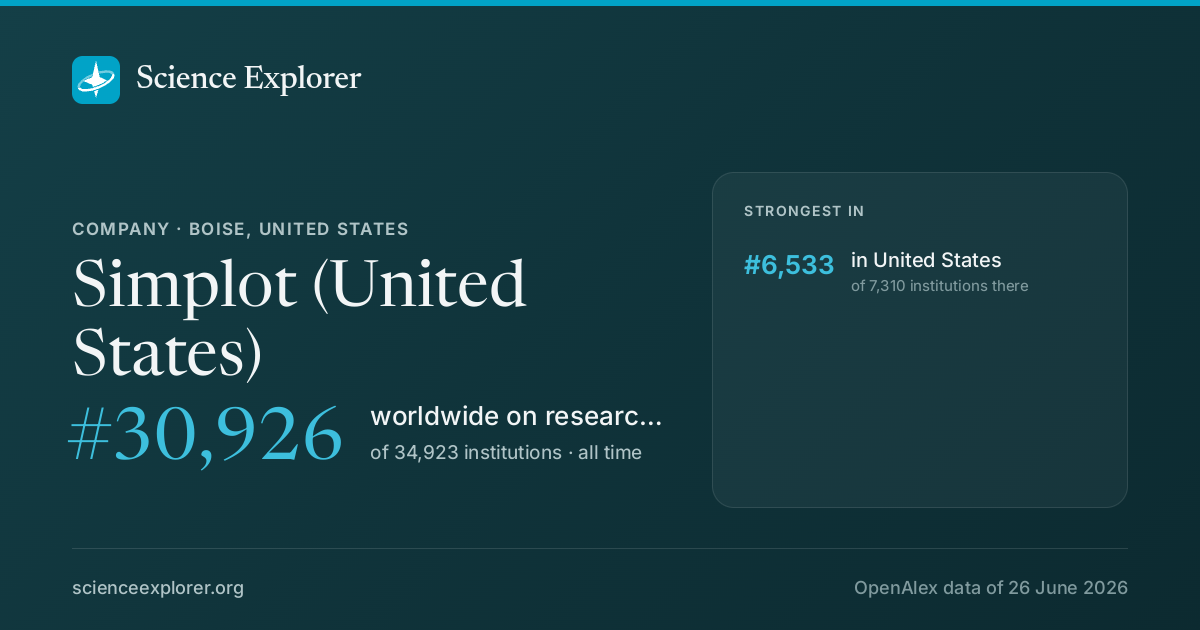
Simplot (United States) on Science Explorer

A card with Simplot (United States)'s standing and the fields it leads in, for a post or a slide. A link to this page previews as the same card.

Download the card

1200 × 630 PNG, sized for social posts, drawn from the latest snapshot.

Badges for a website1Each links back here and updates with every snapshot

Research measures only: rankings here say nothing about teaching, admissions or student experience. Comparable institutions and collaboration partners have tabs of their own, above.

Discussion

Ask a question or share a note about Simplot (United States). Keep it to the research: no personal attacks, advertising or links. Any reader can report a post, which collapses it for everyone until it is opened.
