Science Explorer Back to mapMap
Discussion
Archive · New York · United States

Solomon R. Guggenheim Museum

World rank, all time
#19,764
of 34,923
Rank in United States
#4,100
of 7,310
Research works
199
▼ 14% vs 2018-21
Citations
3.9k
19.8 per fractional work
Top-10% rate
14.7%
all institutions 10.0%
vs its own fields
1.02×
1.00× is exactly expected
Open access
27%
world 40%
International
16%
world 18%

Which fields of science does Solomon R. Guggenheim Museum work in?

In 2022-now, 55% of research at Solomon R. Guggenheim Museum is in Physical Sciences, 33% in Social Sciences. Its largest fields are Engineering (34%), Social Sciences (18%), Computer Science (7%). It does 1.3× the world's share of Physical Sciences.

Physical Sciences: 15 fractional works · 55.2% of its workEngineering: 9 fractional works · 34.4% of its workAerospace Engineering: 3 fractional works · 10.0% of its workControl and Systems Engineering: 2 fractional works · 8.3% of its workComputational Mechanics: 1 fractional works · 5.2% of its workSafety, Risk, Reliability and Quality: 1 fractional works · 2.5% of its workMechanical Engineering: 1 fractional works · 2.4% of its workBiomedical Engineering: 0 fractional works · 1.4% of its workAutomotive Engineering: 0 fractional works · 1.2% of its workElectrical and Electronic Engineering: 0 fractional works · 1.2% of its workIndustrial and Manufacturing Engineering: 0 fractional works · 0.6% of its workOcean Engineering: 0 fractional works · 0.6% of its workCivil and Structural Engineering: 0 fractional works · 0.4% of its workMechanics of Materials: 0 fractional works · 0.4% of its workComputer Science: 2 fractional works · 6.5% of its workComputational Theory and Mathematics: 1 fractional works · 2.2% of its workArtificial Intelligence: 0 fractional works · 1.9% of its workComputer Networks and Communications: 0 fractional works · 1.2% of its workComputer Vision and Pattern Recognition: 0 fractional works · 1.2% of its workSmaller subfields together: 0 fractional works · 0.0% of its workPhysics and Astronomy: 1 fractional works · 5.0% of its workStatistical and Nonlinear Physics: 1 fractional works · 2.3% of its workAstronomy and Astrophysics: 0 fractional works · 1.3% of its workAtomic and Molecular Physics, and Optics: 0 fractional works · 0.7% of its workCondensed Matter Physics: 0 fractional works · 0.6% of its workSmaller subfields together: 0 fractional works · 0.0% of its workMaterials Science: 1 fractional works · 2.9% of its workMaterials Chemistry: 0 fractional works · 1.6% of its workSurfaces, Coatings and Films: 0 fractional works · 0.6% of its workBiomaterials: 0 fractional works · 0.4% of its workPolymers and Plastics: 0 fractional works · 0.3% of its workEarth and Planetary Sciences: 1 fractional works · 2.4% of its workEarth-Surface Processes: 1 fractional works · 2.1% of its workAtmospheric Science: 0 fractional works · 0.3% of its workEnvironmental Science: 0 fractional works · 1.5% of its workGlobal and Planetary Change: 0 fractional works · 0.6% of its workIndustrial and Manufacturing Engineering: 0 fractional works · 0.4% of its workPollution: 0 fractional works · 0.4% of its workChemical Engineering: 0 fractional works · 1.2% of its workFluid Flow and Transfer Processes: 0 fractional works · 1.2% of its workEnergy: 0 fractional works · 1.2% of its workRenewable Energy, Sustainability and the Environment: 0 fractional works · 1.2% of its workSocial Sciences: 9 fractional works · 33.4% of its workSocial Sciences: 5 fractional works · 18.0% of its workSociology and Political Science: 3 fractional works · 12.7% of its workPolitical Science and International Relations: 1 fractional works · 2.7% of its workDemography: 0 fractional works · 1.2% of its workUrban Studies: 0 fractional works · 0.6% of its workLinguistics and Language: 0 fractional works · 0.4% of its workCultural Studies: 0 fractional works · 0.3% of its workArts and Humanities: 2 fractional works · 5.8% of its workArcheology: 1 fractional works · 1.9% of its workLiterature and Literary Theory: 0 fractional works · 1.5% of its workConservation: 0 fractional works · 0.8% of its workVisual Arts and Performing Arts: 0 fractional works · 0.6% of its workHistory: 0 fractional works · 0.3% of its workMuseology: 0 fractional works · 0.3% of its workPhilosophy: 0 fractional works · 0.2% of its workSmaller subfields together: 0 fractional works · 0.1% of its workEconomics, Econometrics and Finance: 1 fractional works · 5.4% of its workEconomics and Econometrics: 1 fractional works · 5.0% of its workFinance: 0 fractional works · 0.4% of its workPsychology: 1 fractional works · 3.2% of its workClinical Psychology: 0 fractional works · 1.5% of its workApplied Psychology: 0 fractional works · 0.6% of its workSocial Psychology: 0 fractional works · 0.6% of its workExperimental and Cognitive Psychology: 0 fractional works · 0.4% of its workSmaller subfields together: 0 fractional works · 0.1% of its workDecision Sciences: 0 fractional works · 0.9% of its workManagement Science and Operations Research: 0 fractional works · 0.9% of its workHealth Sciences: 2 fractional works · 9.3% of its workMedicine: 1 fractional works · 4.7% of its workPsychiatry and Mental health: 0 fractional works · 1.9% of its workEmergency Medicine: 0 fractional works · 0.6% of its workEpidemiology: 0 fractional works · 0.6% of its workNeurology: 0 fractional works · 0.6% of its workPhysiology: 0 fractional works · 0.4% of its workDermatology: 0 fractional works · 0.3% of its workSmaller subfields together: 0 fractional works · 0.1% of its workDentistry: 1 fractional works · 3.0% of its workOral Surgery: 0 fractional works · 1.6% of its workOrthodontics: 0 fractional works · 1.5% of its workHealth Professions: 0 fractional works · 1.6% of its workGeneral Health Professions: 0 fractional works · 1.6% of its workLife Sciences: 1 fractional works · 2.1% of its workNeuroscience: 0 fractional works · 1.8% of its workCellular and Molecular Neuroscience: 0 fractional works · 0.6% of its workEndocrine and Autonomic Systems: 0 fractional works · 0.6% of its workCognitive Neuroscience: 0 fractional works · 0.6% of its workBiochemistry, Genetics and Molecular Biology: 0 fractional works · 0.3% of its workCancer Research: 0 fractional works · 0.2% of its workSmaller subfields together: 0 fractional works · 0.1% of its workALL ITS WORKSolomon R.Guggenheim Museum27fractional works, 2022-now
Life Sciences2%Physical Sciences55%Health Sciences9%Social Sciences33%

Each ring splits the one inside it: the four domains of science, their fields, their subfields. Size is fractional works in 2022-now. Every slice is a page; the interactive view zooms down to single topics and colours each by how much more of it this institution does than the world.

Its 4 domains and 18 fields, with their numbers
    1. Engineering934.4%
    2. Computer Science26.5%
    3. Physics and Astronomy15.0%
    4. Materials Science12.9%
    5. Earth and Planetary Sciences12.4%
    6. Environmental Science01.5%
    7. Chemical Engineering01.2%
    8. Energy01.2%
    1. Social Sciences518.0%
    2. Arts and Humanities25.8%
    3. Economics, Econometrics and Finance15.4%
    4. Psychology13.2%
    5. Decision Sciences00.9%
    1. Medicine14.7%
    2. Dentistry13.0%
    3. Health Professions01.6%
    1. Neuroscience01.8%
    2. Biochemistry, Genetics and Molecular Biology00.3%
All of science, and how each field's share has moved since 1950: the Science domain explorer

Field profile

Location quotient across every field it publishes in: outside the ring is more than an institution of this size would be expected to publish, inside it is less.

Biochemistry, Genetics and Molecular Biology: 0.06× its world share, 0 worksBiochemistry, Geneti…Neuroscience: 1.11× its world share, 0 worksNeuroscienceChemical Engineering: 3.56× its world share, 0 worksChemical EngineeringComputer Science: 0.84× its world share, 2 worksComputer ScienceEarth and Planetary Sciences: 1.52× its world share, 1 worksEarth and Planetary …Energy: 1.35× its world share, 0 worksEnergyEngineering: 2.30× its world share, 9 worksEngineeringEnvironmental Science: 0.29× its world share, 0 worksEnvironmental ScienceMaterials Science: 0.83× its world share, 1 worksMaterials SciencePhysics and Astronomy: 2.26× its world share, 1 worksPhysics and AstronomyDentistry: 6.20× its world share, 1 worksDentistryHealth Professions: 0.59× its world share, 0 worksHealth ProfessionsMedicine: 0.24× its world share, 1 worksMedicineArts and Humanities: 2.00× its world share, 2 worksArts and HumanitiesDecision Sciences: 0.98× its world share, 0 worksDecision SciencesEconomics, Econometrics and Finance: 2.52× its world share, 1 worksEconomics, Econometr…Psychology: 1.07× its world share, 1 worksPsychologySocial Sciences: 1.43× its world share, 5 worksSocial Sciences1×world share
more than its size predictsabout as predictedless

Rings at 0.5×, 1× and 2×. Widest outward: Dentistry, 6.2×. Every wedge is a field page.

All 18 fields, with their numbers
  1. Dentistry6.20×1 works
  2. Chemical Engineering3.56×0 works
  3. Economics, Econometrics and Finance2.52×1 works
  4. Engineering2.30×9 works
  5. Physics and Astronomy2.26×1 works
  6. Arts and Humanities2.00×2 works
  7. Earth and Planetary Sciences1.52×1 works
  8. Social Sciences1.43×5 works
  9. Energy1.35×0 works
  10. Neuroscience1.11×0 works
  11. Psychology1.07×1 works
  12. Decision Sciences0.98×0 works
  13. Computer Science0.84×2 works
  14. Materials Science0.83×1 works
  15. Health Professions0.59×0 works
  16. Environmental Science0.29×0 works
  17. Medicine0.24×1 works
  18. Biochemistry, Genetics and Molecular Biology0.06×0 works

Who are the top researchers at Solomon R. Guggenheim Museum?

Ranked on the quality score, Luciano Pensabene Buemi, Nelly Richard and Vivian Endicott Barnett lead among researchers whose main affiliation is Solomon R. Guggenheim Museum.

  1. 1 Luciano Pensabene Buemi United States · #834,242 worldwide 448 citations · 23 works
  2. 2 Nelly Richard United States · #1,943,205 worldwide 980 citations · 117 works
  3. 3 Vivian Endicott Barnett United States · #2,473,363 worldwide 53 citations · 32 works
  4. 4 John Oppie McCall United States · #2,695,604 worldwide 275 citations · 98 works
  5. 5 Frances Krasnow United States · #2,958,784 worldwide 221 citations · 65 works
  6. 6 Paul M. Schwartzbaum United States · #3,388,529 worldwide 108 citations · 15 works
  7. 7 Alexander Klemin United States · #4,404,828 worldwide 30 citations · 67 works
  8. 8 Octavio Zaya United States · #5,096,850 worldwide 152 citations · 44 works
All ranked researchers at Solomon R. Guggenheim Museum

What are the most cited papers from Solomon R. Guggenheim Museum?

The most cited paper from Solomon R. Guggenheim Museum is "Formation of the First Supermassive Black Holes" (Volker Bromm, Abraham Loeb, 2003), with 818 citations. Next come "Self‐regulated Growth of Supermassive Black Holes in Galaxies as the Origin of the Optical and X‐Ray Luminosity Functions of Quasars" (445) and "Dynamic Friction Models for Road/Tire Longitudinal Interaction" (399).

Most cited papers
#PaperReleasedCitations
1 Formation of the First Supermassive Black Holes Volker Bromm, Abraham Loeb · The Astrophysical Journal Open access 8 Oct 2003 818
2 Self‐regulated Growth of Supermassive Black Holes in Galaxies as the Origin of the Optical and X‐Ray Luminosity Functions of Quasars J. Stuart B. Wyithe, Abraham Loeb · The Astrophysical Journal Open access 30 Sep 2003 445
3 Dynamic Friction Models for Road/Tire Longitudinal Interaction Carlos Canudas de Wit, Panagiotis Tsiotras, Efstathios Velenis et al. · Vehicle System Dynamics Open access Mar 2003 399
4 The time sequence of tissue regeneration in human extraction wounds Melvin H. Amler · Oral Surgery Oral Medicine Oral Pathology Mar 1969 396
5 Low‐Frequency Gravitational Waves from Massive Black Hole Binaries: Predictions for LISA and Pulsar Timing Arrays J. Stuart B. Wyithe, Abraham Loeb · The Astrophysical Journal Open access 20 Jun 2003 364
All 58 most cited papers, with filters and sorting

Which keywords describe research at Solomon R. Guggenheim Museum?

By fractional works in 2022-now, weighted toward what it does more of than the world: Cultural Heritage, Nonlinear Systems, Large-Eddy Simulation, Chemical Kinetics, Distributed Control, Innovation, Heat Transfer and Optimization.

▲ more of its work than of the world's◆ about the world's share▼ less than the world's

Size is fractional works in 2022-now in the topics tagged with each word; colour is the word's share of this institution's work against its share of the world's. The 19 words are chosen for being large and distinctive. Each links to the topic it comes from most.

All 19 words, with their numbers
  1. Cultural Heritage2▲ 17×6 topics
  2. Nonlinear Systems2▲ 33×5 topics
  3. Innovation2▲ 5.3×4 topics
  4. Large-Eddy Simulation2▲ 30×3 topics
  5. Globalization1▲ 2.7×3 topics
  6. Sustainable Development1▲ 3.4×3 topics
  7. Chemical Kinetics1▲ 54×2 topics
  8. Distributed Control1▲ 44×3 topics
  9. Heat Transfer1▲ 9.2×3 topics
  10. Neural Networks1▲ 3.0×4 topics
  11. Human Rights1▲ 3.9×3 topics
  12. Model Predictive Control1▲ 16×2 topics
  13. Optimization1▲ 9.5×3 topics
  14. Real-time Optimization1▲ 78×2 topics
  15. Stability Analysis1▲ 26×2 topics
  16. Combustion Instabilities1▲ 61×1 topic
  17. Knowledge Economy1▲ 34×1 topic
  18. Territorial Marketing1▲ 504×1 topic
  19. Turbulent Flames1▲ 93×1 topic

Which research topics does Solomon R. Guggenheim Museum publish most on?

By volume in 2022-now: Combustion and flame dynamics, Diverse academic and cultural studies, Advanced Control Systems Optimization and Combustion and Detonation Processes.

  1. 1 Combustion and flame dynamics Computational Mechanics 1 works
  2. 2 Diverse academic and cultural studies Economics and Econometrics 1 works
  3. 3 Advanced Control Systems Optimization Control and Systems Engineering 1 works
  4. 4 Combustion and Detonation Processes Aerospace Engineering 1 works
  5. 5 Fire dynamics and safety research Safety, Risk, Reliability and Quality 1 works
  6. 6 Political Conflict and Governance Sociology and Political Science 1 works
  7. 7 Building materials and conservation Earth-Surface Processes 1 works
  8. 8 Adaptive Dynamic Programming Control Computational Theory and Mathematics 1 works
  9. 9 Cultural Heritage Materials Analysis Archeology 0 works
  10. 10 Space Satellite Systems and Control Aerospace Engineering 0 works

How open and international is its research?

Against the world's own shares: the tick on each track. Both are shares of its output, so they sit on one scale and can be read against each other as well as against the world.

openly available27.0%not open73.0%

World: 40% of research is openly available.

with international co-authors15.8%domestic only84.2%

World: 18% is written across borders.

How has Solomon R. Guggenheim Museum's research output changed?

Output in 2022-2025 was 14% lower than in 2018-2021.

still counting1990200020102020
grewheldshrank

The same series as a ribbon: one cell per year, darker for more. The line above answers how much; this answers when.

Its share of all research

Growing output can still be a shrinking share: all of science grows. This is Solomon R. Guggenheim Museum as a percentage of every work published that year, 0.00011% in 2024.

still counting0.00050%0.0010%0.0015%Solomon R. Guggenheim Museum0.00012% in 202519801990200020102020

Fractional works of Solomon R. Guggenheim Museum over all fractional works that year. How the balance of science has shifted.

Other research institutions in New York

All research institutions in New York

Share Solomon R. Guggenheim Museum's ranking
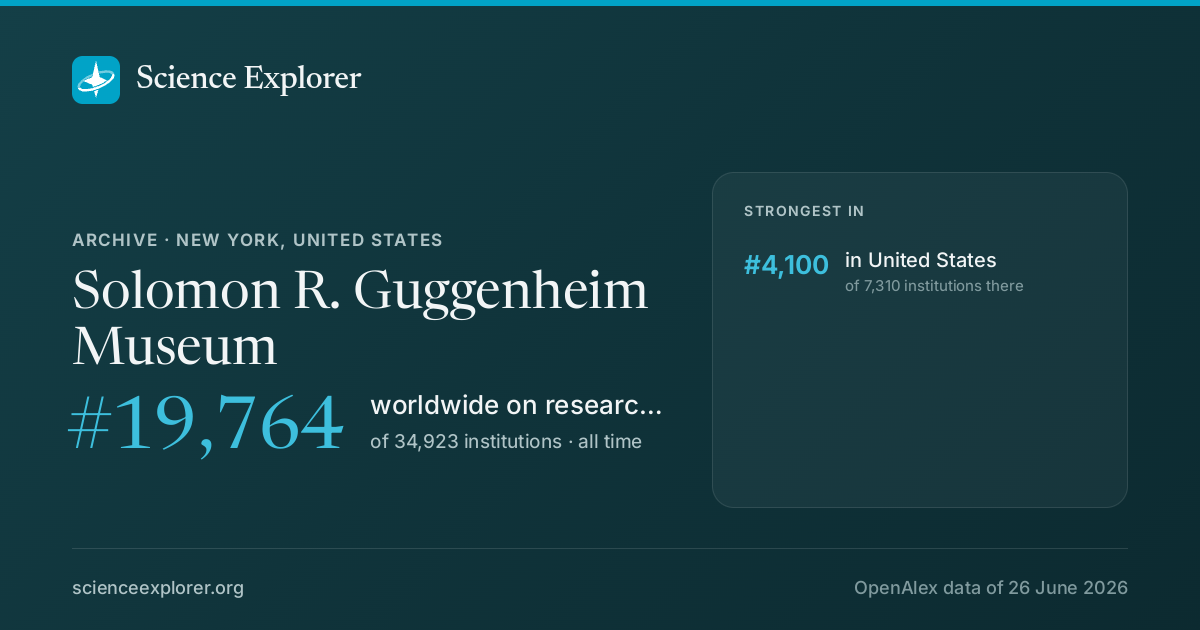
Solomon R. Guggenheim Museum on Science Explorer

A card with Solomon R. Guggenheim Museum's standing and the fields it leads in, for a post or a slide. A link to this page previews as the same card.

Download the card

1200 × 630 PNG, sized for social posts, drawn from the latest snapshot.

Badges for a website1Each links back here and updates with every snapshot

Research measures only: rankings here say nothing about teaching, admissions or student experience. Comparable institutions and collaboration partners have tabs of their own, above.

Discussion

Ask a question or share a note about Solomon R. Guggenheim Museum. Keep it to the research: no personal attacks, advertising or links. Any reader can report a post, which collapses it for everyone until it is opened.