Science Explorer Back to mapMap
Discussion
Company · Tokyo · ??

Solutions Inc. (Japan)

In research, Solutions Inc. (Japan) stands highest in Physical Sciences (#13,411 of 17,446 worldwide), over all time.

World rank, all time
#28,930
of 34,923
Rank in ??
#441
of 615
Research works
168
▲ 53% vs 2018-21
Citations
1.9k
11.0 per fractional work
Top-10% rate
4.4%
all institutions 10.0%
vs its own fields
0.90×
1.00× is exactly expected
Open access
27%
world 40%
International
18%
world 18%

What is Solutions Inc. (Japan) known for in research?

The fields where it stands highest, over all time, ranked among every institution above the floor in each field.

FieldWorld rankWhere that sitsTop-10% rateWorks
Physical SciencesDomain #13,411 of 17,446 4.2%126

Each strip is that field's whole ranked pool, with the notch where Solutions Inc. (Japan) sits in it, in the colour of the band that rank falls in. The track under the rate is the rate itself: it carries no average mark, because the average differs by field (from about 6% in Dentistry to 21% in Economics).

Which fields of science does Solutions Inc. (Japan) work in?

In 2022-now, 55% of research at Solutions Inc. (Japan) is in Physical Sciences, 19% in Life Sciences. Its largest fields are Engineering (38%), Medicine (15%), Agricultural and Biological Sciences (9%). It does 1.3× the world's share of Physical Sciences.

Physical Sciences: 21 fractional works · 54.8% of its workEngineering: 14 fractional works · 38.1% of its workOcean Engineering: 4 fractional works · 11.4% of its workMechanical Engineering: 3 fractional works · 6.8% of its workAerospace Engineering: 2 fractional works · 4.0% of its workCivil and Structural Engineering: 1 fractional works · 4.0% of its workElectrical and Electronic Engineering: 1 fractional works · 3.5% of its workComputational Mechanics: 1 fractional works · 2.7% of its workBuilding and Construction: 0 fractional works · 1.3% of its workBiomedical Engineering: 0 fractional works · 0.9% of its workMedia Technology: 0 fractional works · 0.9% of its workSafety, Risk, Reliability and Quality: 0 fractional works · 0.7% of its workMechanics of Materials: 0 fractional works · 0.6% of its workAutomotive Engineering: 0 fractional works · 0.5% of its workControl and Systems Engineering: 0 fractional works · 0.5% of its workIndustrial and Manufacturing Engineering: 0 fractional works · 0.5% of its workEnvironmental Science: 2 fractional works · 4.3% of its workEnvironmental Engineering: 0 fractional works · 1.3% of its workGlobal and Planetary Change: 0 fractional works · 1.2% of its workManagement, Monitoring, Policy and Law: 0 fractional works · 0.9% of its workEcology: 0 fractional works · 0.7% of its workEcological Modeling: 0 fractional works · 0.2% of its workSmaller subfields together: 0 fractional works · 0.0% of its workComputer Science: 2 fractional works · 4.1% of its workArtificial Intelligence: 1 fractional works · 2.9% of its workComputer Networks and Communications: 0 fractional works · 1.0% of its workSoftware: 0 fractional works · 0.2% of its workSmaller subfields together: 0 fractional works · 0.0% of its workMaterials Science: 1 fractional works · 2.8% of its workMaterials Chemistry: 1 fractional works · 1.8% of its workPolymers and Plastics: 0 fractional works · 0.7% of its workElectronic, Optical and Magnetic Materials: 0 fractional works · 0.3% of its workEarth and Planetary Sciences: 1 fractional works · 2.2% of its workGeochemistry and Petrology: 0 fractional works · 0.9% of its workOceanography: 0 fractional works · 0.8% of its workAtmospheric Science: 0 fractional works · 0.5% of its workChemical Engineering: 1 fractional works · 2.1% of its workCatalysis: 0 fractional works · 1.1% of its workFluid Flow and Transfer Processes: 0 fractional works · 0.8% of its workSmaller subfields together: 0 fractional works · 0.1% of its workPhysics and Astronomy: 0 fractional works · 0.7% of its workAtomic and Molecular Physics, and Optics: 0 fractional works · 0.7% of its workChemistry: 0 fractional works · 0.7% of its workAnalytical Chemistry: 0 fractional works · 0.5% of its workSpectroscopy: 0 fractional works · 0.2% of its workLife Sciences: 7 fractional works · 19.1% of its workAgricultural and Biological Sciences: 3 fractional works · 8.8% of its workAgronomy and Crop Science: 1 fractional works · 2.7% of its workEcology, Evolution, Behavior and Systematics: 1 fractional works · 2.4% of its workFood Science: 1 fractional works · 2.4% of its workPlant Science: 0 fractional works · 1.1% of its workInsect Science: 0 fractional works · 0.3% of its workBiochemistry, Genetics and Molecular Biology: 3 fractional works · 8.2% of its workMolecular Biology: 3 fractional works · 7.4% of its workGenetics: 0 fractional works · 0.3% of its workCancer Research: 0 fractional works · 0.2% of its workDevelopmental Biology: 0 fractional works · 0.2% of its workSmaller subfields together: 0 fractional works · 0.2% of its workNeuroscience: 0 fractional works · 1.2% of its workCognitive Neuroscience: 0 fractional works · 0.7% of its workBiological Psychiatry: 0 fractional works · 0.5% of its workImmunology and Microbiology: 0 fractional works · 0.9% of its workMicrobiology: 0 fractional works · 0.9% of its workHealth Sciences: 7 fractional works · 18.7% of its workMedicine: 6 fractional works · 15.1% of its workPhysiology: 1 fractional works · 4.0% of its workInfectious Diseases: 1 fractional works · 2.2% of its workPulmonary and Respiratory Medicine: 1 fractional works · 2.1% of its workPathology and Forensic Medicine: 0 fractional works · 1.1% of its workCardiology and Cardiovascular Medicine: 0 fractional works · 1.1% of its workSurgery: 0 fractional works · 0.9% of its workGastroenterology: 0 fractional works · 0.9% of its workInternal Medicine: 0 fractional works · 0.6% of its workEpidemiology: 0 fractional works · 0.6% of its workOncology: 0 fractional works · 0.5% of its workRadiology, Nuclear Medicine and Imaging: 0 fractional works · 0.4% of its workPublic Health, Environmental and Occupational Health: 0 fractional works · 0.4% of its workCritical Care and Intensive Care Medicine: 0 fractional works · 0.2% of its workSmaller subfields together: 0 fractional works · 0.2% of its workHealth Professions: 1 fractional works · 3.5% of its workGeneral Health Professions: 1 fractional works · 1.8% of its workSpeech and Hearing: 0 fractional works · 0.9% of its workOccupational Therapy: 0 fractional works · 0.5% of its workHealth Information Management: 0 fractional works · 0.3% of its workSmaller subfields together: 0 fractional works · 0.1% of its workSocial Sciences: 3 fractional works · 7.4% of its workDecision Sciences: 1 fractional works · 2.8% of its workStatistics, Probability and Uncertainty: 1 fractional works · 2.0% of its workManagement Science and Operations Research: 0 fractional works · 0.5% of its workInformation Systems and Management: 0 fractional works · 0.4% of its workBusiness, Management and Accounting: 1 fractional works · 1.5% of its workManagement of Technology and Innovation: 0 fractional works · 0.9% of its workManagement Information Systems: 0 fractional works · 0.5% of its workTourism, Leisure and Hospitality Management: 0 fractional works · 0.2% of its workSocial Sciences: 1 fractional works · 1.5% of its workDevelopment: 0 fractional works · 0.9% of its workSociology and Political Science: 0 fractional works · 0.7% of its workPsychology: 0 fractional works · 1.2% of its workSocial Psychology: 0 fractional works · 0.9% of its workExperimental and Cognitive Psychology: 0 fractional works · 0.3% of its workArts and Humanities: 0 fractional works · 0.3% of its workVisual Arts and Performing Arts: 0 fractional works · 0.3% of its workALL ITS WORKSolutions Inc.(Japan)38fractional works, 2022-now
Life Sciences19%Physical Sciences55%Health Sciences19%Social Sciences7%

Each ring splits the one inside it: the four domains of science, their fields, their subfields. Size is fractional works in 2022-now. Every slice is a page; the interactive view zooms down to single topics and colours each by how much more of it this institution does than the world.

Its 4 domains and 19 fields, with their numbers
    1. Engineering1438.1%
    2. Environmental Science24.3%
    3. Computer Science24.1%
    4. Materials Science12.8%
    5. Earth and Planetary Sciences12.2%
    6. Chemical Engineering12.1%
    7. Physics and Astronomy00.7%
    8. Chemistry00.7%
    1. Agricultural and Biological Sciences38.8%
    2. Biochemistry, Genetics and Molecular Biology38.2%
    3. Neuroscience01.2%
    4. Immunology and Microbiology00.9%
    1. Medicine615.1%
    2. Health Professions13.5%
    1. Decision Sciences12.8%
    2. Business, Management and Accounting11.5%
    3. Social Sciences11.5%
    4. Psychology01.2%
    5. Arts and Humanities00.3%
All of science, and how each field's share has moved since 1950: the Science domain explorer

Field profile

Location quotient across every field it publishes in: outside the ring is more than an institution of this size would be expected to publish, inside it is less.

Agricultural and Biological Sciences: 1.85× its world share, 3 worksAgricultural and Bio…Biochemistry, Genetics and Molecular Biology: 1.55× its world share, 3 worksBiochemistry, Geneti…Immunology and Microbiology: 0.88× its world share, 0 worksImmunology and Micro…Neuroscience: 0.72× its world share, 0 worksNeuroscienceChemical Engineering: 5.92× its world share, 1 worksChemical EngineeringChemistry: 0.42× its world share, 0 worksChemistryComputer Science: 0.52× its world share, 2 worksComputer ScienceEarth and Planetary Sciences: 1.37× its world share, 1 worksEarth and Planetary …Engineering: 2.54× its world share, 14 worksEngineeringEnvironmental Science: 0.86× its world share, 2 worksEnvironmental ScienceMaterials Science: 0.80× its world share, 1 worksMaterials SciencePhysics and Astronomy: 0.31× its world share, 0 worksPhysics and AstronomyHealth Professions: 1.35× its world share, 1 worksHealth ProfessionsMedicine: 0.79× its world share, 6 worksMedicineArts and Humanities: 0.10× its world share, 0 worksArts and HumanitiesBusiness, Management and Accounting: 0.48× its world share, 1 worksBusiness, Management…Decision Sciences: 2.92× its world share, 1 worksDecision SciencesPsychology: 0.39× its world share, 0 worksPsychologySocial Sciences: 0.12× its world share, 1 worksSocial Sciences1×world share
more than its size predictsabout as predictedless

Rings at 0.5×, 1× and 2×. Widest outward: Chemical Engineering, 5.9×. Every wedge is a field page.

All 19 fields, with their numbers
  1. Chemical Engineering5.92×1 works
  2. Decision Sciences2.92×1 works
  3. Engineering2.54×14 works
  4. Agricultural and Biological Sciences1.85×3 works
  5. Biochemistry, Genetics and Molecular Biology1.55×3 works
  6. Earth and Planetary Sciences1.37×1 works
  7. Health Professions1.35×1 works
  8. Immunology and Microbiology0.88×0 works
  9. Environmental Science0.86×2 works
  10. Materials Science0.80×1 works
  11. Medicine0.79×6 works
  12. Neuroscience0.72×0 works
  13. Computer Science0.52×2 works
  14. Business, Management and Accounting0.48×1 works
  15. Chemistry0.42×0 works
  16. Psychology0.39×0 works
  17. Physics and Astronomy0.31×0 works
  18. Social Sciences0.12×1 works
  19. Arts and Humanities0.10×0 works

Who are the top researchers at Solutions Inc. (Japan)?

Ranked on the quality score, Naresh Babu Bynagari and Brent K. Warren lead among researchers whose main affiliation is Solutions Inc. (Japan).

  1. 1 Naresh Babu Bynagari #3,774,949 worldwide 700 citations · 17 works
  2. 2 Brent K. Warren #5,305,080 worldwide 203 citations · 28 works
All ranked researchers at Solutions Inc. (Japan)

What are the most cited papers from Solutions Inc. (Japan)?

The most cited paper from Solutions Inc. (Japan) is "KEGG: biological systems database as a model of the real world" (Minoru I. Kanehisa, Miho Furumichi, Yoko Sato et al., 2024), with 2,523 citations. Next come "Development of a wide range-operable, rich-lean low-NOx combustor for NH3 fuel gas-turbine power generation" (276) and "Development and Validation of a Deep Neural Network for Accurate Evaluation of Endoscopic Images From Patients With Ulcerative Colitis" (263).

Most cited papers
#PaperReleasedCitations
1 KEGG: biological systems database as a model of the real world Minoru I. Kanehisa, Miho Furumichi, Yoko Sato et al. · Nucleic Acids Research Open access 2 Oct 2024 2,523
2 Development of a wide range-operable, rich-lean low-NOx combustor for NH3 fuel gas-turbine power generation Osamu Kurata, Norihiko Iki, Takahiro Inoue et al. · Proceedings of the Combustion Institute Open access 22 Sep 2018 276
3 Development and Validation of a Deep Neural Network for Accurate Evaluation of Endoscopic Images From Patients With Ulcerative Colitis Kento Takenaka, Kazuo Ohtsuka, Toshimitsu Fujii et al. · Gastroenterology Open access 12 Feb 2020 263
4 Intraperitoneal cancer dissemination: Mechanisms of the patterns of spread C. Pablo Carmignani, Tessa A. Sugarbaker, Christina M. Bromley et al. · Cancer and Metastasis Reviews 6 Jun 2003 233
5 Bifidobacterium longum and Lactobacillus helveticus Synergistically Suppress Stress-related Visceral Hypersensitivity Through Hypothalamic-Pituitary-Adrenal Axis Modulation Afifa Ait-Belgnaoui, Isabelle Payard, Claire Rolland et al. · Journal of Neurogastroenterology and Motility Open access 2 Jan 2018 143
All 61 most cited papers, with filters and sorting

Which keywords describe research at Solutions Inc. (Japan)?

By fractional works in 2022-now, weighted toward what it does more of than the world: Gut Microbiota, Microbial Communities, Climate Change, Data Assimilation, Hydraulic Fracturing, Ensemble Kalman Filter, Optimization and Artificial Neural Networks.

▲ more of its work than of the world's◆ about the world's share▼ less than the world's

Size is fractional works in 2022-now in the topics tagged with each word; colour is the word's share of this institution's work against its share of the world's. The 26 words are chosen for being large and distinctive. Each links to the topic it comes from most.

All 26 words, with their numbers
  1. Climate Change3▲ 2.6×14 topics
  2. Sustainability2▲ 2.2×8 topics
  3. Deep Learning2▲ 1.29×3 topics
  4. Gut Microbiota2▲ 13×1 topic
  5. Microbial Communities2▲ 10×1 topic
  6. Data Assimilation2▲ 25×2 topics
  7. Neural Networks2▲ 2.7×3 topics
  8. Risk Factors2▲ 3.9×6 topics
  9. Hydraulic Fracturing2▲ 38×2 topics
  10. Ensemble Kalman Filter1▲ 38×1 topic
  11. Epidemiology1◆ 0.92×4 topics
  12. Optimization1▲ 8.6×1 topic
  13. Artificial Neural Networks1▲ 7.3×2 topics
  14. Fracture Propagation1▲ 52×1 topic
  15. Inflammation1▲ 1.46×5 topics
  16. Machine Learning1◆ 1.00×4 topics
  17. Shale Gas Reservoirs1▲ 52×1 topic
  18. Clinical Practice Guidelines1▲ 5.2×2 topics
  19. Mass Spectrometry1▲ 19×4 topics
  20. African Swine Fever1▲ 99×1 topic
  21. Artificial Lift Systems1▲ 97×1 topic
  22. Backpropagation Learning1▲ 35×1 topic
  23. Fault Diagnosis1▲ 19×1 topic
  24. Foot-and-Mouth Disease1▲ 99×1 topic
  25. Nanoparticles1▲ 2.1×5 topics
  26. Self-Organizing Maps1▲ 35×1 topic

Which research topics does Solutions Inc. (Japan) publish most on?

By volume in 2022-now: Gut microbiota and health, Reservoir Engineering and Simulation Methods, Hydraulic Fracturing and Reservoir Analysis and Oil and Gas Production Techniques.

  1. 1 Gut microbiota and health Molecular Biology 2 works
  2. 2 Reservoir Engineering and Simulation Methods Ocean Engineering 1 works
  3. 3 Hydraulic Fracturing and Reservoir Analysis Mechanical Engineering 1 works
  4. 4 Oil and Gas Production Techniques Ocean Engineering 1 works
  5. 5 Animal Disease Management and Epidemiology Agronomy and Crop Science 1 works
  6. 6 Neural Networks and Applications Artificial Intelligence 1 works
  7. 7 Combustion and Detonation Processes Aerospace Engineering 1 works
  8. 8 Clostridium difficile and Clostridium perfringens research Infectious Diseases 1 works
  9. 9 Risk and Safety Analysis Statistics, Probability and Uncertainty 1 works
  10. 10 Combustion and flame dynamics Computational Mechanics 1 works

How open and international is its research?

Against the world's own shares: the tick on each track. Both are shares of its output, so they sit on one scale and can be read against each other as well as against the world.

openly available27.0%not open73.0%

World: 40% of research is openly available.

with international co-authors18.2%domestic only81.8%

World: 18% is written across borders.

How has Solutions Inc. (Japan)'s research output changed?

Output in 2022-2025 was 53% higher than in 2018-2021.

still counting1990200020102020
grewheldshrank

The same series as a ribbon: one cell per year, darker for more. The line above answers how much; this answers when.

Its share of all research

Growing output can still be a shrinking share: all of science grows. This is Solutions Inc. (Japan) as a percentage of every work published that year, 0.00022% in 2024.

still counting0.00020%0.00040%0.00060%Solutions Inc. (Japan)0.000063% in 20251990200020102020

Fractional works of Solutions Inc. (Japan) over all fractional works that year. How the balance of science has shifted.

Other research institutions in Tokyo

All research institutions in Tokyo

Share Solutions Inc. (Japan)'s ranking
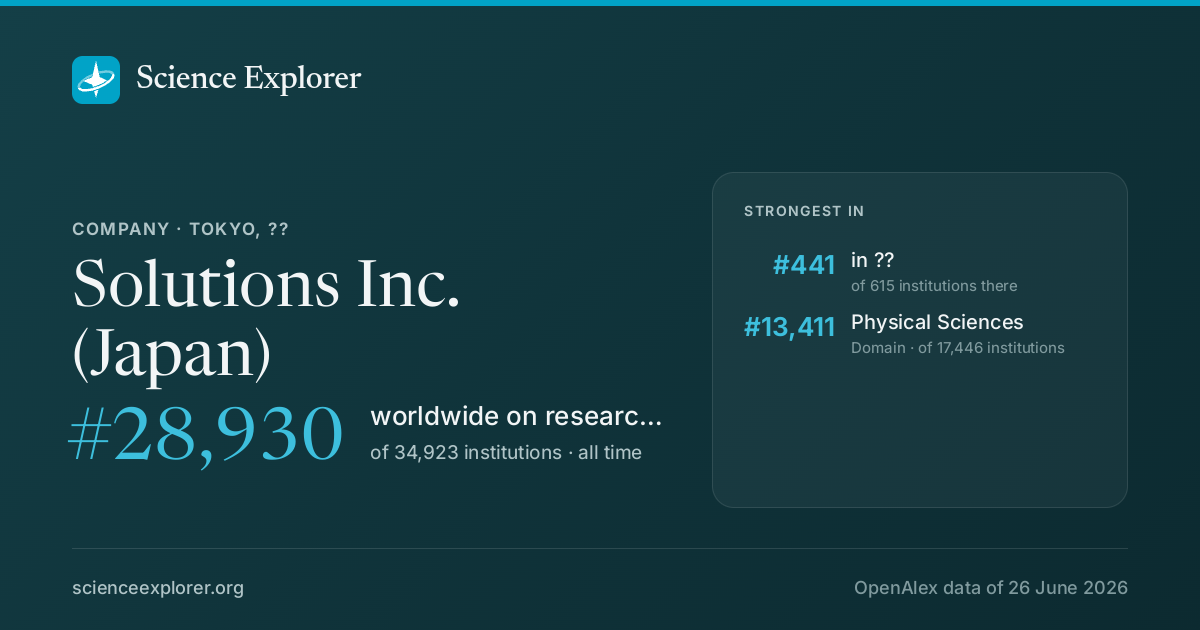
Solutions Inc. (Japan) on Science Explorer

A card with Solutions Inc. (Japan)'s standing and the fields it leads in, for a post or a slide. A link to this page previews as the same card.

Download the card

1200 × 630 PNG, sized for social posts, drawn from the latest snapshot.

Badges for a website1Each links back here and updates with every snapshot

Research measures only: rankings here say nothing about teaching, admissions or student experience. Comparable institutions and collaboration partners have tabs of their own, above.

Discussion

Ask a question or share a note about Solutions Inc. (Japan). Keep it to the research: no personal attacks, advertising or links. Any reader can report a post, which collapses it for everyone until it is opened.