Science Explorer Back to mapMap
Discussion
Institution · Liestal · Switzerland

Theological Seminary Bienenberg

World rank, all time
#23,782
of 34,923
Rank in Switzerland
#286
of 378
Research works
146
▲ 63% vs 2018-21
Citations
3.6k
24.5 per fractional work
Top-10% rate
5.0%
all institutions 10.0%
vs its own fields
1.09×
1.00× is exactly expected
Open access
47%
world 40%
International
20%
world 18%

Which fields of science does Theological Seminary Bienenberg work in?

In 2022-now, 40% of research at Theological Seminary Bienenberg is in Health Sciences, 37% in Social Sciences. Its largest fields are Medicine (30%), Psychology (13%), Social Sciences (12%). It does 1.5× the world's share of Health Sciences.

Health Sciences: 15 fractional works · 40.0% of its workMedicine: 11 fractional works · 29.7% of its workSurgery: 2 fractional works · 5.4% of its workPhysiology: 2 fractional works · 3.9% of its workOncology: 1 fractional works · 3.2% of its workReproductive Medicine: 1 fractional works · 2.0% of its workPulmonary and Respiratory Medicine: 1 fractional works · 2.0% of its workCardiology and Cardiovascular Medicine: 1 fractional works · 1.7% of its workInfectious Diseases: 1 fractional works · 1.6% of its workPsychiatry and Mental health: 1 fractional works · 1.5% of its workPublic Health, Environmental and Occupational Health: 0 fractional works · 1.3% of its workEpidemiology: 0 fractional works · 1.1% of its workRadiology, Nuclear Medicine and Imaging: 0 fractional works · 1.0% of its workPathology and Forensic Medicine: 0 fractional works · 0.9% of its workNeurology: 0 fractional works · 0.8% of its workHealth Informatics: 0 fractional works · 0.6% of its workEmergency Medicine: 0 fractional works · 0.5% of its workEndocrinology, Diabetes and Metabolism: 0 fractional works · 0.3% of its workGastroenterology: 0 fractional works · 0.2% of its workFamily Practice: 0 fractional works · 0.2% of its workSmaller subfields together: 1 fractional works · 1.5% of its workHealth Professions: 4 fractional works · 10.2% of its workPhysical Therapy, Sports Therapy and Rehabilitation: 2 fractional works · 4.5% of its workGeneral Health Professions: 1 fractional works · 3.8% of its workOccupational Therapy: 0 fractional works · 0.9% of its workPharmacy: 0 fractional works · 0.9% of its workSmaller subfields together: 0 fractional works · 0.2% of its workSocial Sciences: 14 fractional works · 37.3% of its workPsychology: 5 fractional works · 12.7% of its workSocial Psychology: 4 fractional works · 9.1% of its workClinical Psychology: 1 fractional works · 2.7% of its workExperimental and Cognitive Psychology: 0 fractional works · 0.9% of its workSocial Sciences: 5 fractional works · 12.2% of its workSociology and Political Science: 2 fractional works · 5.0% of its workCultural Studies: 2 fractional works · 4.4% of its workPolitical Science and International Relations: 1 fractional works · 1.6% of its workEducation: 0 fractional works · 0.5% of its workGender Studies: 0 fractional works · 0.4% of its workLaw: 0 fractional works · 0.2% of its workArts and Humanities: 4 fractional works · 9.7% of its workLiterature and Literary Theory: 2 fractional works · 3.9% of its workArcheology: 1 fractional works · 1.5% of its workReligious studies: 0 fractional works · 1.3% of its workVisual Arts and Performing Arts: 0 fractional works · 1.1% of its workLanguage and Linguistics: 0 fractional works · 0.9% of its workPhilosophy: 0 fractional works · 0.7% of its workHistory: 0 fractional works · 0.3% of its workEconomics, Econometrics and Finance: 1 fractional works · 1.8% of its workEconomics and Econometrics: 1 fractional works · 1.8% of its workBusiness, Management and Accounting: 0 fractional works · 0.9% of its workManagement of Technology and Innovation: 0 fractional works · 0.9% of its workPhysical Sciences: 5 fractional works · 13.0% of its workEnvironmental Science: 2 fractional works · 4.6% of its workGlobal and Planetary Change: 1 fractional works · 1.5% of its workNature and Landscape Conservation: 0 fractional works · 1.3% of its workEnvironmental Chemistry: 0 fractional works · 0.9% of its workWater Science and Technology: 0 fractional works · 0.5% of its workEcology: 0 fractional works · 0.3% of its workSmaller subfields together: 0 fractional works · 0.1% of its workComputer Science: 1 fractional works · 3.4% of its workInformation Systems: 1 fractional works · 2.8% of its workArtificial Intelligence: 0 fractional works · 0.4% of its workSmaller subfields together: 0 fractional works · 0.1% of its workChemistry: 1 fractional works · 2.6% of its workPhysical and Theoretical Chemistry: 1 fractional works · 1.8% of its workOrganic Chemistry: 0 fractional works · 0.9% of its workEngineering: 1 fractional works · 1.9% of its workCivil and Structural Engineering: 0 fractional works · 0.9% of its workBiomedical Engineering: 0 fractional works · 0.6% of its workSafety, Risk, Reliability and Quality: 0 fractional works · 0.4% of its workPhysics and Astronomy: 0 fractional works · 0.4% of its workAtomic and Molecular Physics, and Optics: 0 fractional works · 0.3% of its workSmaller subfields together: 0 fractional works · 0.1% of its workEarth and Planetary Sciences: 0 fractional works · 0.1% of its workLife Sciences: 4 fractional works · 9.8% of its workNeuroscience: 1 fractional works · 3.0% of its workEndocrine and Autonomic Systems: 1 fractional works · 1.8% of its workCognitive Neuroscience: 0 fractional works · 1.0% of its workCellular and Molecular Neuroscience: 0 fractional works · 0.2% of its workBiochemistry, Genetics and Molecular Biology: 1 fractional works · 2.9% of its workMolecular Biology: 0 fractional works · 1.0% of its workGenetics: 0 fractional works · 0.9% of its workBiochemistry: 0 fractional works · 0.4% of its workCell Biology: 0 fractional works · 0.3% of its workCancer Research: 0 fractional works · 0.2% of its workAgricultural and Biological Sciences: 1 fractional works · 2.4% of its workFood Science: 1 fractional works · 1.8% of its workGeneral Agricultural and Biological Sciences: 0 fractional works · 0.4% of its workInsect Science: 0 fractional works · 0.2% of its workImmunology and Microbiology: 0 fractional works · 1.0% of its workImmunology: 0 fractional works · 0.5% of its workMicrobiology: 0 fractional works · 0.3% of its workSmaller subfields together: 0 fractional works · 0.2% of its workPharmacology, Toxicology and Pharmaceutics: 0 fractional works · 0.4% of its workPharmacology: 0 fractional works · 0.4% of its workALL ITS WORKTheologicalSeminary…38fractional works, 2022-now
Life Sciences10%Physical Sciences13%Health Sciences40%Social Sciences37%

Each ring splits the one inside it: the four domains of science, their fields, their subfields. Size is fractional works in 2022-now. Every slice is a page; the interactive view zooms down to single topics and colours each by how much more of it this institution does than the world.

Its 4 domains and 18 fields, with their numbers
    1. Medicine1129.7%
    2. Health Professions410.2%
    1. Psychology512.7%
    2. Social Sciences512.2%
    3. Arts and Humanities49.7%
    4. Economics, Econometrics and Finance11.8%
    5. Business, Management and Accounting00.9%
    1. Environmental Science24.6%
    2. Computer Science13.4%
    3. Chemistry12.6%
    4. Engineering11.9%
    5. Physics and Astronomy00.4%
    6. Earth and Planetary Sciences00.1%
    1. Neuroscience13.0%
    2. Biochemistry, Genetics and Molecular Biology12.9%
    3. Agricultural and Biological Sciences12.4%
    4. Immunology and Microbiology01.0%
    5. Pharmacology, Toxicology and Pharmaceutics00.4%
All of science, and how each field's share has moved since 1950: the Science domain explorer

Field profile

Location quotient across every field it publishes in: outside the ring is more than an institution of this size would be expected to publish, inside it is less.

Agricultural and Biological Sciences: 0.50× its world share, 1 worksAgricultural and Bio…Biochemistry, Genetics and Molecular Biology: 0.55× its world share, 1 worksBiochemistry, Geneti…Immunology and Microbiology: 1.04× its world share, 0 worksImmunology and Micro…Neuroscience: 1.83× its world share, 1 worksNeurosciencePharmacology, Toxicology and Pharmaceutics: 1.24× its world share, 0 worksPharmacology, Toxico…Chemistry: 1.67× its world share, 1 worksChemistryComputer Science: 0.44× its world share, 1 worksComputer ScienceEarth and Planetary Sciences: 0.08× its world share, 0 worksEarth and Planetary …Engineering: 0.13× its world share, 1 worksEngineeringEnvironmental Science: 0.93× its world share, 2 worksEnvironmental SciencePhysics and Astronomy: 0.16× its world share, 0 worksPhysics and AstronomyHealth Professions: 3.89× its world share, 4 worksHealth ProfessionsMedicine: 1.54× its world share, 11 worksMedicineArts and Humanities: 3.38× its world share, 4 worksArts and HumanitiesBusiness, Management and Accounting: 0.27× its world share, 0 worksBusiness, Management…Economics, Econometrics and Finance: 0.85× its world share, 1 worksEconomics, Econometr…Psychology: 4.16× its world share, 5 worksPsychologySocial Sciences: 0.96× its world share, 5 worksSocial Sciences1×world share
more than its size predictsabout as predictedless

Rings at 0.5×, 1× and 2×. Widest outward: Psychology, 4.2×. Every wedge is a field page.

All 18 fields, with their numbers
  1. Psychology4.16×5 works
  2. Health Professions3.89×4 works
  3. Arts and Humanities3.38×4 works
  4. Neuroscience1.83×1 works
  5. Chemistry1.67×1 works
  6. Medicine1.54×11 works
  7. Pharmacology, Toxicology and Pharmaceutics1.24×0 works
  8. Immunology and Microbiology1.04×0 works
  9. Social Sciences0.96×5 works
  10. Environmental Science0.93×2 works
  11. Economics, Econometrics and Finance0.85×1 works
  12. Biochemistry, Genetics and Molecular Biology0.55×1 works
  13. Agricultural and Biological Sciences0.50×1 works
  14. Computer Science0.44×1 works
  15. Business, Management and Accounting0.27×0 works
  16. Physics and Astronomy0.16×0 works
  17. Engineering0.13×1 works
  18. Earth and Planetary Sciences0.08×0 works

Who are the top researchers at Theological Seminary Bienenberg?

Ranked on the quality score, P. A. L. Chapman-Rietschi lead among researchers whose main affiliation is Theological Seminary Bienenberg.

  1. 1 P. A. L. Chapman-Rietschi Switzerland · #4,368,416 worldwide 8 citations · 15 works
All ranked researchers at Theological Seminary Bienenberg

What are the most cited papers from Theological Seminary Bienenberg?

The most cited paper from Theological Seminary Bienenberg is "Metastatic patterns of prostate cancer: An autopsy study of 1,589 patients" (Lukas Bubendorf, S. Alain, Urs Wagner et al., 2000), with 1,921 citations. Next come "Modules for Experiments in Stellar Astrophysics (MESA): Pulsating Variable Stars, Rotation, Convective Boundaries, and Energy Conservation" (1,789) and "Cessation of CCL2 inhibition accelerates breast cancer metastasis by promoting angiogenesis" (674).

Most cited papers
#PaperReleasedCitations
1 Metastatic patterns of prostate cancer: An autopsy study of 1,589 patients Lukas Bubendorf, S. Alain, Urs Wagner et al. · Human Pathology May 2000 1,921
2 Modules for Experiments in Stellar Astrophysics (MESA): Pulsating Variable Stars, Rotation, Convective Boundaries, and Energy Conservation Bill Paxton, R. Smolec, Josiah Schwab et al. · The Astrophysical Journal Supplement Series Open access Jul 2019 1,789
3 Cessation of CCL2 inhibition accelerates breast cancer metastasis by promoting angiogenesis Laura Bonapace, Marie‐May Coissieux, Jeffrey B. Wyckoff et al. · Nature 21 Oct 2014 674
4 Mitochondria‐targeted antioxidants protect Friedreich Ataxia fibroblasts from endogenous oxidative stress more effectively than untargeted antioxidants Matthias L. Jauslin, Thomas W. Meier, Robin A.J. Smith et al. · The FASEB Journal 15 Aug 2003 360
5 Arterial Neovascularization and Inflammation in Vulnerable Patients Michael Fleiner, Marco Kummer, Martina Mirlacher et al. · Circulation Open access 26 Oct 2004 349
All 60 most cited papers, with filters and sorting

Which keywords describe research at Theological Seminary Bienenberg?

By fractional works in 2022-now, weighted toward what it does more of than the world: Coaching, Psychodrama, Philosophy, Identity, Social Theory, Religion, Psychoanalysis and Healthcare.

▲ more of its work than of the world's◆ about the world's share▼ less than the world's

Size is fractional works in 2022-now in the topics tagged with each word; colour is the word's share of this institution's work against its share of the world's. The 28 words are chosen for being large and distinctive. Each links to the topic it comes from most.

All 28 words, with their numbers
  1. Coaching3▲ 492×1 topic
  2. Psychodrama3▲ 460×1 topic
  3. Healthcare2▲ 5.0×5 topics
  4. Epidemiology2▲ 1.38×19 topics
  5. Identity2▲ 7.4×4 topics
  6. Philosophy2▲ 12×3 topics
  7. Public Health2▲ 3.4×9 topics
  8. Social Theory2▲ 176×3 topics
  9. Innovation2▲ 4.6×3 topics
  10. Psychoanalysis2▲ 57×2 topics
  11. Religion2▲ 10×2 topics
  12. Ethics2▲ 8.6×1 topic
  13. Gender Studies2▲ 29×1 topic
  14. Patient Care2▲ 36×1 topic
  15. Quality2▲ 100×1 topic
  16. Rehabilitation2▲ 11×2 topics
  17. Treatment2▲ 3.4×11 topics
  18. Autorschaft2▲ 197×1 topic
  19. Bildung2▲ 124×1 topic
  20. Big Data1▲ 3.6×3 topics
  21. Media1▲ 23×2 topics
  22. Sustainable Development1▲ 2.2×4 topics
  23. Inflammation1▲ 1.47×13 topics
  24. Technology1▲ 5.8×2 topics
  25. Cardiovascular Disease1▲ 2.6×5 topics
  26. Foresight1▲ 20×1 topic
  27. Information Science1▲ 114×1 topic
  28. Mortality1▲ 4.7×6 topics

Which research topics does Theological Seminary Bienenberg publish most on?

By volume in 2022-now: Psychology, Coaching, and Therapy, Medical Practices and Rehabilitation, Psychoanalysis and Social Critique and German Literature and Culture Studies.

  1. 1 Psychology, Coaching, and Therapy Social Psychology 3 works
  2. 2 Medical Practices and Rehabilitation Physical Therapy, Sports Therapy and Rehabilitation 2 works
  3. 3 Psychoanalysis and Social Critique Cultural Studies 2 works
  4. 4 German Literature and Culture Studies Literature and Literary Theory 2 works
  5. 5 Scientific Research and Philosophical Inquiry Information Systems 1 works
  6. 6 Economic and Social Issues Sociology and Political Science 1 works
  7. 7 Neuroscience of respiration and sleep Endocrine and Autonomic Systems 1 works
  8. 8 Obstructive Sleep Apnea Research Physiology 1 works
  9. 9 Biomedical and Chemical Research Surgery 1 works
  10. 10 Public Administration and Political Analysis Political Science and International Relations 0 works

How open and international is its research?

Against the world's own shares: the tick on each track. Both are shares of its output, so they sit on one scale and can be read against each other as well as against the world.

openly available47.4%not open52.6%

World: 40% of research is openly available.

with international co-authors20.5%domestic only79.5%

World: 18% is written across borders.

How has Theological Seminary Bienenberg's research output changed?

Output in 2022-2025 was 63% higher than in 2018-2021.

still counting1990200020102020
grewheldshrank

The same series as a ribbon: one cell per year, darker for more. The line above answers how much; this answers when.

Its share of all research

Growing output can still be a shrinking share: all of science grows. This is Theological Seminary Bienenberg as a percentage of every work published that year, 0.00013% in 2024.

still counting0.00020%0.00040%0.00060%Theological Seminary Bienenberg0.00019% in 202519801990200020102020

Fractional works of Theological Seminary Bienenberg over all fractional works that year. How the balance of science has shifted.

Other research institutions in Liestal

All research institutions in Liestal

Share Theological Seminary Bienenberg's ranking

Theological Seminary Bienenberg on Science Explorer

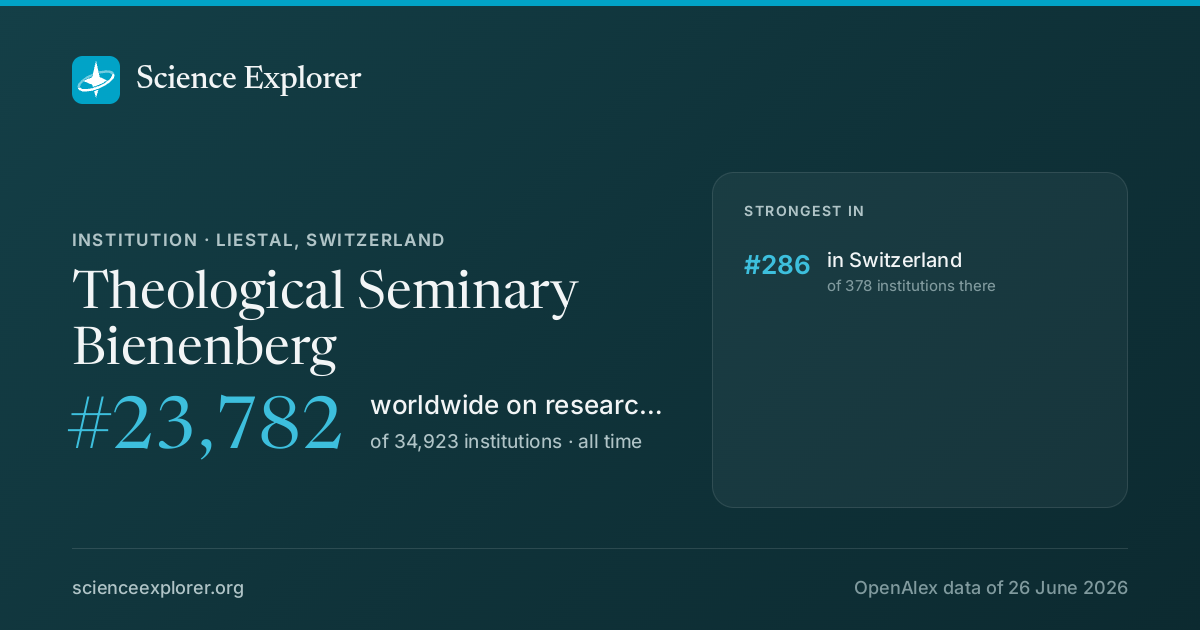
A card with Theological Seminary Bienenberg's standing and the fields it leads in, for a post or a slide. A link to this page previews as the same card.

Download the card

1200 × 630 PNG, sized for social posts, drawn from the latest snapshot.

Badges for a website1Each links back here and updates with every snapshot

Research measures only: rankings here say nothing about teaching, admissions or student experience. Comparable institutions and collaboration partners have tabs of their own, above.

Discussion

Ask a question or share a note about Theological Seminary Bienenberg. Posts are plain text and can be reported.