Science Explorer Back to mapMap
Discussion
University · Charleston · United States

Trident Technical College

World rank, all time
#31,235
of 34,923
Rank in United States
#6,606
of 7,310
Research works
126
▲ 146% vs 2018-21
Citations
651
5.2 per fractional work
Top-10% rate
5.5%
all institutions 10.0%
vs its own fields
0.87×
1.00× is exactly expected
Open access
19%
world 40%
International
9%
world 18%

Which fields of science does Trident Technical College work in?

In 2022-now, 54% of research at Trident Technical College is in Health Sciences, 19% in Physical Sciences. Its largest fields are Medicine (49%), Psychology (7%), Arts and Humanities (6%). It does 1.8× the world's share of Health Sciences.

Health Sciences: 11 fractional works · 53.8% of its workMedicine: 10 fractional works · 48.9% of its workSurgery: 2 fractional works · 12.1% of its workPulmonary and Respiratory Medicine: 1 fractional works · 4.7% of its workCardiology and Cardiovascular Medicine: 1 fractional works · 4.5% of its workNeurology: 1 fractional works · 3.9% of its workEpidemiology: 0 fractional works · 2.4% of its workPublic Health, Environmental and Occupational Health: 0 fractional works · 2.4% of its workOncology: 0 fractional works · 1.8% of its workEndocrinology, Diabetes and Metabolism: 0 fractional works · 1.7% of its workPhysiology: 0 fractional works · 1.5% of its workInternal Medicine: 0 fractional works · 1.5% of its workPediatrics, Perinatology and Child Health: 0 fractional works · 1.2% of its workGastroenterology: 0 fractional works · 1.1% of its workPathology and Forensic Medicine: 0 fractional works · 1.1% of its workGenetics: 0 fractional works · 1.0% of its workInfectious Diseases: 0 fractional works · 1.0% of its workAnesthesiology and Pain Medicine: 0 fractional works · 0.8% of its workImmunology and Allergy: 0 fractional works · 0.8% of its workOtorhinolaryngology: 0 fractional works · 0.8% of its workRadiology, Nuclear Medicine and Imaging: 0 fractional works · 0.7% of its workHealth Informatics: 0 fractional works · 0.6% of its workRheumatology: 0 fractional works · 0.6% of its workUrology: 0 fractional works · 0.6% of its workCritical Care and Intensive Care Medicine: 0 fractional works · 0.4% of its workEmergency Medicine: 0 fractional works · 0.4% of its workHematology: 0 fractional works · 0.3% of its workHepatology: 0 fractional works · 0.3% of its workOphthalmology: 0 fractional works · 0.2% of its workSmaller subfields together: 0 fractional works · 0.2% of its workHealth Professions: 1 fractional works · 3.2% of its workGeneral Health Professions: 0 fractional works · 2.4% of its workOccupational Therapy: 0 fractional works · 0.8% of its workDentistry: 0 fractional works · 0.8% of its workPeriodontics: 0 fractional works · 0.8% of its workNursing: 0 fractional works · 0.8% of its workIssues, ethics and legal aspects: 0 fractional works · 0.8% of its workPhysical Sciences: 4 fractional works · 19.5% of its workEngineering: 1 fractional works · 5.3% of its workBiomedical Engineering: 1 fractional works · 2.5% of its workElectrical and Electronic Engineering: 0 fractional works · 1.9% of its workCivil and Structural Engineering: 0 fractional works · 0.8% of its workSmaller subfields together: 0 fractional works · 0.0% of its workPhysics and Astronomy: 1 fractional works · 4.9% of its workAstronomy and Astrophysics: 1 fractional works · 4.9% of its workEnvironmental Science: 1 fractional works · 3.7% of its workEcology: 1 fractional works · 3.7% of its workEarth and Planetary Sciences: 0 fractional works · 2.4% of its workOceanography: 0 fractional works · 2.4% of its workComputer Science: 0 fractional works · 1.5% of its workComputer Networks and Communications: 0 fractional works · 1.0% of its workArtificial Intelligence: 0 fractional works · 0.5% of its workChemistry: 0 fractional works · 0.9% of its workOrganic Chemistry: 0 fractional works · 0.9% of its workMaterials Science: 0 fractional works · 0.8% of its workGeneral Materials Science: 0 fractional works · 0.8% of its workSocial Sciences: 4 fractional works · 19.4% of its workPsychology: 1 fractional works · 6.9% of its workClinical Psychology: 1 fractional works · 4.3% of its workSocial Psychology: 1 fractional works · 2.5% of its workSmaller subfields together: 0 fractional works · 0.0% of its workArts and Humanities: 1 fractional works · 5.7% of its workArcheology: 1 fractional works · 5.7% of its workSocial Sciences: 1 fractional works · 5.7% of its workEducation: 0 fractional works · 2.1% of its workAnthropology: 0 fractional works · 1.6% of its workSociology and Political Science: 0 fractional works · 1.2% of its workSafety Research: 0 fractional works · 0.8% of its workEconomics, Econometrics and Finance: 0 fractional works · 1.1% of its workFinance: 0 fractional works · 0.8% of its workEconomics and Econometrics: 0 fractional works · 0.3% of its workLife Sciences: 1 fractional works · 7.3% of its workBiochemistry, Genetics and Molecular Biology: 1 fractional works · 5.6% of its workMolecular Biology: 0 fractional works · 1.9% of its workCell Biology: 0 fractional works · 0.8% of its workPhysiology: 0 fractional works · 0.8% of its workGenetics: 0 fractional works · 0.6% of its workBiophysics: 0 fractional works · 0.5% of its workCancer Research: 0 fractional works · 0.5% of its workBiochemistry: 0 fractional works · 0.3% of its workNeuroscience: 0 fractional works · 0.9% of its workCognitive Neuroscience: 0 fractional works · 0.5% of its workCellular and Molecular Neuroscience: 0 fractional works · 0.4% of its workPharmacology, Toxicology and Pharmaceutics: 0 fractional works · 0.4% of its workPharmacology: 0 fractional works · 0.4% of its workImmunology and Microbiology: 0 fractional works · 0.3% of its workParasitology: 0 fractional works · 0.3% of its workALL ITS WORKTrident TechnicalCollege20fractional works, 2022-now
Life Sciences7%Physical Sciences19%Health Sciences54%Social Sciences19%

Each ring splits the one inside it: the four domains of science, their fields, their subfields. Size is fractional works in 2022-now. Every slice is a page; the interactive view zooms down to single topics and colours each by how much more of it this institution does than the world.

Its 4 domains and 19 fields, with their numbers
    1. Medicine1048.9%
    2. Health Professions13.2%
    3. Dentistry00.8%
    4. Nursing00.8%
    1. Engineering15.3%
    2. Physics and Astronomy14.9%
    3. Environmental Science13.7%
    4. Earth and Planetary Sciences02.4%
    5. Computer Science01.5%
    6. Chemistry00.9%
    7. Materials Science00.8%
    1. Psychology16.9%
    2. Arts and Humanities15.7%
    3. Social Sciences15.7%
    4. Economics, Econometrics and Finance01.1%
    1. Biochemistry, Genetics and Molecular Biology15.6%
    2. Neuroscience00.9%
    3. Pharmacology, Toxicology and Pharmaceutics00.4%
    4. Immunology and Microbiology00.3%
All of science, and how each field's share has moved since 1950: the Science domain explorer

Field profile

Location quotient across every field it publishes in: outside the ring is more than an institution of this size would be expected to publish, inside it is less.

Biochemistry, Genetics and Molecular Biology: 1.05× its world share, 1 worksBiochemistry, Geneti…Immunology and Microbiology: 0.32× its world share, 0 worksImmunology and Micro…Neuroscience: 0.59× its world share, 0 worksNeurosciencePharmacology, Toxicology and Pharmaceutics: 1.28× its world share, 0 worksPharmacology, Toxico…Chemistry: 0.56× its world share, 0 worksChemistryComputer Science: 0.19× its world share, 0 worksComputer ScienceEarth and Planetary Sciences: 1.56× its world share, 0 worksEarth and Planetary …Engineering: 0.35× its world share, 1 worksEngineeringEnvironmental Science: 0.74× its world share, 1 worksEnvironmental ScienceMaterials Science: 0.23× its world share, 0 worksMaterials SciencePhysics and Astronomy: 2.20× its world share, 1 worksPhysics and AstronomyDentistry: 1.68× its world share, 0 worksDentistryHealth Professions: 1.23× its world share, 1 worksHealth ProfessionsMedicine: 2.54× its world share, 10 worksMedicineNursing: 1.67× its world share, 0 worksNursingArts and Humanities: 1.98× its world share, 1 worksArts and HumanitiesEconomics, Econometrics and Finance: 0.52× its world share, 0 worksEconomics, Econometr…Psychology: 2.24× its world share, 1 worksPsychologySocial Sciences: 0.45× its world share, 1 worksSocial Sciences1×world share
more than its size predictsabout as predictedless

Rings at 0.5×, 1× and 2×. Widest outward: Medicine, 2.5×. Every wedge is a field page.

All 19 fields, with their numbers
  1. Medicine2.54×10 works
  2. Psychology2.24×1 works
  3. Physics and Astronomy2.20×1 works
  4. Arts and Humanities1.98×1 works
  5. Dentistry1.68×0 works
  6. Nursing1.67×0 works
  7. Earth and Planetary Sciences1.56×0 works
  8. Pharmacology, Toxicology and Pharmaceutics1.28×0 works
  9. Health Professions1.23×1 works
  10. Biochemistry, Genetics and Molecular Biology1.05×1 works
  11. Environmental Science0.74×1 works
  12. Neuroscience0.59×0 works
  13. Chemistry0.56×0 works
  14. Economics, Econometrics and Finance0.52×0 works
  15. Social Sciences0.45×1 works
  16. Engineering0.35×1 works
  17. Immunology and Microbiology0.32×0 works
  18. Materials Science0.23×0 works
  19. Computer Science0.19×0 works

Who are the top researchers at Trident Technical College?

Ranked on the quality score, Sean A. Day and Charles R. Wall lead among researchers whose main affiliation is Trident Technical College.

  1. 1 Sean A. Day United States · #4,475,176 worldwide 452 citations · 33 works
  2. 2 Charles R. Wall United States · #5,725,078 worldwide 121 citations · 45 works
All ranked researchers at Trident Technical College

What are the most cited papers from Trident Technical College?

The most cited paper from Trident Technical College is "Prediction of Opioid-Induced Respiratory Depression on Inpatient Wards Using Continuous Capnography and Oximetry: An International Prospective, Observational Trial" (Ashish Kumar Khanna et al., 2020), with 222 citations. Next come "Some Demographic and Socio-cultural Aspects of Synesthesia" (116) and "Regulatory B cells in infection, inflammation, and autoimmunity" (94).

Most cited papers
#PaperReleasedCitations
1 Prediction of Opioid-Induced Respiratory Depression on Inpatient Wards Using Continuous Capnography and Oximetry: An International Prospective, Observational Trial Ashish Kumar Khanna et al. · Anesthesia & Analgesia Open access 16 Apr 2020 222
2 Some Demographic and Socio-cultural Aspects of Synesthesia Sean A. Day Book chapter 14 Oct 2004 116
3 Regulatory B cells in infection, inflammation, and autoimmunity Subhajit Dasgupta, Subhajit Dasgupta, Shaoni Dasgupta et al. · Cellular Immunology 27 Feb 2020 94
4 Pulsed Field Ablation of Persistent Atrial Fibrillation With Continuous Electrocardiographic Monitoring Follow-Up: ADVANTAGE AF Phase 2 Vivek Yerrapu Reddy et al. · Circulation Open access 24 Apr 2025 83
5 Retaining Men in Nursing Programs Designed for Women Marilyn S. Brady, Dennis R. Sherrod · Journal of Nursing Education Apr 2003 75
All 62 most cited papers, with filters and sorting

Which research topics does Trident Technical College publish most on?

By volume in 2022-now: Historical Astronomy and Related Studies, Research studies in Vietnam, Marine and environmental studies and Ancient and Medieval Archaeology Studies.

  1. 1 Historical Astronomy and Related Studies Astronomy and Astrophysics 1 works
  2. 2 Research studies in Vietnam Ecology 1 works
  3. 3 Marine and environmental studies Oceanography 0 works
  4. 4 Ancient and Medieval Archaeology Studies Archeology 0 works
  5. 5 Pediatric Hepatobiliary Diseases and Treatments Surgery 0 works
  6. 6 Attachment and Relationship Dynamics Social Psychology 0 works
  7. 7 Eurasian Exchange Networks Anthropology 0 works
  8. 8 Congenital gastrointestinal and neural anomalies Surgery 0 works
  9. 9 Archaeology and Historical Studies Archeology 0 works
  10. 10 Child Therapy and Development Clinical Psychology 0 works

How open and international is its research?

Against the world's own shares: the tick on each track. Both are shares of its output, so they sit on one scale and can be read against each other as well as against the world.

openly available19.1%not open80.9%

World: 40% of research is openly available.

with international co-authors8.9%domestic only91.1%

World: 18% is written across borders.

How has Trident Technical College's research output changed?

Output in 2022-2025 was 146% higher than in 2018-2021.

still counting1990200020102020
grewheldshrank

The same series as a ribbon: one cell per year, darker for more. The line above answers how much; this answers when.

Its share of all research

Growing output can still be a shrinking share: all of science grows. This is Trident Technical College as a percentage of every work published that year, 0.00012% in 2024.

still counting0.0010%0.0020%Trident Technical College0.00013% in 202519801990200020102020

Fractional works of Trident Technical College over all fractional works that year. How the balance of science has shifted.

Other research institutions in Charleston

All research institutions in Charleston

Share Trident Technical College's ranking
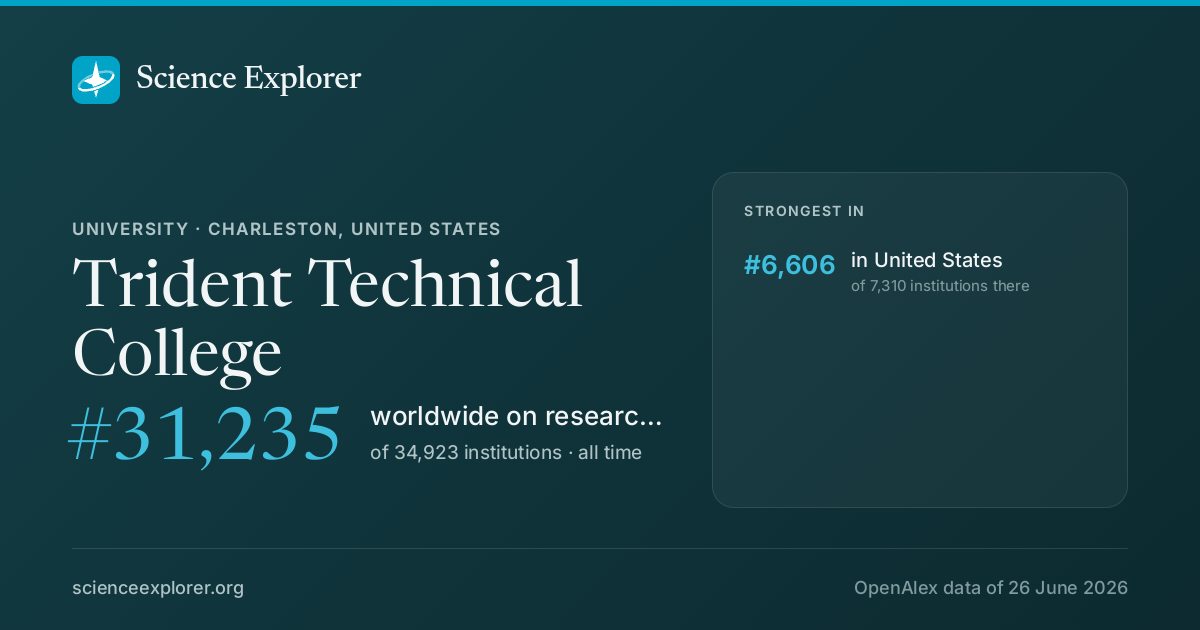
Trident Technical College on Science Explorer

A card with Trident Technical College's standing and the fields it leads in, for a post or a slide. A link to this page previews as the same card.

Download the card

1200 × 630 PNG, sized for social posts, drawn from the latest snapshot.

Badges for a website1Each links back here and updates with every snapshot

Research measures only: rankings here say nothing about teaching, admissions or student experience. Comparable institutions and collaboration partners have tabs of their own, above.

Discussion

Ask a question or share a note about Trident Technical College. Keep it to the research: no personal attacks, advertising or links. Any reader can report a post, which collapses it for everyone until it is opened.
