Science Explorer Back to mapMap
Discussion
Government institution · Gebze · Türkiye

TUBITAK BILGEM

In research, TUBITAK BILGEM stands highest in Physical Sciences (#5,936 of 10,670 worldwide), 2022-now. Relative to its size it is most specialised in Electrical and Electronic Engineering (Electrical and Electronic Engineering is 4.8× its share of world research).

World rank, 2022-now
#12,616
of 22,385 · #14,252 all time
Rank in Türkiye
#214
of 297
Research works
770
▼ 33% vs 2018-21
Citations
5.2k
6.7 per fractional work
Top-10% rate
5.8%
all institutions 10.0%
vs its own fields
0.93×
1.00× is exactly expected
Open access
32%
world 40%
International
12%
world 18%

What is TUBITAK BILGEM known for in research?

The fields where it stands highest, 2022-now, ranked among every institution above the floor in each field.

FieldWorld rankWhere that sitsTop-10% rateWorksAll time
Physical SciencesDomain #5,936 of 10,670 5.5%108 #6022

Each strip is that field's whole ranked pool, with the notch where TUBITAK BILGEM sits in it, in the colour of the band that rank falls in. The track under the rate is the rate itself: it carries no average mark, because the average differs by field (from about 6% in Dentistry to 21% in Economics).

Which fields of science does TUBITAK BILGEM work in?

In 2022-now, 71% of research at TUBITAK BILGEM is in Physical Sciences, 16% in Social Sciences. Its largest fields are Engineering (37%), Computer Science (26%), Social Sciences (7%). It does 1.8× the world's share of Physical Sciences.

Physical Sciences: 118 fractional works · 71.1% of its workEngineering: 61 fractional works · 36.8% of its workElectrical and Electronic Engineering: 29 fractional works · 17.2% of its workAerospace Engineering: 8 fractional works · 4.7% of its workBiomedical Engineering: 4 fractional works · 2.5% of its workIndustrial and Manufacturing Engineering: 4 fractional works · 2.5% of its workMechanical Engineering: 4 fractional works · 2.2% of its workMechanics of Materials: 2 fractional works · 1.2% of its workControl and Systems Engineering: 2 fractional works · 1.2% of its workComputational Mechanics: 2 fractional works · 1.1% of its workOcean Engineering: 2 fractional works · 1.1% of its workMedia Technology: 2 fractional works · 1.0% of its workAutomotive Engineering: 1 fractional works · 0.8% of its workCivil and Structural Engineering: 1 fractional works · 0.6% of its workSafety, Risk, Reliability and Quality: 1 fractional works · 0.5% of its workComputer Science: 43 fractional works · 25.8% of its workArtificial Intelligence: 12 fractional works · 7.1% of its workComputer Vision and Pattern Recognition: 11 fractional works · 6.8% of its workComputer Networks and Communications: 6 fractional works · 3.6% of its workInformation Systems: 5 fractional works · 3.1% of its workHardware and Architecture: 3 fractional works · 1.7% of its workSignal Processing: 2 fractional works · 1.3% of its workComputational Theory and Mathematics: 2 fractional works · 1.2% of its workSoftware: 1 fractional works · 0.6% of its workComputer Graphics and Computer-Aided Design: 0 fractional works · 0.2% of its workSmaller subfields together: 0 fractional works · 0.3% of its workMaterials Science: 4 fractional works · 2.6% of its workMaterials Chemistry: 3 fractional works · 1.6% of its workPolymers and Plastics: 1 fractional works · 0.6% of its workElectronic, Optical and Magnetic Materials: 1 fractional works · 0.3% of its workSmaller subfields together: 0 fractional works · 0.0% of its workPhysics and Astronomy: 4 fractional works · 2.2% of its workStatistical and Nonlinear Physics: 2 fractional works · 1.2% of its workAtomic and Molecular Physics, and Optics: 1 fractional works · 0.5% of its workCondensed Matter Physics: 1 fractional works · 0.4% of its workSmaller subfields together: 0 fractional works · 0.1% of its workEnvironmental Science: 3 fractional works · 1.7% of its workManagement, Monitoring, Policy and Law: 1 fractional works · 0.4% of its workPollution: 1 fractional works · 0.3% of its workHealth, Toxicology and Mutagenesis: 0 fractional works · 0.3% of its workGlobal and Planetary Change: 0 fractional works · 0.2% of its workSmaller subfields together: 1 fractional works · 0.4% of its workChemistry: 1 fractional works · 0.7% of its workOrganic Chemistry: 0 fractional works · 0.3% of its workInorganic Chemistry: 0 fractional works · 0.2% of its workSmaller subfields together: 0 fractional works · 0.2% of its workEarth and Planetary Sciences: 1 fractional works · 0.6% of its workGeophysics: 1 fractional works · 0.4% of its workSmaller subfields together: 0 fractional works · 0.2% of its workMathematics: 1 fractional works · 0.4% of its workAlgebra and Number Theory: 0 fractional works · 0.2% of its workSmaller subfields together: 0 fractional works · 0.2% of its workEnergy: 0 fractional works · 0.2% of its workRenewable Energy, Sustainability and the Environment: 0 fractional works · 0.2% of its workChemical Engineering: 0 fractional works · 0.1% of its workSocial Sciences: 26 fractional works · 15.7% of its workSocial Sciences: 12 fractional works · 7.4% of its workEducation: 5 fractional works · 2.9% of its workPolitical Science and International Relations: 2 fractional works · 1.4% of its workSociology and Political Science: 2 fractional works · 1.3% of its workLaw: 1 fractional works · 0.6% of its workSafety Research: 1 fractional works · 0.6% of its workGender Studies: 0 fractional works · 0.3% of its workSmaller subfields together: 1 fractional works · 0.4% of its workArts and Humanities: 7 fractional works · 4.2% of its workLiterature and Literary Theory: 2 fractional works · 1.2% of its workPhilosophy: 2 fractional works · 1.0% of its workArcheology: 1 fractional works · 0.7% of its workVisual Arts and Performing Arts: 1 fractional works · 0.5% of its workHistory: 1 fractional works · 0.4% of its workMuseology: 1 fractional works · 0.3% of its workSmaller subfields together: 0 fractional works · 0.1% of its workPsychology: 3 fractional works · 1.8% of its workSocial Psychology: 1 fractional works · 0.8% of its workClinical Psychology: 1 fractional works · 0.4% of its workDevelopmental and Educational Psychology: 1 fractional works · 0.4% of its workExperimental and Cognitive Psychology: 0 fractional works · 0.2% of its workBusiness, Management and Accounting: 2 fractional works · 0.9% of its workManagement Information Systems: 1 fractional works · 0.6% of its workSmaller subfields together: 0 fractional works · 0.3% of its workDecision Sciences: 1 fractional works · 0.7% of its workManagement Science and Operations Research: 1 fractional works · 0.3% of its workInformation Systems and Management: 0 fractional works · 0.3% of its workSmaller subfields together: 0 fractional works · 0.1% of its workEconomics, Econometrics and Finance: 1 fractional works · 0.7% of its workEconomics and Econometrics: 1 fractional works · 0.7% of its workLife Sciences: 12 fractional works · 7.5% of its workAgricultural and Biological Sciences: 7 fractional works · 4.2% of its workPlant Science: 4 fractional works · 2.3% of its workFood Science: 1 fractional works · 0.7% of its workInsect Science: 1 fractional works · 0.4% of its workAgronomy and Crop Science: 1 fractional works · 0.4% of its workSmaller subfields together: 1 fractional works · 0.4% of its workBiochemistry, Genetics and Molecular Biology: 3 fractional works · 2.1% of its workMolecular Biology: 2 fractional works · 1.2% of its workGenetics: 1 fractional works · 0.4% of its workCell Biology: 0 fractional works · 0.2% of its workSmaller subfields together: 1 fractional works · 0.4% of its workNeuroscience: 2 fractional works · 1.0% of its workNeurology: 1 fractional works · 0.4% of its workCognitive Neuroscience: 1 fractional works · 0.4% of its workSensory Systems: 0 fractional works · 0.2% of its workSmaller subfields together: 0 fractional works · 0.0% of its workImmunology and Microbiology: 0 fractional works · 0.1% of its workHealth Sciences: 10 fractional works · 5.7% of its workMedicine: 6 fractional works · 3.6% of its workRadiology, Nuclear Medicine and Imaging: 1 fractional works · 0.7% of its workSurgery: 1 fractional works · 0.5% of its workEpidemiology: 1 fractional works · 0.4% of its workNeurology: 0 fractional works · 0.2% of its workPublic Health, Environmental and Occupational Health: 0 fractional works · 0.2% of its workDermatology: 0 fractional works · 0.2% of its workHealth Informatics: 0 fractional works · 0.2% of its workOphthalmology: 0 fractional works · 0.2% of its workSmaller subfields together: 2 fractional works · 0.9% of its workDentistry: 2 fractional works · 0.9% of its workOral Surgery: 1 fractional works · 0.8% of its workSmaller subfields together: 0 fractional works · 0.1% of its workHealth Professions: 1 fractional works · 0.8% of its workRadiological and Ultrasound Technology: 0 fractional works · 0.2% of its workGeneral Health Professions: 0 fractional works · 0.2% of its workSpeech and Hearing: 0 fractional works · 0.2% of its workSmaller subfields together: 0 fractional works · 0.2% of its workNursing: 1 fractional works · 0.3% of its workNutrition and Dietetics: 1 fractional works · 0.3% of its workALL ITS WORKTUBITAK BILGEM166fractional works, 2022-now
Life Sciences7%Physical Sciences71%Health Sciences6%Social Sciences16%

Each ring splits the one inside it: the four domains of science, their fields, their subfields. Size is fractional works in 2022-now. Every slice is a page; the interactive view zooms down to single topics and colours each by how much more of it this institution does than the world.

Its 4 domains and 24 fields, with their numbers
    1. Engineering6136.8%
    2. Computer Science4325.8%
    3. Materials Science42.6%
    4. Physics and Astronomy42.2%
    5. Environmental Science31.7%
    6. Chemistry10.7%
    7. Earth and Planetary Sciences10.6%
    8. Mathematics10.4%
    9. Energy00.2%
    10. Chemical Engineering00.1%
    1. Social Sciences127.4%
    2. Arts and Humanities74.2%
    3. Psychology31.8%
    4. Business, Management and Accounting20.9%
    5. Decision Sciences10.7%
    6. Economics, Econometrics and Finance10.7%
    1. Agricultural and Biological Sciences74.2%
    2. Biochemistry, Genetics and Molecular Biology32.1%
    3. Neuroscience21.0%
    4. Immunology and Microbiology00.1%
    1. Medicine63.6%
    2. Dentistry20.9%
    3. Health Professions10.8%
    4. Nursing10.3%
All of science, and how each field's share has moved since 1950: the Science domain explorer

What does TUBITAK BILGEM specialise in?

Where its research is concentrated relative to its size: Electrical and Electronic Engineering takes 4.8× the share of its output that it takes of world research.

  1. Electrical and Electronic EngineeringSubfield · 28.6 works4.8×
← less than its size predicts1×more →

Location quotient, a volume reading rather than an impact one. It surfaces small, lopsided specialities.

Field profile

Location quotient across every field it publishes in: outside the ring is more than an institution of this size would be expected to publish, inside it is less.

Agricultural and Biological Sciences: 0.89× its world share, 7 worksAgricultural and Bio…Biochemistry, Genetics and Molecular Biology: 0.39× its world share, 4 worksBiochemistry, Geneti…Immunology and Microbiology: 0.10× its world share, 0 worksImmunology and Micro…Neuroscience: 0.64× its world share, 2 worksNeuroscienceChemical Engineering: 0.38× its world share, 0 worksChemical EngineeringChemistry: 0.45× its world share, 1 worksChemistryComputer Science: 3.32× its world share, 43 worksComputer ScienceEarth and Planetary Sciences: 0.36× its world share, 1 worksEarth and Planetary …Energy: 0.22× its world share, 0 worksEnergyEngineering: 2.45× its world share, 61 worksEngineeringEnvironmental Science: 0.33× its world share, 3 worksEnvironmental ScienceMaterials Science: 0.74× its world share, 4 worksMaterials ScienceMathematics: 0.33× its world share, 1 worksMathematicsPhysics and Astronomy: 0.99× its world share, 4 worksPhysics and AstronomyDentistry: 1.93× its world share, 2 worksDentistryHealth Professions: 0.32× its world share, 1 worksHealth ProfessionsMedicine: 0.19× its world share, 6 worksMedicineNursing: 0.69× its world share, 1 worksNursingArts and Humanities: 1.44× its world share, 7 worksArts and HumanitiesBusiness, Management and Accounting: 0.30× its world share, 2 worksBusiness, Management…Decision Sciences: 0.74× its world share, 1 worksDecision SciencesEconomics, Econometrics and Finance: 0.33× its world share, 1 worksEconomics, Econometr…Psychology: 0.58× its world share, 3 worksPsychologySocial Sciences: 0.59× its world share, 12 worksSocial Sciences1×world share
more than its size predictsabout as predictedless

Rings at 0.5×, 1× and 2×. Widest outward: Computer Science, 3.3×. Every wedge is a field page.

All 24 fields, with their numbers
  1. Computer Science3.32×43 works
  2. Engineering2.45×61 works
  3. Dentistry1.93×2 works
  4. Arts and Humanities1.44×7 works
  5. Physics and Astronomy0.99×4 works
  6. Agricultural and Biological Sciences0.89×7 works
  7. Materials Science0.74×4 works
  8. Decision Sciences0.74×1 works
  9. Nursing0.69×1 works
  10. Neuroscience0.64×2 works
  11. Social Sciences0.59×12 works
  12. Psychology0.58×3 works
  13. Chemistry0.45×1 works
  14. Biochemistry, Genetics and Molecular Biology0.39×4 works
  15. Chemical Engineering0.38×0 works
  16. Earth and Planetary Sciences0.36×1 works
  17. Environmental Science0.33×3 works
  18. Mathematics0.33×1 works
  19. Economics, Econometrics and Finance0.33×1 works
  20. Health Professions0.32×1 works
  21. Business, Management and Accounting0.30×2 works
  22. Energy0.22×0 works
  23. Medicine0.19×6 works
  24. Immunology and Microbiology0.10×0 works

Who are the top researchers at TUBITAK BILGEM?

Ranked on the quality score, Özgür Yürekten, Mehmet Sabır Kiraz and Nida Kumbasar lead among researchers whose main affiliation is TUBITAK BILGEM.

  1. 1 Özgür Yürekten Türkiye · #1,437,721 worldwide 545 citations · 20 works
  2. 2 Mehmet Sabır Kiraz Türkiye · #1,856,915 worldwide 1.1k citations · 79 works
  3. 3 Nida Kumbasar Türkiye · #2,108,962 worldwide 164 citations · 18 works
  4. 4 Sefa Kayraklık Türkiye · #2,541,523 worldwide 111 citations · 19 works
  5. 5 M. Nedim Alpdemir Türkiye · #2,673,036 worldwide 997 citations · 31 works
  6. 6 Onur Salan Türkiye · #2,703,227 worldwide 44 citations · 20 works
  7. 7 Ferhat Karakoç Türkiye · #3,241,745 worldwide 415 citations · 43 works
  8. 8 Mümin İmamoğlu Türkiye · #3,816,372 worldwide 143 citations · 18 works
  9. 9 Mehmet Haklıdır Türkiye · #3,852,277 worldwide 276 citations · 47 works
  10. 10 İsa Sertkaya Türkiye · #4,153,750 worldwide 95 citations · 23 works
All ranked researchers at TUBITAK BILGEM

What are the most cited papers from TUBITAK BILGEM?

The most cited paper from TUBITAK BILGEM is "Software defect prediction using cost-sensitive neural network" (Ömer Faruk Arar, Kürşat Ayan, 2015), with 254 citations. Next come "Terahertz band communication systems: Challenges, novelties and standardization efforts" (215) and "Deep Learning for Detection of Routing Attacks in the Internet of Things" (170).

Most cited papers
#PaperReleasedCitations
1 Software defect prediction using cost-sensitive neural network Ömer Faruk Arar, Kürşat Ayan · Applied Soft Computing 2 May 2015 254
2 Terahertz band communication systems: Challenges, novelties and standardization efforts Kürşat Tekbıyık, Ali Rıza Ekti, Güneş Karabulut Kurt et al. · Physical Communication 9 May 2019 215
3 Deep Learning for Detection of Routing Attacks in the Internet of Things Furkan Yusuf Yavuz, Devrim Ünal, Ensar Gül · International Journal of Computational Intelligence Systems Open access 2018 170
4 Robust and Fast Automatic Modulation Classification with CNN under Multipath Fading Channels Kürşat Tekbıyık, Ali Rıza Ekti, Ali Görçin et al. Conference paperOpen access May 2020 165
5 Deep learning based Sequential model for malware analysis using Windows exe API Calls Ferhat Özgür Çatak, Ahmet Faruk Yazı, Ogerta Elezaj et al. · PeerJ Computer Science Open access 27 Jul 2020 164
All 61 most cited papers, with filters and sorting

Which keywords describe research at TUBITAK BILGEM?

By fractional works in 2022-now, weighted toward what it does more of than the world: Deep Learning, Security Analysis, Chaos, Cryptanalysis, Machine Learning, MIMO Systems, Energy Efficiency and Chaotic Maps.

▲ more of its work than of the world's◆ about the world's share▼ less than the world's

Size is fractional works in 2022-now in the topics tagged with each word; colour is the word's share of this institution's work against its share of the world's. The 40 words are chosen for being large and distinctive. Each links to the topic it comes from most.

All 40 words, with their numbers
  1. Deep Learning16▲ 2.8×39 topics
  2. Machine Learning11▲ 1.96×32 topics
  3. Security Analysis6▲ 22×4 topics
  4. Chaos6▲ 48×2 topics
  5. Cryptanalysis6▲ 40×3 topics
  6. Energy Efficiency6▲ 3.6×9 topics
  7. Artificial Intelligence5▲ 2.3×15 topics
  8. Neural Networks5▲ 2.1×16 topics
  9. Convolutional Neural Networks4▲ 3.6×11 topics
  10. MIMO Systems4▲ 32×3 topics
  11. Chaotic Maps4▲ 60×1 topic
  12. Image Encryption4▲ 60×1 topic
  13. Teacher Training4▲ 3.8×7 topics
  14. Channel Estimation4▲ 25×3 topics
  15. Complex Systems4▲ 21×2 topics
  16. Frequency Synthesizer4▲ 57×2 topics
  17. Integrated Circuits4▲ 16×3 topics
  18. CMOS4▲ 42×2 topics
  19. Power Electronics3▲ 6.4×5 topics
  20. Wireless Communications3▲ 12×5 topics
  21. Image Processing3▲ 4.5×6 topics
  22. Texture Analysis3▲ 8.3×3 topics
  23. Wireless Communication3▲ 12×3 topics
  24. Low-Noise Amplifiers3▲ 60×1 topic
  25. Oscillators3▲ 60×1 topic
  26. Constitutional Law3▲ 12×3 topics
  27. Intelligent Reflecting Surfaces3▲ 38×1 topic
  28. Non-Orthogonal Multiple Access3▲ 38×1 topic
  29. Nonlinear Dynamics2▲ 6.8×3 topics
  30. Sparse Representation2▲ 8.0×5 topics
  31. Control2▲ 11×3 topics
  32. Channel Modeling2▲ 11×5 topics
  33. Time Series Analysis2▲ 7.7×2 topics
  34. Massive MIMO2▲ 16×3 topics
  35. Side-Channel Attacks2▲ 24×3 topics
  36. Synchronization2▲ 10×2 topics
  37. Attractors2▲ 31×1 topic
  38. Computation2▲ 17×2 topics
  39. Legislation2▲ 7.7×2 topics
  40. Wireless Networks2▲ 8.3×7 topics

Which research topics does TUBITAK BILGEM publish most on?

By volume in 2022-now: Chaos-based Image/Signal Encryption, Radio Frequency Integrated Circuit Design, Advanced Wireless Communication Technologies and Public Administration and Governance.

  1. 1 Chaos-based Image/Signal Encryption Computer Vision and Pattern Recognition 4 works
  2. 2 Radio Frequency Integrated Circuit Design Electrical and Electronic Engineering 3 works
  3. 3 Advanced Wireless Communication Technologies Electrical and Electronic Engineering 3 works
  4. 4 Public Administration and Governance Political Science and International Relations 2 works
  5. 5 Chaos control and synchronization Statistical and Nonlinear Physics 2 works
  6. 6 Industrial Vision Systems and Defect Detection Industrial and Manufacturing Engineering 2 works
  7. 7 Cryptographic Implementations and Security Artificial Intelligence 2 works
  8. 8 Cellular Automata and Applications Computational Theory and Mathematics 2 works
  9. 9 Antenna Design and Analysis Aerospace Engineering 2 works
  10. 10 Educational Methods and Analysis Education 2 works

How open and international is its research?

Against the world's own shares: the tick on each track. Both are shares of its output, so they sit on one scale and can be read against each other as well as against the world.

openly available32.1%not open67.9%

World: 40% of research is openly available.

with international co-authors11.9%domestic only88.1%

World: 18% is written across borders.

How has TUBITAK BILGEM's research output changed?

Output in 2022-2025 was 33% lower than in 2018-2021.

still counting1990200020102020
grewheldshrank

The same series as a ribbon: one cell per year, darker for more. The line above answers how much; this answers when.

Its share of all research

Growing output can still be a shrinking share: all of science grows. This is TUBITAK BILGEM as a percentage of every work published that year, 0.00053% in 2024.

still counting0.0010%0.0020%TUBITAK BILGEM0.00051% in 202519801990200020102020

Fractional works of TUBITAK BILGEM over all fractional works that year. How the balance of science has shifted.

How much of it reaches the world top 10%

Year by year, against all institutions in the same year.

still counting5%10%15%all institutions10.0% in 2025TUBITAK BILGEM7.6% in 20252020

Of each year's output, the share that reached the world's 10% most cited for its field and year. Peak 9.4% in 2017.

Other research institutions in Gebze

All research institutions in Gebze

Share TUBITAK BILGEM's ranking
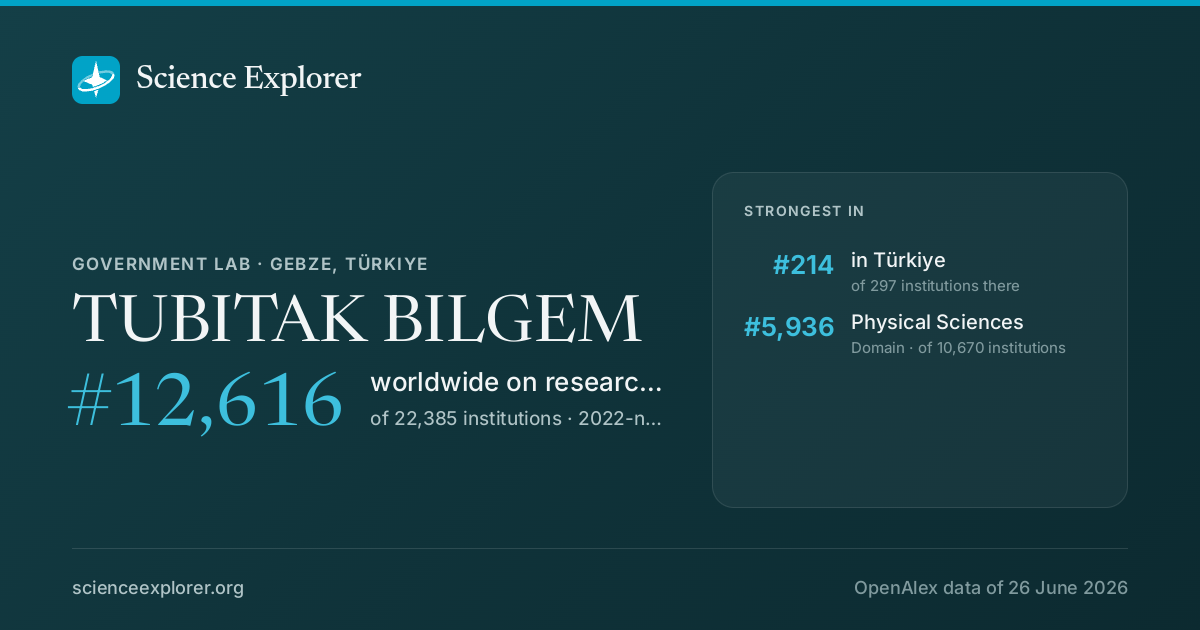
TUBITAK BILGEM on Science Explorer

A card with TUBITAK BILGEM's standing and the fields it leads in, for a post or a slide. A link to this page previews as the same card.

Download the card

1200 × 630 PNG, sized for social posts, drawn from the latest snapshot.

Badges for a website1Each links back here and updates with every snapshot

Research measures only: rankings here say nothing about teaching, admissions or student experience. Comparable institutions and collaboration partners have tabs of their own, above.

Discussion

Ask a question or share a note about TUBITAK BILGEM. Posts are plain text and can be reported.