Turkish Atomic Energy Authority
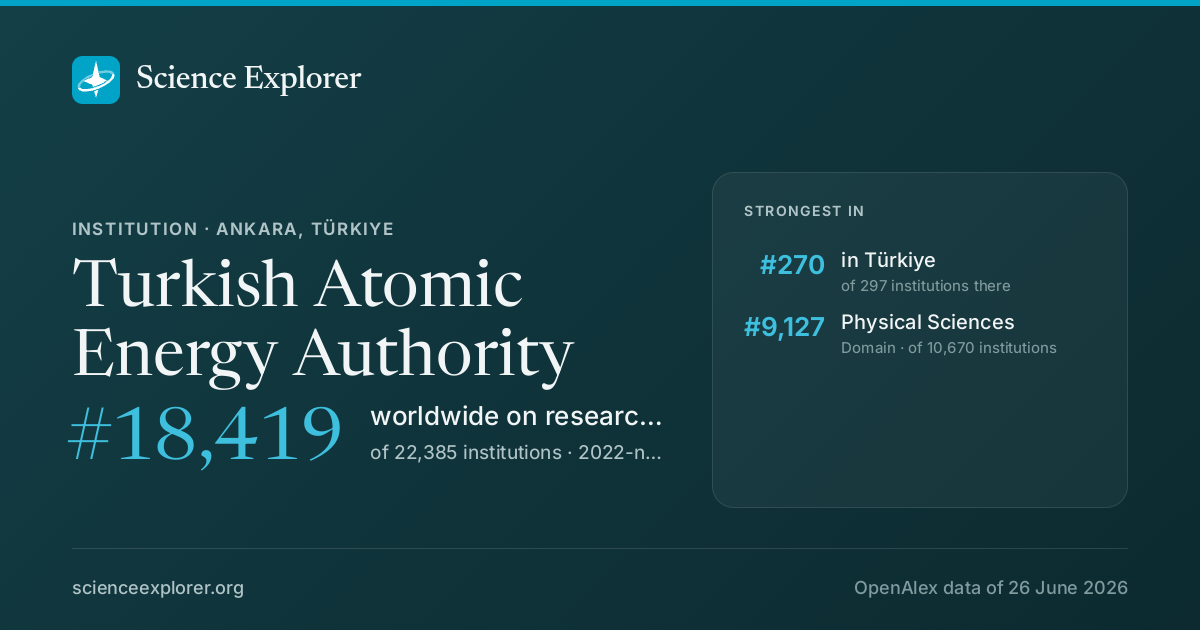
In research, Turkish Atomic Energy Authority stands highest in Physical Sciences (#9,127 of 10,670 worldwide), 2022-now.
- World rank, 2022-now
- #18,419 of 22,385 · #26,010 all time
- Rank in Türkiye
- #270 of 297
- Research works
- 544 ▲ 61% vs 2018-21
- Citations
- 6.5k 11.9 per fractional work
- Top-10% rate
- 9.9% all institutions 10.0%
- vs its own fields
- 0.94× 1.00× is exactly expected
- Open access
- 22% world 40%
- International
- 11% world 18%
What is Turkish Atomic Energy Authority known for in research?
The fields where it stands highest, 2022-now, ranked among every institution above the floor in each field.
| Field | World rank | Where that sits | Top-10% rate | Works | All time |
|---|---|---|---|---|---|
| Physical SciencesDomain | #9,127 of 10,670 | 9.8% | 64 | #15321 |
Each strip is that field's whole ranked pool, with the notch where Turkish Atomic Energy Authority sits in it, in the colour of the band that rank falls in. The track under the rate is the rate itself: it carries no average mark, because the average differs by field (from about 6% in Dentistry to 21% in Economics).
Which fields of science does Turkish Atomic Energy Authority work in?
In 2022-now, 71% of research at Turkish Atomic Energy Authority is in Physical Sciences, 13% in Life Sciences. Its largest fields are Engineering (28%), Physics and Astronomy (9%), Materials Science (9%). It does 1.8× the world's share of Physical Sciences.
Each ring splits the one inside it: the four domains of science, their fields, their subfields. Size is fractional works in 2022-now. Every slice is a page; the interactive view zooms down to single topics and colours each by how much more of it this institution does than the world.
Its 4 domains and 23 fields, with their numbers
- Physical Sciences8171.3%
- Engineering3228.0%
- Physics and Astronomy119.4%
- Materials Science109.1%
- Energy109.0%
- Environmental Science76.5%
- Earth and Planetary Sciences54.3%
- Chemistry22.1%
- Chemical Engineering21.7%
- Computer Science11.1%
- Life Sciences1412.7%
- Health Sciences108.5%
- Medicine54.6%
- Health Professions43.6%
- Nursing00.2%
- Dentistry00.1%
- Social Sciences97.5%
Field profile
Location quotient across every field it publishes in: outside the ring is more than an institution of this size would be expected to publish, inside it is less.
Rings at 0.5×, 1× and 2×. Widest outward: Energy, 9.8×. Every wedge is a field page.
All 23 fields, with their numbers
- Energy9.83×10 works
- Chemical Engineering4.97×2 works
- Physics and Astronomy4.24×11 works
- Earth and Planetary Sciences2.75×5 works
- Materials Science2.59×10 works
- Engineering1.86×32 works
- Agricultural and Biological Sciences1.66×9 works
- Chemistry1.37×2 works
- Health Professions1.35×4 works
- Environmental Science1.31×7 works
- Economics, Econometrics and Finance1.26×3 works
- Neuroscience0.73×1 works
- Biochemistry, Genetics and Molecular Biology0.68×4 works
- Decision Sciences0.61×1 works
- Nursing0.40×0 works
- Arts and Humanities0.38×1 works
- Medicine0.24×5 works
- Dentistry0.20×0 works
- Psychology0.18×1 works
- Social Sciences0.18×3 works
- Pharmacology, Toxicology and Pharmaceutics0.14×0 works
- Computer Science0.14×1 works
- Business, Management and Accounting0.09×0 works
- Energy 9.8×
- Chemical Engineering 5.0×
- Physics and Astronomy 4.2×
- Earth and Planetary Sciences 2.8×
- Materials Science 2.6×
- Engineering 1.9×
- Agricultural and Biological Sciences 1.7×
- Chemistry 1.4×
- Health Professions 1.4×
- Environmental Science 1.3×
- Economics, Econometrics and Finance 1.3×
- Neuroscience 0.7×
- Biochemistry, Genetics and Molecular Biology 0.7×
- Decision Sciences 0.6×
- Nursing 0.4×
- Arts and Humanities 0.4×
- Medicine 0.2×
- Dentistry 0.2×
- Psychology 0.2×
- Social Sciences 0.2×
- Pharmacology, Toxicology and Pharmaceutics 0.1×
- Computer Science 0.1×
- Business, Management and Accounting 0.1×
Who are the top researchers at Turkish Atomic Energy Authority?
Ranked on the quality score, Erkan Erdoğdu, Ahmet Erdal Osmanlıoğlu and Abdullah Dirican lead among researchers whose main affiliation is Turkish Atomic Energy Authority.
- 1
Erkan Erdoğdu
 Türkiye · #1,189,133 worldwide
946 citations · 58 works
- 2
Ahmet Erdal Osmanlıoğlu
Türkiye · #3,309,991 worldwide
467 citations · 18 works
- 3
Abdullah Dirican
Türkiye · #4,038,412 worldwide
279 citations · 34 works
- 4
Ahmet Varinlioğlu
Türkiye · #4,104,095 worldwide
706 citations · 40 works
- 5
A. Köse
Türkiye · #4,179,541 worldwide
301 citations · 17 works
- 6
Önder Bayır
Türkiye · #4,342,319 worldwide
38 citations · 17 works
- 7
Namık Kemal Şahin
Türkiye · #4,343,030 worldwide
126 citations · 16 works
- 8
Perihan Aysal
Türkiye · #4,482,452 worldwide
180 citations · 16 works
- 9
Berna Ataksor
Türkiye · #4,495,582 worldwide
210 citations · 16 works
- 10
İsmail Hakkı Arıkan
Türkiye · #4,650,302 worldwide
155 citations · 19 works
Which keywords describe research at Turkish Atomic Energy Authority?
By fractional works in 2022-now, weighted toward what it does more of than the world: Renewable Energy, Environmental Impact, Health Effects, Radionuclides, Ionizing Radiation, Toxicity, Energy Transition and Energy Storage.
- Mutation Breeding
- Battery Recycling
- Scintillation Detectors
- Neutron Activation Analysis
- Raman Spectroscopy
- Electrolysis
- Small-Angle Scattering
- Rare Earth Elements
- Nuclear Fuel
- Finite Element Analysis
- Metal Recovery
- Fossil Fuels
- Renewable Energy Integration
- Environmental Impacts
- Depleted Uranium
- Energy Transition
- Toxicity
- Ionizing Radiation
- Sustainability
- Environmental Impact
- Renewable Energy
- Health Effects
- Radionuclides
- Climate Change
- Energy Storage
- Lung Cancer
- Radon
- Nanomaterials
- EROI
- Fukushima Daiichi
- nuclear accident
- Food Safety
- Radiation Protection
- Tomography
- Crystal Growth
- Hydrogen
- Inorganic Scintillators
- Neutron Imaging
- Thermal Properties
- Sustainable Technology
Size is fractional works in 2022-now in the topics tagged with each word; colour is the word's share of this institution's work against its share of the world's. The 40 words are chosen for being large and distinctive. Each links to the topic it comes from most.
All 40 words, with their numbers
- Renewable Energy12▲ 7.0×20 topics
- Environmental Impact10▲ 5.0×13 topics
- Health Effects8▲ 11×8 topics
- Sustainability7▲ 2.5×12 topics
- Radionuclides7▲ 151×2 topics
- Ionizing Radiation6▲ 84×3 topics
- Climate Change6▲ 1.90×14 topics
- Toxicity5▲ 10×7 topics
- Energy Storage5▲ 6.5×9 topics
- Energy Transition4▲ 26×3 topics
- Lung Cancer4▲ 23×2 topics
- Depleted Uranium4▲ 158×1 topic
- Radon4▲ 158×1 topic
- Environmental Impacts3▲ 11×3 topics
- Nanomaterials3▲ 2.4×10 topics
- Renewable Energy Integration3▲ 7.6×5 topics
- EROI3▲ 71×1 topic
- Fossil Fuels3▲ 48×1 topic
- Fukushima Daiichi3▲ 141×1 topic
- Metal Recovery3▲ 12×3 topics
- nuclear accident3▲ 141×1 topic
- Finite Element Analysis2▲ 9.7×2 topics
- Food Safety2▲ 7.6×3 topics
- Nuclear Fuel2▲ 137×1 topic
- Radiation Protection2▲ 137×1 topic
- Rare Earth Elements2▲ 14×3 topics
- Tomography2▲ 11×4 topics
- Small-Angle Scattering2▲ 36×2 topics
- Crystal Growth2▲ 6.5×2 topics
- Electrolysis2▲ 26×1 topic
- Hydrogen2▲ 21×1 topic
- Raman Spectroscopy2▲ 9.0×4 topics
- Inorganic Scintillators2▲ 51×1 topic
- Neutron Activation Analysis2▲ 52×1 topic
- Neutron Imaging2▲ 52×1 topic
- Scintillation Detectors2▲ 51×1 topic
- Thermal Properties2▲ 13×4 topics
- Battery Recycling2▲ 18×1 topic
- Sustainable Technology2▲ 13×1 topic
- Mutation Breeding2▲ 97×1 topic
Which research topics does Turkish Atomic Energy Authority publish most on?
By volume in 2022-now: Radioactivity and Radon Measurements, Global Energy and Sustainability Research, Radioactive contamination and transfer and Nuclear and radioactivity studies.
Area is fractional works; colour is the subfield each topic belongs to.
- 1 Radioactivity and Radon Measurements Radiological and Ultrasound Technology 4 works
- 2 Global Energy and Sustainability Research Renewable Energy, Sustainability and the Environment 3 works
- 3 Radioactive contamination and transfer Global and Planetary Change 3 works
- 4 Nuclear and radioactivity studies Safety, Risk, Reliability and Quality 2 works
- 5 Hybrid Renewable Energy Systems Energy Engineering and Power Technology 2 works
- 6 Radiation Detection and Scintillator Technologies Radiation 2 works
- 7 Nuclear Physics and Applications Radiation 2 works
- 8 Extraction and Separation Processes Mechanical Engineering 2 works
- 9 Plant Genetic and Mutation Studies Plant Science 2 works
- 10 Electric Power System Optimization Electrical and Electronic Engineering 1 works
How open and international is its research?
Against the world's own shares: the tick on each track. Both are shares of its output, so they sit on one scale and can be read against each other as well as against the world.
World: 40% of research is openly available.
World: 18% is written across borders.
How has Turkish Atomic Energy Authority's research output changed?
Output in 2022-2025 was 61% higher than in 2018-2021.
The same series as a ribbon: one cell per year, darker for more. The line above answers how much; this answers when.
Its share of all research
Growing output can still be a shrinking share: all of science grows. This is Turkish Atomic Energy Authority as a percentage of every work published that year, 0.00046% in 2024.
Fractional works of Turkish Atomic Energy Authority over all fractional works that year. How the balance of science has shifted.
How much of it reaches the world top 10%
Year by year, against all institutions in the same year.
Of each year's output, the share that reached the world's 10% most cited for its field and year. Peak 14.2% in 2006.
Other research institutions in Ankara
- Hacettepe University
- Ankara University
- Gazi University
- Middle East Technical University
- Başkent University
- Bilkent University
- Ankara Sosyal Bilimler Üniversitesi
- Ankara Yıldırım Beyazıt University





Share Turkish Atomic Energy Authority's ranking
Badges for a website1Each links back here and updates with every snapshot

Research measures only: rankings here say nothing about teaching, admissions or student experience. Comparable institutions and collaboration partners have tabs of their own, above.
Discussion
Ask a question or share a note about Turkish Atomic Energy Authority. Posts are plain text and can be reported.