Ankara University

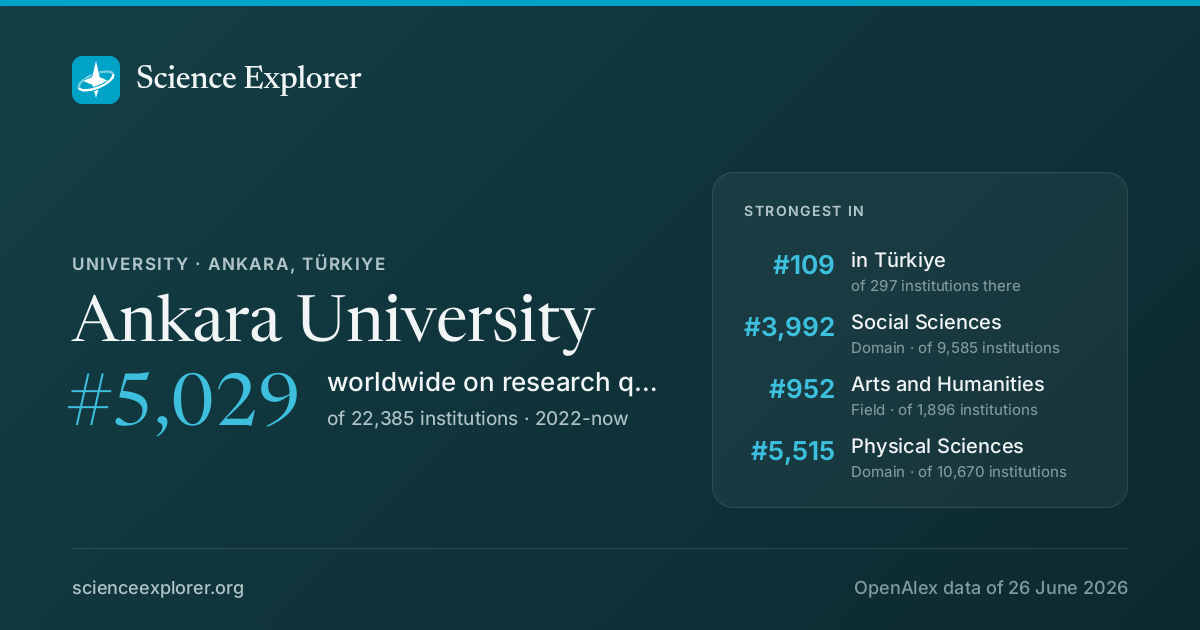
In research, Ankara University stands highest in Social Sciences (#3,992 of 9,585 worldwide), Arts and Humanities (#952 of 1,896 worldwide) and Physical Sciences (#5,515 of 10,670 worldwide), 2022-now. Relative to its size it is most specialised in Museology, Orthodontics and Oral Surgery (Museology is 9.0× its share of world research).
- World rank, 2022-now
- #5,029 of 22,385 · #7,745 all time
- Rank in Türkiye
- #109 of 297
- Research works
- 39k ▲ 19% vs 2018-21
- Citations
- 428k 11.1 per fractional work
- Top-10% rate
- 7.0% all institutions 10.0%
- vs its own fields
- 0.62× 1.00× is exactly expected
- Open access
- 55% world 40%
- International
- 12% world 18%
What is Ankara University known for in research?
The fields where it stands highest, 2022-now, ranked among every institution above the floor in each field.
| Field | World rank | Where that sits | Top-10% rate | Works | All time |
|---|---|---|---|---|---|
| Social SciencesDomain | #3,992 of 9,585 | 7.8% | 2,801 | #5246 | |
| Arts and HumanitiesField | #952 of 1,896 | 8.6% | 690 | #1993 | |
| Physical SciencesDomain | #5,515 of 10,670 | 7.6% | 1,872 | #12732 | |
| Agricultural and Biological SciencesField | #1,850 of 3,157 | 7.8% | 652 | #2909 | |
| DentistryField | #240 of 405 | 9.9% | 199 | #577 | |
| Oral SurgerySubfield | #56 of 94 | 10.8% | 99 | #289 | |
| Social SciencesField | #3,963 of 5,988 | 8.1% | 1,323 | #4943 | |
| Plant ScienceSubfield | #966 of 1,317 | 8.5% | 248 | #1957 | |
| MuseologySubfield | #30 of 40 | 7.5% | 112 | #95 | |
| EngineeringField | #4,432 of 5,901 | 7.9% | 585 | #6810 |
Each strip is that field's whole ranked pool, with the notch where Ankara University sits in it, in the colour of the band that rank falls in. The track under the rate is the rate itself: it carries no average mark, because the average differs by field (from about 6% in Dentistry to 21% in Economics).
Which of those standings moved
The same fields on both windows: where it stood over the whole record, and where it stands in 2022-now. The distance is the story, and it is the one thing the two rank columns above cannot show.
- Social Sciences#5,246 #3,992
- Arts and Humanities#1,993 #952
- Physical Sciences#12,732 #5,515
- Agricultural and Biological Sciences#2,909 #1,850
- Dentistry#577 #240
- Oral Surgery#289 #56
- Social Sciences#4,943 #3,963
- Plant Science#1,957 #966
- Museology#95 #30
- Engineering#6,810 #4,432
A dot further right is a better standing. Fields it was not ranked in over the whole record are left out.
Which fields of science does Ankara University work in?
In 2022-now, 33% of research at Ankara University is in Health Sciences, 30% in Social Sciences. Its largest fields are Medicine (27%), Social Sciences (14%), Agricultural and Biological Sciences (7%). It does 1.4× the world's share of Health Sciences.
Each ring splits the one inside it: the four domains of science, their fields, their subfields. Size is fractional works in 2022-now. Every slice is a page; the interactive view zooms down to single topics and colours each by how much more of it this institution does than the world.
Its 4 domains and 26 fields, with their numbers
- Health Sciences3,41332.5%
- Medicine2,78526.6%
- Health Professions2612.5%
- Dentistry2422.3%
- Nursing900.9%
- Veterinary360.3%
- Social Sciences3,15130.0%
- Social Sciences1,50014.3%
- Arts and Humanities7477.1%
- Psychology4934.7%
- Economics, Econometrics and Finance1701.6%
- Business, Management and Accounting1661.6%
- Decision Sciences750.7%
- Physical Sciences2,18020.8%
- Engineering6756.4%
- Computer Science3583.4%
- Environmental Science3243.1%
- Materials Science2052.0%
- Chemistry1711.6%
- Mathematics1391.3%
- Physics and Astronomy1191.1%
- Earth and Planetary Sciences1131.1%
- Energy470.4%
- Chemical Engineering290.3%
- Life Sciences1,74316.6%
What does Ankara University specialise in?
Where its research is concentrated relative to its size: Museology takes 9.0× the share of its output that it takes of world research.
- MuseologySubfield · 115.6 works9.0×
- OrthodonticsSubfield · 71.6 works6.1×
- Oral SurgerySubfield · 115.9 works5.7×
- DentistryField · 241.8 works4.8×
- Religious studiesSubfield · 80.4 works4.6×
- General DentistrySubfield · 20.2 works4.4×
Location quotient, a volume reading rather than an impact one. It surfaces small, lopsided specialities.
Field profile
Location quotient across every field it publishes in: outside the ring is more than an institution of this size would be expected to publish, inside it is less.
Rings at 0.5×, 1× and 2×. Widest outward: Dentistry, 4.8×. Every wedge is a field page.
All 26 fields, with their numbers
- Dentistry4.75×242 works
- Veterinary2.51×36 works
- Arts and Humanities2.47×747 works
- Nursing1.76×90 works
- Pharmacology, Toxicology and Pharmaceutics1.57×58 works
- Psychology1.54×493 works
- Agricultural and Biological Sciences1.51×752 works
- Medicine1.38×2,785 works
- Biochemistry, Genetics and Molecular Biology1.18×661 works
- Mathematics1.13×139 works
- Social Sciences1.13×1,500 works
- Chemistry1.04×171 works
- Immunology and Microbiology1.02×108 works
- Neuroscience0.97×165 works
- Health Professions0.94×261 works
- Chemical Engineering0.80×29 works
- Economics, Econometrics and Finance0.76×170 works
- Decision Sciences0.74×75 works
- Earth and Planetary Sciences0.69×113 works
- Environmental Science0.62×324 works
- Materials Science0.56×205 works
- Physics and Astronomy0.51×118 works
- Business, Management and Accounting0.49×166 works
- Energy0.48×46 works
- Computer Science0.44×358 works
- Engineering0.43×675 works
- Dentistry 4.8×
- Veterinary 2.5×
- Arts and Humanities 2.5×
- Nursing 1.8×
- Pharmacology, Toxicology and Pharmaceutics 1.6×
- Psychology 1.5×
- Agricultural and Biological Sciences 1.5×
- Medicine 1.4×
- Biochemistry, Genetics and Molecular Biology 1.2×
- Mathematics 1.1×
- Social Sciences 1.1×
- Chemistry 1.0×
- Immunology and Microbiology 1.0×
- Neuroscience 1.0×
- Health Professions 0.9×
- Chemical Engineering 0.8×
- Economics, Econometrics and Finance 0.8×
- Decision Sciences 0.7×
- Earth and Planetary Sciences 0.7×
- Environmental Science 0.6×
- Materials Science 0.6×
- Physics and Astronomy 0.5×
- Business, Management and Accounting 0.5×
- Energy 0.5×
- Computer Science 0.4×
- Engineering 0.4×
Who are the top researchers at Ankara University?
Ranked on the quality score, Oğuzhan Şahin, Cihan Yurdaydın and Ramazan Idılman lead among researchers whose main affiliation is Ankara University.
- 1
Oğuzhan Şahin
 Türkiye · #345,601 worldwide
1.2k citations · 53 works
- 2
Cihan Yurdaydın
Türkiye · #447,082 worldwide
14k citations · 428 works
- 3
Ramazan Idılman
Türkiye · #479,206 worldwide
12k citations · 372 works
- 4
C. Kamiscioglu
Türkiye · #513,385 worldwide
1.7k citations · 60 works
- 5
Nevin Erk
Türkiye · #584,836 worldwide
5.1k citations · 179 works
- 6
Meral Beksaç
Türkiye · #597,632 worldwide
17k citations · 281 works
- 7
Duygu Duman
Türkiye · #703,115 worldwide
2.8k citations · 60 works
- 8
Aydan İkincioğulları
Türkiye · #705,968 worldwide
5.9k citations · 194 works
- 9
Burak Derkuş
Türkiye · #715,588 worldwide
1.9k citations · 82 works
- 10 Figen Doğu #754,007 worldwide 5.7k citations · 196 works
Which keywords describe research at Ankara University?
By fractional works in 2022-now, weighted toward what it does more of than the world: Cultural Heritage, Epidemiology, Ottoman Empire, Sufism, Mental Health, Nationalism, Ethnography and Rituals.
- Education Policy
- Etymology
- Mu'tazilite Thought
- Syntax
- Theology
- Divan Poetry
- Genetic Processes
- Social Systems
- Traditional Beliefs
- Storytelling
- Psychological Functioning
- Migration
- Neoliberalism
- Antioxidant
- Sufism
- Nationalism
- Oxidative Stress
- Sustainability
- Mental Health
- Cultural Heritage
- Epidemiology
- Inflammation
- Quality of Life
- Globalization
- Treatment
- Ottoman Empire
- Public Policy
- Ethnography
- Rituals
- Therapy
- Mythology
- Folklore
- Turkish Culture
- Family Constellations
- Diplomacy
- Turkish Literature
- Authoritarianism
- Islamic Studies
- Religious Language
- Historical Phonology
Size is fractional works in 2022-now in the topics tagged with each word; colour is the word's share of this institution's work against its share of the world's. The 40 words are chosen for being large and distinctive. Each links to the topic it comes from most.
All 40 words, with their numbers
- Epidemiology555▲ 1.33×132 topics
- Cultural Heritage372▲ 6.7×24 topics
- Inflammation292▲ 1.31×83 topics
- Mental Health288▲ 1.92×42 topics
- Quality of Life242▲ 1.60×56 topics
- Sustainability236◆ 0.92×88 topics
- Globalization226◆ 1.10×97 topics
- Oxidative Stress219▲ 1.27×62 topics
- Treatment182▲ 1.42×50 topics
- Nationalism172▲ 3.7×24 topics
- Ottoman Empire162▲ 22×3 topics
- Sufism145▲ 30×2 topics
- Public Policy143▲ 2.9×13 topics
- Antioxidant138▲ 1.92×50 topics
- Ethnography127▲ 7.0×13 topics
- Neoliberalism119▲ 3.2×19 topics
- Rituals113▲ 13×4 topics
- Migration113▲ 3.1×26 topics
- Therapy113▲ 5.5×8 topics
- Psychological Functioning111▲ 13×2 topics
- Mythology110▲ 21×3 topics
- Storytelling110▲ 22×4 topics
- Folklore110▲ 20×2 topics
- Traditional Beliefs107▲ 32×1 topic
- Turkish Culture107▲ 32×1 topic
- Social Systems94▲ 15×2 topics
- Family Constellations92▲ 30×1 topic
- Genetic Processes92▲ 30×1 topic
- Diplomacy82▲ 8.4×8 topics
- Divan Poetry76▲ 29×1 topic
- Turkish Literature76▲ 29×1 topic
- Theology73▲ 7.6×5 topics
- Authoritarianism71▲ 7.7×5 topics
- Syntax71▲ 9.4×3 topics
- Islamic Studies68▲ 23×2 topics
- Mu'tazilite Thought68▲ 31×1 topic
- Religious Language68▲ 31×1 topic
- Etymology68▲ 14×2 topics
- Historical Phonology68▲ 14×2 topics
- Education Policy67▲ 9.4×6 topics
Which research topics does Ankara University publish most on?
By volume in 2022-now: Cultural and Sociopolitical Studies, Families in Therapy and Culture, Turkish Literature and Culture and Islamic Thought and Society Studies.
Area is fractional works; colour is the subfield each topic belongs to.
- 1 Cultural and Sociopolitical Studies Museology 107 works
- 2 Families in Therapy and Culture Social Psychology 92 works
- 3 Turkish Literature and Culture Literature and Literary Theory 76 works
- 4 Islamic Thought and Society Studies Religious studies 68 works
- 5 Linguistics and Cultural Studies Language and Linguistics 67 works
- 6 Turkey's Politics and Society Political Science and International Relations 62 works
- 7 Historical Turkish Studies Political Science and International Relations 62 works
- 8 Ottoman and Turkish Studies History 58 works
- 9 Education Practices and Challenges Philosophy 54 works
- 10 Electrochemical sensors and biosensors Electrical and Electronic Engineering 51 works
How open and international is its research?
Against the world's own shares: the tick on each track. Both are shares of its output, so they sit on one scale and can be read against each other as well as against the world.
World: 40% of research is openly available.
World: 18% is written across borders.
How has Ankara University's research output changed?
Output in 2022-2025 was 19% higher than in 2018-2021.
The same series as a ribbon: one cell per year, darker for more. The line above answers how much; this answers when.
Its share of all research
Growing output can still be a shrinking share: all of science grows. This is Ankara University as a percentage of every work published that year, 0.039% in 2024.
Fractional works of Ankara University over all fractional works that year. How the balance of science has shifted.
How much of it reaches the world top 10%
Year by year, against all institutions in the same year.
Of each year's output, the share that reached the world's 10% most cited for its field and year. Peak 8.4% in 2006.
Other research institutions in Ankara
- Hacettepe University
- Gazi University
- Middle East Technical University
- Başkent University
- Bilkent University
- Ankara Sosyal Bilimler Üniversitesi
- Ankara Yıldırım Beyazıt University
- Mi̇lli̇ Eği̇ti̇m Bakanliği







Share Ankara University's ranking
Badges for a website1Each links back here and updates with every snapshot

Research measures only: rankings here say nothing about teaching, admissions or student experience. Comparable institutions and collaboration partners have tabs of their own, above.
Discussion
Ask a question or share a note about Ankara University. Posts are plain text and can be reported.