Tver State University
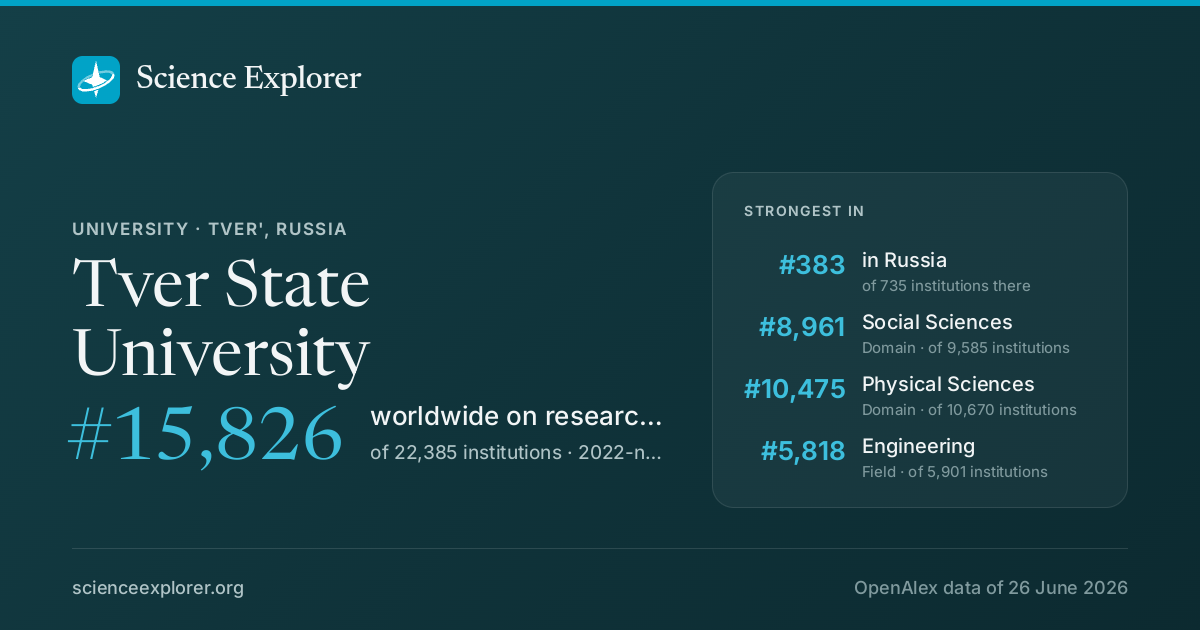
In research, Tver State University stands highest in Social Sciences (#8,961 of 9,585 worldwide), Social Sciences (#5,623 of 5,988 worldwide) and Physical Sciences (#10,475 of 10,670 worldwide), 2022-now.
- World rank, 2022-now
- #15,826 of 22,385 · #32,808 all time
- Rank in Russia
- #383 of 735
- Research works
- 2k ▼ 14% vs 2018-21
- Citations
- 8.9k 4.5 per fractional work
- Top-10% rate
- 4.8% all institutions 10.0%
- vs its own fields
- 0.72× 1.00× is exactly expected
- Open access
- 41% world 40%
- International
- 11% world 18%
What is Tver State University known for in research?
The fields where it stands highest, 2022-now, ranked among every institution above the floor in each field.
| Field | World rank | Where that sits | Top-10% rate | Works | All time |
|---|---|---|---|---|---|
| Social SciencesDomain | #8,961 of 9,585 | 6.9% | 165 | #12097 | |
| Social SciencesField | #5,623 of 5,988 | 8.0% | 113 | #8598 | |
| Physical SciencesDomain | #10,475 of 10,670 | 3.0% | 265 | #17227 | |
| EngineeringField | #5,818 of 5,901 | 2.9% | 67 | #9410 |
Each strip is that field's whole ranked pool, with the notch where Tver State University sits in it, in the colour of the band that rank falls in. The track under the rate is the rate itself: it carries no average mark, because the average differs by field (from about 6% in Dentistry to 21% in Economics).
Which of those standings moved
The same fields on both windows: where it stood over the whole record, and where it stands in 2022-now. The distance is the story, and it is the one thing the two rank columns above cannot show.
- Social Sciences#12,097 #8,961
- Social Sciences#8,598 #5,623
- Physical Sciences#17,227 #10,475
- Engineering#9,410 #5,818
A dot further right is a better standing. Fields it was not ranked in over the whole record are left out.
Which fields of science does Tver State University work in?
In 2022-now, 57% of research at Tver State University is in Physical Sciences, 36% in Social Sciences. Its largest fields are Social Sciences (25%), Engineering (14%), Materials Science (12%). It does 1.5× the world's share of Social Sciences.
Each ring splits the one inside it: the four domains of science, their fields, their subfields. Size is fractional works in 2022-now. Every slice is a page; the interactive view zooms down to single topics and colours each by how much more of it this institution does than the world.
Its 4 domains and 24 fields, with their numbers
- Physical Sciences27656.8%
- Engineering6914.2%
- Materials Science5812.0%
- Physics and Astronomy326.7%
- Computer Science326.6%
- Chemistry234.7%
- Earth and Planetary Sciences204.2%
- Environmental Science173.5%
- Mathematics132.7%
- Chemical Engineering91.9%
- Energy10.2%
- Social Sciences17636.3%
- Social Sciences12124.9%
- Arts and Humanities255.2%
- Economics, Econometrics and Finance122.5%
- Business, Management and Accounting112.2%
- Psychology51.0%
- Decision Sciences30.6%
- Life Sciences234.7%
- Health Sciences102.1%
- Medicine91.8%
- Health Professions10.2%
- Dentistry00.1%
- Nursing00.0%
Field profile
Location quotient across every field it publishes in: outside the ring is more than an institution of this size would be expected to publish, inside it is less.
Rings at 0.5×, 1× and 2×. Widest outward: Chemical Engineering, 5.5×. Every wedge is a field page.
All 23 fields, with their numbers
- Chemical Engineering5.54×9 works
- Materials Science3.45×58 works
- Physics and Astronomy3.00×32 works
- Chemistry2.99×23 works
- Earth and Planetary Sciences2.68×20 works
- Mathematics2.32×13 works
- Social Sciences1.97×121 works
- Arts and Humanities1.79×25 works
- Economics, Econometrics and Finance1.15×12 works
- Engineering0.95×69 works
- Computer Science0.85×32 works
- Agricultural and Biological Sciences0.74×17 works
- Environmental Science0.71×17 works
- Business, Management and Accounting0.68×11 works
- Decision Sciences0.64×3 works
- Psychology0.31×5 works
- Energy0.26×1 works
- Biochemistry, Genetics and Molecular Biology0.21×6 works
- Dentistry0.18×0 works
- Medicine0.09×9 works
- Nursing0.09×0 works
- Health Professions0.07×1 works
- Neuroscience0.03×0 works
- Chemical Engineering 5.5×
- Materials Science 3.5×
- Physics and Astronomy 3.0×
- Chemistry 3.0×
- Earth and Planetary Sciences 2.7×
- Mathematics 2.3×
- Social Sciences 2.0×
- Arts and Humanities 1.8×
- Economics, Econometrics and Finance 1.1×
- Engineering 0.9×
- Computer Science 0.8×
- Agricultural and Biological Sciences 0.7×
- Environmental Science 0.7×
- Business, Management and Accounting 0.7×
- Decision Sciences 0.6×
- Psychology 0.3×
- Energy 0.3×
- Biochemistry, Genetics and Molecular Biology 0.2×
- Dentistry 0.2×
- Medicine 0.1×
- Nursing 0.1×
- Health Professions 0.1×
- Neuroscience 0.0×
Who are the top researchers at Tver State University?
Ranked on the quality score, G. S. Sharov, Nadezhda V. Pilipchuk and K.G. Savina lead among researchers whose main affiliation is Tver State University.
- 1
G. S. Sharov
 Russia · #2,574,516 worldwide
1k citations · 101 works
- 2
Nadezhda V. Pilipchuk
Russia · #5,514,916 worldwide
87 citations · 37 works
- 3
K.G. Savina
Russia · #5,575,639 worldwide
117 citations · 17 works
- 4
Iuliia Vladimirovna Stepanova
Russia · #5,712,200 worldwide
50 citations · 32 works
- 5
Denis L. Stupin
Russia · #5,845,167 worldwide
26 citations · 15 works
- 6
A. I. Zhiliba
Russia · #5,875,816 worldwide
265 citations · 25 works
- 7
Aleksey A. Vasiliev
Russia · #5,937,495 worldwide
156 citations · 16 works
- 8
A. N. Adamyan
Russia · #6,000,992 worldwide
224 citations · 15 works
- 9
Michael A. Taitslin
Russia · #6,057,879 worldwide
408 citations · 43 works
- 10
Ulyana N. Spirina
Russia · #6,118,778 worldwide
172 citations · 96 works
Which keywords describe research at Tver State University?
By fractional works in 2022-now, weighted toward what it does more of than the world: Digital Transformation, Nanoparticles, Regional Development, Language, Legal Regulation, Media, Sustainable Development and Ethnicity.
- Legal Modernization
- Geographical Analysis
- Green Chemistry
- Digital Economy
- Transport Policy
- International Trade Law
- Migration
- Ice Nucleation
- Molecular Dynamics Simulation
- Phase Diagrams
- Literature
- Economic Security
- Crystal Growth
- Catalysis
- Media
- Language
- Artificial Intelligence
- Innovation
- Climate Change
- Sustainable Development
- Nanoparticles
- Digital Transformation
- Globalization
- Social Media
- Regional Development
- Legal Regulation
- Economic Development
- Ethnicity
- Discourse Analysis
- Phraseology
- Linguistics
- Cultural Communication
- Persuasion Strategies
- Melting
- Blockchain Technology
- Public Oversight
- Foresight
- Digital Technologies
- Fiscal Policy
- Constitutional Reform
Size is fractional works in 2022-now in the topics tagged with each word; colour is the word's share of this institution's work against its share of the world's. The 40 words are chosen for being large and distinctive. Each links to the topic it comes from most.
All 40 words, with their numbers
- Nanoparticles28▲ 4.6×23 topics
- Sustainable Development24▲ 3.2×23 topics
- Digital Transformation23▲ 8.7×11 topics
- Climate Change22▲ 1.66×28 topics
- Globalization20▲ 2.1×22 topics
- Innovation20▲ 4.0×13 topics
- Social Media20▲ 3.0×8 topics
- Artificial Intelligence20▲ 2.9×16 topics
- Regional Development19▲ 12×4 topics
- Language18▲ 15×5 topics
- Legal Regulation18▲ 16×6 topics
- Media17▲ 24×4 topics
- Economic Development16▲ 4.2×13 topics
- Catalysis15▲ 4.6×16 topics
- Ethnicity15▲ 8.3×4 topics
- Crystal Growth14▲ 11×6 topics
- Discourse Analysis14▲ 12×3 topics
- Economic Security14▲ 13×4 topics
- Phraseology13▲ 39×3 topics
- Literature13▲ 5.0×12 topics
- Linguistics13▲ 17×3 topics
- Phase Diagrams13▲ 105×2 topics
- Cultural Communication12▲ 72×1 topic
- Molecular Dynamics Simulation12▲ 23×2 topics
- Persuasion Strategies12▲ 72×1 topic
- Ice Nucleation12▲ 59×1 topic
- Melting12▲ 168×1 topic
- Migration12▲ 7.1×5 topics
- Blockchain Technology12▲ 43×2 topics
- International Trade Law12▲ 18×2 topics
- Public Oversight11▲ 19×1 topic
- Transport Policy11▲ 19×1 topic
- Foresight11▲ 17×2 topics
- Digital Economy10▲ 10×9 topics
- Digital Technologies10▲ 15×3 topics
- Green Chemistry10▲ 11×6 topics
- Fiscal Policy10▲ 9.8×2 topics
- Geographical Analysis10▲ 47×2 topics
- Constitutional Reform9▲ 56×1 topic
- Legal Modernization9▲ 65×1 topic
Which research topics does Tver State University publish most on?
By volume in 2022-now: Discourse Analysis and Cultural Communication, nanoparticles nucleation surface interactions, Legal and Regulatory Analysis and Legal and Policy Issues.
Area is fractional works; colour is the subfield each topic belongs to.
- 1 Discourse Analysis and Cultural Communication Cultural Studies 12 works
- 2 nanoparticles nucleation surface interactions Atmospheric Science 12 works
- 3 Legal and Regulatory Analysis Transportation 11 works
- 4 Legal and Policy Issues Law 9 works
- 5 Regional Socio-Economic Development Trends Demography 8 works
- 6 Military Technology and Strategies Aerospace Engineering 8 works
- 7 Magnetic Properties of Alloys Electronic, Optical and Magnetic Materials 7 works
- 8 Linguistic, Cultural, and Literary Studies Sociology and Political Science 7 works
- 9 Economic and Technological Developments in Russia Development 7 works
- 10 Sociopolitical Dynamics in Russia Sociology and Political Science 6 works
How open and international is its research?
Against the world's own shares: the tick on each track. Both are shares of its output, so they sit on one scale and can be read against each other as well as against the world.
World: 40% of research is openly available.
World: 18% is written across borders.
How has Tver State University's research output changed?
Output in 2022-2025 was 14% lower than in 2018-2021.
The same series as a ribbon: one cell per year, darker for more. The line above answers how much; this answers when.
Its share of all research
Growing output can still be a shrinking share: all of science grows. This is Tver State University as a percentage of every work published that year, 0.0016% in 2024.
Fractional works of Tver State University over all fractional works that year. How the balance of science has shifted.
How much of it reaches the world top 10%
Year by year, against all institutions in the same year.
Of each year's output, the share that reached the world's 10% most cited for its field and year. Peak 6.8% in 2025.
Other research institutions in Tver'
- Tver State Technical University
- Tver State Medical University
- Research Institute of Synthetic Fiber with the Pilot Plant
- Tver State Agricultural Academy
- Central Forest Nature Reserve
- Military Academy of Air-Space Defense named after Marshal of the Soviet Union GK Zhukov
- Scientific Research Institute of Flax Mechanization
- Tver Wagon Building Institute (Russia)
Share Tver State University's ranking
Badges for a website1Each links back here and updates with every snapshot

Research measures only: rankings here say nothing about teaching, admissions or student experience. Comparable institutions and collaboration partners have tabs of their own, above.
Discussion
Ask a question or share a note about Tver State University. Posts are plain text and can be reported.