Utano Hospital
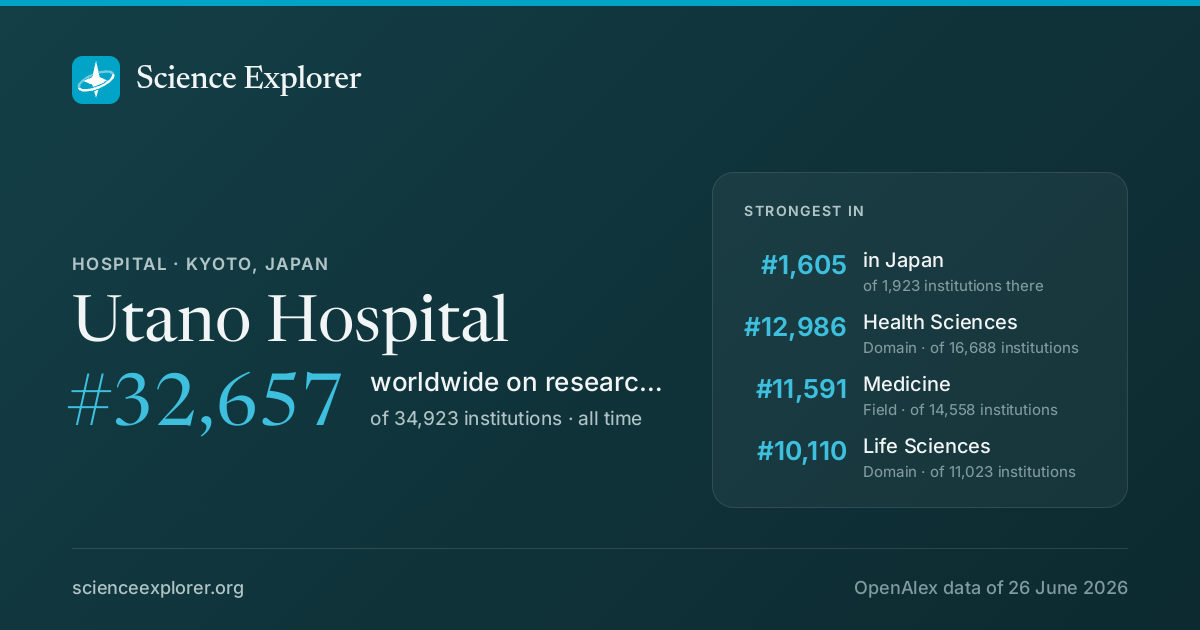
In research, Utano Hospital stands highest in Health Sciences (#12,986 of 16,688 worldwide), Medicine (#11,591 of 14,558 worldwide) and Life Sciences (#10,110 of 11,023 worldwide), over all time.
- World rank, all time
- #32,657 of 34,923
- Rank in Japan
- #1,605 of 1,923
- Research works
- 448 ▼ 21% vs 2018-21
- Citations
- 9.3k 20.8 per fractional work
- Top-10% rate
- 10.5% all institutions 10.0%
- vs its own fields
- 0.79× 1.00× is exactly expected
- Open access
- 31% world 40%
- International
- 7% world 18%
What is Utano Hospital known for in research?
The fields where it stands highest, over all time, ranked among every institution above the floor in each field.
| Field | World rank | Where that sits | Top-10% rate | Works |
|---|---|---|---|---|
| Health SciencesDomain | #12,986 of 16,688 | 6.4% | 281 | |
| MedicineField | #11,591 of 14,558 | 6.5% | 272 | |
| Life SciencesDomain | #10,110 of 11,023 | 3.8% | 148 |
Each strip is that field's whole ranked pool, with the notch where Utano Hospital sits in it, in the colour of the band that rank falls in. The track under the rate is the rate itself: it carries no average mark, because the average differs by field (from about 6% in Dentistry to 21% in Economics).
Which fields of science does Utano Hospital work in?
In all years, 63% of research at Utano Hospital is in Health Sciences, 33% in Life Sciences. Its largest fields are Medicine (61%), Neuroscience (13%), Biochemistry, Genetics and Molecular Biology (13%). It does 2.6× the world's share of Health Sciences.
Each ring splits the one inside it: the four domains of science, their fields, their subfields. Size is fractional works in all years. Every slice is a page; the interactive view zooms down to single topics and colours each by how much more of it this institution does than the world.
Its 4 domains and 22 fields, with their numbers
- Health Sciences28162.7%
- Medicine27260.6%
- Nursing51.2%
- Health Professions40.9%
- Dentistry00.0%
- Life Sciences14833.0%
- Physical Sciences163.7%
- Environmental Science61.4%
- Engineering40.9%
- Chemistry30.6%
- Materials Science10.3%
- Physics and Astronomy10.2%
- Computer Science10.2%
- Energy00.1%
- Earth and Planetary Sciences00.0%
- Social Sciences30.6%
Field profile
Location quotient across every field it publishes in: outside the ring is more than an institution of this size would be expected to publish, inside it is less.
Rings at 0.5×, 1× and 2×. Widest outward: Neuroscience, 9.2×. Every wedge is a field page.
All 11 fields, with their numbers
- Neuroscience9.18×3 works
- Medicine3.86×14 works
- Immunology and Microbiology1.89×0 works
- Biochemistry, Genetics and Molecular Biology1.15×1 works
- Nursing0.78×0 works
- Energy0.49×0 works
- Health Professions0.34×0 works
- Arts and Humanities0.15×0 works
- Materials Science0.09×0 works
- Psychology0.07×0 works
- Engineering0.02×0 works
Who are the top researchers at Utano Hospital?
Ranked on the quality score, Tomoko Oeda, Sadako Kuno and Kyoko Saida lead among researchers whose main affiliation is Utano Hospital.
- 1
Tomoko Oeda
 Japan · #1,466,912 worldwide
2.7k citations · 73 works
- 2
Sadako Kuno
Japan · #2,779,807 worldwide
4.8k citations · 127 works
- 3
Kyoko Saida
Japan · #2,921,441 worldwide
2.3k citations · 81 works
- 4
Osamu Komure
Japan · #3,074,484 worldwide
3.7k citations · 46 works
- 5
Masayuki Tahara
Japan · #3,190,694 worldwide
830 citations · 54 works
- 6
Takahiko Saida
Japan · #3,427,832 worldwide
6k citations · 168 works
- 7
Masataka Nishimura
Japan · #3,441,675 worldwide
5.5k citations · 166 works
- 8
Satoshi Tomita
Japan · #3,680,539 worldwide
664 citations · 30 works
- 9
Masayuki Kohsaka
Japan · #3,693,732 worldwide
651 citations · 26 works
- 10
Kwiyoung Park
Japan · #3,725,160 worldwide
576 citations · 27 works
Which keywords describe research at Utano Hospital?
By fractional works in all years, weighted toward what it does more of than the world: Neurological Disorders, Oxidative Stress, Diagnostic Criteria, Parkinson's Disease, Mitochondrial Dysfunction, Prognosis, Immunotherapy and Neurodegeneration.
- Dendritic Spines
- Chronic Inflammatory Demyelinating Polyradiculoneuropathy
- Basal Ganglia
- Deep Brain Stimulation
- Status Epilepticus
- Thymic Tumors
- Myasthenia Gravis
- Drug Resistance
- Genetic Risk Factors
- Neuromuscular Junction
- Classification
- Diagnosis
- Antiepileptic Drugs
- Cognitive Impairment
- Autoantibodies
- Neurodegeneration
- Prognosis
- Parkinson's Disease
- Diagnostic Criteria
- Oxidative Stress
- Neurological Disorders
- Epidemiology
- Inflammation
- Mitochondrial Dysfunction
- Immunotherapy
- Epilepsy
- Treatment
- Genetics
- Seizures
- Neurobiology
- Dopaminergic Neurons
- Surgery
- a-Synuclein
- Multiple Sclerosis
- Neuromyelitis Optica
- Pathogenesis
- Synaptic Plasticity
- Genetic Mutations
- Intravenous Immunoglobulin
- Guillain-Barré Syndrome
Size is fractional works in all years in the topics tagged with each word; colour is the word's share of this institution's work against its share of the world's. The 40 words are chosen for being large and distinctive. Each links to the topic it comes from most.
All 40 words, with their numbers
- Neurological Disorders64▲ 21×18 topics
- Oxidative Stress52▲ 6.4×35 topics
- Epidemiology48▲ 2.7×57 topics
- Diagnostic Criteria44▲ 47×8 topics
- Inflammation40▲ 3.8×51 topics
- Parkinson's Disease38▲ 37×8 topics
- Mitochondrial Dysfunction38▲ 23×11 topics
- Prognosis35▲ 24×7 topics
- Immunotherapy34▲ 12×14 topics
- Neurodegeneration34▲ 24×11 topics
- Epilepsy33▲ 59×4 topics
- Autoantibodies29▲ 28×8 topics
- Treatment29▲ 5.0×28 topics
- Cognitive Impairment26▲ 25×9 topics
- Genetics25▲ 7.2×12 topics
- Antiepileptic Drugs24▲ 53×2 topics
- Seizures22▲ 66×2 topics
- Diagnosis21▲ 4.6×20 topics
- Neurobiology20▲ 14×7 topics
- Classification20▲ 12×3 topics
- Dopaminergic Neurons20▲ 69×2 topics
- Neuromuscular Junction20▲ 96×2 topics
- Surgery20▲ 13×5 topics
- Genetic Risk Factors19▲ 85×1 topic
- a-Synuclein19▲ 85×1 topic
- Drug Resistance18▲ 13×2 topics
- Multiple Sclerosis18▲ 123×1 topic
- Myasthenia Gravis18▲ 179×1 topic
- Neuromyelitis Optica18▲ 123×1 topic
- Thymic Tumors18▲ 179×1 topic
- Pathogenesis18▲ 7.3×8 topics
- Status Epilepticus18▲ 73×1 topic
- Synaptic Plasticity18▲ 13×5 topics
- Deep Brain Stimulation15▲ 45×2 topics
- Genetic Mutations14▲ 6.2×18 topics
- Basal Ganglia14▲ 52×2 topics
- Intravenous Immunoglobulin14▲ 52×2 topics
- Chronic Inflammatory Demyelinating Polyradiculoneuropathy14▲ 131×1 topic
- Guillain-Barré Syndrome14▲ 131×1 topic
- Dendritic Spines14▲ 19×2 topics
Which research topics does Utano Hospital publish most on?
By volume in 2022-now: Epilepsy research and treatment, Parkinson's Disease Mechanisms and Treatments, Neurological disorders and treatments and Multiple Sclerosis Research Studies.
Area is fractional works; colour is the subfield each topic belongs to.
- 1 Epilepsy research and treatment Psychiatry and Mental health 1 works
- 2 Parkinson's Disease Mechanisms and Treatments Neurology 1 works
- 3 Neurological disorders and treatments Neurology 1 works
- 4 Multiple Sclerosis Research Studies Pathology and Forensic Medicine 1 works
- 5 Autoimmune Neurological Disorders and Treatments Neurology 1 works
- 6 Peripheral Neuropathies and Disorders Neurology 0 works
- 7 Neuroscience and Neural Engineering Cellular and Molecular Neuroscience 0 works
- 8 Botulinum Toxin and Related Neurological Disorders Neurology 0 works
- 9 EEG and Brain-Computer Interfaces Cognitive Neuroscience 0 works
- 10 Genetic Neurodegenerative Diseases Cellular and Molecular Neuroscience 0 works
How open and international is its research?
Against the world's own shares: the tick on each track. Both are shares of its output, so they sit on one scale and can be read against each other as well as against the world.
World: 40% of research is openly available.
World: 18% is written across borders.
How has Utano Hospital's research output changed?
Output in 2022-2025 was 21% lower than in 2018-2021.
The same series as a ribbon: one cell per year, darker for more. The line above answers how much; this answers when.
Its share of all research
Growing output can still be a shrinking share: all of science grows. This is Utano Hospital as a percentage of every work published that year, 0.000028% in 2024.
Fractional works of Utano Hospital over all fractional works that year. How the balance of science has shifted.
Other research institutions in Kyoto
- Kyoto University
- Ritsumeikan University
- Kyoto Prefectural University of Medicine
- Kyoto Institute of Technology
- Doshisha University
- Kyoto Pharmaceutical University
- Ryukoku University
- Ōtani University


Share Utano Hospital's ranking
Badges for a website1Each links back here and updates with every snapshot

Research measures only: rankings here say nothing about teaching, admissions or student experience. Comparable institutions and collaboration partners have tabs of their own, above.
Discussion
Ask a question or share a note about Utano Hospital. Keep it to the research: no personal attacks, advertising or links. Any reader can report a post, which collapses it for everyone until it is opened.