
Science Explorer Back to mapMap
University · Forest City · United States

Waldorf College

World rank, all time
#24,633
of 34,923
Rank in United States
#5,129
of 7,310
Research works
159
▲ 22% vs 2018-21
Citations
2.8k
17.9 per fractional work
Top-10% rate
4.7%
all institutions 10.0%
vs its own fields
1.02×
1.00× is exactly expected
Open access
40%
world 40%
International
13%
world 18%

Which fields of science does Waldorf College work in?

In 2022-now, 54% of research at Waldorf College is in Social Sciences, 20% in Health Sciences. Its largest fields are Social Sciences (24%), Arts and Humanities (23%), Medicine (14%). It does 1.9× the world's share of Social Sciences.

Social Sciences: 19 fractional works · 54.1% of its workSocial Sciences: 9 fractional works · 24.5% of its workEducation: 4 fractional works · 10.9% of its workSociology and Political Science: 3 fractional works · 9.4% of its workHuman Factors and Ergonomics: 0 fractional works · 1.1% of its workCommunication: 0 fractional works · 0.5% of its workDemography: 0 fractional works · 0.5% of its workGender Studies: 0 fractional works · 0.5% of its workLaw: 0 fractional works · 0.5% of its workSafety Research: 0 fractional works · 0.5% of its workUrban Studies: 0 fractional works · 0.5% of its workHealth: 0 fractional works · 0.3% of its workArts and Humanities: 8 fractional works · 23.4% of its workHistory: 2 fractional works · 7.0% of its workHistory and Philosophy of Science: 2 fractional works · 6.5% of its workPhilosophy: 1 fractional works · 2.8% of its workArcheology: 1 fractional works · 1.9% of its workMusic: 1 fractional works · 1.9% of its workVisual Arts and Performing Arts: 1 fractional works · 1.9% of its workReligious studies: 0 fractional works · 1.4% of its workBusiness, Management and Accounting: 1 fractional works · 4.0% of its workStrategy and Management: 1 fractional works · 1.9% of its workMarketing: 0 fractional works · 1.4% of its workManagement Information Systems: 0 fractional works · 0.5% of its workBusiness and International Management: 0 fractional works · 0.2% of its workPsychology: 0 fractional works · 1.3% of its workSocial Psychology: 0 fractional works · 1.0% of its workApplied Psychology: 0 fractional works · 0.2% of its workEconomics, Econometrics and Finance: 0 fractional works · 0.9% of its workEconomics and Econometrics: 0 fractional works · 0.9% of its workHealth Sciences: 7 fractional works · 19.6% of its workMedicine: 5 fractional works · 14.2% of its workPublic Health, Environmental and Occupational Health: 2 fractional works · 5.8% of its workEndocrinology, Diabetes and Metabolism: 1 fractional works · 1.9% of its workSurgery: 1 fractional works · 1.9% of its workNeurology: 1 fractional works · 1.5% of its workPulmonary and Respiratory Medicine: 0 fractional works · 1.0% of its workCardiology and Cardiovascular Medicine: 0 fractional works · 0.6% of its workDermatology: 0 fractional works · 0.5% of its workEpidemiology: 0 fractional works · 0.4% of its workEmergency Medicine: 0 fractional works · 0.2% of its workSmaller subfields together: 0 fractional works · 0.4% of its workHealth Professions: 2 fractional works · 4.3% of its workGeneral Health Professions: 1 fractional works · 2.2% of its workOccupational Therapy: 0 fractional works · 0.9% of its workSpeech and Hearing: 0 fractional works · 0.9% of its workEmergency Medical Services: 0 fractional works · 0.2% of its workSmaller subfields together: 0 fractional works · 0.0% of its workVeterinary: 0 fractional works · 0.9% of its workSmall Animals: 0 fractional works · 0.9% of its workNursing: 0 fractional works · 0.2% of its workResearch and Theory: 0 fractional works · 0.2% of its workPhysical Sciences: 7 fractional works · 18.3% of its workEnvironmental Science: 2 fractional works · 6.9% of its workEcology: 1 fractional works · 3.3% of its workHealth, Toxicology and Mutagenesis: 0 fractional works · 0.9% of its workPollution: 0 fractional works · 0.9% of its workNature and Landscape Conservation: 0 fractional works · 0.6% of its workManagement, Monitoring, Policy and Law: 0 fractional works · 0.5% of its workEcological Modeling: 0 fractional works · 0.3% of its workGlobal and Planetary Change: 0 fractional works · 0.2% of its workEngineering: 1 fractional works · 2.8% of its workElectrical and Electronic Engineering: 1 fractional works · 1.9% of its workMechanics of Materials: 0 fractional works · 0.3% of its workOcean Engineering: 0 fractional works · 0.3% of its workSmaller subfields together: 0 fractional works · 0.3% of its workMaterials Science: 1 fractional works · 2.2% of its workMaterials Chemistry: 0 fractional works · 1.2% of its workBiomaterials: 0 fractional works · 0.6% of its workPolymers and Plastics: 0 fractional works · 0.3% of its workPhysics and Astronomy: 1 fractional works · 2.1% of its workAstronomy and Astrophysics: 0 fractional works · 1.1% of its workAtomic and Molecular Physics, and Optics: 0 fractional works · 0.9% of its workSmaller subfields together: 0 fractional works · 0.0% of its workEarth and Planetary Sciences: 1 fractional works · 1.6% of its workGeophysics: 0 fractional works · 0.5% of its workPaleontology: 0 fractional works · 0.5% of its workAtmospheric Science: 0 fractional works · 0.3% of its workOceanography: 0 fractional works · 0.3% of its workMathematics: 0 fractional works · 1.0% of its workTheoretical Computer Science: 0 fractional works · 0.9% of its workSmaller subfields together: 0 fractional works · 0.1% of its workComputer Science: 0 fractional works · 0.9% of its workInformation Systems: 0 fractional works · 0.5% of its workArtificial Intelligence: 0 fractional works · 0.2% of its workSmaller subfields together: 0 fractional works · 0.2% of its workChemical Engineering: 0 fractional works · 0.6% of its workCatalysis: 0 fractional works · 0.3% of its workProcess Chemistry and Technology: 0 fractional works · 0.3% of its workEnergy: 0 fractional works · 0.3% of its workRenewable Energy, Sustainability and the Environment: 0 fractional works · 0.3% of its workLife Sciences: 3 fractional works · 8.0% of its workNeuroscience: 1 fractional works · 3.1% of its workCognitive Neuroscience: 1 fractional works · 2.9% of its workSmaller subfields together: 0 fractional works · 0.2% of its workBiochemistry, Genetics and Molecular Biology: 1 fractional works · 2.6% of its workMolecular Biology: 1 fractional works · 2.4% of its workCancer Research: 0 fractional works · 0.2% of its workSmaller subfields together: 0 fractional works · 0.0% of its workAgricultural and Biological Sciences: 1 fractional works · 2.3% of its workPlant Science: 0 fractional works · 1.2% of its workInsect Science: 0 fractional works · 0.9% of its workEcology, Evolution, Behavior and Systematics: 0 fractional works · 0.2% of its workALL ITS WORKWaldorf College36fractional works, 2022-now
Life Sciences8%Physical Sciences18%Health Sciences20%Social Sciences54%

Each ring splits the one inside it: the four domains of science, their fields, their subfields. Size is fractional works in 2022-now. Every slice is a page; the interactive view zooms down to single topics and colours each by how much more of it this institution does than the world.

Its 4 domains and 21 fields, with their numbers
    1. Social Sciences924.5%
    2. Arts and Humanities823.4%
    3. Business, Management and Accounting14.0%
    4. Psychology01.3%
    5. Economics, Econometrics and Finance00.9%
    1. Medicine514.2%
    2. Health Professions24.3%
    3. Veterinary00.9%
    4. Nursing00.2%
    1. Environmental Science26.9%
    2. Engineering12.8%
    3. Materials Science12.2%
    4. Physics and Astronomy12.1%
    5. Earth and Planetary Sciences11.6%
    6. Mathematics01.0%
    7. Computer Science00.9%
    8. Chemical Engineering00.6%
    9. Energy00.3%
    1. Neuroscience13.1%
    2. Biochemistry, Genetics and Molecular Biology12.6%
    3. Agricultural and Biological Sciences12.3%
All of science, and how each field's share has moved since 1950: the Science domain explorer

Field profile

Location quotient across every field it publishes in: outside the ring is more than an institution of this size would be expected to publish, inside it is less.

Agricultural and Biological Sciences: 0.49× its world share, 1 worksAgricultural and Bio…Biochemistry, Genetics and Molecular Biology: 0.49× its world share, 1 worksBiochemistry, Geneti…Neuroscience: 1.92× its world share, 1 worksNeuroscienceChemical Engineering: 1.78× its world share, 0 worksChemical EngineeringComputer Science: 0.11× its world share, 0 worksComputer ScienceEarth and Planetary Sciences: 1.04× its world share, 1 worksEarth and Planetary …Energy: 0.34× its world share, 0 worksEnergyEngineering: 0.18× its world share, 1 worksEngineeringEnvironmental Science: 1.38× its world share, 2 worksEnvironmental ScienceMaterials Science: 0.62× its world share, 1 worksMaterials ScienceMathematics: 0.85× its world share, 0 worksMathematicsPhysics and Astronomy: 0.94× its world share, 1 worksPhysics and AstronomyHealth Professions: 1.62× its world share, 2 worksHealth ProfessionsMedicine: 0.74× its world share, 5 worksMedicineNursing: 0.48× its world share, 0 worksNursingVeterinary: 6.89× its world share, 0 worksVeterinaryArts and Humanities: 8.10× its world share, 8 worksArts and HumanitiesBusiness, Management and Accounting: 1.23× its world share, 1 worksBusiness, Management…Economics, Econometrics and Finance: 0.44× its world share, 0 worksEconomics, Econometr…Psychology: 0.42× its world share, 0 worksPsychologySocial Sciences: 1.93× its world share, 9 worksSocial Sciences1×world share
more than its size predictsabout as predictedless

Rings at 0.5×, 1× and 2×. Widest outward: Arts and Humanities, 8.1×. Every wedge is a field page.

All 21 fields, with their numbers
  1. Arts and Humanities8.10×8 works
  2. Veterinary6.89×0 works
  3. Social Sciences1.93×9 works
  4. Neuroscience1.92×1 works
  5. Chemical Engineering1.78×0 works
  6. Health Professions1.62×2 works
  7. Environmental Science1.38×2 works
  8. Business, Management and Accounting1.23×1 works
  9. Earth and Planetary Sciences1.04×1 works
  10. Physics and Astronomy0.94×1 works
  11. Mathematics0.85×0 works
  12. Medicine0.74×5 works
  13. Materials Science0.62×1 works
  14. Agricultural and Biological Sciences0.49×1 works
  15. Biochemistry, Genetics and Molecular Biology0.49×1 works
  16. Nursing0.48×0 works
  17. Economics, Econometrics and Finance0.44×0 works
  18. Psychology0.42×0 works
  19. Energy0.34×0 works
  20. Engineering0.18×1 works
  21. Computer Science0.11×0 works

Who are the top researchers at Waldorf College?

Ranked on the quality score, Cornelia Giese, John H. Lovell and Tara Nichols lead among researchers whose main affiliation is Waldorf College.

  1. 1 Cornelia Giese United States · #2,554,871 worldwide 9 citations · 28 works
  2. 2 John H. Lovell United States · #2,601,387 worldwide 152 citations · 38 works
  3. 3 Tara Nichols United States · #2,812,077 worldwide 393 citations · 32 works
  4. 4 Janni Nicol United States · #3,407,291 worldwide 77 citations · 24 works
  5. 5 Baldomero Sanín Cano United States · #3,509,485 worldwide 8 citations · 22 works
  6. 6 Robert Zelenka United States · #4,935,439 worldwide 11 citations · 26 works
  7. 7 Joni Ketter United States · #5,656,960 worldwide 33 citations · 38 works
All ranked researchers at Waldorf College

What are the most cited papers from Waldorf College?

The most cited paper from Waldorf College is "Association of Symptom Network Structure With the Course of Depression" (Claudia D. van Borkulo, Lynn Boschloo, Denny Borsboom et al., 2015), with 889 citations. Next come "Entrainment and interruption of atrial flutter with atrial pacing: studies in man following open heart surgery." (448) and "From Suspicion of Physical Child Abuse to Reporting: Primary Care Clinician Decision-Making" (272).

Most cited papers
#PaperReleasedCitations
1 Association of Symptom Network Structure With the Course of Depression Claudia D. van Borkulo, Lynn Boschloo, Denny Borsboom et al. · JAMA Psychiatry Open access 11 Nov 2015 889
2 Entrainment and interruption of atrial flutter with atrial pacing: studies in man following open heart surgery. Albert L. Waldo, William A.H. MacLean, Robert B. Karp et al. · Circulation Nov 1977 448
3 From Suspicion of Physical Child Abuse to Reporting: Primary Care Clinician Decision-Making Emalee Gottbrath Flaherty, Robert D Sege, John L. Griffith et al. · PEDIATRICS 2 Aug 2008 272
4 Characterization of atrial flutter. Studies in man after open heart surgery using fixed atrial electrodes. James Leroy Wells, William A.H. MacLean, Thomas N. James et al. · Circulation Open access Sep 1979 262
5 Breast-feeding and infant illness: a dose-response relationship? Jeanne Raisler, Claire E Alexander, Paula Linares Ocampo · American Journal of Public Health Open access 1999 258
All 61 most cited papers, with filters and sorting

Which keywords describe research at Waldorf College?

By fractional works in 2022-now, weighted toward what it does more of than the world: Teacher Training, History, Innovation, Philosophy, Cultural Identity, Science, Qualitative Research and Calvinism.

▲ more of its work than of the world's◆ about the world's share▼ less than the world's

Size is fractional works in 2022-now in the topics tagged with each word; colour is the word's share of this institution's work against its share of the world's. The 32 words are chosen for being large and distinctive. Each links to the topic it comes from most.

All 32 words, with their numbers
  1. Teacher Training4▲ 16×6 topics
  2. History3▲ 11×5 topics
  3. Innovation2▲ 6.8×4 topics
  4. Philosophy2▲ 15×4 topics
  5. Cultural Identity2▲ 12×2 topics
  6. Qualitative Research2▲ 6.9×7 topics
  7. Education2▲ 3.3×5 topics
  8. Science2▲ 23×3 topics
  9. Calvinism2▲ 229×1 topic
  10. Reformation2▲ 184×1 topic
  11. Child Development2▲ 11×1 topic
  12. Medicine2▲ 56×2 topics
  13. Montessori Education2▲ 1006×1 topic
  14. Technology2▲ 8.9×2 topics
  15. Ethics1▲ 7.9×5 topics
  16. Social Media1▲ 2.9×4 topics
  17. Interdisciplinary Collaboration1▲ 53×2 topics
  18. Nationalism1▲ 8.3×2 topics
  19. Observations1▲ 209×1 topic
  20. Society1▲ 20×1 topic
  21. Educational Reform1▲ 27×2 topics
  22. Invasive Species1▲ 8.1×5 topics
  23. Social Justice1▲ 5.6×5 topics
  24. Informal Learning1▲ 23×2 topics
  25. Reflective Practice1▲ 16×3 topics
  26. Chronic Pain Management1▲ 84×1 topic
  27. Cognitive Neuroscience1▲ 83×1 topic
  28. Identity1▲ 3.9×1 topic
  29. Neuromyths1▲ 140×1 topic
  30. Neuroscience1▲ 9.6×2 topics
  31. Opioid Prescribing1▲ 84×1 topic
  32. Youth1▲ 20×1 topic

Which research topics does Waldorf College publish most on?

By volume in 2022-now: Reformation and Early Modern Christianity, Education Methods and Practices, History of Science and Medicine and Sociopolitical Dynamics in Russia.

  1. 1 Reformation and Early Modern Christianity History 2 works
  2. 2 Education Methods and Practices Education 2 works
  3. 3 History of Science and Medicine History and Philosophy of Science 1 works
  4. 4 Sociopolitical Dynamics in Russia Sociology and Political Science 1 works
  5. 5 Opioid Use Disorder Treatment Public Health, Environmental and Occupational Health 1 works
  6. 6 Neuroscience, Education and Cognitive Function Cognitive Neuroscience 1 works
  7. 7 Diverse Music Education Insights Music 1 works
  8. 8 Criminal Law and Policy Sociology and Political Science 0 works
  9. 9 Early Modern Women Writers Religious studies 0 works
  10. 10 Service and Product Innovation Marketing 0 works

How open and international is its research?

Against the world's own shares: the tick on each track. Both are shares of its output, so they sit on one scale and can be read against each other as well as against the world.

openly available40.0%not open60.0%

World: 40% of research is openly available.

with international co-authors13.1%domestic only86.9%

World: 18% is written across borders.

How has Waldorf College's research output changed?

Output in 2022-2025 was 22% higher than in 2018-2021.

still counting1990200020102020
grewheldshrank

The same series as a ribbon: one cell per year, darker for more. The line above answers how much; this answers when.

Its share of all research

Growing output can still be a shrinking share: all of science grows. This is Waldorf College as a percentage of every work published that year, 0.00019% in 2024.

still counting0.00050%0.0010%0.0015%Waldorf College0.000058% in 202519801990200020102020

Fractional works of Waldorf College over all fractional works that year. How the balance of science has shifted.

Share Waldorf College's ranking
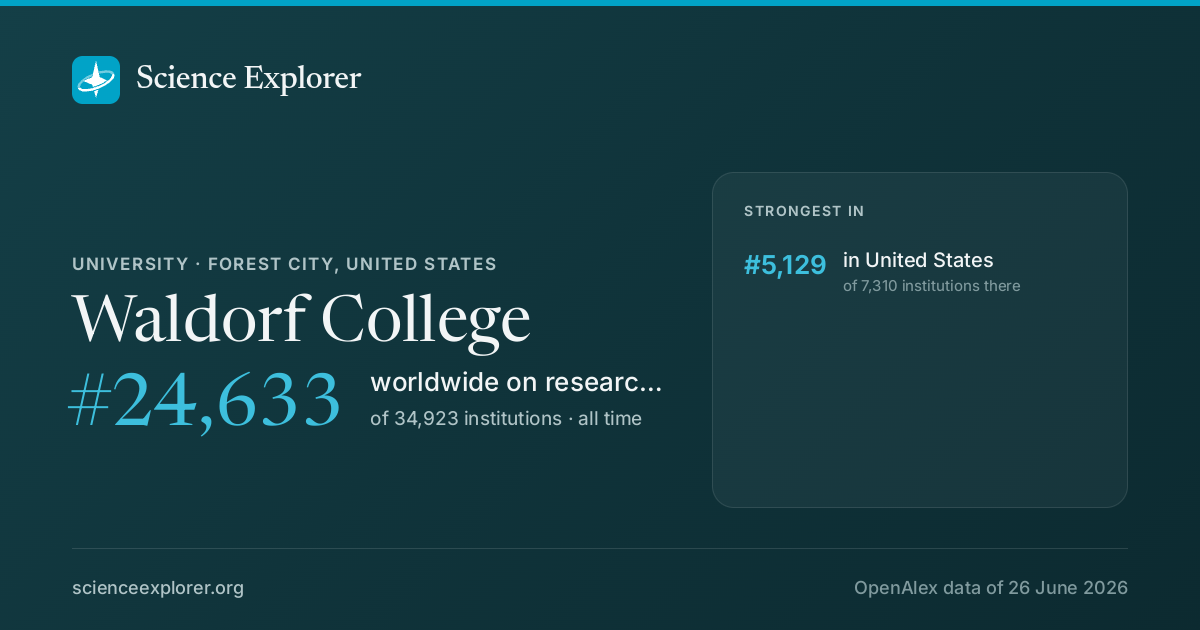
Waldorf College on Science Explorer

A card with Waldorf College's standing and the fields it leads in, for a post or a slide. A link to this page previews as the same card.

Download the card

1200 × 630 PNG, sized for social posts, drawn from the latest snapshot.

Badges for a website1Each links back here and updates with every snapshot

Research measures only: rankings here say nothing about teaching, admissions or student experience. Comparable institutions and collaboration partners have tabs of their own, above.

Discussion

Ask a question or share a note about Waldorf College. Keep it to the research: no personal attacks, advertising or links. Any reader can report a post, which collapses it for everyone until it is opened.
