Zhejiang Normal University
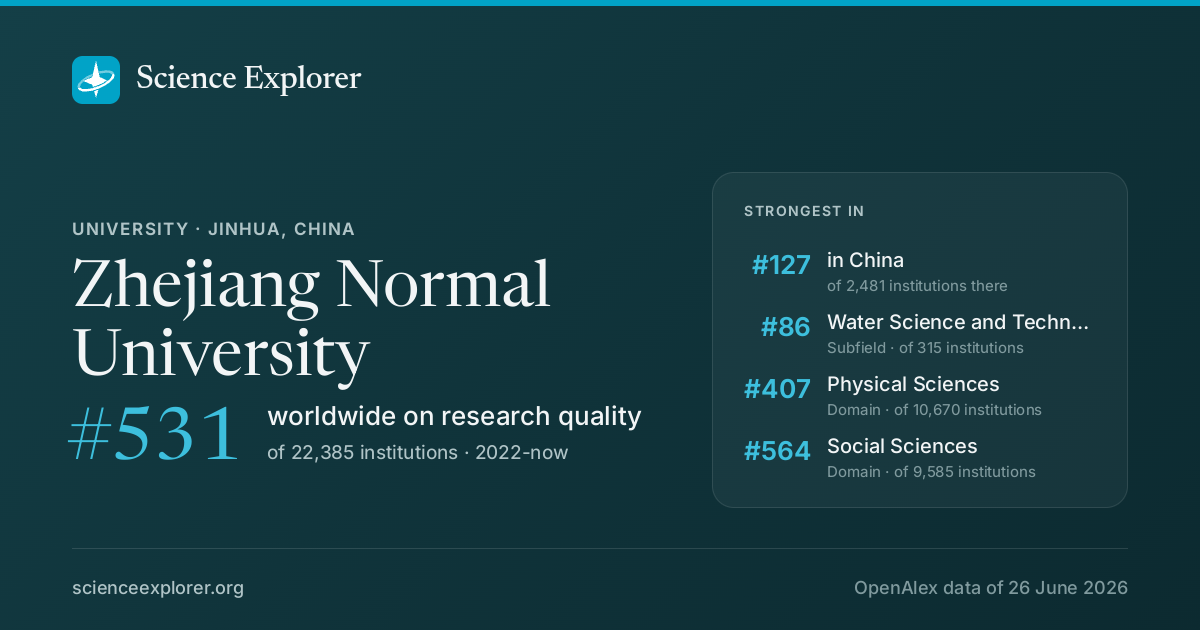
In research, Zhejiang Normal University stands highest in Physical Sciences (#407 of 10,670 worldwide), Social Sciences (#564 of 9,585 worldwide) and Engineering (#356 of 5,901 worldwide), 2022-now. Relative to its size it is most specialised in Statistical and Nonlinear Physics, Music and Discrete Mathematics and Combinatorics (Statistical and Nonlinear Physics is 9.5× its share of world research).
- World rank, 2022-now
- #531 of 22,385 · #625 all time
- Rank in China
- #127 of 2,481
- Research works
- 19k ▲ 152% vs 2018-21
- Citations
- 256k 13.2 per fractional work
- Top-10% rate
- 16.3% all institutions 10.0%
- vs its own fields
- 1.17× 1.00× is exactly expected
- Open access
- 27% world 40%
- International
- 13% world 18%
What is Zhejiang Normal University known for in research?
The fields where it stands highest, 2022-now, ranked among every institution above the floor in each field.
| Field | World rank | Where that sits | Top-10% rate | Works | All time |
|---|---|---|---|---|---|
| Physical SciencesDomain | #407 of 10,670 | 17.0% | 3,942 | #491 | |
| Social SciencesDomain | #564 of 9,585 | 17.3% | 1,206 | #616 | |
| EngineeringField | #356 of 5,901 | 17.4% | 999 | #458 | |
| Materials ScienceField | #171 of 2,276 | 17.7% | 471 | #246 | |
| Computer ScienceField | #408 of 4,417 | 15.2% | 824 | #406 | |
| Health SciencesDomain | #1,071 of 9,902 | 17.2% | 295 | #2300 | |
| Social SciencesField | #653 of 5,988 | 14.6% | 560 | #757 | |
| Life SciencesDomain | #716 of 6,403 | 11.8% | 493 | #819 | |
| Materials ChemistrySubfield | #165 of 1,473 | 17.4% | 329 | #256 | |
| Electrical and Electronic EngineeringSubfield | #290 of 2,176 | 18.2% | 333 | #358 |
Each strip is that field's whole ranked pool, with the notch where Zhejiang Normal University sits in it, in the colour of the band that rank falls in. The track under the rate is the rate itself: it carries no average mark, because the average differs by field (from about 6% in Dentistry to 21% in Economics).
Which of those standings moved
The same fields on both windows: where it stood over the whole record, and where it stands in 2022-now. The distance is the story, and it is the one thing the two rank columns above cannot show.
- Physical Sciences#491 #407
- Social Sciences#616 #564
- Engineering#458 #356
- Materials Science#246 #171
- Computer Science#406 #408
- Health Sciences#2,300 #1,071
- Social Sciences#757 #653
- Life Sciences#819 #716
- Materials Chemistry#256 #165
- Electrical and Electronic Engineering#358 #290
A dot further right is a better standing. Fields it was not ranked in over the whole record are left out.
Which fields of science does Zhejiang Normal University work in?
In 2022-now, 66% of research at Zhejiang Normal University is in Physical Sciences, 21% in Social Sciences. Its largest fields are Engineering (17%), Computer Science (14%), Social Sciences (10%). It does 1.7× the world's share of Physical Sciences.
Each ring splits the one inside it: the four domains of science, their fields, their subfields. Size is fractional works in 2022-now. Every slice is a page; the interactive view zooms down to single topics and colours each by how much more of it this institution does than the world.
Its 4 domains and 26 fields, with their numbers
- Physical Sciences4,43666.1%
- Engineering1,11816.7%
- Computer Science94814.1%
- Physics and Astronomy5317.9%
- Materials Science5187.7%
- Environmental Science3755.6%
- Mathematics3545.3%
- Chemistry2924.3%
- Energy1662.5%
- Earth and Planetary Sciences771.1%
- Chemical Engineering570.9%
- Social Sciences1,39520.8%
- Social Sciences6399.5%
- Psychology3615.4%
- Arts and Humanities1492.2%
- Business, Management and Accounting1081.6%
- Economics, Econometrics and Finance841.3%
- Decision Sciences540.8%
- Life Sciences5568.3%
- Health Sciences3274.9%
- Medicine2704.0%
- Health Professions470.7%
- Nursing80.1%
- Dentistry20.0%
- Veterinary00.0%
What does Zhejiang Normal University specialise in?
Where its research is concentrated relative to its size: Statistical and Nonlinear Physics takes 9.5× the share of its output that it takes of world research.
- Statistical and Nonlinear PhysicsSubfield · 199.3 works9.5×
- MusicSubfield · 48.9 works8.9×
- Discrete Mathematics and CombinatoricsSubfield · 23.6 works8.8×
- Computer Graphics and Computer-Aided DesignSubfield · 47.9 works8.7×
- Mathematical PhysicsSubfield · 73.1 works6.9×
- Applied MathematicsSubfield · 112.0 works5.8×
- Numerical AnalysisSubfield · 31.6 works5.5×
- Geometry and TopologySubfield · 60.1 works5.5×
Location quotient, a volume reading rather than an impact one. It surfaces small, lopsided specialities.
Field profile
Location quotient across every field it publishes in: outside the ring is more than an institution of this size would be expected to publish, inside it is less.
Rings at 0.5×, 1× and 2×. Widest outward: Mathematics, 4.5×. Every wedge is a field page.
All 26 fields, with their numbers
- Mathematics4.48×354 works
- Physics and Astronomy3.56×531 works
- Chemistry2.77×292 works
- Energy2.68×166 works
- Chemical Engineering2.44×57 works
- Materials Science2.21×518 works
- Computer Science1.82×948 works
- Psychology1.77×361 works
- Neuroscience1.14×125 works
- Environmental Science1.12×375 works
- Engineering1.11×1,118 works
- Decision Sciences0.83×54 works
- Pharmacology, Toxicology and Pharmaceutics0.81×19 works
- Arts and Humanities0.77×149 works
- Social Sciences0.75×639 works
- Earth and Planetary Sciences0.73×77 works
- Biochemistry, Genetics and Molecular Biology0.63×227 works
- Economics, Econometrics and Finance0.59×84 works
- Agricultural and Biological Sciences0.54×171 works
- Business, Management and Accounting0.50×108 works
- Health Professions0.27×47 works
- Nursing0.23×8 works
- Immunology and Microbiology0.21×14 works
- Medicine0.21×270 works
- Dentistry0.05×2 works
- Veterinary0.05×0 works
- Mathematics 4.5×
- Physics and Astronomy 3.6×
- Chemistry 2.8×
- Energy 2.7×
- Chemical Engineering 2.4×
- Materials Science 2.2×
- Computer Science 1.8×
- Psychology 1.8×
- Neuroscience 1.1×
- Environmental Science 1.1×
- Engineering 1.1×
- Decision Sciences 0.8×
- Pharmacology, Toxicology and Pharmaceutics 0.8×
- Arts and Humanities 0.8×
- Social Sciences 0.8×
- Earth and Planetary Sciences 0.7×
- Biochemistry, Genetics and Molecular Biology 0.6×
- Economics, Econometrics and Finance 0.6×
- Agricultural and Biological Sciences 0.5×
- Business, Management and Accounting 0.5×
- Health Professions 0.3×
- Nursing 0.2×
- Immunology and Microbiology 0.2×
- Medicine 0.2×
- Dentistry 0.1×
- Veterinary 0.1×
Who are the top researchers at Zhejiang Normal University?
Ranked on the quality score, Ghulam Mustafa, Liguo Shen and Yanchao Xu lead among researchers whose main affiliation is Zhejiang Normal University.
- 1
Ghulam Mustafa
 China · #3,391 worldwide
7.2k citations · 325 works
- 2
Liguo Shen
China · #4,366 worldwide
17k citations · 348 works
- 3
Yanchao Xu
China · #5,546 worldwide
12k citations · 233 works
- 4
Renjie Li
China · #9,114 worldwide
8.8k citations · 164 works
- 5
Yasin Orooji
China · #10,864 worldwide
19k citations · 277 works
- 6
Hongjun Lin
China · #11,650 worldwide
18k citations · 437 works
- 7
Yong Ming Hu
China · #12,253 worldwide
18k citations · 263 works
- 8
Zeeshan Ajmal
China · #13,760 worldwide
6.5k citations · 116 works
- 9
Adnan Khurshid
China · #16,269 worldwide
2.9k citations · 92 works
- 10
Leihong Zhao
China · #17,668 worldwide
8.8k citations · 172 works
Which keywords describe research at Zhejiang Normal University?
By fractional works in 2022-now, weighted toward what it does more of than the world: Deep Learning, Catalysis, Nanomaterials, Nonlinear Equations, Metal-Organic Frameworks, Graphene, Water Splitting and Nonlinear Schrödinger Equation.
- Approximation Algorithms
- Hydrogen Storage
- Discrete
- Integrable Equations
- Pollution Monitoring
- Environmental Risk Assessment
- Stability
- Plasmonic
- Solar Energy
- Visible Light
- Hydrogen Production
- Regional Planning
- Electrocatalysis
- Semiconductor
- Nonlinear Schrödinger Equation
- Nonlinear Equations
- Metal-Organic Frameworks
- Neural Networks
- Catalysis
- Machine Learning
- Deep Learning
- Nanomaterials
- Graphene
- Artificial Intelligence
- Water Splitting
- Energy Storage
- Solitons
- Chemical Sensors
- Optical Lattices
- CO2 Reduction
- Methane Storage
- Heterogeneous Catalysis
- Photocatalyst
- Crystal Growth
- Biochar Application
- Conservation Issues
- Rogue Waves
- Soliton Solutions
- Nonlinear Photonic Systems
- Multimedia Technology
Size is fractional works in 2022-now in the topics tagged with each word; colour is the word's share of this institution's work against its share of the world's. The 40 words are chosen for being large and distinctive. Each links to the topic it comes from most.
All 40 words, with their numbers
- Deep Learning419▲ 1.81×84 topics
- Machine Learning260▲ 1.16×88 topics
- Nanomaterials234▲ 3.3×20 topics
- Catalysis219▲ 4.9×28 topics
- Graphene166▲ 3.7×12 topics
- Neural Networks159▲ 1.53×40 topics
- Artificial Intelligence159▲ 1.66×44 topics
- Metal-Organic Frameworks146▲ 5.2×6 topics
- Water Splitting129▲ 5.2×4 topics
- Nonlinear Equations126▲ 15×5 topics
- Energy Storage106▲ 2.4×11 topics
- Nonlinear Schrödinger Equation106▲ 29×2 topics
- Solitons103▲ 35×2 topics
- Semiconductor99▲ 4.5×7 topics
- Chemical Sensors98▲ 6.3×3 topics
- Electrocatalysis95▲ 5.0×5 topics
- Optical Lattices94▲ 22×3 topics
- Regional Planning93▲ 21×2 topics
- CO2 Reduction92▲ 6.3×2 topics
- Hydrogen Production90▲ 5.0×6 topics
- Methane Storage90▲ 10×2 topics
- Visible Light87▲ 5.6×3 topics
- Heterogeneous Catalysis86▲ 7.0×5 topics
- Solar Energy86▲ 4.1×5 topics
- Photocatalyst80▲ 6.9×1 topic
- Plasmonic80▲ 6.9×1 topic
- Crystal Growth80▲ 4.3×12 topics
- Stability75▲ 5.0×8 topics
- Biochar Application72▲ 10×2 topics
- Environmental Risk Assessment71▲ 12×4 topics
- Conservation Issues69▲ 28×1 topic
- Pollution Monitoring69▲ 28×1 topic
- Rogue Waves68▲ 17×2 topics
- Integrable Equations66▲ 28×1 topic
- Soliton Solutions66▲ 28×1 topic
- Discrete63▲ 38×1 topic
- Nonlinear Photonic Systems63▲ 38×1 topic
- Hydrogen Storage62▲ 7.3×3 topics
- Multimedia Technology59▲ 14×2 topics
- Approximation Algorithms58▲ 12×5 topics
Which research topics does Zhejiang Normal University publish most on?
By volume in 2022-now: Advanced Photocatalysis Techniques, Educational Reforms and Innovations, Nonlinear Waves and Solitons and Nonlinear Photonic Systems.
Area is fractional works; colour is the subfield each topic belongs to.
- 1 Advanced Photocatalysis Techniques Renewable Energy, Sustainability and the Environment 80 works
- 2 Educational Reforms and Innovations Health, Toxicology and Mutagenesis 69 works
- 3 Nonlinear Waves and Solitons Statistical and Nonlinear Physics 66 works
- 4 Nonlinear Photonic Systems Statistical and Nonlinear Physics 63 works
- 5 Metal-Organic Frameworks: Synthesis and Applications Inorganic Chemistry 49 works
- 6 Perovskite Materials and Applications Electrical and Electronic Engineering 45 works
- 7 Covalent Organic Framework Applications Materials Chemistry 41 works
- 8 Electrocatalysts for Energy Conversion Renewable Energy, Sustainability and the Environment 41 works
- 9 Advanced Mathematical Physics Problems Mathematical Physics 40 works
- 10 Catalytic Processes in Materials Science Materials Chemistry 39 works
How open and international is its research?
Against the world's own shares: the tick on each track. Both are shares of its output, so they sit on one scale and can be read against each other as well as against the world.
World: 40% of research is openly available.
World: 18% is written across borders.
How has Zhejiang Normal University's research output changed?
Output in 2022-2025 was 152% higher than in 2018-2021.
The same series as a ribbon: one cell per year, darker for more. The line above answers how much; this answers when.
Its share of all research
Growing output can still be a shrinking share: all of science grows. This is Zhejiang Normal University as a percentage of every work published that year, 0.029% in 2024.
Fractional works of Zhejiang Normal University over all fractional works that year. How the balance of science has shifted.
How much of it reaches the world top 10%
Year by year, against all institutions in the same year.
Of each year's output, the share that reached the world's 10% most cited for its field and year. Peak 17.4% in 2022.
Other research institutions in Jinhua
- Jinhua University of Vocational Technology
- Jinhua Central Hospital
- Guang Fu Hospital
- ZheJiang East Crystal Electronic (China)
- Jinhua Municipal Science and Technology Bureau
Compare Zhejiang Normal University with
- vs
 TU Wien
- vs
 The University of Texas Health Science Center at Houston
- vs Beijing National Laboratory for Molecular Sciences
- vs
 National Cheng Kung University
- vs Nanjing University of Information Science and Technology
- vs Wenzhou Medical University
Share Zhejiang Normal University's ranking



Research measures only: rankings here say nothing about teaching, admissions or student experience. Comparable institutions and collaboration partners have tabs of their own, above.
Discussion
Ask a question or share a note about Zhejiang Normal University. Posts are plain text and can be reported.