Science Explorer Back to mapMap
Discussion
Country

Science in Mauritania

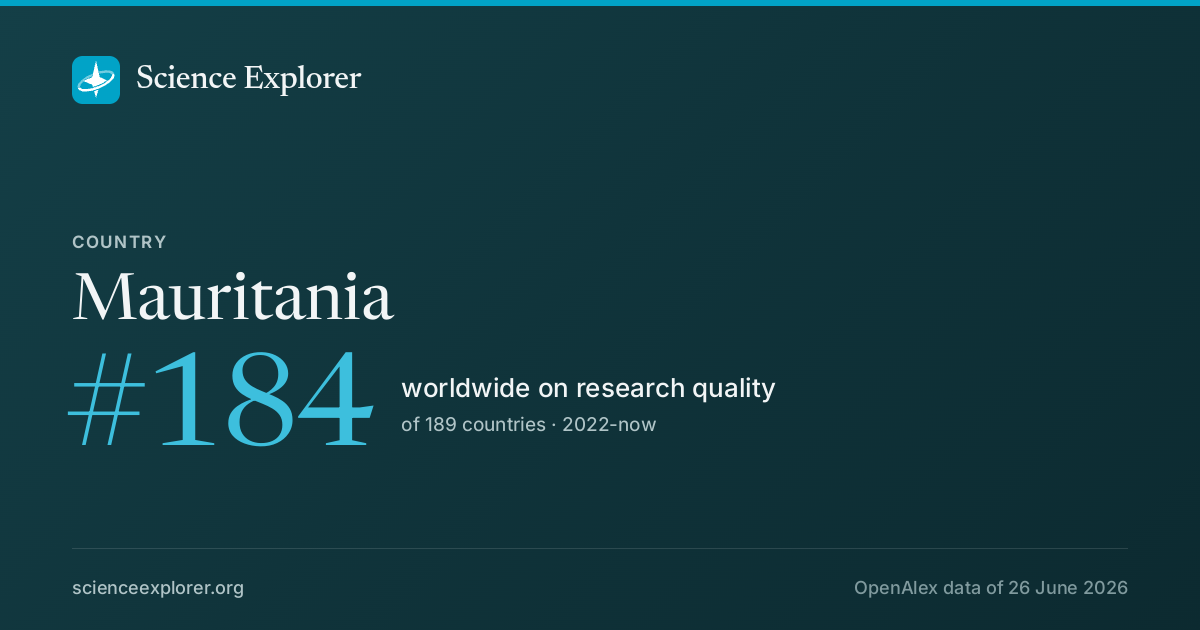
Mauritania ranks #184 of 189 countries on research quality in 2022-now (#192 all time), with 269 research works and 6.2% of them in the world's top 10%.

World rank, 2022-now
#184
of 189 · #192 all time
Works, 2022-now
269
▲ 36% vs 2018-21
Citations
7.8k
8.6 per fractional work, all time
Top-10% rate
6.2%
all institutions 10.0%
vs its own fields
0.85×
1.00× is exactly expected
In the world top 100
0
0 in the top 1,000
Open access
55%
world 40%
International
56%
world 18%

Which fields of science does Mauritania work in?

In 2022-now, 50% of research in Mauritania is in Physical Sciences, 23% in Health Sciences. Its largest fields are Medicine (19%), Engineering (11%), Computer Science (11%). It does 1.3× the world's share of Physical Sciences.

Physical Sciences: 162 fractional works · 49.9% of its workEngineering: 36 fractional works · 11.1% of its workElectrical and Electronic Engineering: 15 fractional works · 4.5% of its workControl and Systems Engineering: 4 fractional works · 1.2% of its workAerospace Engineering: 3 fractional works · 1.0% of its workIndustrial and Manufacturing Engineering: 3 fractional works · 0.9% of its workMechanical Engineering: 3 fractional works · 0.8% of its workMechanics of Materials: 2 fractional works · 0.7% of its workBiomedical Engineering: 2 fractional works · 0.5% of its workAutomotive Engineering: 1 fractional works · 0.4% of its workMedia Technology: 1 fractional works · 0.3% of its workComputational Mechanics: 1 fractional works · 0.3% of its workCivil and Structural Engineering: 1 fractional works · 0.2% of its workBuilding and Construction: 1 fractional works · 0.2% of its workSmaller subfields together: 0 fractional works · 0.1% of its workComputer Science: 35 fractional works · 10.8% of its workArtificial Intelligence: 15 fractional works · 4.6% of its workComputational Theory and Mathematics: 5 fractional works · 1.7% of its workComputer Vision and Pattern Recognition: 5 fractional works · 1.6% of its workInformation Systems: 4 fractional works · 1.3% of its workComputer Networks and Communications: 3 fractional works · 0.9% of its workComputer Science Applications: 2 fractional works · 0.5% of its workSignal Processing: 1 fractional works · 0.2% of its workEnvironmental Science: 32 fractional works · 9.8% of its workEcology: 8 fractional works · 2.3% of its workGlobal and Planetary Change: 7 fractional works · 2.3% of its workWater Science and Technology: 4 fractional works · 1.2% of its workPollution: 3 fractional works · 0.9% of its workEnvironmental Engineering: 3 fractional works · 0.8% of its workNature and Landscape Conservation: 2 fractional works · 0.7% of its workManagement, Monitoring, Policy and Law: 2 fractional works · 0.7% of its workHealth, Toxicology and Mutagenesis: 1 fractional works · 0.4% of its workIndustrial and Manufacturing Engineering: 1 fractional works · 0.3% of its workSmaller subfields together: 1 fractional works · 0.2% of its workMathematics: 23 fractional works · 7.2% of its workApplied Mathematics: 12 fractional works · 3.7% of its workModeling and Simulation: 4 fractional works · 1.2% of its workMathematical Physics: 3 fractional works · 0.8% of its workNumerical Analysis: 2 fractional works · 0.7% of its workStatistics and Probability: 2 fractional works · 0.6% of its workSmaller subfields together: 1 fractional works · 0.3% of its workEarth and Planetary Sciences: 12 fractional works · 3.6% of its workGeophysics: 4 fractional works · 1.3% of its workEarth-Surface Processes: 3 fractional works · 0.8% of its workOceanography: 2 fractional works · 0.6% of its workGeochemistry and Petrology: 1 fractional works · 0.4% of its workAtmospheric Science: 1 fractional works · 0.2% of its workSmaller subfields together: 1 fractional works · 0.3% of its workPhysics and Astronomy: 7 fractional works · 2.2% of its workAtomic and Molecular Physics, and Optics: 5 fractional works · 1.6% of its workStatistical and Nonlinear Physics: 1 fractional works · 0.3% of its workCondensed Matter Physics: 1 fractional works · 0.3% of its workSmaller subfields together: 0 fractional works · 0.0% of its workMaterials Science: 6 fractional works · 1.9% of its workMaterials Chemistry: 3 fractional works · 1.1% of its workElectronic, Optical and Magnetic Materials: 1 fractional works · 0.4% of its workPolymers and Plastics: 1 fractional works · 0.2% of its workSmaller subfields together: 1 fractional works · 0.3% of its workChemistry: 6 fractional works · 1.8% of its workOrganic Chemistry: 3 fractional works · 1.0% of its workInorganic Chemistry: 2 fractional works · 0.5% of its workAnalytical Chemistry: 1 fractional works · 0.2% of its workSmaller subfields together: 0 fractional works · 0.1% of its workEnergy: 4 fractional works · 1.4% of its workRenewable Energy, Sustainability and the Environment: 3 fractional works · 0.8% of its workEnergy Engineering and Power Technology: 2 fractional works · 0.5% of its workSmaller subfields together: 0 fractional works · 0.0% of its workChemical Engineering: 0 fractional works · 0.0% of its workHealth Sciences: 74 fractional works · 22.8% of its workMedicine: 63 fractional works · 19.4% of its workPublic Health, Environmental and Occupational Health: 9 fractional works · 2.7% of its workEpidemiology: 8 fractional works · 2.5% of its workSurgery: 8 fractional works · 2.5% of its workInfectious Diseases: 4 fractional works · 1.4% of its workOncology: 4 fractional works · 1.2% of its workCardiology and Cardiovascular Medicine: 4 fractional works · 1.1% of its workObstetrics and Gynecology: 3 fractional works · 0.8% of its workPediatrics, Perinatology and Child Health: 3 fractional works · 0.8% of its workHepatology: 3 fractional works · 0.8% of its workPulmonary and Respiratory Medicine: 2 fractional works · 0.7% of its workPhysiology: 2 fractional works · 0.5% of its workReproductive Medicine: 2 fractional works · 0.5% of its workHematology: 1 fractional works · 0.4% of its workGenetics: 1 fractional works · 0.4% of its workRheumatology: 1 fractional works · 0.3% of its workRadiology, Nuclear Medicine and Imaging: 1 fractional works · 0.3% of its workEndocrinology, Diabetes and Metabolism: 1 fractional works · 0.3% of its workGastroenterology: 1 fractional works · 0.2% of its workOrthopedics and Sports Medicine: 1 fractional works · 0.2% of its workSmaller subfields together: 5 fractional works · 1.6% of its workHealth Professions: 7 fractional works · 2.3% of its workGeneral Health Professions: 5 fractional works · 1.6% of its workSmaller subfields together: 2 fractional works · 0.6% of its workNursing: 3 fractional works · 0.8% of its workNutrition and Dietetics: 3 fractional works · 0.8% of its workSmaller subfields together: 0 fractional works · 0.0% of its workDentistry: 1 fractional works · 0.3% of its workVeterinary: 0 fractional works · 0.1% of its workSocial Sciences: 48 fractional works · 14.7% of its workSocial Sciences: 25 fractional works · 7.7% of its workSociology and Political Science: 8 fractional works · 2.4% of its workPolitical Science and International Relations: 5 fractional works · 1.4% of its workEducation: 4 fractional works · 1.2% of its workAnthropology: 3 fractional works · 1.0% of its workLinguistics and Language: 1 fractional works · 0.4% of its workSafety Research: 1 fractional works · 0.3% of its workLaw: 1 fractional works · 0.2% of its workSmaller subfields together: 3 fractional works · 0.9% of its workBusiness, Management and Accounting: 7 fractional works · 2.3% of its workStrategy and Management: 2 fractional works · 0.7% of its workAccounting: 2 fractional works · 0.7% of its workManagement Information Systems: 2 fractional works · 0.6% of its workManagement of Technology and Innovation: 1 fractional works · 0.2% of its workSmaller subfields together: 0 fractional works · 0.1% of its workEconomics, Econometrics and Finance: 6 fractional works · 1.8% of its workEconomics and Econometrics: 4 fractional works · 1.2% of its workFinance: 1 fractional works · 0.4% of its workSmaller subfields together: 1 fractional works · 0.2% of its workArts and Humanities: 5 fractional works · 1.7% of its workPhilosophy: 2 fractional works · 0.7% of its workLanguage and Linguistics: 2 fractional works · 0.6% of its workLiterature and Literary Theory: 1 fractional works · 0.4% of its workSmaller subfields together: 0 fractional works · 0.0% of its workDecision Sciences: 2 fractional works · 0.7% of its workManagement Science and Operations Research: 1 fractional works · 0.4% of its workSmaller subfields together: 1 fractional works · 0.3% of its workPsychology: 1 fractional works · 0.4% of its workLife Sciences: 41 fractional works · 12.6% of its workAgricultural and Biological Sciences: 24 fractional works · 7.3% of its workPlant Science: 7 fractional works · 2.1% of its workEcology, Evolution, Behavior and Systematics: 5 fractional works · 1.6% of its workForestry: 4 fractional works · 1.4% of its workFood Science: 3 fractional works · 0.8% of its workAquatic Science: 2 fractional works · 0.7% of its workGeneral Agricultural and Biological Sciences: 1 fractional works · 0.4% of its workSmaller subfields together: 1 fractional works · 0.5% of its workBiochemistry, Genetics and Molecular Biology: 10 fractional works · 3.2% of its workMolecular Biology: 5 fractional works · 1.6% of its workGenetics: 2 fractional works · 0.6% of its workMolecular Medicine: 1 fractional works · 0.3% of its workSmaller subfields together: 2 fractional works · 0.6% of its workImmunology and Microbiology: 5 fractional works · 1.4% of its workParasitology: 3 fractional works · 0.8% of its workApplied Microbiology and Biotechnology: 1 fractional works · 0.3% of its workSmaller subfields together: 1 fractional works · 0.3% of its workNeuroscience: 2 fractional works · 0.5% of its workCellular and Molecular Neuroscience: 1 fractional works · 0.2% of its workSmaller subfields together: 1 fractional works · 0.3% of its workPharmacology, Toxicology and Pharmaceutics: 1 fractional works · 0.2% of its workALL ITS WORKMauritania324fractional works, 2022-now
Life Sciences13%Physical Sciences50%Health Sciences23%Social Sciences15%

Each ring splits the one inside it: the four domains of science, their fields, their subfields. Size is fractional works in 2022-now. Every slice is a page; the interactive view zooms down to single topics and colours each by how much more of it this country does than the world.

Its 4 domains and 26 fields, with their numbers
    1. Engineering3611.1%
    2. Computer Science3510.8%
    3. Environmental Science329.8%
    4. Mathematics237.2%
    5. Earth and Planetary Sciences123.6%
    6. Physics and Astronomy72.2%
    7. Materials Science61.9%
    8. Chemistry61.8%
    9. Energy41.4%
    10. Chemical Engineering00.0%
    1. Medicine6319.4%
    2. Health Professions72.3%
    3. Nursing30.8%
    4. Dentistry10.3%
    5. Veterinary00.1%
    1. Social Sciences257.7%
    2. Business, Management and Accounting72.3%
    3. Economics, Econometrics and Finance61.8%
    4. Arts and Humanities51.7%
    5. Decision Sciences20.7%
    6. Psychology10.4%
    1. Agricultural and Biological Sciences247.3%
    2. Biochemistry, Genetics and Molecular Biology103.2%
    3. Immunology and Microbiology51.4%
    4. Neuroscience20.5%
    5. Pharmacology, Toxicology and Pharmaceutics10.2%
All of science, and how each field's share has moved since 1950: the Science domain explorer

Which keywords describe research in Mauritania?

By fractional works in 2022-now, weighted toward what it does more of than the world: Climate Change, Nonlinear Equations, Epidemiology, Machine Learning, Smallholder Farmers, Renewable Energy, Fractional Laplacian and Sobolev Spaces.

▲ more of its work than of the world's◆ about the world's share▼ less than the world's

Size is fractional works in 2022-now in the topics tagged with each word; colour is the word's share of this country's work against its share of the world's. The 40 words are chosen for being large and distinctive. Each links to the topic it comes from most.

All 40 words, with their numbers
  1. Epidemiology20▲ 1.54×55 topics
  2. Climate Change20▲ 2.2×41 topics
  3. Machine Learning17▲ 1.60×35 topics
  4. Deep Learning15▲ 1.34×32 topics
  5. Renewable Energy11▲ 2.4×22 topics
  6. Remote Sensing10▲ 2.5×17 topics
  7. Sustainability9◆ 1.11×22 topics
  8. Nonlinear Equations9▲ 21×3 topics
  9. Environmental Impact7▲ 1.34×19 topics
  10. Public Health7▲ 1.43×22 topics
  11. Smallholder Farmers7▲ 9.9×2 topics
  12. Fractional Laplacian6▲ 87×1 topic
  13. Immune Response6▲ 3.4×11 topics
  14. Sobolev Spaces6▲ 87×1 topic
  15. Biodiversity Conservation5▲ 4.3×4 topics
  16. Finite Element5▲ 35×2 topics
  17. Porous Media5▲ 11×3 topics
  18. Infectious Diseases5▲ 4.3×5 topics
  19. Population Dynamics4▲ 5.4×7 topics
  20. Agroforestry4▲ 20×1 topic
  21. Tree Domestication4▲ 60×1 topic
  22. Heterogeneous4▲ 37×1 topic
  23. Multiscale Methods4▲ 37×1 topic
  24. Conservation4▲ 2.9×10 topics
  25. Antiviral Therapy4▲ 13×3 topics
  26. Boundary Value Problems4▲ 24×3 topics
  27. Islam4▲ 5.9×3 topics
  28. Gender Equality4▲ 4.1×4 topics
  29. Migration4▲ 3.4×5 topics
  30. North Africa4▲ 32×2 topics
  31. Liver Disease4▲ 12×2 topics
  32. Poverty Reduction4▲ 8.5×3 topics
  33. Grid Integration4▲ 11×3 topics
  34. Controllability3▲ 23×2 topics
  35. Sea-Level Rise3▲ 7.8×4 topics
  36. Cancer Incidence3▲ 6.4×3 topics
  37. Marine Ecosystems3▲ 16×2 topics
  38. Empowerment2▲ 8.0×1 topic
  39. Fisheries Sustainability2▲ 9.1×2 topics
  40. Microfinance2▲ 15×1 topic

Which research topics does Mauritania publish the most in?

Its largest topics in 2022-now are Nonlinear Partial Differential Equations, African Botany and Ecology Studies, Advanced Mathematical Modeling in Engineering.

  1. 1 Nonlinear Partial Differential Equations Applied Mathematics 6 works
  2. 2 African Botany and Ecology Studies Forestry 4 works
  3. 3 Advanced Mathematical Modeling in Engineering Computational Theory and Mathematics 4 works
  4. 4 Microfinance and Financial Inclusion Economics and Econometrics 3 works
  5. 5 Marine and fisheries research Global and Planetary Change 2 works
  6. 6 Agriculture and Rural Development Research Ecology, Evolution, Behavior and Systematics 2 works
  7. 7 African Studies and Geopolitics Anthropology 2 works
  8. 8 Solar Radiation and Photovoltaics Artificial Intelligence 2 works
  9. 9 Hepatitis B Virus Studies Epidemiology 2 works
  10. 10 Smart Agriculture and AI Plant Science 2 works
  11. 11 Fractional Differential Equations Solutions Modeling and Simulation 2 works
  12. 12 Geological and Geochemical Analysis Geophysics 2 works

Which universities in Mauritania lead research?

Université de Nouakchott rank highest in Mauritania on research quality in 2022-now.

  1. 1Université de NouakchottUniversity · Nouakchott · #11,353 worldwide5.9% top 10% · 184 works

The track on each row is its top-10% rate; the tick is the average of all institutions, 10.0% (how it is set): teal above it, red below.

All ranked institutions in Mauritania

Who are the top researchers in Mauritania?

Mohamedhen Vall Nounou, Boudy Bilal and Hamed Ould Sidi rank highest among researchers based in Mauritania.

  1. 1 Mohamedhen Vall Nounou #914,374 worldwide 20 citations · 18 works
  2. 2 Boudy Bilal #1,746,841 worldwide 960 citations · 40 works
  3. 3 Hamed Ould Sidi #2,005,584 worldwide 92 citations · 30 works
  4. 4 Ousmane Ly #2,150,804 worldwide 372 citations · 24 works
  5. 5 Mohamed Lemine Cheikh Brahim Ahmed #2,182,622 worldwide 1.8k citations · 32 works
  6. 6 Elimane Abou Kane #2,340,184 worldwide 324 citations · 16 works
  7. 7 Cheikh-Baye Braham #2,552,337 worldwide 199 citations · 15 works
  8. 8 Mamoudou Ndongo #2,571,784 worldwide 799 citations · 29 works
  9. 9 Robert Vernet #2,693,620 worldwide 673 citations · 55 works
  10. 10 Hampaté Bâ #2,838,087 worldwide 1.2k citations · 38 works
Top researchers in Mauritania

How open and international is Mauritania's research?

55% of its research is openly available (world: 40%), and 56% is written with international co-authors (world: 18%).

openly available55.4%not open44.6%

World: 40% of research is openly available.

with international co-authors56.3%domestic only43.7%

World: 18% is written across borders.

How has Mauritania's research grown?

Output in 2022-2025 was 36% higher than in 2018-2021.

still counting1990200020102020
grewheldshrank

The same series as a ribbon: one cell per year, darker for more. The line above answers how much; this answers when.

Its share of all research

Growing output can still be a shrinking share: all of science grows. This is Mauritania as a percentage of every work published that year, 0.0014% in 2024.

still counting0.00050%0.0010%0.0015%Mauritania0.0014% in 202519801990200020102020

Fractional works of Mauritania over all fractional works that year. How the balance of science has shifted.

How much of it reaches the world top 10%

Over the whole record, 5.9% of its 910 works since 1963 reached the world top 10% for their field and year.

still counting5%10%15%all institutions10.0% in 2025Mauritania7.6% in 20252020

Of each year's output, the share that reached the world's 10% most cited for its field and year. Peak 11.7% in 2012.

Which countries have research most like Mauritania's?

Senegal is Mauritania's closest research twin: of all countries, its research is spread across the fields most like Mauritania's, with both strong in Mathematics.

  1. 1 SenegalBoth strong in Mathematics, Nursing, Agricultural and Biological Sciences 0.72 Compare
  2. 2 ChadBoth strong in Nursing, Agricultural and Biological Sciences, Earth and Planetary Sciences 0.67 Compare
  3. 3 MoroccoBoth strong in Mathematics, Energy, Computer Science 0.66 Compare
  4. 4 Central African RepublicBoth strong in Nursing, Mathematics, Agricultural and Biological Sciences 0.62 Compare
  5. 5 Burkina FasoBoth strong in Mathematics, Nursing, Agricultural and Biological Sciences 0.59 Compare

Similarity is the correlation of each side's location quotients across every field it publishes in, on a log scale: 1 is the same shape of research, 0 is unrelated. It ignores size. How it is measured.

Compare Mauritania with
Compare any two

Share Mauritania's ranking

Mauritania on Science Explorer

A card with Mauritania's standing and the fields it leads in, for a post or a slide. A link to this page previews as the same card.

Download the card

1200 × 630 PNG, sized for social posts, drawn from the latest snapshot.

Badges for a website1Each links back here and updates with every snapshot

Discussion

Ask a question or share a note about Mauritania. Posts are plain text and can be reported.