 Science in Senegal
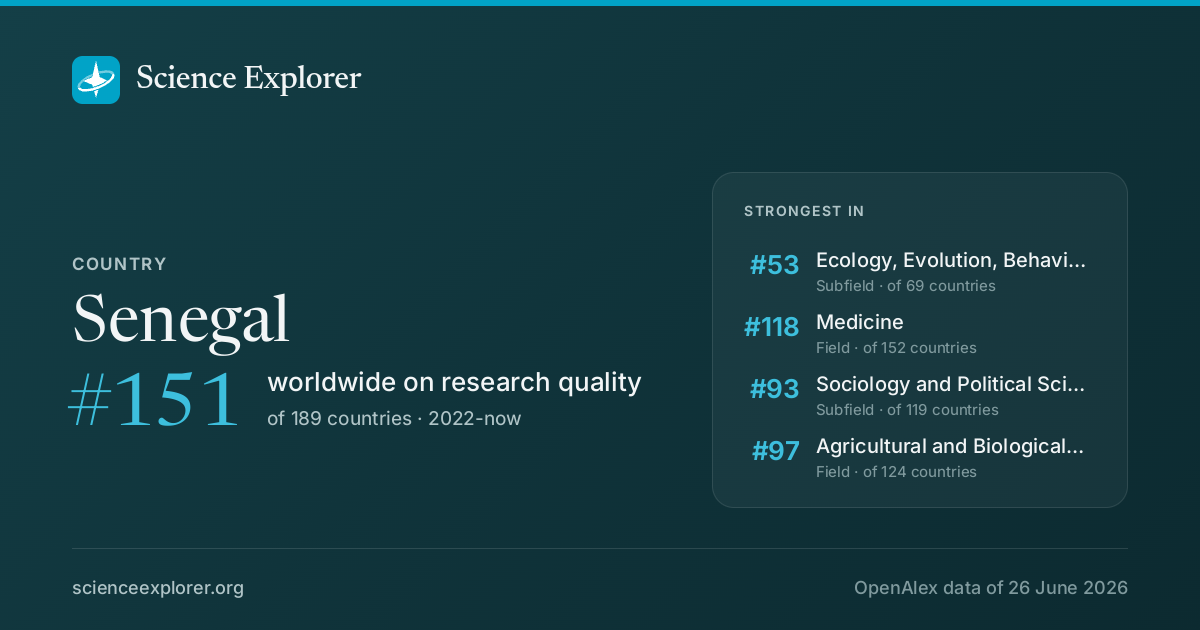
Senegal ranks #151 of 189 countries on research quality in 2022-now (#136 all time), with 5.3k research works and 4.3% of them in the world's top 10%.
- World rank, 2022-now
- #151 of 189 · #136 all time
- Works, 2022-now
- 5.3k ▲ 15% vs 2018-21
- Citations
- 146k 6.7 per fractional work, all time
- Top-10% rate
- 4.3% all institutions 10.0%
- vs its own fields
- 0.40× 1.00× is exactly expected
- In the world top 100
- 0 0 in the top 1,000
- Open access
- 62% world 40%
- International
- 30% world 18%
SenegalWhat is Senegal strongest at in science?
On research quality in 2022-now, Senegal ranks highest in Ecology, Evolution, Behavior and Systematics (#53 of 69), Medicine (#118 of 152) and Sociology and Political Science (#93 of 119). Relative to its size it is most specialised in Forestry, Horticulture and Microbiology.
| Field | World rank | Where that sits | Top-10% rate | Works | All time | Institutions |
|---|---|---|---|---|---|---|
| Ecology, Evolution, Behavior and SystematicsSubfield | #53 of 69 | 6.4% | 224 | #66 | Institutions | |
| MedicineField | #118 of 152 | 2.6% | 1,416 | #109 | Institutions | |
| Sociology and Political ScienceSubfield | #93 of 119 | 11.0% | 264 | #104 | Institutions | |
| Agricultural and Biological SciencesField | #97 of 124 | 5.5% | 657 | #105 | Institutions | |
| Social SciencesField | #122 of 148 | 8.4% | 643 | #133 | Institutions | |
| Environmental ScienceField | #106 of 122 | 3.8% | 310 | #109 | Institutions | |
| Computer ScienceField | #121 of 128 | 3.1% | 314 | #122 | Institutions | |
| EngineeringField | #124 of 131 | 2.8% | 419 | #131 | Institutions |
Where its research is concentrated
Location quotient: how much more (or less) of each node it does than its size predicts. Drawn around 1×, where "twice the world share" and "half of it" are the same distance apart in opposite directions. A volume reading, which on a country axis is largely population and industrial structure.
- ForestrySubfield · 86.9 works · #41 of 204 active here14×
- HorticultureSubfield · 10.4 works · #51 of 178 active here13×
- MicrobiologySubfield · 3.7 works · #48 of 137 active here10×
- Ecology, Evolution, Behavior and SystematicsSubfield · 247.3 works · #67 of 223 active here8.6×
- AnthropologySubfield · 106.3 works · #64 of 213 active here6.2×
- Linguistics and LanguageSubfield · 41.5 works · #76 of 194 active here5.9×
- Metals and AlloysSubfield · 10.2 works · #58 of 147 active here5.0×
- Applied Microbiology and BiotechnologySubfield · 12.9 works · #85 of 202 active here4.2×
The whole field profile
All 26 fields at once. A specialist and a generalist produce the same ranked list and a completely different shape.
Rings at 0.5×, 1× and 2×. Widest outward: Agricultural and Biological Sciences, 2.6×. Every wedge is a field page.
All 26 fields, with their numbers
- Agricultural and Biological Sciences2.59×755 works
- Mathematics2.34×169 works
- Nursing1.72×52 works
- Veterinary1.47×12 works
- Medicine1.37×1,620 works
- Immunology and Microbiology1.36×84 works
- Economics, Econometrics and Finance1.33×175 works
- Health Professions1.32×214 works
- Environmental Science1.23×375 works
- Energy1.07×60 works
- Arts and Humanities1.04×185 works
- Social Sciences0.96×744 works
- Earth and Planetary Sciences0.90×87 works
- Dentistry0.85×25 works
- Computer Science0.77×368 works
- Chemistry0.72×70 works
- Decision Sciences0.71×42 works
- Biochemistry, Genetics and Molecular Biology0.63×205 works
- Pharmacology, Toxicology and Pharmaceutics0.57×12 works
- Business, Management and Accounting0.56×111 works
- Engineering0.55×507 works
- Materials Science0.53×115 works
- Physics and Astronomy0.47×64 works
- Chemical Engineering0.36×8 works
- Psychology0.30×56 works
- Neuroscience0.28×28 works
Which fields of science does Senegal work in?
In 2022-now, 31% of research in Senegal is in Health Sciences, 30% in Physical Sciences. Its largest fields are Medicine (26%), Agricultural and Biological Sciences (12%), Social Sciences (12%). It does 1.4× the world's share of Health Sciences.
Each ring splits the one inside it: the four domains of science, their fields, their subfields. Size is fractional works in 2022-now. Every slice is a page; the interactive view zooms down to single topics and colours each by how much more of it this country does than the world.
Its 4 domains and 26 fields, with their numbers
- Health Sciences1,92331.3%
- Medicine1,62026.4%
- Health Professions2143.5%
- Nursing520.8%
- Dentistry250.4%
- Veterinary120.2%
- Physical Sciences1,82129.7%
- Engineering5078.3%
- Environmental Science3756.1%
- Computer Science3686.0%
- Mathematics1692.7%
- Materials Science1151.9%
- Earth and Planetary Sciences871.4%
- Chemistry701.1%
- Physics and Astronomy641.0%
- Energy601.0%
- Chemical Engineering80.1%
- Social Sciences1,31321.4%
- Social Sciences74412.1%
- Arts and Humanities1853.0%
- Economics, Econometrics and Finance1752.8%
- Business, Management and Accounting1111.8%
- Psychology560.9%
- Decision Sciences420.7%
- Life Sciences1,08417.7%
Which keywords describe research in Senegal?
By fractional works in 2022-now, weighted toward what it does more of than the world: Smallholder Farmers, Epidemiology, Climate Change, Adaptation, Agroecology, Diversity, Agricultural Development and Livestock Farming.
- Political Transition
- Proximity and Innovation
- Citizen Participation
- Tree Domestication
- Rural Livelihoods
- Vaccine
- Ethnicity
- Agroforestry
- Genetic Diversity
- Local Development
- Colonialism
- Community Engagement
- Pathogenesis
- Sustainable Agriculture
- Public Health
- Multifunctionality
- Agricultural Development
- Agroecology
- Smallholder Farmers
- Climate Change
- Epidemiology
- Sustainability
- Adaptation
- Diversity
- Livestock Farming
- Work Organization
- Healthcare
- Biodiversity Conservation
- Social Justice
- Global Burden
- Territorial Governance
- Vaccine Development
- Governance
- Climate Resilience
- Nutritional Value
- Social Movements
- Indigenous Fruits
- Decentralization
- Environmental Participation
- Africa
Size is fractional works in 2022-now in the topics tagged with each word; colour is the word's share of this country's work against its share of the world's. The 40 words are chosen for being large and distinctive. Each links to the topic it comes from most.
All 40 words, with their numbers
- Epidemiology498▲ 2.0×129 topics
- Climate Change426▲ 2.5×90 topics
- Sustainability328▲ 2.2×77 topics
- Smallholder Farmers307▲ 24×6 topics
- Adaptation238▲ 13×13 topics
- Agroecology208▲ 24×5 topics
- Diversity207▲ 19×10 topics
- Agricultural Development202▲ 22×5 topics
- Livestock Farming201▲ 55×2 topics
- Multifunctionality201▲ 70×2 topics
- Work Organization199▲ 84×1 topic
- Public Health191▲ 2.1×56 topics
- Healthcare160▲ 2.3×27 topics
- Sustainable Agriculture126▲ 6.6×12 topics
- Biodiversity Conservation113▲ 4.9×14 topics
- Pathogenesis112▲ 3.6×23 topics
- Social Justice112▲ 3.0×31 topics
- Community Engagement110▲ 5.5×15 topics
- Global Burden110▲ 3.3×12 topics
- Colonialism108▲ 3.7×34 topics
- Territorial Governance105▲ 15×4 topics
- Local Development105▲ 16×2 topics
- Vaccine Development100▲ 6.4×11 topics
- Genetic Diversity99▲ 3.7×19 topics
- Governance98▲ 4.9×11 topics
- Agroforestry96▲ 23×3 topics
- Climate Resilience95▲ 26×2 topics
- Ethnicity94▲ 4.1×13 topics
- Nutritional Value92▲ 13×4 topics
- Vaccine90▲ 3.7×11 topics
- Social Movements82▲ 4.5×18 topics
- Rural Livelihoods82▲ 25×2 topics
- Indigenous Fruits82▲ 58×1 topic
- Tree Domestication82▲ 58×1 topic
- Decentralization77▲ 6.0×4 topics
- Citizen Participation74▲ 10×2 topics
- Environmental Participation73▲ 17×1 topic
- Proximity and Innovation73▲ 17×1 topic
- Africa65▲ 26×3 topics
- Political Transition62▲ 20×3 topics
Which research topics does Senegal publish the most in?
Its largest topics in 2022-now are Agriculture and Rural Development Research, African Botany and Ecology Studies, French Urban and Social Studies.
Area is fractional works in 2022-now; colour is the subfield each topic belongs to. Every tile is a topic page.
- 1 Agriculture and Rural Development Research Ecology, Evolution, Behavior and Systematics 199 works
- 2 African Botany and Ecology Studies Forestry 82 works
- 3 French Urban and Social Studies Sociology and Political Science 73 works
- 4 African Studies and Ethnography Sociology and Political Science 62 works
- 5 Healthcare Systems and Practices General Health Professions 51 works
- 6 Global Maternal and Child Health Pediatrics, Perinatology and Child Health 43 works
- 7 Malaria Research and Control Public Health, Environmental and Occupational Health 41 works
- 8 African history and culture studies Anthropology 38 works
- 9 Mosquito-borne diseases and control Public Health, Environmental and Occupational Health 37 works
- 10 Child Nutrition and Water Access Nutrition and Dietetics 32 works
- 11 Social Sciences and Governance Urban Studies 32 works
- 12 African Studies and Geopolitics Anthropology 27 works
Which universities in Senegal lead research?
Université Gaston Berger, Cheikh Anta Diop University and Ziguinchor University rank highest in Senegal on research quality in 2022-now.
One dot per institution in the list below. The upper left is the interesting corner.
- 1Université Gaston BergerUniversity · Saint-Louis · #5,471 worldwide4.4% top 10% · 520 works
- 2Cheikh Anta Diop UniversityUniversity · Dakar · #7,463 worldwide3.6% top 10% · 2.2k works
- 3Ziguinchor UniversityUniversity · Ziguinchor · #7,579 worldwide5.2% top 10% · 302 works
- 4Université Alioune Diop de BambeyUniversity · Diourbel · #10,689 worldwide1.8% top 10% · 254 works
- 5Ministère de l’Environnement et du Développement DurableGovernment institution · Dakar · #11,134 worldwide10.7% top 10% · 168 works
- 6Centre Hospitalier National Universitaire de FannHospital / health system · Dakar · #13,326 worldwide2.0% top 10% · 262 works
- 7Université de ThièsUniversity · Thiès · #13,796 worldwide2.8% top 10% · 243 works
- 8Institut Sénégalais de Recherches AgricolesResearch facility · Dakar · #18,094 worldwide7.7% top 10% · 113 works
- 9Hôpital Aristide Le DantecHospital / health system · Dakar · #18,697 worldwide1.0% top 10% · 164 works
- 10Hôpital Principal de DakarHospital / health system · Dakar · #18,728 worldwide1.5% top 10% · 190 works
The track on each row is its top-10% rate; the tick is the average of all institutions, 10.0% (how it is set): teal above it, red below.
All ranked institutions in SenegalWho are the top researchers in Senegal?
Amadou Alpha Sall, Amadou Alpha Sall and Susan Shepherd rank highest among researchers based in Senegal.
- 1 Amadou Alpha Sall #62,432 worldwide 13k citations · 193 works
- 2 Amadou Alpha Sall #98,926 worldwide 12k citations · 199 works
- 3 Susan Shepherd #185,173 worldwide 10k citations · 146 works
- 4 Massamba Sylla #244,316 worldwide 2.4k citations · 71 works
- 5 Gamou Fall #272,079 worldwide 2.7k citations · 161 works
- 6 Diawo Diallo #298,920 worldwide 3.7k citations · 109 works
- 7 Jean‐François Trape #303,073 worldwide 8.5k citations · 175 works
- 8 Ousmane Faye #311,319 worldwide 11k citations · 297 works
- 9 Ousmane Madiagne Diop #347,204 worldwide 5.7k citations · 130 works
- 10 Nicolas Jouanard #360,695 worldwide 1.7k citations · 55 works
How open and international is Senegal's research?
62% of its research is openly available (world: 40%), and 30% is written with international co-authors (world: 18%).
World: 40% of research is openly available.
World: 18% is written across borders.
In 2022-now, 74% of its research is openly available (world 63%) and 32% is written with co-authors abroad (world 22%). Against what its own mix of topics predicts, that is 1.16× the expected open access and 1.36× the expected international share, which puts it #59 of 173 countries on openness.
How has Senegal's research grown?
Output in 2022-2025 was 15% higher than in 2018-2021.
The same series as a ribbon: one cell per year, darker for more. The line above answers how much; this answers when.
Its share of all research
Growing output can still be a shrinking share: all of science grows. This is Senegal as a percentage of every work published that year, 0.022% in 2024.
Fractional works of Senegal over all fractional works that year. How the balance of science has shifted.
How much of it reaches the world top 10%
Over the whole record, 5.0% of its 22k works since 1951 reached the world top 10% for their field and year.
Of each year's output, the share that reached the world's 10% most cited for its field and year. Peak 8.5% in 1996.
Which countries have research most like Senegal's?
Burkina Faso is Senegal's closest research twin: of all countries, its research is spread across the fields most like Senegal's, with both strong in Agricultural and Biological Sciences.
- 1
 Burkina FasoBoth strong in Agricultural and Biological Sciences, Mathematics, Nursing
0.86 Compare
- 2
 NigerBoth strong in Agricultural and Biological Sciences, Nursing, Immunology and Microbiology
0.82 Compare
- 3
 Central African RepublicBoth strong in Nursing, Mathematics, Agricultural and Biological Sciences
0.81 Compare
- 4
 ChadBoth strong in Agricultural and Biological Sciences, Nursing, Immunology and Microbiology
0.78 Compare
- 5
 TogoBoth strong in Agricultural and Biological Sciences, Nursing, Veterinary
0.74 Compare
Similarity is the correlation of each side's location quotients across every field it publishes in, on a log scale: 1 is the same shape of research, 0 is unrelated. It ignores size. How it is measured.
Compare Senegal with
 Martinique
 French Polynesia
 Turkmenistan
 Armenia
 Algeria
 Faroe Islands
Share Senegal's ranking
Badges for a website1Each links back here and updates with every snapshot

Research fields in Senegal
Discussion
Ask a question or share a note about Senegal. Posts are plain text and can be reported.