Science Explorer Back to mapMap
Discussion
Hospital / health system · Guangzhou · China

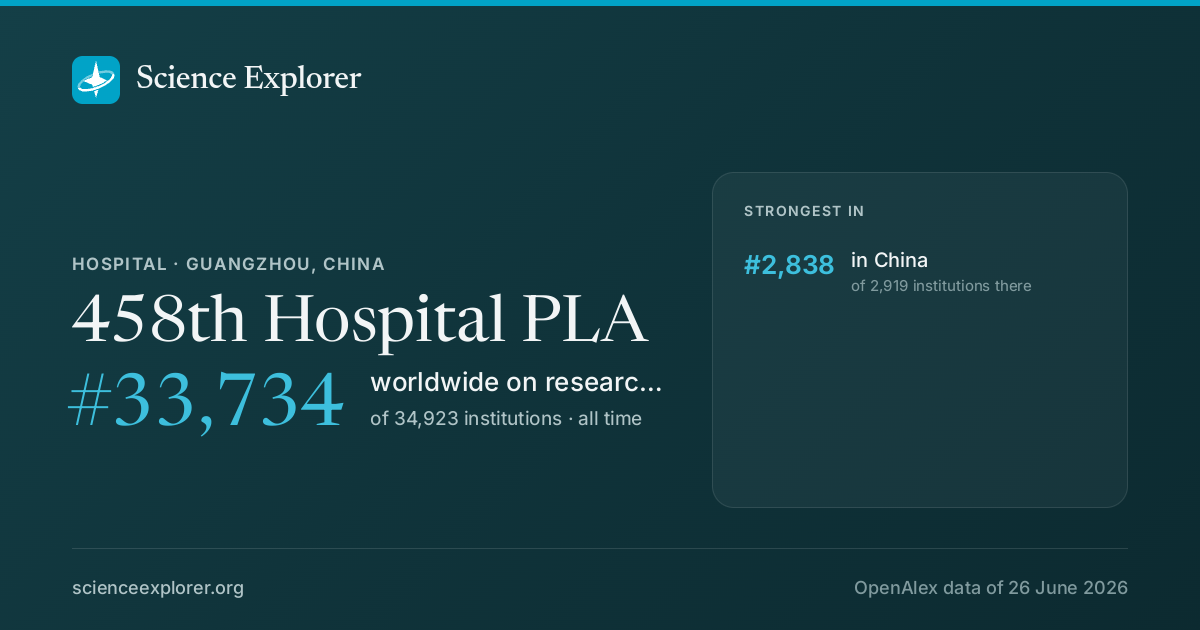
458th Hospital PLA

World rank, all time
#33,734
of 34,923
Rank in China
#2,838
of 2,919
Research works
174
▲ 21% vs 2018-21
Citations
856
4.9 per fractional work
Top-10% rate
6.5%
all institutions 10.0%
vs its own fields
0.82×
1.00× is exactly expected
Open access
25%
world 40%
International
5%
world 18%

Which fields of science does 458th Hospital PLA work in?

In 2022-now, 67% of research at 458th Hospital PLA is in Health Sciences, 20% in Life Sciences. Its largest fields are Medicine (65%), Biochemistry, Genetics and Molecular Biology (9%), Neuroscience (7%). It does 2.3× the world's share of Health Sciences.

Health Sciences: 17 fractional works · 67.4% of its workMedicine: 17 fractional works · 64.7% of its workSurgery: 5 fractional works · 19.7% of its workPulmonary and Respiratory Medicine: 3 fractional works · 11.3% of its workOncology: 2 fractional works · 8.0% of its workEpidemiology: 1 fractional works · 4.3% of its workOtorhinolaryngology: 1 fractional works · 2.6% of its workRheumatology: 1 fractional works · 2.5% of its workPharmacology: 1 fractional works · 2.2% of its workCardiology and Cardiovascular Medicine: 0 fractional works · 1.8% of its workOrthopedics and Sports Medicine: 0 fractional works · 1.7% of its workOphthalmology: 0 fractional works · 1.6% of its workNeurology: 0 fractional works · 1.5% of its workInfectious Diseases: 0 fractional works · 1.2% of its workPhysiology: 0 fractional works · 0.9% of its workComplementary and alternative medicine: 0 fractional works · 0.8% of its workNephrology: 0 fractional works · 0.8% of its workPathology and Forensic Medicine: 0 fractional works · 0.7% of its workRadiology, Nuclear Medicine and Imaging: 0 fractional works · 0.7% of its workGenetics: 0 fractional works · 0.7% of its workPediatrics, Perinatology and Child Health: 0 fractional works · 0.4% of its workPsychiatry and Mental health: 0 fractional works · 0.4% of its workHepatology: 0 fractional works · 0.3% of its workSmaller subfields together: 0 fractional works · 0.6% of its workHealth Professions: 0 fractional works · 1.5% of its workEmergency Medical Services: 0 fractional works · 0.9% of its workOccupational Therapy: 0 fractional works · 0.4% of its workSmaller subfields together: 0 fractional works · 0.2% of its workDentistry: 0 fractional works · 0.8% of its workPeriodontics: 0 fractional works · 0.3% of its workGeneral Dentistry: 0 fractional works · 0.3% of its workOral Surgery: 0 fractional works · 0.2% of its workNursing: 0 fractional works · 0.4% of its workNutrition and Dietetics: 0 fractional works · 0.4% of its workLife Sciences: 5 fractional works · 19.7% of its workBiochemistry, Genetics and Molecular Biology: 2 fractional works · 9.0% of its workMolecular Biology: 1 fractional works · 5.2% of its workCancer Research: 0 fractional works · 1.3% of its workBiotechnology: 0 fractional works · 1.1% of its workGenetics: 0 fractional works · 0.9% of its workEndocrinology: 0 fractional works · 0.5% of its workSmaller subfields together: 0 fractional works · 0.2% of its workNeuroscience: 2 fractional works · 7.1% of its workNeurology: 1 fractional works · 2.9% of its workCognitive Neuroscience: 0 fractional works · 1.7% of its workCellular and Molecular Neuroscience: 0 fractional works · 0.9% of its workSensory Systems: 0 fractional works · 0.7% of its workBehavioral Neuroscience: 0 fractional works · 0.4% of its workBiological Psychiatry: 0 fractional works · 0.4% of its workSmaller subfields together: 0 fractional works · 0.0% of its workImmunology and Microbiology: 1 fractional works · 2.6% of its workImmunology: 0 fractional works · 1.7% of its workParasitology: 0 fractional works · 0.7% of its workSmaller subfields together: 0 fractional works · 0.2% of its workPharmacology, Toxicology and Pharmaceutics: 0 fractional works · 0.5% of its workToxicology: 0 fractional works · 0.3% of its workPharmacology: 0 fractional works · 0.2% of its workAgricultural and Biological Sciences: 0 fractional works · 0.4% of its workPlant Science: 0 fractional works · 0.2% of its workSmaller subfields together: 0 fractional works · 0.2% of its workPhysical Sciences: 2 fractional works · 7.3% of its workEnvironmental Science: 1 fractional works · 2.2% of its workManagement, Monitoring, Policy and Law: 0 fractional works · 1.9% of its workSmaller subfields together: 0 fractional works · 0.3% of its workEngineering: 0 fractional works · 1.7% of its workBiomedical Engineering: 0 fractional works · 0.4% of its workElectrical and Electronic Engineering: 0 fractional works · 0.4% of its workMechanical Engineering: 0 fractional works · 0.4% of its workMechanics of Materials: 0 fractional works · 0.4% of its workSmaller subfields together: 0 fractional works · 0.0% of its workComputer Science: 0 fractional works · 1.5% of its workHuman-Computer Interaction: 0 fractional works · 1.3% of its workSmaller subfields together: 0 fractional works · 0.2% of its workEarth and Planetary Sciences: 0 fractional works · 1.1% of its workPaleontology: 0 fractional works · 1.1% of its workMaterials Science: 0 fractional works · 0.4% of its workBiomaterials: 0 fractional works · 0.4% of its workChemistry: 0 fractional works · 0.3% of its workOrganic Chemistry: 0 fractional works · 0.3% of its workSocial Sciences: 1 fractional works · 5.6% of its workPsychology: 1 fractional works · 2.6% of its workApplied Psychology: 0 fractional works · 1.3% of its workSocial Psychology: 0 fractional works · 1.3% of its workSmaller subfields together: 0 fractional works · 0.0% of its workBusiness, Management and Accounting: 0 fractional works · 1.9% of its workStrategy and Management: 0 fractional works · 1.9% of its workSocial Sciences: 0 fractional works · 0.8% of its workDemography: 0 fractional works · 0.4% of its workGender Studies: 0 fractional works · 0.4% of its workDecision Sciences: 0 fractional works · 0.3% of its workStatistics, Probability and Uncertainty: 0 fractional works · 0.3% of its workALL ITS WORK458th HospitalPLA26fractional works, 2022-now
Life Sciences20%Physical Sciences7%Health Sciences67%Social Sciences6%

Each ring splits the one inside it: the four domains of science, their fields, their subfields. Size is fractional works in 2022-now. Every slice is a page; the interactive view zooms down to single topics and colours each by how much more of it this institution does than the world.

Its 4 domains and 19 fields, with their numbers
    1. Medicine1764.7%
    2. Health Professions01.5%
    3. Dentistry00.8%
    4. Nursing00.4%
    1. Biochemistry, Genetics and Molecular Biology29.0%
    2. Neuroscience27.1%
    3. Immunology and Microbiology12.6%
    4. Pharmacology, Toxicology and Pharmaceutics00.5%
    5. Agricultural and Biological Sciences00.4%
    1. Environmental Science12.2%
    2. Engineering01.7%
    3. Computer Science01.5%
    4. Earth and Planetary Sciences01.1%
    5. Materials Science00.4%
    6. Chemistry00.3%
    1. Psychology12.6%
    2. Business, Management and Accounting01.9%
    3. Social Sciences00.8%
    4. Decision Sciences00.3%
All of science, and how each field's share has moved since 1950: the Science domain explorer

Field profile

Location quotient across every field it publishes in: outside the ring is more than an institution of this size would be expected to publish, inside it is less.

Agricultural and Biological Sciences: 0.08× its world share, 0 worksAgricultural and Bio…Biochemistry, Genetics and Molecular Biology: 1.70× its world share, 2 worksBiochemistry, Geneti…Immunology and Microbiology: 2.60× its world share, 1 worksImmunology and Micro…Neuroscience: 4.40× its world share, 2 worksNeurosciencePharmacology, Toxicology and Pharmaceutics: 1.34× its world share, 0 worksPharmacology, Toxico…Chemistry: 0.21× its world share, 0 worksChemistryComputer Science: 0.19× its world share, 0 worksComputer ScienceEarth and Planetary Sciences: 0.68× its world share, 0 worksEarth and Planetary …Engineering: 0.12× its world share, 0 worksEngineeringEnvironmental Science: 0.45× its world share, 1 worksEnvironmental ScienceMaterials Science: 0.12× its world share, 0 worksMaterials ScienceDentistry: 1.64× its world share, 0 worksDentistryHealth Professions: 0.55× its world share, 0 worksHealth ProfessionsMedicine: 3.37× its world share, 17 worksMedicineNursing: 0.88× its world share, 0 worksNursingBusiness, Management and Accounting: 0.60× its world share, 0 worksBusiness, Management…Decision Sciences: 0.27× its world share, 0 worksDecision SciencesPsychology: 0.85× its world share, 1 worksPsychologySocial Sciences: 0.07× its world share, 0 worksSocial Sciences1×world share
more than its size predictsabout as predictedless

Rings at 0.5×, 1× and 2×. Widest outward: Neuroscience, 4.4×. Every wedge is a field page.

All 19 fields, with their numbers
  1. Neuroscience4.40×2 works
  2. Medicine3.37×17 works
  3. Immunology and Microbiology2.60×1 works
  4. Biochemistry, Genetics and Molecular Biology1.70×2 works
  5. Dentistry1.64×0 works
  6. Pharmacology, Toxicology and Pharmaceutics1.34×0 works
  7. Nursing0.88×0 works
  8. Psychology0.85×1 works
  9. Earth and Planetary Sciences0.68×0 works
  10. Business, Management and Accounting0.60×0 works
  11. Health Professions0.55×0 works
  12. Environmental Science0.45×1 works
  13. Decision Sciences0.27×0 works
  14. Chemistry0.21×0 works
  15. Computer Science0.19×0 works
  16. Engineering0.12×0 works
  17. Materials Science0.12×0 works
  18. Agricultural and Biological Sciences0.08×0 works
  19. Social Sciences0.07×0 works

Who are the top researchers at 458th Hospital PLA?

Ranked on the quality score, Guangze Liu, Xiangping Kong and Liu Xian-tang lead among researchers whose main affiliation is 458th Hospital PLA.

  1. 1 Guangze Liu China · #4,583,304 worldwide 548 citations · 42 works
  2. 2 Xiangping Kong China · #4,964,447 worldwide 486 citations · 24 works
  3. 3 Liu Xian-tang China · #5,132,006 worldwide 2 citations · 24 works
All ranked researchers at 458th Hospital PLA

What are the most cited papers from 458th Hospital PLA?

The most cited paper from 458th Hospital PLA is "Antibacterial effects and biocompatibility of titanium surfaces with graded silver incorporation in titania nanotubes" (Shenglin Mei, Huaiyu Wang, Wei Wang et al., 2014), with 368 citations. Next come "GWAS Identifies Novel Susceptibility Loci on 6p21.32 and 21q21.3 for Hepatocellular Carcinoma in Chronic Hepatitis B Virus Carriers" (211) and "Expert consensus on the diagnosis and treatment of heat stroke in China" (171).

Most cited papers
#PaperReleasedCitations
1 Antibacterial effects and biocompatibility of titanium surfaces with graded silver incorporation in titania nanotubes Shenglin Mei, Huaiyu Wang, Wei Wang et al. · Biomaterials 22 Feb 2014 368
2 GWAS Identifies Novel Susceptibility Loci on 6p21.32 and 21q21.3 for Hepatocellular Carcinoma in Chronic Hepatitis B Virus Carriers Shengping Li et al. · PLoS Genetics Open access 12 Jul 2012 211
3 Expert consensus on the diagnosis and treatment of heat stroke in China Shuyuan Liu, Jingchun Song, Handing Mao et al. · Military Medical Research Open access 12 Jan 2020 171
4 Prevalence, awareness, and treatment of anemia in Chinese patients with nondialysis chronic kidney disease Ya Li, Hao Shi, Weiming Wang et al. · Medicine Open access Jun 2016 119
5 Transcatheter Closure of Perimembranous Ventricular Septal Defect Using a Modified Double-Disk Occluder Yongwen Qin, Jinming Chen, Xianxian Zhao et al. · The American Journal of Cardiology 11 Apr 2008 89
All 60 most cited papers, with filters and sorting

Which keywords describe research at 458th Hospital PLA?

By fractional works in 2022-now, weighted toward what it does more of than the world: Epidemiology, Chemotherapy, Neoadjuvant Therapy, Endoscopic Resection, Treatment, Tumor Microenvironment, Meta-Analysis and Surgery.

▲ more of its work than of the world's◆ about the world's share▼ less than the world's

Size is fractional works in 2022-now in the topics tagged with each word; colour is the word's share of this institution's work against its share of the world's. The 19 words are chosen for being large and distinctive. Each links to the topic it comes from most.

All 19 words, with their numbers
  1. Epidemiology4▲ 4.1×20 topics
  2. Chemotherapy3▲ 14×5 topics
  3. Neoadjuvant Therapy2▲ 41×2 topics
  4. Endoscopic Resection2▲ 89×2 topics
  5. Treatment2▲ 6.3×11 topics
  6. Tumor Microenvironment2▲ 13×4 topics
  7. Diagnosis1▲ 5.6×8 topics
  8. Immunotherapy1▲ 7.2×3 topics
  9. Meta-Analysis1▲ 9.0×2 topics
  10. Esophageal Carcinoma1▲ 121×1 topic
  11. Preoperative Chemoradiotherapy1▲ 63×1 topic
  12. Surgery1▲ 15×2 topics
  13. Clinical Practice Guidelines1▲ 8.8×3 topics
  14. Depression1▲ 5.1×7 topics
  15. Pancreatic Cancer1▲ 44×1 topic
  16. Surgical Complications1▲ 59×1 topic
  17. Adjuvant Therapy1▲ 35×2 topics
  18. Inflammation1▲ 1.93×13 topics
  19. Neurological Disorders1▲ 6.8×4 topics

Which research topics does 458th Hospital PLA publish most on?

By volume in 2022-now: Esophageal Cancer Research and Treatment, Pancreatic and Hepatic Oncology Research, Gastric Cancer Management and Outcomes and Vestibular and auditory disorders.

  1. 1 Esophageal Cancer Research and Treatment Surgery 1 works
  2. 2 Pancreatic and Hepatic Oncology Research Oncology 1 works
  3. 3 Gastric Cancer Management and Outcomes Pulmonary and Respiratory Medicine 1 works
  4. 4 Vestibular and auditory disorders Neurology 0 works
  5. 5 Public-Private Partnership Projects Strategy and Management 0 works
  6. 6 Environmental and Social Impact Assessments Management, Monitoring, Policy and Law 0 works
  7. 7 Orthopaedic implants and arthroplasty Surgery 0 works
  8. 8 Surgical site infection prevention Surgery 0 works
  9. 9 Ear Surgery and Otitis Media Otorhinolaryngology 0 works
  10. 10 Bone and Joint Diseases Orthopedics and Sports Medicine 0 works

How open and international is its research?

Against the world's own shares: the tick on each track. Both are shares of its output, so they sit on one scale and can be read against each other as well as against the world.

openly available25.3%not open74.7%

World: 40% of research is openly available.

with international co-authors4.8%domestic only95.2%

World: 18% is written across borders.

How has 458th Hospital PLA's research output changed?

Output in 2022-2025 was 21% higher than in 2018-2021.

still counting1990200020102020
grewheldshrank

The same series as a ribbon: one cell per year, darker for more. The line above answers how much; this answers when.

Its share of all research

Growing output can still be a shrinking share: all of science grows. This is 458th Hospital PLA as a percentage of every work published that year, 0.000066% in 2024.

still counting0.00020%0.00040%0.00060%458th Hospital PLA0.000097% in 20251990200020102020

Fractional works of 458th Hospital PLA over all fractional works that year. How the balance of science has shifted.

Other research institutions in Guangzhou

All research institutions in Guangzhou

Share 458th Hospital PLA's ranking

458th Hospital PLA on Science Explorer

A card with 458th Hospital PLA's standing and the fields it leads in, for a post or a slide. A link to this page previews as the same card.

Download the card

1200 × 630 PNG, sized for social posts, drawn from the latest snapshot.

Badges for a website1Each links back here and updates with every snapshot

Research measures only: rankings here say nothing about teaching, admissions or student experience. Comparable institutions and collaboration partners have tabs of their own, above.

Discussion

Ask a question or share a note about 458th Hospital PLA. Keep it to the research: no personal attacks, advertising or links. Any reader can report a post, which collapses it for everyone until it is opened.