Jinan University
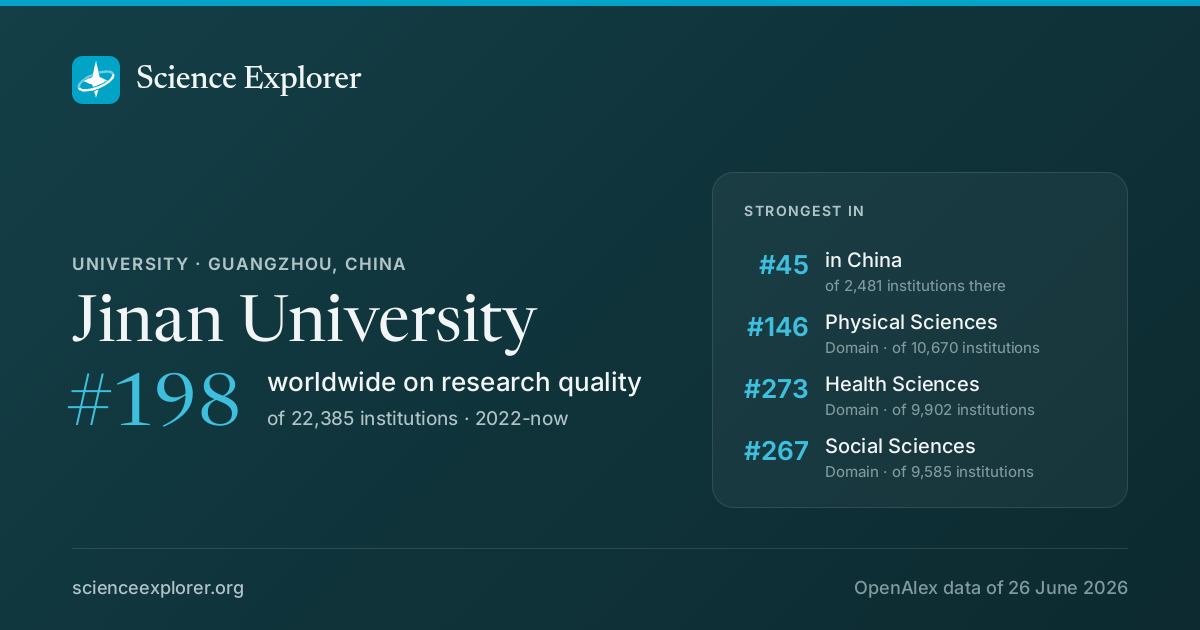
In research, Jinan University stands highest in Physical Sciences (#146 of 10,670 worldwide), Health Sciences (#273 of 9,902 worldwide) and Social Sciences (#267 of 9,585 worldwide), 2022-now. Relative to its size it is most specialised in Cancer Research, Biological Psychiatry and Health, Toxicology and Mutagenesis (Cancer Research is 3.5× its share of world research).
- World rank, 2022-now
- #198 of 22,385 · #304 all time
- Rank in China
- #45 of 2,481
- Research works
- 42k ▲ 29% vs 2018-21
- Citations
- 629k 15.0 per fractional work
- Top-10% rate
- 14.7% all institutions 10.0%
- vs its own fields
- 1.34× 1.00× is exactly expected
- Open access
- 34% world 40%
- International
- 13% world 18%
What is Jinan University known for in research?
The fields where it stands highest, 2022-now, ranked among every institution above the floor in each field.
| Field | World rank | Where that sits | Top-10% rate | Works | All time |
|---|---|---|---|---|---|
| Physical SciencesDomain | #146 of 10,670 | 14.0% | 4,657 | #181 | |
| Health SciencesDomain | #273 of 9,902 | 16.6% | 3,111 | #606 | |
| Social SciencesDomain | #267 of 9,585 | 15.8% | 1,502 | #362 | |
| MedicineField | #249 of 8,541 | 16.2% | 2,866 | #550 | |
| Environmental ScienceField | #103 of 3,334 | 13.8% | 606 | #81 | |
| EngineeringField | #206 of 5,901 | 14.3% | 1,546 | #314 | |
| Life SciencesDomain | #266 of 6,403 | 14.4% | 2,128 | #472 | |
| Computer ScienceField | #227 of 4,417 | 14.2% | 1,022 | #364 | |
| Social SciencesField | #377 of 5,988 | 16.2% | 515 | #366 | |
| Health, Toxicology and MutagenesisSubfield | #21 of 322 | 14.5% | 196 | #18 |
Each strip is that field's whole ranked pool, with the notch where Jinan University sits in it, in the colour of the band that rank falls in. The track under the rate is the rate itself: it carries no average mark, because the average differs by field (from about 6% in Dentistry to 21% in Economics).
Which of those standings moved
The same fields on both windows: where it stood over the whole record, and where it stands in 2022-now. The distance is the story, and it is the one thing the two rank columns above cannot show.
- Physical Sciences#181 #146
- Health Sciences#606 #273
- Social Sciences#362 #267
- Medicine#550 #249
- Environmental Science#81 #103
- Engineering#314 #206
- Life Sciences#472 #266
- Computer Science#364 #227
- Social Sciences#366 #377
- Health, Toxicology and Mutagenesis#18 #21
A dot further right is a better standing. Fields it was not ranked in over the whole record are left out.
Which fields of science does Jinan University work in?
In 2022-now, 41% of research at Jinan University is in Physical Sciences, 28% in Health Sciences. Its largest fields are Medicine (26%), Engineering (13%), Biochemistry, Genetics and Molecular Biology (11%). It does 1.4× the world's share of Life Sciences.
Each ring splits the one inside it: the four domains of science, their fields, their subfields. Size is fractional works in 2022-now. Every slice is a page; the interactive view zooms down to single topics and colours each by how much more of it this institution does than the world.
Its 4 domains and 26 fields, with their numbers
- Physical Sciences5,18340.7%
- Engineering1,71113.4%
- Computer Science1,1429.0%
- Environmental Science6825.4%
- Materials Science6445.1%
- Chemistry3542.8%
- Physics and Astronomy2201.7%
- Energy1751.4%
- Earth and Planetary Sciences1281.0%
- Mathematics890.7%
- Chemical Engineering380.3%
- Health Sciences3,53427.7%
- Medicine3,26325.6%
- Health Professions1231.0%
- Nursing910.7%
- Dentistry530.4%
- Veterinary40.0%
- Life Sciences2,39518.8%
- Social Sciences1,63612.8%
- Social Sciences5604.4%
- Business, Management and Accounting3312.6%
- Economics, Econometrics and Finance3202.5%
- Psychology2241.8%
- Arts and Humanities1030.8%
- Decision Sciences990.8%
What does Jinan University specialise in?
Where its research is concentrated relative to its size: Cancer Research takes 3.5× the share of its output that it takes of world research.
- Cancer ResearchSubfield · 192.7 works3.5×
- Biological PsychiatrySubfield · 23.2 works3.3×
- Health, Toxicology and MutagenesisSubfield · 212.4 works3.1×
- NephrologySubfield · 81.1 works2.9×
- Molecular MedicineSubfield · 38.9 works2.8×
- Pharmaceutical ScienceSubfield · 35.6 works2.6×
Location quotient, a volume reading rather than an impact one. It surfaces small, lopsided specialities.
Field profile
Location quotient across every field it publishes in: outside the ring is more than an institution of this size would be expected to publish, inside it is less.
Rings at 0.5×, 1× and 2×. Widest outward: Pharmacology, Toxicology and Pharmaceutics, 2.3×. Every wedge is a field page.
All 26 fields, with their numbers
- Pharmacology, Toxicology and Pharmaceutics2.26×102 works
- Biochemistry, Genetics and Molecular Biology2.13×1,447 works
- Immunology and Microbiology2.05×263 works
- Chemistry1.77×354 works
- Neuroscience1.60×332 works
- Energy1.49×174 works
- Materials Science1.45×644 works
- Nursing1.45×91 works
- Medicine1.33×3,263 works
- Economics, Econometrics and Finance1.17×320 works
- Computer Science1.15×1,142 works
- Environmental Science1.08×682 works
- Engineering0.89×1,711 works
- Chemical Engineering0.86×38 works
- Dentistry0.85×53 works
- Business, Management and Accounting0.81×331 works
- Decision Sciences0.80×99 works
- Physics and Astronomy0.78×220 works
- Earth and Planetary Sciences0.64×128 works
- Mathematics0.59×89 works
- Psychology0.58×224 works
- Agricultural and Biological Sciences0.42×252 works
- Health Professions0.37×123 works
- Social Sciences0.35×560 works
- Arts and Humanities0.28×103 works
- Veterinary0.25×4 works
- Pharmacology, Toxicology and Pharmaceutics 2.3×
- Biochemistry, Genetics and Molecular Biology 2.1×
- Immunology and Microbiology 2.0×
- Chemistry 1.8×
- Neuroscience 1.6×
- Energy 1.5×
- Materials Science 1.4×
- Nursing 1.4×
- Medicine 1.3×
- Economics, Econometrics and Finance 1.2×
- Computer Science 1.1×
- Environmental Science 1.1×
- Engineering 0.9×
- Chemical Engineering 0.9×
- Dentistry 0.8×
- Business, Management and Accounting 0.8×
- Decision Sciences 0.8×
- Physics and Astronomy 0.8×
- Earth and Planetary Sciences 0.6×
- Mathematics 0.6×
- Psychology 0.6×
- Agricultural and Biological Sciences 0.4×
- Health Professions 0.4×
- Social Sciences 0.3×
- Arts and Humanities 0.3×
- Veterinary 0.2×
Who are the top researchers at Jinan University?
Ranked on the quality score, Mingshan Zhu, Wenjie Mai and Lixi Zeng lead among researchers whose main affiliation is Jinan University.
- 1
Mingshan Zhu
 China · #9,913 worldwide
26k citations · 395 works
- 2
Wenjie Mai
China · #14,531 worldwide
30k citations · 379 works
- 3
Lixi Zeng
China · #23,687 worldwide
11k citations · 163 works
- 4
Tianfeng Chen
China · #24,913 worldwide
22k citations · 510 works
- 5
Xiya Yang
China · #27,417 worldwide
6.7k citations · 135 works
- 6
Bangzhu Zhu
China · #28,705 worldwide
10k citations · 182 works
- 7
Weigang Lu
China · #30,551 worldwide
15k citations · 187 works
- 8
Hengrui Liu
China · #31,870 worldwide
4.2k citations · 106 works
- 9
Weixiong Wu
China · #34,340 worldwide
6.7k citations · 110 works
- 10
Junyun Liao
China · #34,573 worldwide
2.2k citations · 60 works
Which keywords describe research at Jinan University?
By fractional works in 2022-now, weighted toward what it does more of than the world: Inflammation, Cancer, Oxidative Stress, Deep Learning, Biomedical Applications, Epidemiology, Machine Learning and Tumor Microenvironment.
- Lipid Peroxidation
- Fluorescence Imaging
- Photodynamic Therapy
- Biogenesis
- Apoptosis
- Biosensors
- Immunity
- Cell Death
- Cancer Therapy
- Reactive Oxygen Species
- Regulation
- Tissue Engineering
- Immunotherapy
- Drug Delivery
- Nanomaterials
- Neural Networks
- Nanoparticles
- Machine Learning
- Oxidative Stress
- Deep Learning
- Inflammation
- Cancer
- Epidemiology
- Biomedical Applications
- Cardiovascular Disease
- Biomarkers
- Gene Expression
- Tumor Microenvironment
- Metabolic Syndrome
- Antioxidant
- Metabolism
- Health Effects
- Catalysis
- Metal-Organic Frameworks
- Diabetes
- Angiogenesis
- Cathode Materials
- Metastasis
- Tumor Targeting
- Photothermal Therapy
Size is fractional works in 2022-now in the topics tagged with each word; colour is the word's share of this institution's work against its share of the world's. The 40 words are chosen for being large and distinctive. Each links to the topic it comes from most.
All 40 words, with their numbers
- Inflammation672▲ 2.5×83 topics
- Deep Learning572▲ 1.30×84 topics
- Cancer565▲ 3.3×58 topics
- Oxidative Stress544▲ 2.6×62 topics
- Epidemiology510◆ 1.00×127 topics
- Machine Learning462◆ 1.09×87 topics
- Biomedical Applications331▲ 2.2×36 topics
- Nanoparticles301▲ 1.87×43 topics
- Cardiovascular Disease272▲ 1.87×38 topics
- Neural Networks263▲ 1.34×39 topics
- Biomarkers237▲ 2.7×18 topics
- Nanomaterials226▲ 1.69×19 topics
- Gene Expression216▲ 2.7×19 topics
- Drug Delivery213▲ 3.1×16 topics
- Tumor Microenvironment211▲ 3.7×8 topics
- Immunotherapy204▲ 2.2×18 topics
- Metabolic Syndrome188▲ 1.83×22 topics
- Tissue Engineering184▲ 2.4×13 topics
- Antioxidant184▲ 2.1×49 topics
- Regulation174▲ 2.6×23 topics
- Metabolism167▲ 2.5×31 topics
- Reactive Oxygen Species166▲ 3.2×14 topics
- Health Effects163▲ 2.1×24 topics
- Cancer Therapy162▲ 2.2×20 topics
- Catalysis161▲ 1.90×28 topics
- Cell Death153▲ 4.9×6 topics
- Metal-Organic Frameworks152▲ 2.9×6 topics
- Immunity151▲ 2.9×11 topics
- Diabetes149▲ 2.3×21 topics
- Biosensors147▲ 2.3×12 topics
- Angiogenesis144▲ 3.4×16 topics
- Apoptosis140▲ 3.5×22 topics
- Cathode Materials129▲ 2.6×3 topics
- Biogenesis127▲ 5.8×3 topics
- Metastasis124▲ 2.9×12 topics
- Photodynamic Therapy118▲ 4.1×6 topics
- Tumor Targeting113▲ 4.8×3 topics
- Fluorescence Imaging101▲ 5.3×2 topics
- Photothermal Therapy91▲ 5.6×2 topics
- Lipid Peroxidation85▲ 6.0×3 topics
Which research topics does Jinan University publish most on?
By volume in 2022-now: Nanoplatforms for cancer theranostics, Ferroptosis and cancer prognosis, Perovskite Materials and Applications and Energy, Environment, Economic Growth.
Area is fractional works; colour is the subfield each topic belongs to.
- 1 Nanoplatforms for cancer theranostics Biomedical Engineering 79 works
- 2 Ferroptosis and cancer prognosis Pulmonary and Respiratory Medicine 76 works
- 3 Perovskite Materials and Applications Electrical and Electronic Engineering 64 works
- 4 Energy, Environment, Economic Growth Economics and Econometrics 62 works
- 5 Advanced Photocatalysis Techniques Renewable Energy, Sustainability and the Environment 61 works
- 6 Cancer-related molecular mechanisms research Cancer Research 57 works
- 7 RNA modifications and cancer Molecular Biology 52 works
- 8 Air Quality and Health Impacts Health, Toxicology and Mutagenesis 52 works
- 9 MicroRNA in disease regulation Cancer Research 50 works
- 10 Privacy-Preserving Technologies in Data Artificial Intelligence 47 works
How open and international is its research?
Against the world's own shares: the tick on each track. Both are shares of its output, so they sit on one scale and can be read against each other as well as against the world.
World: 40% of research is openly available.
World: 18% is written across borders.
How has Jinan University's research output changed?
Output in 2022-2025 was 29% higher than in 2018-2021.
The same series as a ribbon: one cell per year, darker for more. The line above answers how much; this answers when.
Its share of all research
Growing output can still be a shrinking share: all of science grows. This is Jinan University as a percentage of every work published that year, 0.052% in 2024.
Fractional works of Jinan University over all fractional works that year. How the balance of science has shifted.
How much of it reaches the world top 10%
Year by year, against all institutions in the same year.
Of each year's output, the share that reached the world's 10% most cited for its field and year. Peak 15.8% in 2024.
Other research institutions in Guangzhou
- Sun Yat-sen University
- South China University of Technology
- Southern Medical University
- Guangdong University of Technology
- South China Normal University
- South China Agricultural University
- Guangzhou Medical University
- Guangzhou University
Which institutions have research most like Jinan University's?
Among the world's leading institutions, Zhengzhou University has the research profile closest to Jinan University's, with both strong in Biochemistry, Genetics and Molecular Biology.
- 1
Zhengzhou UniversityChina · Both strong in Biochemistry, Genetics and Molecular Biology, Immunology and Microbiology, Chemistry
0.84 Compare
- 2
Qingdao UniversityChina · Both strong in Biochemistry, Genetics and Molecular Biology, Immunology and Microbiology, Chemistry
0.83 Compare
- 3
Fudan UniversityChina · Both strong in Biochemistry, Genetics and Molecular Biology, Immunology and Microbiology, Neuroscience
0.79 Compare
- 4
Sichuan UniversityChina · Both strong in Biochemistry, Genetics and Molecular Biology, Immunology and Microbiology, Chemistry
0.79 Compare
- 5
Huazhong University of Science and TechnologyChina · Both strong in Immunology and Microbiology, Biochemistry, Genetics and Molecular Biology, Energy
0.79 Compare

Similarity is the correlation of each side's location quotients across every field it publishes in, on a log scale: 1 is the same shape of research, 0 is unrelated. It ignores size. How it is measured.
Compare Jinan University with
- vs
 University of Virginia
- vs Henan University
- vs
 University of Padua
- vs
 Universitat Autònoma de Barcelona
- vs University of Macau
- vs Universitat Pompeu Fabra
Share Jinan University's ranking



Research measures only: rankings here say nothing about teaching, admissions or student experience. Comparable institutions and collaboration partners have tabs of their own, above.
Discussion
Ask a question or share a note about Jinan University. Posts are plain text and can be reported.