Science Explorer Back to mapMap
Discussion

AEgis Technologies (United States)

World rank, all time
#23,671
of 34,923
Rank in United States
#4,924
of 7,310
Research works
191
▲ 14% vs 2018-21
Citations
2.4k
12.8 per fractional work
Top-10% rate
13.5%
all institutions 10.0%
vs its own fields
1.02×
1.00× is exactly expected
Open access
38%
world 40%
International
13%
world 18%

Which fields of science does AEgis Technologies (United States) work in?

In 2022-now, 48% of research at AEgis Technologies (United States) is in Health Sciences, 26% in Life Sciences. Its largest fields are Medicine (45%), Biochemistry, Genetics and Molecular Biology (15%), Engineering (11%). It does 1.7× the world's share of Health Sciences.

Health Sciences: 11 fractional works · 47.8% of its workMedicine: 10 fractional works · 44.6% of its workPhysiology: 3 fractional works · 11.2% of its workInfectious Diseases: 2 fractional works · 7.8% of its workEpidemiology: 1 fractional works · 4.8% of its workPulmonary and Respiratory Medicine: 1 fractional works · 4.1% of its workSurgery: 0 fractional works · 2.2% of its workPublic Health, Environmental and Occupational Health: 0 fractional works · 2.0% of its workRadiology, Nuclear Medicine and Imaging: 0 fractional works · 2.0% of its workFamily Practice: 0 fractional works · 1.4% of its workGeriatrics and Gerontology: 0 fractional works · 1.4% of its workPharmacology: 0 fractional works · 0.9% of its workPathology and Forensic Medicine: 0 fractional works · 0.8% of its workRehabilitation: 0 fractional works · 0.8% of its workCritical Care and Intensive Care Medicine: 0 fractional works · 0.8% of its workNephrology: 0 fractional works · 0.8% of its workNeurology: 0 fractional works · 0.7% of its workOrthopedics and Sports Medicine: 0 fractional works · 0.5% of its workPsychiatry and Mental health: 0 fractional works · 0.4% of its workComplementary and alternative medicine: 0 fractional works · 0.4% of its workOncology: 0 fractional works · 0.4% of its workPediatrics, Perinatology and Child Health: 0 fractional works · 0.4% of its workCardiology and Cardiovascular Medicine: 0 fractional works · 0.3% of its workOphthalmology: 0 fractional works · 0.3% of its workHepatology: 0 fractional works · 0.3% of its workHealth Professions: 0 fractional works · 1.4% of its workPhysical Therapy, Sports Therapy and Rehabilitation: 0 fractional works · 1.0% of its workGeneral Health Professions: 0 fractional works · 0.2% of its workSmaller subfields together: 0 fractional works · 0.2% of its workVeterinary: 0 fractional works · 1.1% of its workSmall Animals: 0 fractional works · 1.1% of its workDentistry: 0 fractional works · 0.8% of its workOral Surgery: 0 fractional works · 0.8% of its workLife Sciences: 6 fractional works · 25.6% of its workBiochemistry, Genetics and Molecular Biology: 3 fractional works · 15.2% of its workMolecular Biology: 1 fractional works · 5.6% of its workCancer Research: 1 fractional works · 5.2% of its workGenetics: 1 fractional works · 2.5% of its workClinical Biochemistry: 0 fractional works · 1.5% of its workPhysiology: 0 fractional works · 0.4% of its workAgricultural and Biological Sciences: 1 fractional works · 3.9% of its workForestry: 0 fractional works · 2.2% of its workAnimal Science and Zoology: 0 fractional works · 0.5% of its workAquatic Science: 0 fractional works · 0.4% of its workEcology, Evolution, Behavior and Systematics: 0 fractional works · 0.4% of its workGeneral Agricultural and Biological Sciences: 0 fractional works · 0.2% of its workSmaller subfields together: 0 fractional works · 0.2% of its workImmunology and Microbiology: 1 fractional works · 2.6% of its workMicrobiology: 0 fractional works · 1.5% of its workImmunology: 0 fractional works · 0.8% of its workParasitology: 0 fractional works · 0.3% of its workPharmacology, Toxicology and Pharmaceutics: 1 fractional works · 2.6% of its workToxicology: 1 fractional works · 2.6% of its workNeuroscience: 0 fractional works · 1.4% of its workCognitive Neuroscience: 0 fractional works · 0.5% of its workCellular and Molecular Neuroscience: 0 fractional works · 0.3% of its workNeurology: 0 fractional works · 0.3% of its workSmaller subfields together: 0 fractional works · 0.3% of its workPhysical Sciences: 5 fractional works · 21.1% of its workEngineering: 2 fractional works · 10.7% of its workAerospace Engineering: 2 fractional works · 8.4% of its workBiomedical Engineering: 0 fractional works · 1.2% of its workElectrical and Electronic Engineering: 0 fractional works · 0.8% of its workIndustrial and Manufacturing Engineering: 0 fractional works · 0.4% of its workChemistry: 1 fractional works · 4.4% of its workAnalytical Chemistry: 1 fractional works · 4.4% of its workPhysics and Astronomy: 1 fractional works · 3.4% of its workAstronomy and Astrophysics: 1 fractional works · 3.0% of its workStatistical and Nonlinear Physics: 0 fractional works · 0.4% of its workComputer Science: 1 fractional works · 2.4% of its workComputer Vision and Pattern Recognition: 0 fractional works · 1.2% of its workInformation Systems: 0 fractional works · 0.5% of its workHardware and Architecture: 0 fractional works · 0.4% of its workSmaller subfields together: 0 fractional works · 0.3% of its workEnvironmental Science: 0 fractional works · 0.2% of its workHealth, Toxicology and Mutagenesis: 0 fractional works · 0.2% of its workSocial Sciences: 1 fractional works · 5.5% of its workPsychology: 1 fractional works · 2.7% of its workClinical Psychology: 0 fractional works · 1.5% of its workSocial Psychology: 0 fractional works · 1.1% of its workSmaller subfields together: 0 fractional works · 0.2% of its workSocial Sciences: 1 fractional works · 2.6% of its workSociology and Political Science: 0 fractional works · 2.2% of its workHealth: 0 fractional works · 0.4% of its workBusiness, Management and Accounting: 0 fractional works · 0.2% of its workOrganizational Behavior and Human Resource Management: 0 fractional works · 0.2% of its workALL ITS WORKAEgisTechnologies…23fractional works, 2022-now
Life Sciences26%Physical Sciences21%Health Sciences48%Social Sciences5%

Each ring splits the one inside it: the four domains of science, their fields, their subfields. Size is fractional works in 2022-now. Every slice is a page; the interactive view zooms down to single topics and colours each by how much more of it this institution does than the world.

Its 4 domains and 17 fields, with their numbers
    1. Medicine1044.6%
    2. Health Professions01.4%
    3. Veterinary01.1%
    4. Dentistry00.8%
    1. Biochemistry, Genetics and Molecular Biology315.2%
    2. Agricultural and Biological Sciences13.9%
    3. Immunology and Microbiology12.6%
    4. Pharmacology, Toxicology and Pharmaceutics12.6%
    5. Neuroscience01.4%
    1. Engineering210.7%
    2. Chemistry14.4%
    3. Physics and Astronomy13.4%
    4. Computer Science12.4%
    5. Environmental Science00.2%
    1. Psychology12.7%
    2. Social Sciences12.6%
    3. Business, Management and Accounting00.2%
All of science, and how each field's share has moved since 1950: the Science domain explorer

Field profile

Location quotient across every field it publishes in: outside the ring is more than an institution of this size would be expected to publish, inside it is less.

Agricultural and Biological Sciences: 0.82× its world share, 1 worksAgricultural and Bio…Biochemistry, Genetics and Molecular Biology: 2.84× its world share, 3 worksBiochemistry, Geneti…Immunology and Microbiology: 2.57× its world share, 1 worksImmunology and Micro…Neuroscience: 0.86× its world share, 0 worksNeurosciencePharmacology, Toxicology and Pharmaceutics: 7.34× its world share, 1 worksPharmacology, Toxico…Chemistry: 2.83× its world share, 1 worksChemistryComputer Science: 0.31× its world share, 0 worksComputer ScienceEngineering: 0.71× its world share, 2 worksEngineeringEnvironmental Science: 0.04× its world share, 0 worksEnvironmental SciencePhysics and Astronomy: 1.52× its world share, 1 worksPhysics and AstronomyDentistry: 1.52× its world share, 0 worksDentistryHealth Professions: 0.52× its world share, 0 worksHealth ProfessionsMedicine: 2.32× its world share, 10 worksMedicineVeterinary: 8.16× its world share, 0 worksVeterinaryBusiness, Management and Accounting: 0.07× its world share, 0 worksBusiness, Management…Psychology: 0.89× its world share, 1 worksPsychologySocial Sciences: 0.20× its world share, 1 worksSocial Sciences1×world share
more than its size predictsabout as predictedless

Rings at 0.5×, 1× and 2×. Widest outward: Veterinary, 8.2×. Every wedge is a field page.

All 17 fields, with their numbers
  1. Veterinary8.16×0 works
  2. Pharmacology, Toxicology and Pharmaceutics7.34×1 works
  3. Biochemistry, Genetics and Molecular Biology2.84×3 works
  4. Chemistry2.83×1 works
  5. Immunology and Microbiology2.57×1 works
  6. Medicine2.32×10 works
  7. Physics and Astronomy1.52×1 works
  8. Dentistry1.52×0 works
  9. Psychology0.89×1 works
  10. Neuroscience0.86×0 works
  11. Agricultural and Biological Sciences0.82×1 works
  12. Engineering0.71×2 works
  13. Health Professions0.52×0 works
  14. Computer Science0.31×0 works
  15. Social Sciences0.20×1 works
  16. Business, Management and Accounting0.07×0 works
  17. Environmental Science0.04×0 works

Who are the top researchers at AEgis Technologies (United States)?

Ranked on the quality score, Stephen S. Tower, Nikolay I. Nemchuk and John M. Callahan lead among researchers whose main affiliation is AEgis Technologies (United States).

  1. 1 Stephen S. Tower United States · #1,320,033 worldwide 2.3k citations · 25 works
  2. 2 Nikolay I. Nemchuk United States · #2,736,204 worldwide 330 citations · 17 works
  3. 3 John M. Callahan United States · #2,790,424 worldwide 290 citations · 25 works
  4. 4 Rebecca M. Heltsley United States · #3,046,990 worldwide 1.1k citations · 45 works
  5. 5 Joshua Schrecker United States · #3,660,770 worldwide 155 citations · 17 works
  6. 6 Anne Z. DePriest United States · #3,933,231 worldwide 444 citations · 21 works
  7. 7 Timothy A. Robert United States · #4,953,975 worldwide 430 citations · 20 works
  8. 8 David L. Black United States · #5,107,389 worldwide 1.1k citations · 41 works
  9. 9 E Maggio United States · #5,420,612 worldwide 585 citations · 58 works
  10. 10 Milan C. Buncick United States · #5,797,816 worldwide 474 citations · 39 works
All ranked researchers at AEgis Technologies (United States)

What are the most cited papers from AEgis Technologies (United States)?

The most cited paper from AEgis Technologies (United States) is "Associations of Perfluoroalkyl Substances (PFAS) with Lower Birth Weight: An Evaluation of Potential Confounding by Glomerular Filtration Rate Using a Physiologically Based Pharmacokinetic Model (PBPK)" (Marc-André Verner, Anne E. Loccisano, Nils‐Halvdan Morken et al., 2015), with 250 citations. Next come "Second- and third-harmonic generation in metal-based structures" (250) and "Boosting optical nonlinearities in ε -near-zero plasmonic channels" (233).

Most cited papers
#PaperReleasedCitations
1 Associations of Perfluoroalkyl Substances (PFAS) with Lower Birth Weight: An Evaluation of Potential Confounding by Glomerular Filtration Rate Using a Physiologically Based Pharmacokinetic Model (PBPK) Marc-André Verner, Anne E. Loccisano, Nils‐Halvdan Morken et al. · Environmental Health Perspectives Open access 21 May 2015 250
2 Second- and third-harmonic generation in metal-based structures Michael Scalora, Maria Antonietta Vincenti, Domenico de Ceglia et al. · Physical Review A Open access 18 Oct 2010 250
3 Boosting optical nonlinearities in ε -near-zero plasmonic channels Christos Argyropoulos, Pai‐Yen Chen, Giuseppe D’Aguanno et al. · Physical Review B Open access 27 Jan 2012 233
4 Broadband absorbers and selective emitters based on plasmonic Brewster metasurfaces Christos Argyropoulos, Khai Quang Le, Nadia Mattiucci et al. · Physical Review B Open access 10 May 2013 225
5 Plasmonic Brewster Angle: Broadband Extraordinary Transmission through Optical Gratings Andrea Alù, Giuseppe D’Aguanno, Nadia Mattiucci et al. · Physical Review Letters 23 Mar 2011 201
All 60 most cited papers, with filters and sorting

Which keywords describe research at AEgis Technologies (United States)?

By fractional works in 2022-now, weighted toward what it does more of than the world: Immune System, Microgravity, Spaceflight, SARS-CoV-2, Method Validation, Extravehicular Activity, Space Suit and Genomic Instability.

▲ more of its work than of the world's◆ about the world's share▼ less than the world's

Size is fractional works in 2022-now in the topics tagged with each word; colour is the word's share of this institution's work against its share of the world's. The 16 words are chosen for being large and distinctive. Each links to the topic it comes from most.

All 16 words, with their numbers
  1. Immune System2▲ 42×2 topics
  2. Microgravity2▲ 533×1 topic
  3. Spaceflight2▲ 533×1 topic
  4. SARS-CoV-22▲ 24×2 topics
  5. Epidemiology2▲ 1.74×11 topics
  6. Method Validation2▲ 125×2 topics
  7. COVID-191▲ 4.9×3 topics
  8. Extravehicular Activity1▲ 732×1 topic
  9. Space Suit1▲ 732×1 topic
  10. Cancer Genomics1▲ 72×1 topic
  11. Genomic Instability1▲ 48×2 topics
  12. Mutational Signatures1▲ 72×1 topic
  13. Diagnostics1▲ 60×1 topic
  14. wastewater surveillance1▲ 163×1 topic
  15. Green Analytical Chemistry1▲ 79×1 topic
  16. Pharmaceutical Analysis1▲ 245×1 topic

Which research topics does AEgis Technologies (United States) publish most on?

By volume in 2022-now: Spaceflight effects on biology, Space Exploration and Technology, Cancer Genomics and Diagnostics and SARS-CoV-2 detection and testing.

  1. 1 Spaceflight effects on biology Physiology 2 works
  2. 2 Space Exploration and Technology Aerospace Engineering 1 works
  3. 3 Cancer Genomics and Diagnostics Cancer Research 1 works
  4. 4 SARS-CoV-2 detection and testing Infectious Diseases 1 works
  5. 5 Analytical Methods in Pharmaceuticals Analytical Chemistry 1 works
  6. 6 Cardiovascular and Diving-Related Complications Pulmonary and Respiratory Medicine 1 works
  7. 7 Gut microbiota and health Molecular Biology 1 works
  8. 8 SARS-CoV-2 and COVID-19 Research Infectious Diseases 1 works
  9. 9 Forensic Toxicology and Drug Analysis Toxicology 1 works
  10. 10 High Altitude and Hypoxia Genetics 1 works

How open and international is its research?

Against the world's own shares: the tick on each track. Both are shares of its output, so they sit on one scale and can be read against each other as well as against the world.

openly available38.4%not open61.6%

World: 40% of research is openly available.

with international co-authors12.9%domestic only87.1%

World: 18% is written across borders.

How has AEgis Technologies (United States)'s research output changed?

Output in 2022-2025 was 14% higher than in 2018-2021.

still counting200020102020
grewheldshrank

The same series as a ribbon: one cell per year, darker for more. The line above answers how much; this answers when.

Its share of all research

Growing output can still be a shrinking share: all of science grows. This is AEgis Technologies (United States) as a percentage of every work published that year, 0.000066% in 2024.

still counting0.00025%0.00050%0.00075%AEgis Technologies (United States)0.000077% in 202519801990200020102020

Fractional works of AEgis Technologies (United States) over all fractional works that year. How the balance of science has shifted.

Other research institutions in Huntsville

All research institutions in Huntsville

Share AEgis Technologies (United States)'s ranking
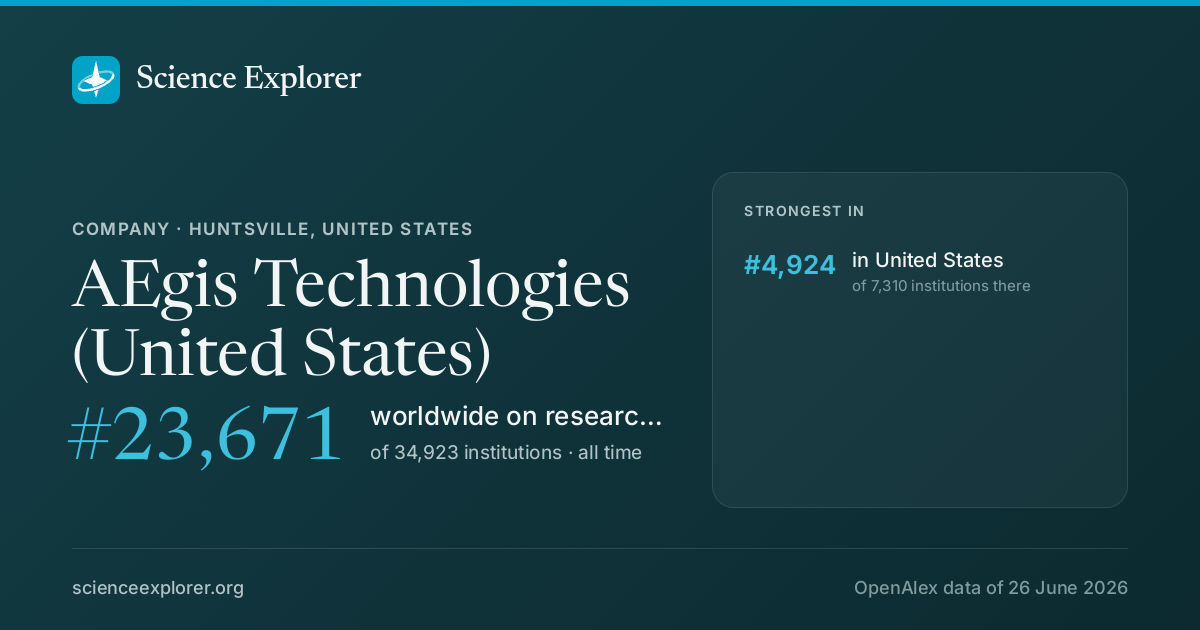
AEgis Technologies (United States) on Science Explorer

A card with AEgis Technologies (United States)'s standing and the fields it leads in, for a post or a slide. A link to this page previews as the same card.

Download the card

1200 × 630 PNG, sized for social posts, drawn from the latest snapshot.

Badges for a website1Each links back here and updates with every snapshot

Research measures only: rankings here say nothing about teaching, admissions or student experience. Comparable institutions and collaboration partners have tabs of their own, above.

Discussion

Ask a question or share a note about AEgis Technologies (United States). Keep it to the research: no personal attacks, advertising or links. Any reader can report a post, which collapses it for everyone until it is opened.