Science Explorer Back to mapMap
Discussion
University · Afyonkarahisar · Türkiye

Afyon Kocatepe University

In research, Afyon Kocatepe University stands highest in Social Sciences (#1,971 of 9,585 worldwide), Social Sciences (#2,614 of 5,988 worldwide) and Health Sciences (#4,542 of 9,902 worldwide), 2022-now. Relative to its size it is most specialised in Museology and Religious studies (Museology is 14.4× its share of world research).

World rank, 2022-now
#2,657
of 22,385 · #7,727 all time
Rank in Türkiye
#30
of 297
Research works
9.2k
▲ 24% vs 2018-21
Citations
91k
9.9 per fractional work
Top-10% rate
7.7%
all institutions 10.0%
vs its own fields
0.81×
1.00× is exactly expected
Open access
67%
world 40%
International
7%
world 18%

What is Afyon Kocatepe University known for in research?

The fields where it stands highest, 2022-now, ranked among every institution above the floor in each field.

FieldWorld rankWhere that sitsTop-10% rateWorksAll time
Social SciencesDomain #1,971 of 9,585 8.4%1,309 #4545
Social SciencesField #2,614 of 5,988 8.2%542 #5070
Health SciencesDomain #4,542 of 9,902 6.1%482 #13415
Physical SciencesDomain #5,092 of 10,670 7.7%853 #11886
MedicineField #4,247 of 8,541 5.7%353 #11482
Materials ScienceField #1,214 of 2,276 5.9%91 #3085
EngineeringField #3,321 of 5,901 7.8%372 #5541
PsychologyField #1,246 of 2,121 7.4%172 #2469
Arts and HumanitiesField #1,123 of 1,896 11.1%315 #2750
Business, Management and AccountingField #1,583 of 2,581 7.8%123 #3090

Each strip is that field's whole ranked pool, with the notch where Afyon Kocatepe University sits in it, in the colour of the band that rank falls in. The track under the rate is the rate itself: it carries no average mark, because the average differs by field (from about 6% in Dentistry to 21% in Economics).

Which of those standings moved

The same fields on both windows: where it stood over the whole record, and where it stands in 2022-now. The distance is the story, and it is the one thing the two rank columns above cannot show.

  1. Social Sciences#4,545 #1,971
  2. Social Sciences#5,070 #2,614
  3. Health Sciences#13,415 #4,542
  4. Physical Sciences#11,886 #5,092
  5. Medicine#11,482 #4,247
  6. Materials Science#3,085 #1,214
  7. Engineering#5,541 #3,321
  8. Psychology#2,469 #1,246
  9. Arts and Humanities#2,750 #1,123
  10. Business, Management and Accounting#3,090 #1,583
all time2022-now, better2022-now, worse

A dot further right is a better standing. Fields it was not ranked in over the whole record are left out.

Which fields of science does Afyon Kocatepe University work in?

In 2022-now, 43% of research at Afyon Kocatepe University is in Social Sciences, 29% in Physical Sciences. Its largest fields are Social Sciences (18%), Medicine (13%), Engineering (13%). It does 1.7× the world's share of Social Sciences.

Social Sciences: 1,446 fractional works · 43.2% of its workSocial Sciences: 605 fractional works · 18.1% of its workEducation: 187 fractional works · 5.6% of its workSociology and Political Science: 164 fractional works · 4.9% of its workPolitical Science and International Relations: 106 fractional works · 3.2% of its workGender Studies: 34 fractional works · 1.0% of its workUrban Studies: 28 fractional works · 0.8% of its workCommunication: 14 fractional works · 0.4% of its workCultural Studies: 14 fractional works · 0.4% of its workDemography: 13 fractional works · 0.4% of its workSafety Research: 10 fractional works · 0.3% of its workHealth: 8 fractional works · 0.2% of its workSmaller subfields together: 27 fractional works · 0.8% of its workArts and Humanities: 340 fractional works · 10.2% of its workLiterature and Literary Theory: 63 fractional works · 1.9% of its workPhilosophy: 60 fractional works · 1.8% of its workMuseology: 59 fractional works · 1.8% of its workReligious studies: 41 fractional works · 1.2% of its workHistory: 38 fractional works · 1.1% of its workLanguage and Linguistics: 37 fractional works · 1.1% of its workArcheology: 19 fractional works · 0.6% of its workMusic: 10 fractional works · 0.3% of its workVisual Arts and Performing Arts: 8 fractional works · 0.2% of its workSmaller subfields together: 5 fractional works · 0.1% of its workPsychology: 189 fractional works · 5.7% of its workSocial Psychology: 99 fractional works · 3.0% of its workClinical Psychology: 45 fractional works · 1.4% of its workDevelopmental and Educational Psychology: 23 fractional works · 0.7% of its workExperimental and Cognitive Psychology: 14 fractional works · 0.4% of its workSmaller subfields together: 8 fractional works · 0.2% of its workEconomics, Econometrics and Finance: 147 fractional works · 4.4% of its workEconomics and Econometrics: 111 fractional works · 3.3% of its workFinance: 19 fractional works · 0.6% of its workGeneral Economics, Econometrics and Finance: 17 fractional works · 0.5% of its workBusiness, Management and Accounting: 134 fractional works · 4.0% of its workStrategy and Management: 38 fractional works · 1.1% of its workAccounting: 30 fractional works · 0.9% of its workOrganizational Behavior and Human Resource Management: 22 fractional works · 0.7% of its workMarketing: 17 fractional works · 0.5% of its workManagement Information Systems: 10 fractional works · 0.3% of its workManagement of Technology and Innovation: 10 fractional works · 0.3% of its workSmaller subfields together: 8 fractional works · 0.2% of its workDecision Sciences: 31 fractional works · 0.9% of its workManagement Science and Operations Research: 25 fractional works · 0.7% of its workSmaller subfields together: 6 fractional works · 0.2% of its workPhysical Sciences: 967 fractional works · 28.9% of its workEngineering: 419 fractional works · 12.5% of its workMechanical Engineering: 101 fractional works · 3.0% of its workElectrical and Electronic Engineering: 59 fractional works · 1.8% of its workCivil and Structural Engineering: 58 fractional works · 1.7% of its workBiomedical Engineering: 54 fractional works · 1.6% of its workAutomotive Engineering: 31 fractional works · 0.9% of its workBuilding and Construction: 29 fractional works · 0.9% of its workMechanics of Materials: 23 fractional works · 0.7% of its workControl and Systems Engineering: 15 fractional works · 0.5% of its workAerospace Engineering: 14 fractional works · 0.4% of its workIndustrial and Manufacturing Engineering: 11 fractional works · 0.3% of its workMedia Technology: 9 fractional works · 0.3% of its workSmaller subfields together: 14 fractional works · 0.4% of its workComputer Science: 143 fractional works · 4.3% of its workArtificial Intelligence: 55 fractional works · 1.7% of its workComputer Vision and Pattern Recognition: 32 fractional works · 1.0% of its workInformation Systems: 28 fractional works · 0.8% of its workHuman-Computer Interaction: 8 fractional works · 0.3% of its workSmaller subfields together: 19 fractional works · 0.6% of its workEnvironmental Science: 104 fractional works · 3.1% of its workPollution: 19 fractional works · 0.6% of its workEnvironmental Engineering: 16 fractional works · 0.5% of its workWater Science and Technology: 13 fractional works · 0.4% of its workManagement, Monitoring, Policy and Law: 12 fractional works · 0.4% of its workEcology: 12 fractional works · 0.4% of its workIndustrial and Manufacturing Engineering: 10 fractional works · 0.3% of its workHealth, Toxicology and Mutagenesis: 8 fractional works · 0.2% of its workGlobal and Planetary Change: 8 fractional works · 0.2% of its workSmaller subfields together: 5 fractional works · 0.2% of its workMaterials Science: 102 fractional works · 3.1% of its workMaterials Chemistry: 48 fractional works · 1.4% of its workBiomaterials: 20 fractional works · 0.6% of its workPolymers and Plastics: 18 fractional works · 0.5% of its workSmaller subfields together: 15 fractional works · 0.5% of its workMathematics: 59 fractional works · 1.8% of its workApplied Mathematics: 18 fractional works · 0.5% of its workStatistics and Probability: 18 fractional works · 0.5% of its workGeometry and Topology: 8 fractional works · 0.2% of its workSmaller subfields together: 14 fractional works · 0.4% of its workEarth and Planetary Sciences: 49 fractional works · 1.5% of its workGeophysics: 17 fractional works · 0.5% of its workEarth-Surface Processes: 9 fractional works · 0.3% of its workGeology: 8 fractional works · 0.2% of its workSmaller subfields together: 15 fractional works · 0.4% of its workEnergy: 39 fractional works · 1.2% of its workRenewable Energy, Sustainability and the Environment: 25 fractional works · 0.7% of its workGeneral Energy: 7 fractional works · 0.2% of its workSmaller subfields together: 7 fractional works · 0.2% of its workChemistry: 35 fractional works · 1.0% of its workOrganic Chemistry: 16 fractional works · 0.5% of its workAnalytical Chemistry: 8 fractional works · 0.2% of its workSmaller subfields together: 10 fractional works · 0.3% of its workPhysics and Astronomy: 12 fractional works · 0.4% of its workChemical Engineering: 5 fractional works · 0.2% of its workHealth Sciences: 578 fractional works · 17.3% of its workMedicine: 427 fractional works · 12.8% of its workSurgery: 45 fractional works · 1.4% of its workPulmonary and Respiratory Medicine: 33 fractional works · 1.0% of its workRadiology, Nuclear Medicine and Imaging: 25 fractional works · 0.7% of its workOncology: 22 fractional works · 0.7% of its workEpidemiology: 22 fractional works · 0.6% of its workPublic Health, Environmental and Occupational Health: 21 fractional works · 0.6% of its workPhysiology: 16 fractional works · 0.5% of its workOrthopedics and Sports Medicine: 15 fractional works · 0.5% of its workPathology and Forensic Medicine: 15 fractional works · 0.4% of its workPharmacology: 15 fractional works · 0.4% of its workInfectious Diseases: 14 fractional works · 0.4% of its workBiochemistry: 13 fractional works · 0.4% of its workPsychiatry and Mental health: 13 fractional works · 0.4% of its workCardiology and Cardiovascular Medicine: 13 fractional works · 0.4% of its workPediatrics, Perinatology and Child Health: 12 fractional works · 0.4% of its workComplementary and alternative medicine: 11 fractional works · 0.3% of its workRheumatology: 11 fractional works · 0.3% of its workOphthalmology: 11 fractional works · 0.3% of its workEndocrinology, Diabetes and Metabolism: 10 fractional works · 0.3% of its workReproductive Medicine: 9 fractional works · 0.3% of its workDermatology: 8 fractional works · 0.2% of its workObstetrics and Gynecology: 8 fractional works · 0.2% of its workNeurology: 8 fractional works · 0.2% of its workHealth Informatics: 7 fractional works · 0.2% of its workSmaller subfields together: 48 fractional works · 1.4% of its workHealth Professions: 67 fractional works · 2.0% of its workGeneral Health Professions: 19 fractional works · 0.6% of its workSpeech and Hearing: 18 fractional works · 0.5% of its workPhysical Therapy, Sports Therapy and Rehabilitation: 7 fractional works · 0.2% of its workSmaller subfields together: 24 fractional works · 0.7% of its workDentistry: 37 fractional works · 1.1% of its workOral Surgery: 15 fractional works · 0.4% of its workOrthodontics: 14 fractional works · 0.4% of its workSmaller subfields together: 8 fractional works · 0.3% of its workNursing: 29 fractional works · 0.9% of its workNutrition and Dietetics: 27 fractional works · 0.8% of its workSmaller subfields together: 2 fractional works · 0.0% of its workVeterinary: 19 fractional works · 0.6% of its workSmall Animals: 17 fractional works · 0.5% of its workSmaller subfields together: 2 fractional works · 0.1% of its workLife Sciences: 353 fractional works · 10.6% of its workAgricultural and Biological Sciences: 199 fractional works · 6.0% of its workFood Science: 63 fractional works · 1.9% of its workPlant Science: 51 fractional works · 1.5% of its workAnimal Science and Zoology: 23 fractional works · 0.7% of its workInsect Science: 17 fractional works · 0.5% of its workForestry: 16 fractional works · 0.5% of its workAgronomy and Crop Science: 12 fractional works · 0.4% of its workEcology, Evolution, Behavior and Systematics: 9 fractional works · 0.3% of its workSmaller subfields together: 8 fractional works · 0.2% of its workBiochemistry, Genetics and Molecular Biology: 94 fractional works · 2.8% of its workMolecular Biology: 46 fractional works · 1.4% of its workGenetics: 19 fractional works · 0.6% of its workBiotechnology: 8 fractional works · 0.2% of its workSmaller subfields together: 21 fractional works · 0.6% of its workNeuroscience: 30 fractional works · 0.9% of its workCognitive Neuroscience: 13 fractional works · 0.4% of its workNeurology: 7 fractional works · 0.2% of its workSmaller subfields together: 10 fractional works · 0.3% of its workImmunology and Microbiology: 20 fractional works · 0.6% of its workImmunology: 9 fractional works · 0.3% of its workSmaller subfields together: 12 fractional works · 0.4% of its workPharmacology, Toxicology and Pharmaceutics: 9 fractional works · 0.3% of its workALL ITS WORKAfyon KocatepeUniversity3,344fractional works, 2022-now
Life Sciences11%Physical Sciences29%Health Sciences17%Social Sciences43%

Each ring splits the one inside it: the four domains of science, their fields, their subfields. Size is fractional works in 2022-now. Every slice is a page; the interactive view zooms down to single topics and colours each by how much more of it this institution does than the world.

Its 4 domains and 26 fields, with their numbers
  1. Social Sciences1,44643.2%
    1. Social Sciences60518.1%
    2. Arts and Humanities34010.2%
    3. Psychology1895.7%
    4. Economics, Econometrics and Finance1474.4%
    5. Business, Management and Accounting1344.0%
    6. Decision Sciences310.9%
    1. Engineering41912.5%
    2. Computer Science1434.3%
    3. Environmental Science1043.1%
    4. Materials Science1023.1%
    5. Mathematics591.8%
    6. Earth and Planetary Sciences491.5%
    7. Energy391.2%
    8. Chemistry351.0%
    9. Physics and Astronomy120.4%
    10. Chemical Engineering50.2%
    1. Medicine42712.8%
    2. Health Professions672.0%
    3. Dentistry371.1%
    4. Nursing290.9%
    5. Veterinary190.6%
    1. Agricultural and Biological Sciences1996.0%
    2. Biochemistry, Genetics and Molecular Biology942.8%
    3. Neuroscience300.9%
    4. Immunology and Microbiology200.6%
    5. Pharmacology, Toxicology and Pharmaceutics90.3%
All of science, and how each field's share has moved since 1950: the Science domain explorer

What does Afyon Kocatepe University specialise in?

Where its research is concentrated relative to its size: Museology takes 14.4× the share of its output that it takes of world research.

  1. MuseologySubfield · 59.1 works14×
  2. Religious studiesSubfield · 40.7 works7.3×
← less than its size predicts1×more →

Location quotient, a volume reading rather than an impact one. It surfaces small, lopsided specialities.

Field profile

Location quotient across every field it publishes in: outside the ring is more than an institution of this size would be expected to publish, inside it is less.

Agricultural and Biological Sciences: 1.25× its world share, 199 worksAgricultural and Bio…Biochemistry, Genetics and Molecular Biology: 0.53× its world share, 94 worksBiochemistry, Geneti…Immunology and Microbiology: 0.61× its world share, 20 worksImmunology and Micro…Neuroscience: 0.56× its world share, 30 worksNeurosciencePharmacology, Toxicology and Pharmaceutics: 0.80× its world share, 9 worksPharmacology, Toxico…Chemical Engineering: 0.47× its world share, 5 worksChemical EngineeringChemistry: 0.67× its world share, 35 worksChemistryComputer Science: 0.55× its world share, 143 worksComputer ScienceEarth and Planetary Sciences: 0.93× its world share, 49 worksEarth and Planetary …Energy: 1.26× its world share, 39 worksEnergyEngineering: 0.84× its world share, 419 worksEngineeringEnvironmental Science: 0.62× its world share, 104 worksEnvironmental ScienceMaterials Science: 0.88× its world share, 102 worksMaterials ScienceMathematics: 1.49× its world share, 59 worksMathematicsPhysics and Astronomy: 0.17× its world share, 12 worksPhysics and AstronomyDentistry: 2.25× its world share, 36 worksDentistryHealth Professions: 0.76× its world share, 67 worksHealth ProfessionsMedicine: 0.66× its world share, 427 worksMedicineNursing: 1.74× its world share, 28 worksNursingVeterinary: 4.12× its world share, 19 worksVeterinaryArts and Humanities: 3.52× its world share, 340 worksArts and HumanitiesBusiness, Management and Accounting: 1.25× its world share, 134 worksBusiness, Management…Decision Sciences: 0.96× its world share, 31 worksDecision SciencesEconomics, Econometrics and Finance: 2.05× its world share, 147 worksEconomics, Econometr…Psychology: 1.86× its world share, 189 worksPsychologySocial Sciences: 1.43× its world share, 605 worksSocial Sciences1×world share
more than its size predictsabout as predictedless

Rings at 0.5×, 1× and 2×. Widest outward: Veterinary, 4.1×. Every wedge is a field page.

All 26 fields, with their numbers
  1. Veterinary4.12×19 works
  2. Arts and Humanities3.52×340 works
  3. Dentistry2.25×36 works
  4. Economics, Econometrics and Finance2.05×147 works
  5. Psychology1.86×189 works
  6. Nursing1.74×28 works
  7. Mathematics1.49×59 works
  8. Social Sciences1.43×605 works
  9. Energy1.26×39 works
  10. Agricultural and Biological Sciences1.25×199 works
  11. Business, Management and Accounting1.25×134 works
  12. Decision Sciences0.96×31 works
  13. Earth and Planetary Sciences0.93×49 works
  14. Materials Science0.88×102 works
  15. Engineering0.84×419 works
  16. Pharmacology, Toxicology and Pharmaceutics0.80×9 works
  17. Health Professions0.76×67 works
  18. Chemistry0.67×35 works
  19. Medicine0.66×427 works
  20. Environmental Science0.62×104 works
  21. Immunology and Microbiology0.61×20 works
  22. Neuroscience0.56×30 works
  23. Computer Science0.55×143 works
  24. Biochemistry, Genetics and Molecular Biology0.53×94 works
  25. Chemical Engineering0.47×5 works
  26. Physics and Astronomy0.17×12 works

Who are the top researchers at Afyon Kocatepe University?

Ranked on the quality score, Fatih Ecer, Ceyhun Yılmaz and Cahit Erdem lead among researchers whose main affiliation is Afyon Kocatepe University.

  1. 1 Fatih Ecer Türkiye · #19,030 worldwide 5.6k citations · 125 works
  2. 2 Ceyhun Yılmaz Türkiye · #702,472 worldwide 1.8k citations · 70 works
  3. 3 Cahit Erdem Türkiye · #1,176,897 worldwide 958 citations · 62 works
  4. 4 Ahmet Murat Uzun Türkiye · #1,187,677 worldwide 577 citations · 35 works
  5. 5 Muhammed Arslan Türkiye · #1,540,491 worldwide 269 citations · 29 works
  6. 6 Hasan Toktaş Türkiye · #2,118,332 worldwide 919 citations · 56 works
  7. 7 İsmail Koyuncu Türkiye · #2,288,150 worldwide 1.6k citations · 73 works
  8. 8 İsmail Kayadibi Türkiye · #2,415,090 worldwide 206 citations · 16 works
  9. 9 Fatih Aksoy Türkiye · #2,604,008 worldwide 1.4k citations · 67 works
  10. 10 Ümit Dündar Türkiye · #2,697,301 worldwide 1.7k citations · 109 works
All ranked researchers at Afyon Kocatepe University

What are the most cited papers from Afyon Kocatepe University?

The most cited paper from Afyon Kocatepe University is "The influence of the NaOH solution on the properties of the fly ash-based geopolymer mortar cured at different temperatures" (Gökhan Görhan, Gökhan Kürklü, 2013), with 640 citations. Next come "Adsorption of cobalt from aqueous solutions onto sepiolite" (481) and "Sustainable supplier selection: A novel integrated fuzzy best worst method (F-BWM) and fuzzy CoCoSo with Bonferroni (CoCoSo’B) multi-criteria model" (420).

Most cited papers
#PaperReleasedCitations
1 The influence of the NaOH solution on the properties of the fly ash-based geopolymer mortar cured at different temperatures Gökhan Görhan, Gökhan Kürklü · Composites Part B Engineering 9 Nov 2013 640
2 Adsorption of cobalt from aqueous solutions onto sepiolite Mustafa Kara, Hayrettin Yüzer, Eyüp Sabah et al. · Water Research 5 Nov 2002 481
3 Sustainable supplier selection: A novel integrated fuzzy best worst method (F-BWM) and fuzzy CoCoSo with Bonferroni (CoCoSo’B) multi-criteria model Fatih Ecer, Dragan Stevan Pamucar · Journal of Cleaner Production 10 May 2020 420
4 Effects of the usage of diatomite and waste marble powder as partial replacement of cement on the mechanical properties of concrete Ali Ergün · Construction and Building Materials 19 Aug 2010 411
5 An Examination of the Factors Influencing Consumers' Attitudes Toward Social Media Marketing Erkan Akar, Birol Topçu · Journal of Internet Commerce 24 Mar 2011 397
All 59 most cited papers, with filters and sorting

Which keywords describe research at Afyon Kocatepe University?

By fractional works in 2022-now, weighted toward what it does more of than the world: Cultural Heritage, Sufism, Ottoman Empire, Ethnography, Mental Health, Professional Development, Teacher Training and Student Perceptions.

▲ more of its work than of the world's◆ about the world's share▼ less than the world's

Size is fractional works in 2022-now in the topics tagged with each word; colour is the word's share of this institution's work against its share of the world's. The 40 words are chosen for being large and distinctive. Each links to the topic it comes from most.

All 40 words, with their numbers
  1. Cultural Heritage197▲ 11×17 topics
  2. Education115▲ 2.0×43 topics
  3. Mental Health113▲ 2.4×35 topics
  4. Sustainability110▲ 1.35×59 topics
  5. Renewable Energy97▲ 2.0×33 topics
  6. Teacher Training83▲ 4.1×15 topics
  7. Mechanical Properties80▲ 2.5×31 topics
  8. Economic Growth80▲ 3.0×24 topics
  9. Qualitative Research80▲ 2.8×13 topics
  10. Sufism78▲ 50×2 topics
  11. Ottoman Empire74▲ 31×3 topics
  12. Public Policy70▲ 4.4×6 topics
  13. Ethnography67▲ 12×5 topics
  14. Professional Development62▲ 8.9×9 topics
  15. Student Perceptions61▲ 10×7 topics
  16. Distance Education60▲ 9.2×4 topics
  17. Meta-Analysis60▲ 3.0×18 topics
  18. Learning57▲ 5.8×7 topics
  19. Rituals57▲ 21×3 topics
  20. Storytelling57▲ 35×3 topics
  21. Folklore56▲ 33×1 topic
  22. Teaching56▲ 13×3 topics
  23. Turkish Culture56▲ 53×1 topic
  24. Covid-19 Pandemic52▲ 11×2 topics
  25. Metaphors52▲ 48×1 topic
  26. Teacher Perspectives52▲ 40×1 topic
  27. Psychological Functioning51▲ 19×2 topics
  28. Content Analysis50▲ 12×7 topics
  29. Therapy49▲ 7.6×7 topics
  30. Social Systems47▲ 24×2 topics
  31. Family Constellations46▲ 47×1 topic
  32. Genetic Processes46▲ 47×1 topic
  33. 21st Century Skills46▲ 4.8×6 topics
  34. Divan Poetry41▲ 48×1 topic
  35. Turkish Literature41▲ 48×1 topic
  36. Quarantine40▲ 8.2×2 topics
  37. Theology39▲ 13×2 topics
  38. Educational Research39▲ 8.6×4 topics
  39. Islamic Studies38▲ 39×1 topic
  40. Religious Language38▲ 53×1 topic

Which research topics does Afyon Kocatepe University publish most on?

By volume in 2022-now: Cultural and Sociopolitical Studies, Education Practices and Challenges, Families in Therapy and Culture and Turkish Literature and Culture.

  1. 1 Cultural and Sociopolitical Studies Museology 56 works
  2. 2 Education Practices and Challenges Philosophy 52 works
  3. 3 Families in Therapy and Culture Social Psychology 46 works
  4. 4 Turkish Literature and Culture Literature and Literary Theory 41 works
  5. 5 Islamic Thought and Society Studies Religious studies 38 works
  6. 6 Ottoman and Turkish Studies History 34 works
  7. 7 Educational Methods and Analysis Education 33 works
  8. 8 Linguistics and Cultural Studies Language and Linguistics 27 works
  9. 9 Historical Turkish Studies Political Science and International Relations 27 works
  10. 10 Energy, Environment, Economic Growth Economics and Econometrics 22 works

How open and international is its research?

Against the world's own shares: the tick on each track. Both are shares of its output, so they sit on one scale and can be read against each other as well as against the world.

openly available67.4%not open32.6%

World: 40% of research is openly available.

with international co-authors7.1%domestic only92.9%

World: 18% is written across borders.

How has Afyon Kocatepe University's research output changed?

Output in 2022-2025 was 24% higher than in 2018-2021.

still counting1990200020102020
grewheldshrank

The same series as a ribbon: one cell per year, darker for more. The line above answers how much; this answers when.

Its share of all research

Growing output can still be a shrinking share: all of science grows. This is Afyon Kocatepe University as a percentage of every work published that year, 0.012% in 2024.

still counting0.0050%0.010%0.015%Afyon Kocatepe University0.013% in 20251990200020102020

Fractional works of Afyon Kocatepe University over all fractional works that year. How the balance of science has shifted.

How much of it reaches the world top 10%

Year by year, against all institutions in the same year.

still counting5%10%15%all institutions10.0% in 2025Afyon Kocatepe University9.5% in 202520102020

Of each year's output, the share that reached the world's 10% most cited for its field and year. Peak 14.6% in 2010.

Share Afyon Kocatepe University's ranking
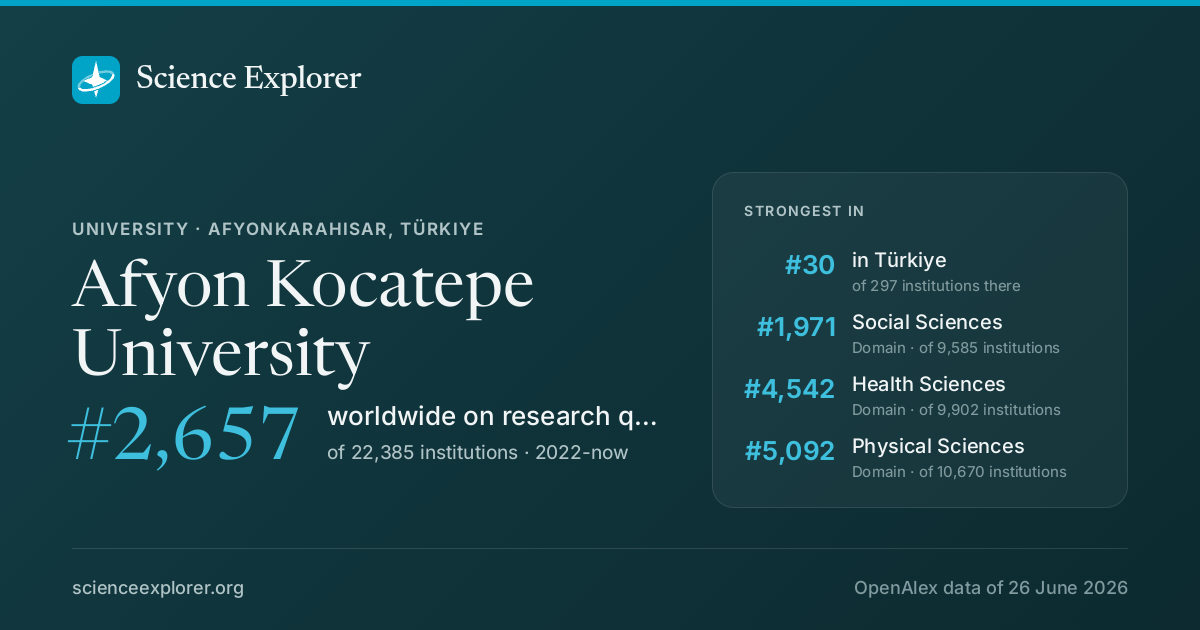
Afyon Kocatepe University on Science Explorer

A card with Afyon Kocatepe University's standing and the fields it leads in, for a post or a slide. A link to this page previews as the same card.

Download the card

1200 × 630 PNG, sized for social posts, drawn from the latest snapshot.

Badges for a website1Each links back here and updates with every snapshot

Research measures only: rankings here say nothing about teaching, admissions or student experience. Comparable institutions and collaboration partners have tabs of their own, above.

Discussion

Ask a question or share a note about Afyon Kocatepe University. Posts are plain text and can be reported.