Science Explorer Back to mapMap
Discussion
Nonprofit · Cotonou · Benin

Aidjan-Lagos Corridor Organization

World rank, all time
#23,701
of 34,923
Rank in Benin
#7
of 11
Research works
164
▲ 6% vs 2018-21
Citations
2.5k
15.0 per fractional work
Top-10% rate
11.2%
all institutions 10.0%
vs its own fields
1.04×
1.00× is exactly expected
Open access
68%
world 40%
International
58%
world 18%

Which fields of science does Aidjan-Lagos Corridor Organization work in?

In 2022-now, 46% of research at Aidjan-Lagos Corridor Organization is in Health Sciences, 25% in Social Sciences. Its largest fields are Medicine (42%), Agricultural and Biological Sciences (15%), Social Sciences (15%). It does 1.7× the world's share of Health Sciences.

Health Sciences: 18 fractional works · 46.1% of its workMedicine: 17 fractional works · 41.7% of its workPublic Health, Environmental and Occupational Health: 9 fractional works · 22.9% of its workInfectious Diseases: 1 fractional works · 3.6% of its workEpidemiology: 1 fractional works · 2.3% of its workDermatology: 1 fractional works · 1.9% of its workOphthalmology: 1 fractional works · 1.7% of its workPediatrics, Perinatology and Child Health: 1 fractional works · 1.4% of its workSurgery: 1 fractional works · 1.3% of its workNeurology: 0 fractional works · 1.1% of its workPsychiatry and Mental health: 0 fractional works · 0.7% of its workCardiology and Cardiovascular Medicine: 0 fractional works · 0.5% of its workRheumatology: 0 fractional works · 0.5% of its workPhysiology: 0 fractional works · 0.5% of its workFamily Practice: 0 fractional works · 0.4% of its workHealth Informatics: 0 fractional works · 0.4% of its workEndocrinology, Diabetes and Metabolism: 0 fractional works · 0.4% of its workPulmonary and Respiratory Medicine: 0 fractional works · 0.4% of its workGenetics: 0 fractional works · 0.3% of its workOrthopedics and Sports Medicine: 0 fractional works · 0.3% of its workEmergency Medicine: 0 fractional works · 0.2% of its workInternal Medicine: 0 fractional works · 0.2% of its workSmaller subfields together: 0 fractional works · 0.5% of its workHealth Professions: 2 fractional works · 3.9% of its workGeneral Health Professions: 1 fractional works · 3.4% of its workHealth Information Management: 0 fractional works · 0.3% of its workOccupational Therapy: 0 fractional works · 0.2% of its workSmaller subfields together: 0 fractional works · 0.0% of its workVeterinary: 0 fractional works · 0.4% of its workSmall Animals: 0 fractional works · 0.4% of its workSocial Sciences: 10 fractional works · 25.3% of its workSocial Sciences: 6 fractional works · 15.2% of its workSociology and Political Science: 2 fractional works · 5.9% of its workEducation: 1 fractional works · 3.7% of its workPolitical Science and International Relations: 0 fractional works · 1.1% of its workLaw: 0 fractional works · 1.0% of its workGeneral Social Sciences: 0 fractional works · 0.8% of its workUrban Studies: 0 fractional works · 0.8% of its workDemography: 0 fractional works · 0.7% of its workGeography, Planning and Development: 0 fractional works · 0.4% of its workSafety Research: 0 fractional works · 0.2% of its workAnthropology: 0 fractional works · 0.2% of its workLinguistics and Language: 0 fractional works · 0.2% of its workArts and Humanities: 2 fractional works · 4.5% of its workVisual Arts and Performing Arts: 0 fractional works · 1.2% of its workPhilosophy: 0 fractional works · 0.8% of its workMusic: 0 fractional works · 0.8% of its workConservation: 0 fractional works · 0.4% of its workMuseology: 0 fractional works · 0.4% of its workLiterature and Literary Theory: 0 fractional works · 0.3% of its workHistory: 0 fractional works · 0.3% of its workSmaller subfields together: 0 fractional works · 0.2% of its workPsychology: 1 fractional works · 3.0% of its workClinical Psychology: 1 fractional works · 1.7% of its workSocial Psychology: 0 fractional works · 0.9% of its workExperimental and Cognitive Psychology: 0 fractional works · 0.4% of its workBusiness, Management and Accounting: 1 fractional works · 1.7% of its workStrategy and Management: 0 fractional works · 0.6% of its workOrganizational Behavior and Human Resource Management: 0 fractional works · 0.5% of its workBusiness and International Management: 0 fractional works · 0.2% of its workSmaller subfields together: 0 fractional works · 0.3% of its workEconomics, Econometrics and Finance: 0 fractional works · 0.4% of its workEconomics and Econometrics: 0 fractional works · 0.4% of its workDecision Sciences: 0 fractional works · 0.4% of its workInformation Systems and Management: 0 fractional works · 0.4% of its workLife Sciences: 8 fractional works · 21.2% of its workAgricultural and Biological Sciences: 6 fractional works · 15.4% of its workPlant Science: 3 fractional works · 6.8% of its workForestry: 2 fractional works · 5.4% of its workEcology, Evolution, Behavior and Systematics: 1 fractional works · 2.1% of its workInsect Science: 0 fractional works · 0.4% of its workSoil Science: 0 fractional works · 0.3% of its workAgronomy and Crop Science: 0 fractional works · 0.2% of its workSmaller subfields together: 0 fractional works · 0.2% of its workImmunology and Microbiology: 1 fractional works · 3.0% of its workParasitology: 1 fractional works · 1.8% of its workApplied Microbiology and Biotechnology: 0 fractional works · 0.5% of its workImmunology: 0 fractional works · 0.4% of its workVirology: 0 fractional works · 0.2% of its workSmaller subfields together: 0 fractional works · 0.1% of its workBiochemistry, Genetics and Molecular Biology: 1 fractional works · 2.3% of its workMolecular Biology: 0 fractional works · 1.1% of its workMolecular Medicine: 0 fractional works · 0.4% of its workGenetics: 0 fractional works · 0.3% of its workEndocrinology: 0 fractional works · 0.3% of its workSmaller subfields together: 0 fractional works · 0.1% of its workNeuroscience: 0 fractional works · 0.5% of its workEndocrine and Autonomic Systems: 0 fractional works · 0.5% of its workPhysical Sciences: 3 fractional works · 7.4% of its workEnvironmental Science: 2 fractional works · 3.8% of its workManagement, Monitoring, Policy and Law: 1 fractional works · 2.3% of its workGlobal and Planetary Change: 0 fractional works · 0.4% of its workNature and Landscape Conservation: 0 fractional works · 0.2% of its workPollution: 0 fractional works · 0.2% of its workSmaller subfields together: 0 fractional works · 0.7% of its workEngineering: 1 fractional works · 2.7% of its workControl and Systems Engineering: 1 fractional works · 2.5% of its workElectrical and Electronic Engineering: 0 fractional works · 0.2% of its workMathematics: 0 fractional works · 0.4% of its workModeling and Simulation: 0 fractional works · 0.4% of its workComputer Science: 0 fractional works · 0.3% of its workComputer Networks and Communications: 0 fractional works · 0.3% of its workSmaller subfields together: 0 fractional works · 0.0% of its workEnergy: 0 fractional works · 0.2% of its workEnergy Engineering and Power Technology: 0 fractional works · 0.2% of its workALL ITS WORKAidjan-LagosCorridor…40fractional works, 2022-now
Life Sciences21%Physical Sciences7%Health Sciences46%Social Sciences25%

Each ring splits the one inside it: the four domains of science, their fields, their subfields. Size is fractional works in 2022-now. Every slice is a page; the interactive view zooms down to single topics and colours each by how much more of it this institution does than the world.

Its 4 domains and 18 fields, with their numbers
    1. Medicine1741.7%
    2. Health Professions23.9%
    3. Veterinary00.4%
    1. Social Sciences615.2%
    2. Arts and Humanities24.5%
    3. Psychology13.0%
    4. Business, Management and Accounting11.7%
    5. Economics, Econometrics and Finance00.4%
    6. Decision Sciences00.4%
    1. Agricultural and Biological Sciences615.4%
    2. Immunology and Microbiology13.0%
    3. Biochemistry, Genetics and Molecular Biology12.3%
    4. Neuroscience00.5%
    1. Environmental Science23.8%
    2. Engineering12.7%
    3. Mathematics00.4%
    4. Computer Science00.3%
    5. Energy00.2%
All of science, and how each field's share has moved since 1950: the Science domain explorer

Field profile

Location quotient across every field it publishes in: outside the ring is more than an institution of this size would be expected to publish, inside it is less.

Agricultural and Biological Sciences: 3.25× its world share, 6 worksAgricultural and Bio…Biochemistry, Genetics and Molecular Biology: 0.43× its world share, 1 worksBiochemistry, Geneti…Immunology and Microbiology: 3.00× its world share, 1 worksImmunology and Micro…Neuroscience: 0.31× its world share, 0 worksNeuroscienceComputer Science: 0.04× its world share, 0 worksComputer ScienceEnergy: 0.23× its world share, 0 worksEnergyEngineering: 0.18× its world share, 1 worksEngineeringEnvironmental Science: 0.77× its world share, 2 worksEnvironmental ScienceMathematics: 0.35× its world share, 0 worksMathematicsHealth Professions: 1.50× its world share, 2 worksHealth ProfessionsMedicine: 2.17× its world share, 17 worksMedicineVeterinary: 3.26× its world share, 0 worksVeterinaryArts and Humanities: 1.58× its world share, 2 worksArts and HumanitiesBusiness, Management and Accounting: 0.55× its world share, 1 worksBusiness, Management…Decision Sciences: 0.39× its world share, 0 worksDecision SciencesEconomics, Econometrics and Finance: 0.19× its world share, 0 worksEconomics, Econometr…Psychology: 0.99× its world share, 1 worksPsychologySocial Sciences: 1.20× its world share, 6 worksSocial Sciences1×world share
more than its size predictsabout as predictedless

Rings at 0.5×, 1× and 2×. Widest outward: Veterinary, 3.3×. Every wedge is a field page.

All 18 fields, with their numbers
  1. Veterinary3.26×0 works
  2. Agricultural and Biological Sciences3.25×6 works
  3. Immunology and Microbiology3.00×1 works
  4. Medicine2.17×17 works
  5. Arts and Humanities1.58×2 works
  6. Health Professions1.50×2 works
  7. Social Sciences1.20×6 works
  8. Psychology0.99×1 works
  9. Environmental Science0.77×2 works
  10. Business, Management and Accounting0.55×1 works
  11. Biochemistry, Genetics and Molecular Biology0.43×1 works
  12. Decision Sciences0.39×0 works
  13. Mathematics0.35×0 works
  14. Neuroscience0.31×0 works
  15. Energy0.23×0 works
  16. Economics, Econometrics and Finance0.19×0 works
  17. Engineering0.18×1 works
  18. Computer Science0.04×0 works

Who are the top researchers at Aidjan-Lagos Corridor Organization?

Ranked on the quality score, Dina Gbénou and Mathieu Odoun lead among researchers whose main affiliation is Aidjan-Lagos Corridor Organization.

  1. 1 Dina Gbénou Benin · #2,409,340 worldwide 360 citations · 17 works
  2. 2 Mathieu Odoun Benin · #4,585,854 worldwide 215 citations · 16 works
All ranked researchers at Aidjan-Lagos Corridor Organization

What are the most cited papers from Aidjan-Lagos Corridor Organization?

The most cited paper from Aidjan-Lagos Corridor Organization is "Effectiveness of COL-1492, a nonoxynol-9 vaginal gel, on HIV-1 transmission in female sex workers: a randomised controlled trial" (Lut Van Damme, Gita Ramjee, Michel Alary et al., 2002), with 799 citations. Next come "Expression of the cytochrome P450s, CYP6P3 and CYP6M2 are significantly elevated in multiple pyrethroid resistant populations of Anopheles gambiae s.s. from Southern Benin and Nigeria" (355) and "Molecular evidence of incipient speciation within Anopheles gambiae s.s. in West Africa" (322).

Most cited papers
#PaperReleasedCitations
1 Effectiveness of COL-1492, a nonoxynol-9 vaginal gel, on HIV-1 transmission in female sex workers: a randomised controlled trial Lut Van Damme, Gita Ramjee, Michel Alary et al. · The Lancet Sep 2002 799
2 Expression of the cytochrome P450s, CYP6P3 and CYP6M2 are significantly elevated in multiple pyrethroid resistant populations of Anopheles gambiae s.s. from Southern Benin and Nigeria Rousseau F Djouaka, Adekunle Akeem Bakare, Ousmane N Coulibaly et al. · BMC Genomics Open access 13 Nov 2008 355
3 Molecular evidence of incipient speciation within Anopheles gambiae s.s. in West Africa Alessandra della Torre, Caterina A. Fanello, Martin Codjo Akogbeto et al. · Insect Molecular Biology Feb 2001 322
4 A sister lineage of the Mycobacterium tuberculosis complex discovered in the African Great Lakes region Jean Claude Semuto Ngabonziza et al. · Nature Communications Open access 9 Jun 2020 225
5 The kdr mutation occurs in the Mopti form of Anopheles gambiae s .s. through introgression Mylène Weill, Fabrice Chandre, C. Brengues et al. · Insect Molecular Biology Oct 2000 206
All 60 most cited papers, with filters and sorting

Which keywords describe research at Aidjan-Lagos Corridor Organization?

By fractional works in 2022-now, weighted toward what it does more of than the world: Epidemiology, Vaccine Development, Insecticide Resistance, Genome Sequence, Global Burden, Artemisinin Resistance, Plasmodium falciparum and Vector Control.

▲ more of its work than of the world's◆ about the world's share▼ less than the world's

Size is fractional works in 2022-now in the topics tagged with each word; colour is the word's share of this institution's work against its share of the world's. The 28 words are chosen for being large and distinctive. Each links to the topic it comes from most.

All 28 words, with their numbers
  1. Epidemiology12▲ 7.6×34 topics
  2. Vaccine Development9▲ 84×3 topics
  3. Insecticide Resistance6▲ 172×4 topics
  4. Genome Sequence5▲ 152×2 topics
  5. Global Burden5▲ 23×4 topics
  6. Artemisinin Resistance5▲ 368×1 topic
  7. Plasmodium falciparum5▲ 368×1 topic
  8. Vector Control4▲ 94×4 topics
  9. Arboviral Diseases4▲ 145×1 topic
  10. Zika Virus4▲ 145×1 topic
  11. Environmental Impact3▲ 4.1×5 topics
  12. Public Health2▲ 4.1×15 topics
  13. Economic Analysis2▲ 35×2 topics
  14. Technological Innovation2▲ 68×2 topics
  15. Forest Biomass2▲ 149×1 topic
  16. Wood Residues2▲ 149×1 topic
  17. Biopesticides2▲ 66×2 topics
  18. Pest Management2▲ 52×2 topics
  19. Sustainability2▲ 1.84×8 topics
  20. Botanical Insecticides2▲ 116×1 topic
  21. Essential Oils2▲ 40×1 topic
  22. Public Policy2▲ 8.4×5 topics
  23. Sustainable Development2▲ 2.4×6 topics
  24. Climate Change1▲ 1.29×6 topics
  25. Teacher Training1▲ 5.1×4 topics
  26. Biodiversity1▲ 3.4×3 topics
  27. Control System1▲ 51×1 topic
  28. Neural Network1▲ 14×1 topic

Which research topics does Aidjan-Lagos Corridor Organization publish most on?

By volume in 2022-now: Malaria Research and Control, Mosquito-borne diseases and control, Agricultural and Food Sciences and Insect Pest Control Strategies.

  1. 1 Malaria Research and Control Public Health, Environmental and Occupational Health 5 works
  2. 2 Mosquito-borne diseases and control Public Health, Environmental and Occupational Health 4 works
  3. 3 Agricultural and Food Sciences Forestry 2 works
  4. 4 Insect Pest Control Strategies Plant Science 2 works
  5. 5 Industrial Technology and Control Systems Control and Systems Engineering 1 works
  6. 6 Environmental Sustainability and Education Management, Monitoring, Policy and Law 1 works
  7. 7 Parasitic Diseases Research and Treatment Infectious Diseases 1 works
  8. 8 Education Pedagogy and Practices Education 1 works
  9. 9 Agriculture and Rural Development Research Ecology, Evolution, Behavior and Systematics 0 works
  10. 10 Maternal and Neonatal Healthcare General Health Professions 0 works

How open and international is its research?

Against the world's own shares: the tick on each track. Both are shares of its output, so they sit on one scale and can be read against each other as well as against the world.

openly available67.6%not open32.4%

World: 40% of research is openly available.

with international co-authors58.2%domestic only41.8%

World: 18% is written across borders.

How has Aidjan-Lagos Corridor Organization's research output changed?

Output in 2022-2025 was 6% higher than in 2018-2021.

still counting1990200020102020
grewheldshrank

The same series as a ribbon: one cell per year, darker for more. The line above answers how much; this answers when.

Its share of all research

Growing output can still be a shrinking share: all of science grows. This is Aidjan-Lagos Corridor Organization as a percentage of every work published that year, 0.00015% in 2024.

still counting0.00025%0.00050%0.00075%Aidjan-Lagos Corridor Organization0.00015% in 202519801990200020102020

Fractional works of Aidjan-Lagos Corridor Organization over all fractional works that year. How the balance of science has shifted.

Other research institutions in Cotonou

All research institutions in Cotonou

Share Aidjan-Lagos Corridor Organization's ranking
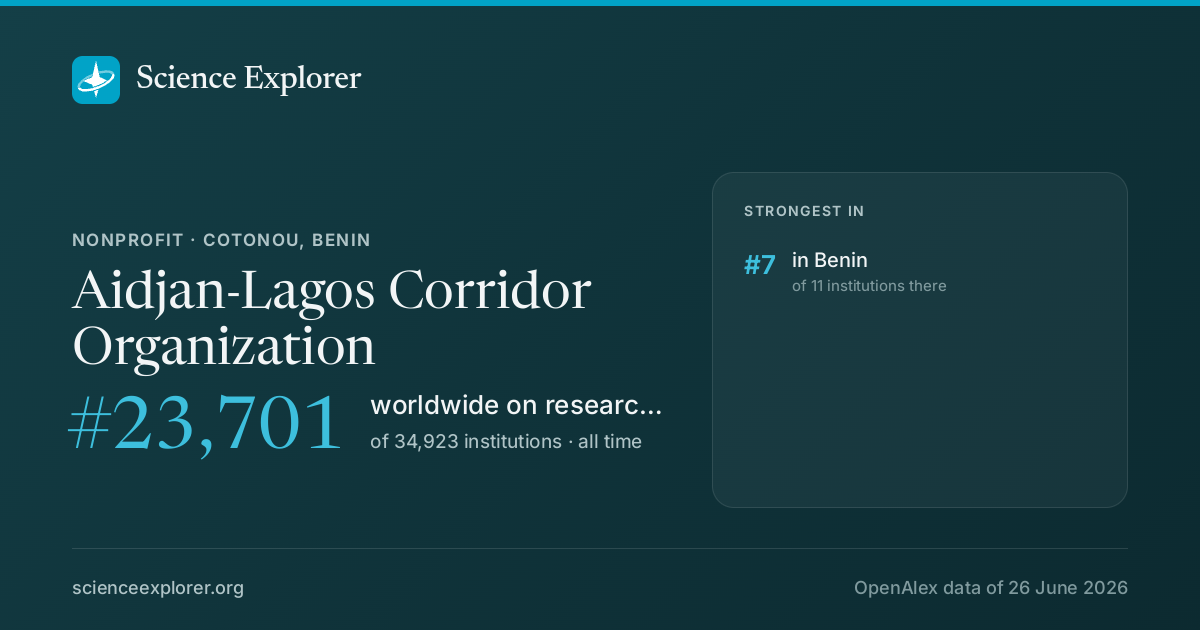
Aidjan-Lagos Corridor Organization on Science Explorer

A card with Aidjan-Lagos Corridor Organization's standing and the fields it leads in, for a post or a slide. A link to this page previews as the same card.

Download the card

1200 × 630 PNG, sized for social posts, drawn from the latest snapshot.

Badges for a website1Each links back here and updates with every snapshot

Research measures only: rankings here say nothing about teaching, admissions or student experience. Comparable institutions and collaboration partners have tabs of their own, above.

Discussion

Ask a question or share a note about Aidjan-Lagos Corridor Organization. Posts are plain text and can be reported.