AstraZeneca (United Kingdom)
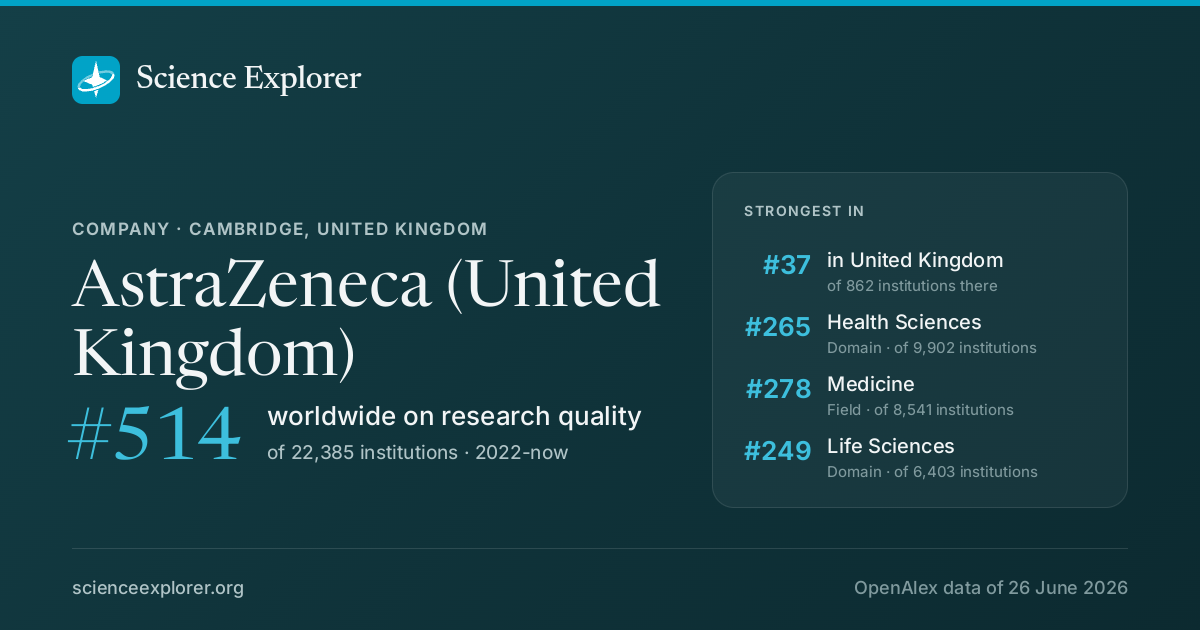
In research, AstraZeneca (United Kingdom) stands highest in Health Sciences (#265 of 9,902 worldwide), Medicine (#278 of 8,541 worldwide) and Life Sciences (#249 of 6,403 worldwide), 2022-now. Relative to its size it is most specialised in Pharmaceutical Science, Nephrology and Oncology (Pharmaceutical Science is 10.0× its share of world research).
- World rank, 2022-now
- #514 of 22,385 · #433 all time
- Rank in United Kingdom
- #37 of 862
- Research works
- 20k ▲ 16% vs 2018-21
- Citations
- 725k 36.2 per fractional work
- Top-10% rate
- 16.6% all institutions 10.0%
- vs its own fields
- 1.24× 1.00× is exactly expected
- Open access
- 38% world 40%
- International
- 49% world 18%
What is AstraZeneca (United Kingdom) known for in research?
The fields where it stands highest, 2022-now, ranked among every institution above the floor in each field.
| Field | World rank | Where that sits | Top-10% rate | Works | All time |
|---|---|---|---|---|---|
| Health SciencesDomain | #265 of 9,902 | 18.3% | 1,873 | #233 | |
| MedicineField | #278 of 8,541 | 18.2% | 1,793 | #244 | |
| Life SciencesDomain | #249 of 6,403 | 17.2% | 909 | #222 | |
| Biochemistry, Genetics and Molecular BiologyField | #125 of 2,964 | 18.5% | 637 | #146 | |
| Molecular BiologySubfield | #101 of 1,880 | 18.0% | 448 | #126 | |
| Physical SciencesDomain | #929 of 10,670 | 14.3% | 553 | #712 | |
| Pulmonary and Respiratory MedicineSubfield | #91 of 1,037 | 20.3% | 375 | #138 | |
| OncologySubfield | #115 of 755 | 16.0% | 284 | #126 | |
| ChemistryField | #251 of 1,299 | 10.9% | 162 | #157 | |
| SurgerySubfield | #346 of 1,532 | 18.3% | 98 | #256 |
Each strip is that field's whole ranked pool, with the notch where AstraZeneca (United Kingdom) sits in it, in the colour of the band that rank falls in. The track under the rate is the rate itself: it carries no average mark, because the average differs by field (from about 6% in Dentistry to 21% in Economics).
Which of those standings moved
The same fields on both windows: where it stood over the whole record, and where it stands in 2022-now. The distance is the story, and it is the one thing the two rank columns above cannot show.
- Health Sciences#233 #265
- Medicine#244 #278
- Life Sciences#222 #249
- Biochemistry, Genetics and Molecular Biology#146 #125
- Molecular Biology#126 #101
- Physical Sciences#712 #929
- Pulmonary and Respiratory Medicine#138 #91
- Oncology#126 #115
- Chemistry#157 #251
- Surgery#256 #346
A dot further right is a better standing. Fields it was not ranked in over the whole record are left out.
Which fields of science does AstraZeneca (United Kingdom) work in?
In 2022-now, 54% of research at AstraZeneca (United Kingdom) is in Health Sciences, 26% in Life Sciences. Its largest fields are Medicine (51%), Biochemistry, Genetics and Molecular Biology (19%), Chemistry (5%). It does 2.3× the world's share of Health Sciences.
Each ring splits the one inside it: the four domains of science, their fields, their subfields. Size is fractional works in 2022-now. Every slice is a page; the interactive view zooms down to single topics and colours each by how much more of it this institution does than the world.
Its 4 domains and 26 fields, with their numbers
- Health Sciences2,14553.5%
- Medicine2,05251.2%
- Health Professions721.8%
- Nursing100.2%
- Veterinary80.2%
- Dentistry30.1%
- Life Sciences1,05126.2%
- Physical Sciences63015.7%
- Chemistry1834.6%
- Engineering1162.9%
- Computer Science1152.9%
- Mathematics701.8%
- Materials Science691.7%
- Environmental Science481.2%
- Physics and Astronomy140.4%
- Chemical Engineering70.2%
- Earth and Planetary Sciences40.1%
- Energy40.1%
- Social Sciences1814.5%
- Economics, Econometrics and Finance1032.6%
- Social Sciences360.9%
- Decision Sciences190.5%
- Psychology140.4%
- Business, Management and Accounting80.2%
- Arts and Humanities10.0%
What does AstraZeneca (United Kingdom) specialise in?
Where its research is concentrated relative to its size: Pharmaceutical Science takes 10.0× the share of its output that it takes of world research.
- Pharmaceutical ScienceSubfield · 42.8 works10×
- NephrologySubfield · 71.5 works8.2×
- OncologySubfield · 331.9 works7.4×
- Pulmonary and Respiratory MedicineSubfield · 442.8 works7.2×
- Statistics and ProbabilitySubfield · 60.2 works7.1×
- ImmunologySubfield · 167.2 works6.1×
Location quotient, a volume reading rather than an impact one. It surfaces small, lopsided specialities.
Field profile
Location quotient across every field it publishes in: outside the ring is more than an institution of this size would be expected to publish, inside it is less.
Rings at 0.5×, 1× and 2×. Widest outward: Pharmacology, Toxicology and Pharmaceutics, 5.5×. Every wedge is a field page.
All 26 fields, with their numbers
- Pharmacology, Toxicology and Pharmaceutics5.46×77 works
- Immunology and Microbiology4.36×176 works
- Biochemistry, Genetics and Molecular Biology3.49×747 works
- Chemistry2.92×183 works
- Medicine2.66×2,052 works
- Veterinary1.53×8 works
- Mathematics1.49×70 works
- Economics, Econometrics and Finance1.20×103 works
- Health Professions0.68×72 works
- Chemical Engineering0.53×7 works
- Decision Sciences0.50×19 works
- Materials Science0.49×69 works
- Nursing0.49×10 works
- Neuroscience0.43×28 works
- Computer Science0.37×115 works
- Environmental Science0.24×48 works
- Engineering0.19×116 works
- Dentistry0.17×3 works
- Physics and Astronomy0.16×14 works
- Agricultural and Biological Sciences0.12×24 works
- Psychology0.12×14 works
- Energy0.10×4 works
- Social Sciences0.07×36 works
- Earth and Planetary Sciences0.06×4 works
- Business, Management and Accounting0.06×8 works
- Arts and Humanities0.01×1 works
- Pharmacology, Toxicology and Pharmaceutics 5.5×
- Immunology and Microbiology 4.4×
- Biochemistry, Genetics and Molecular Biology 3.5×
- Chemistry 2.9×
- Medicine 2.7×
- Veterinary 1.5×
- Mathematics 1.5×
- Economics, Econometrics and Finance 1.2×
- Health Professions 0.7×
- Chemical Engineering 0.5×
- Decision Sciences 0.5×
- Materials Science 0.5×
- Nursing 0.5×
- Neuroscience 0.4×
- Computer Science 0.4×
- Environmental Science 0.2×
- Engineering 0.2×
- Dentistry 0.2×
- Physics and Astronomy 0.2×
- Agricultural and Biological Sciences 0.1×
- Psychology 0.1×
- Energy 0.1×
- Social Sciences 0.1×
- Earth and Planetary Sciences 0.1×
- Business, Management and Accounting 0.1×
- Arts and Humanities 0.0×
Who are the top researchers at AstraZeneca (United Kingdom)?
Ranked on the quality score, Mark J. O’Connor, Slavé Petrovski and Simon T. Barry lead among researchers whose main affiliation is AstraZeneca (United Kingdom).
- 1
Mark J. O’Connor
 United Kingdom · #3,405 worldwide
22k citations · 449 works
- 2
Slavé Petrovski
United Kingdom · #8,356 worldwide
27k citations · 261 works
- 3
Simon T. Barry
United Kingdom · #14,680 worldwide
15k citations · 586 works
- 4
Natasha A. Karp
United Kingdom · #26,984 worldwide
28k citations · 171 works
- 5
Ross A. Stewart
United Kingdom · #37,243 worldwide
5.5k citations · 125 works
- 6
Alan Lau
United Kingdom · #39,099 worldwide
10k citations · 112 works
- 7
Jonathan D. Tugwood
United Kingdom · #51,311 worldwide
10k citations · 95 works
- 8
Paul D. Smith
United Kingdom · #53,591 worldwide
14k citations · 272 works
- 9
Susan E. Critchlow
United Kingdom · #62,320 worldwide
7.9k citations · 308 works
- 10
Viia Valge-Archer
United Kingdom · #66,255 worldwide
5.5k citations · 142 works
Which keywords describe research at AstraZeneca (United Kingdom)?
By fractional works in 2022-now, weighted toward what it does more of than the world: Inflammation, Epidemiology, Treatment, Chemotherapy, Diagnosis, Clinical Trials, Targeted Therapy and Asthma.
- EGFR Mutations
- Cancer Immunotherapy
- Monoclonal Antibody
- spirometry
- Genomic Profiling
- Pharmacokinetics
- Chronic Kidney Disease
- Glycosylation
- Medicinal Chemistry
- Allergic Diseases
- Tumor Microenvironment
- Immunology
- Asthma
- Global Burden
- Cardiovascular Disease
- Genetics
- Management
- Clinical Trials
- Diagnosis
- Inflammation
- Epidemiology
- Treatment
- Chemotherapy
- Cancer
- Targeted Therapy
- Quality of Life
- Immunotherapy
- Biomarkers
- Heart Failure
- Monoclonal Antibodies
- Cancer Therapy
- Eosinophils
- Breast Cancer
- Therapeutic Antibodies
- Prognostic Factors
- Respiratory
- COPD
- Treatment Guidelines
- Resistance Mechanisms
- ALK Inhibitors
Size is fractional works in 2022-now in the topics tagged with each word; colour is the word's share of this institution's work against its share of the world's. The 40 words are chosen for being large and distinctive. Each links to the topic it comes from most.
All 40 words, with their numbers
- Epidemiology342▲ 2.1×100 topics
- Inflammation287▲ 3.4×75 topics
- Treatment224▲ 4.6×39 topics
- Diagnosis193▲ 5.2×32 topics
- Chemotherapy181▲ 6.4×22 topics
- Clinical Trials171▲ 6.4×17 topics
- Cancer147▲ 2.7×44 topics
- Management145▲ 4.5×25 topics
- Targeted Therapy143▲ 16×5 topics
- Genetics142▲ 5.0×18 topics
- Quality of Life139▲ 2.4×38 topics
- Cardiovascular Disease139▲ 3.0×35 topics
- Immunotherapy139▲ 4.8×19 topics
- Global Burden130▲ 6.0×11 topics
- Biomarkers126▲ 4.5×16 topics
- Asthma126▲ 32×2 topics
- Heart Failure125▲ 7.0×14 topics
- Immunology121▲ 28×2 topics
- Monoclonal Antibodies117▲ 33×3 topics
- Tumor Microenvironment116▲ 6.4×8 topics
- Cancer Therapy114▲ 5.0×17 topics
- Allergic Diseases113▲ 48×1 topic
- Eosinophils113▲ 48×1 topic
- Medicinal Chemistry110▲ 10×11 topics
- Breast Cancer108▲ 11×11 topics
- Glycosylation98▲ 22×3 topics
- Therapeutic Antibodies95▲ 34×2 topics
- Chronic Kidney Disease93▲ 9.2×9 topics
- Prognostic Factors91▲ 5.2×13 topics
- Pharmacokinetics87▲ 8.2×9 topics
- Respiratory87▲ 22×2 topics
- Genomic Profiling86▲ 21×2 topics
- COPD82▲ 31×1 topic
- spirometry82▲ 31×1 topic
- Treatment Guidelines81▲ 9.3×5 topics
- Monoclonal Antibody72▲ 33×2 topics
- Resistance Mechanisms70▲ 20×2 topics
- Cancer Immunotherapy70▲ 11×3 topics
- ALK Inhibitors69▲ 28×1 topic
- EGFR Mutations69▲ 28×1 topic
Which research topics does AstraZeneca (United Kingdom) publish most on?
By volume in 2022-now: Asthma and respiratory diseases, Chronic Obstructive Pulmonary Disease (COPD) Research, Lung Cancer Treatments and Mutations and Computational Drug Discovery Methods.
Area is fractional works; colour is the subfield each topic belongs to.
- 1 Asthma and respiratory diseases Physiology 113 works
- 2 Chronic Obstructive Pulmonary Disease (COPD) Research Pulmonary and Respiratory Medicine 82 works
- 3 Lung Cancer Treatments and Mutations Pulmonary and Respiratory Medicine 69 works
- 4 Computational Drug Discovery Methods Computational Theory and Mathematics 64 works
- 5 Monoclonal and Polyclonal Antibodies Research Radiology, Nuclear Medicine and Imaging 61 works
- 6 Cancer Immunotherapy and Biomarkers Oncology 55 works
- 7 Health Systems, Economic Evaluations, Quality of Life Economics and Econometrics 52 works
- 8 CAR-T cell therapy research Oncology 46 works
- 9 HER2/EGFR in Cancer Research Oncology 44 works
- 10 Diabetes Treatment and Management Endocrinology, Diabetes and Metabolism 42 works
How open and international is its research?
Against the world's own shares: the tick on each track. Both are shares of its output, so they sit on one scale and can be read against each other as well as against the world.
World: 40% of research is openly available.
World: 18% is written across borders.
How has AstraZeneca (United Kingdom)'s research output changed?
Output in 2022-2025 was 16% higher than in 2018-2021.
The same series as a ribbon: one cell per year, darker for more. The line above answers how much; this answers when.
Its share of all research
Growing output can still be a shrinking share: all of science grows. This is AstraZeneca (United Kingdom) as a percentage of every work published that year, 0.016% in 2024.
Fractional works of AstraZeneca (United Kingdom) over all fractional works that year. How the balance of science has shifted.
How much of it reaches the world top 10%
Year by year, against all institutions in the same year.
Of each year's output, the share that reached the world's 10% most cited for its field and year. Peak 19.5% in 2019.
Other research institutions in Cambridge
- University of Cambridge
- Anglia Ruskin University
- British Antarctic Survey
- Cambridge University Hospitals NHS Foundation Trust
- Central Research Laboratories (United Kingdom)
- Wellcome Sanger Institute
- Babraham Institute
- The Welding Institute

Compare AstraZeneca (United Kingdom) with
- vs
 Virginia Commonwealth University
- vs
 City University of Hong Kong, Shenzhen Research Institute
- vs Shanghai Normal University
- vs
 University of South Australia
- vs Qingdao University of Science and Technology
- vs The Francis Crick Institute
Share AstraZeneca (United Kingdom)'s ranking



Research measures only: rankings here say nothing about teaching, admissions or student experience. Comparable institutions and collaboration partners have tabs of their own, above.
Discussion
Ask a question or share a note about AstraZeneca (United Kingdom). Posts are plain text and can be reported.