Science Explorer Back to mapMap
Nonprofit · Bristol · United Kingdom

At Bristol

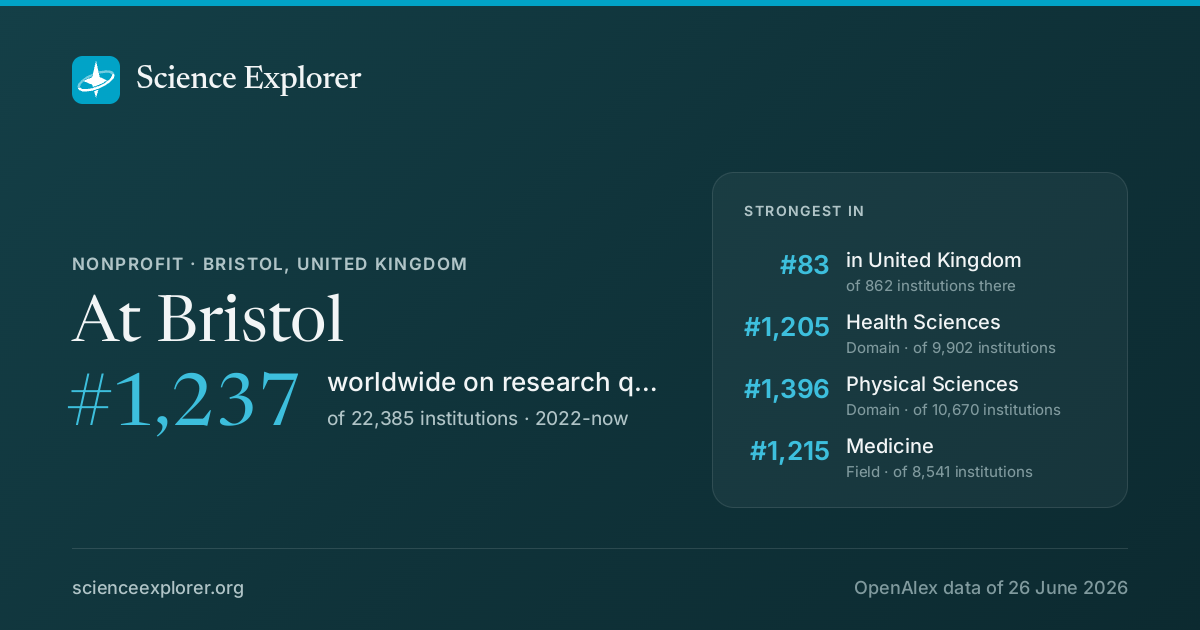
In research, At Bristol stands highest in Health Sciences (#1,205 of 9,902 worldwide), Physical Sciences (#1,396 of 10,670 worldwide) and Medicine (#1,215 of 8,541 worldwide), 2022-now.

World rank, 2022-now
#1,237
of 22,385 · #977 all time
Rank in United Kingdom
#83
of 862
Research works
5.2k
◆ 2% vs 2018-21
Citations
106k
20.5 per fractional work
Top-10% rate
13.1%
all institutions 10.0%
vs its own fields
1.13×
1.00× is exactly expected
Open access
31%
world 40%
International
14%
world 18%

What is At Bristol known for in research?

The fields where it stands highest, 2022-now, ranked among every institution above the floor in each field.

FieldWorld rankWhere that sitsTop-10% rateWorksAll time
Health SciencesDomain #1,205 of 9,902 13.0%240 #1070
Physical SciencesDomain #1,396 of 10,670 12.2%142 #1268
MedicineField #1,215 of 8,541 13.2%181 #1069
Life SciencesDomain #956 of 6,403 16.8%70 #860
Social SciencesDomain #2,005 of 9,585 13.8%172 #960
Social SciencesField #2,633 of 5,988 13.1%81 #1073

Each strip is that field's whole ranked pool, with the notch where At Bristol sits in it, in the colour of the band that rank falls in. The track under the rate is the rate itself: it carries no average mark, because the average differs by field (from about 6% in Dentistry to 21% in Economics).

Which of those standings moved

The same fields on both windows: where it stood over the whole record, and where it stands in 2022-now. The distance is the story, and it is the one thing the two rank columns above cannot show.

  1. Health Sciences#1,070 #1,205
  2. Physical Sciences#1,268 #1,396
  3. Medicine#1,069 #1,215
  4. Life Sciences#860 #956
  5. Social Sciences#960 #2,005
  6. Social Sciences#1,073 #2,633
all time2022-now, better2022-now, worse

A dot further right is a better standing. Fields it was not ranked in over the whole record are left out.

Which fields of science does At Bristol work in?

In 2022-now, 40% of research at At Bristol is in Health Sciences, 26% in Social Sciences. Its largest fields are Medicine (30%), Social Sciences (12%), Engineering (7%). It does 1.7× the world's share of Health Sciences.

Health Sciences: 287 fractional works · 39.9% of its workMedicine: 216 fractional works · 30.0% of its workSurgery: 27 fractional works · 3.8% of its workPublic Health, Environmental and Occupational Health: 26 fractional works · 3.7% of its workPulmonary and Respiratory Medicine: 24 fractional works · 3.4% of its workEpidemiology: 19 fractional works · 2.6% of its workPhysiology: 11 fractional works · 1.5% of its workOncology: 8 fractional works · 1.1% of its workRheumatology: 7 fractional works · 1.0% of its workInfectious Diseases: 7 fractional works · 1.0% of its workPediatrics, Perinatology and Child Health: 7 fractional works · 0.9% of its workRadiology, Nuclear Medicine and Imaging: 6 fractional works · 0.9% of its workEndocrinology, Diabetes and Metabolism: 6 fractional works · 0.9% of its workPsychiatry and Mental health: 6 fractional works · 0.8% of its workCardiology and Cardiovascular Medicine: 6 fractional works · 0.8% of its workUrology: 6 fractional works · 0.8% of its workNeurology: 4 fractional works · 0.6% of its workObstetrics and Gynecology: 4 fractional works · 0.6% of its workPathology and Forensic Medicine: 4 fractional works · 0.6% of its workNephrology: 3 fractional works · 0.4% of its workCritical Care and Intensive Care Medicine: 3 fractional works · 0.4% of its workEmergency Medicine: 3 fractional works · 0.4% of its workDermatology: 2 fractional works · 0.3% of its workHepatology: 2 fractional works · 0.3% of its workGeriatrics and Gerontology: 2 fractional works · 0.3% of its workAnesthesiology and Pain Medicine: 2 fractional works · 0.3% of its workComplementary and alternative medicine: 2 fractional works · 0.3% of its workHealth Informatics: 2 fractional works · 0.3% of its workHematology: 2 fractional works · 0.3% of its workReproductive Medicine: 2 fractional works · 0.3% of its workPharmacology: 2 fractional works · 0.2% of its workRehabilitation: 2 fractional works · 0.2% of its workOphthalmology: 1 fractional works · 0.2% of its workSmaller subfields together: 7 fractional works · 1.0% of its workHealth Professions: 46 fractional works · 6.4% of its workGeneral Health Professions: 29 fractional works · 4.0% of its workSpeech and Hearing: 8 fractional works · 1.1% of its workEmergency Medical Services: 3 fractional works · 0.4% of its workPharmacy: 2 fractional works · 0.3% of its workSmaller subfields together: 5 fractional works · 0.6% of its workVeterinary: 20 fractional works · 2.7% of its workSmall Animals: 17 fractional works · 2.4% of its workEquine: 2 fractional works · 0.3% of its workDentistry: 4 fractional works · 0.6% of its workPeriodontics: 2 fractional works · 0.3% of its workSmaller subfields together: 2 fractional works · 0.3% of its workNursing: 1 fractional works · 0.2% of its workSocial Sciences: 189 fractional works · 26.3% of its workSocial Sciences: 87 fractional works · 12.1% of its workSociology and Political Science: 29 fractional works · 4.0% of its workEducation: 11 fractional works · 1.5% of its workGender Studies: 10 fractional works · 1.4% of its workPolitical Science and International Relations: 10 fractional works · 1.4% of its workHealth: 7 fractional works · 0.9% of its workAnthropology: 4 fractional works · 0.6% of its workSafety Research: 4 fractional works · 0.5% of its workLaw: 2 fractional works · 0.3% of its workGeography, Planning and Development: 2 fractional works · 0.3% of its workDemography: 2 fractional works · 0.3% of its workCultural Studies: 1 fractional works · 0.2% of its workSmaller subfields together: 4 fractional works · 0.6% of its workPsychology: 35 fractional works · 4.9% of its workClinical Psychology: 16 fractional works · 2.2% of its workSocial Psychology: 9 fractional works · 1.2% of its workExperimental and Cognitive Psychology: 6 fractional works · 0.9% of its workApplied Psychology: 2 fractional works · 0.3% of its workSmaller subfields together: 2 fractional works · 0.3% of its workArts and Humanities: 28 fractional works · 3.9% of its workPhilosophy: 7 fractional works · 1.0% of its workArcheology: 3 fractional works · 0.5% of its workHistory: 3 fractional works · 0.5% of its workHistory and Philosophy of Science: 3 fractional works · 0.4% of its workLiterature and Literary Theory: 2 fractional works · 0.3% of its workLanguage and Linguistics: 2 fractional works · 0.2% of its workReligious studies: 2 fractional works · 0.2% of its workVisual Arts and Performing Arts: 2 fractional works · 0.2% of its workSmaller subfields together: 4 fractional works · 0.5% of its workEconomics, Econometrics and Finance: 17 fractional works · 2.3% of its workEconomics and Econometrics: 14 fractional works · 1.9% of its workGeneral Economics, Econometrics and Finance: 2 fractional works · 0.3% of its workSmaller subfields together: 1 fractional works · 0.1% of its workBusiness, Management and Accounting: 13 fractional works · 1.8% of its workOrganizational Behavior and Human Resource Management: 4 fractional works · 0.6% of its workStrategy and Management: 2 fractional works · 0.3% of its workMarketing: 2 fractional works · 0.3% of its workManagement Information Systems: 2 fractional works · 0.2% of its workSmaller subfields together: 3 fractional works · 0.4% of its workDecision Sciences: 9 fractional works · 1.3% of its workStatistics, Probability and Uncertainty: 4 fractional works · 0.6% of its workInformation Systems and Management: 3 fractional works · 0.4% of its workManagement Science and Operations Research: 2 fractional works · 0.3% of its workSmaller subfields together: 0 fractional works · 0.0% of its workPhysical Sciences: 160 fractional works · 22.3% of its workEngineering: 51 fractional works · 7.1% of its workElectrical and Electronic Engineering: 8 fractional works · 1.1% of its workBiomedical Engineering: 7 fractional works · 1.0% of its workCivil and Structural Engineering: 7 fractional works · 0.9% of its workAerospace Engineering: 6 fractional works · 0.9% of its workMechanical Engineering: 6 fractional works · 0.8% of its workControl and Systems Engineering: 3 fractional works · 0.5% of its workMechanics of Materials: 3 fractional works · 0.5% of its workOcean Engineering: 2 fractional works · 0.3% of its workBuilding and Construction: 2 fractional works · 0.2% of its workIndustrial and Manufacturing Engineering: 2 fractional works · 0.2% of its workSafety, Risk, Reliability and Quality: 2 fractional works · 0.2% of its workComputational Mechanics: 1 fractional works · 0.2% of its workSmaller subfields together: 2 fractional works · 0.2% of its workComputer Science: 40 fractional works · 5.5% of its workInformation Systems: 11 fractional works · 1.5% of its workArtificial Intelligence: 10 fractional works · 1.4% of its workComputer Vision and Pattern Recognition: 6 fractional works · 0.8% of its workComputer Networks and Communications: 5 fractional works · 0.7% of its workComputational Theory and Mathematics: 3 fractional works · 0.4% of its workHuman-Computer Interaction: 2 fractional works · 0.3% of its workSmaller subfields together: 3 fractional works · 0.4% of its workEnvironmental Science: 31 fractional works · 4.3% of its workGlobal and Planetary Change: 8 fractional works · 1.1% of its workEcology: 7 fractional works · 1.0% of its workHealth, Toxicology and Mutagenesis: 4 fractional works · 0.6% of its workWater Science and Technology: 2 fractional works · 0.3% of its workEnvironmental Engineering: 2 fractional works · 0.3% of its workNature and Landscape Conservation: 2 fractional works · 0.3% of its workManagement, Monitoring, Policy and Law: 1 fractional works · 0.2% of its workSmaller subfields together: 4 fractional works · 0.6% of its workEarth and Planetary Sciences: 13 fractional works · 1.8% of its workAtmospheric Science: 4 fractional works · 0.6% of its workPaleontology: 4 fractional works · 0.5% of its workGeophysics: 2 fractional works · 0.2% of its workSmaller subfields together: 4 fractional works · 0.5% of its workPhysics and Astronomy: 11 fractional works · 1.5% of its workAstronomy and Astrophysics: 5 fractional works · 0.7% of its workAtomic and Molecular Physics, and Optics: 2 fractional works · 0.2% of its workSmaller subfields together: 4 fractional works · 0.6% of its workChemistry: 5 fractional works · 0.7% of its workOrganic Chemistry: 2 fractional works · 0.2% of its workPhysical and Theoretical Chemistry: 2 fractional works · 0.2% of its workSmaller subfields together: 2 fractional works · 0.3% of its workMathematics: 5 fractional works · 0.7% of its workStatistics and Probability: 2 fractional works · 0.3% of its workModeling and Simulation: 2 fractional works · 0.2% of its workSmaller subfields together: 2 fractional works · 0.2% of its workMaterials Science: 3 fractional works · 0.4% of its workEnergy: 1 fractional works · 0.1% of its workChemical Engineering: 0 fractional works · 0.0% of its workLife Sciences: 83 fractional works · 11.5% of its workBiochemistry, Genetics and Molecular Biology: 37 fractional works · 5.1% of its workGenetics: 16 fractional works · 2.2% of its workMolecular Biology: 12 fractional works · 1.7% of its workCell Biology: 3 fractional works · 0.4% of its workCancer Research: 2 fractional works · 0.3% of its workSmaller subfields together: 4 fractional works · 0.5% of its workAgricultural and Biological Sciences: 18 fractional works · 2.5% of its workEcology, Evolution, Behavior and Systematics: 5 fractional works · 0.7% of its workAnimal Science and Zoology: 3 fractional works · 0.5% of its workPlant Science: 3 fractional works · 0.5% of its workFood Science: 3 fractional works · 0.4% of its workAgronomy and Crop Science: 2 fractional works · 0.2% of its workInsect Science: 2 fractional works · 0.2% of its workSmaller subfields together: 1 fractional works · 0.1% of its workNeuroscience: 17 fractional works · 2.4% of its workCognitive Neuroscience: 10 fractional works · 1.4% of its workCellular and Molecular Neuroscience: 3 fractional works · 0.4% of its workNeurology: 2 fractional works · 0.2% of its workSmaller subfields together: 3 fractional works · 0.4% of its workImmunology and Microbiology: 9 fractional works · 1.3% of its workApplied Microbiology and Biotechnology: 3 fractional works · 0.4% of its workImmunology: 3 fractional works · 0.4% of its workParasitology: 2 fractional works · 0.2% of its workSmaller subfields together: 1 fractional works · 0.2% of its workPharmacology, Toxicology and Pharmaceutics: 1 fractional works · 0.2% of its workALL ITS WORKAt Bristol719fractional works, 2022-now
Life Sciences12%Physical Sciences22%Health Sciences40%Social Sciences26%

Each ring splits the one inside it: the four domains of science, their fields, their subfields. Size is fractional works in 2022-now. Every slice is a page; the interactive view zooms down to single topics and colours each by how much more of it this institution does than the world.

Its 4 domains and 26 fields, with their numbers
    1. Medicine21630.0%
    2. Health Professions466.4%
    3. Veterinary202.7%
    4. Dentistry40.6%
    5. Nursing10.2%
    1. Social Sciences8712.1%
    2. Psychology354.9%
    3. Arts and Humanities283.9%
    4. Economics, Econometrics and Finance172.3%
    5. Business, Management and Accounting131.8%
    6. Decision Sciences91.3%
    1. Engineering517.1%
    2. Computer Science405.5%
    3. Environmental Science314.3%
    4. Earth and Planetary Sciences131.8%
    5. Physics and Astronomy111.5%
    6. Chemistry50.7%
    7. Mathematics50.7%
    8. Materials Science30.4%
    9. Energy10.1%
    10. Chemical Engineering00.0%
    1. Biochemistry, Genetics and Molecular Biology375.1%
    2. Agricultural and Biological Sciences182.5%
    3. Neuroscience172.4%
    4. Immunology and Microbiology91.3%
    5. Pharmacology, Toxicology and Pharmaceutics10.2%
All of science, and how each field's share has moved since 1950: the Science domain explorer

Field profile

Location quotient across every field it publishes in: outside the ring is more than an institution of this size would be expected to publish, inside it is less.

Agricultural and Biological Sciences: 0.54× its world share, 18 worksAgricultural and Bio…Biochemistry, Genetics and Molecular Biology: 0.96× its world share, 37 worksBiochemistry, Geneti…Immunology and Microbiology: 1.24× its world share, 9 worksImmunology and Micro…Neuroscience: 1.49× its world share, 17 worksNeurosciencePharmacology, Toxicology and Pharmaceutics: 0.52× its world share, 1 worksPharmacology, Toxico…Chemical Engineering: 0.11× its world share, 0 worksChemical EngineeringChemistry: 0.48× its world share, 5 worksChemistryComputer Science: 0.71× its world share, 40 worksComputer ScienceEarth and Planetary Sciences: 1.13× its world share, 13 worksEarth and Planetary …Energy: 0.15× its world share, 1 worksEnergyEngineering: 0.47× its world share, 51 worksEngineeringEnvironmental Science: 0.87× its world share, 31 worksEnvironmental ScienceMaterials Science: 0.12× its world share, 3 worksMaterials ScienceMathematics: 0.60× its world share, 5 worksMathematicsPhysics and Astronomy: 0.68× its world share, 11 worksPhysics and AstronomyDentistry: 1.19× its world share, 4 worksDentistryHealth Professions: 2.43× its world share, 46 worksHealth ProfessionsMedicine: 1.56× its world share, 216 worksMedicineNursing: 0.40× its world share, 1 worksNursingVeterinary: 20.07× its world share, 20 worksVeterinaryArts and Humanities: 1.34× its world share, 28 worksArts and HumanitiesBusiness, Management and Accounting: 0.57× its world share, 13 worksBusiness, Management…Decision Sciences: 1.35× its world share, 9 worksDecision SciencesEconomics, Econometrics and Finance: 1.08× its world share, 17 worksEconomics, Econometr…Psychology: 1.61× its world share, 35 worksPsychologySocial Sciences: 0.95× its world share, 87 worksSocial Sciences1×world share
more than its size predictsabout as predictedless

Rings at 0.5×, 1× and 2×. Widest outward: Veterinary, 20.1×. Every wedge is a field page.

All 26 fields, with their numbers
  1. Veterinary20.07×20 works
  2. Health Professions2.43×46 works
  3. Psychology1.61×35 works
  4. Medicine1.56×216 works
  5. Neuroscience1.49×17 works
  6. Decision Sciences1.35×9 works
  7. Arts and Humanities1.34×28 works
  8. Immunology and Microbiology1.24×9 works
  9. Dentistry1.19×4 works
  10. Earth and Planetary Sciences1.13×13 works
  11. Economics, Econometrics and Finance1.08×17 works
  12. Biochemistry, Genetics and Molecular Biology0.96×37 works
  13. Social Sciences0.95×87 works
  14. Environmental Science0.87×31 works
  15. Computer Science0.71×40 works
  16. Physics and Astronomy0.68×11 works
  17. Mathematics0.60×5 works
  18. Business, Management and Accounting0.57×13 works
  19. Agricultural and Biological Sciences0.54×18 works
  20. Pharmacology, Toxicology and Pharmaceutics0.52×1 works
  21. Chemistry0.48×5 works
  22. Engineering0.47×51 works
  23. Nursing0.40×1 works
  24. Energy0.15×1 works
  25. Materials Science0.12×3 works
  26. Chemical Engineering0.11×0 works

Who are the top researchers at At Bristol?

Ranked on the quality score, Stephen J. Falk, Ian B. Vipond and Lisa Kohnle lead among researchers whose main affiliation is At Bristol.

  1. 1 Stephen J. Falk United Kingdom · #43,945 worldwide 26k citations · 220 works
  2. 2 Ian B. Vipond United Kingdom · #326,781 worldwide 6.4k citations · 43 works
  3. 3 Lisa Kohnle United Kingdom · #610,702 worldwide 791 citations · 61 works
  4. 4 Francesca Baldinelli United Kingdom · #708,542 worldwide 1.9k citations · 77 works
  5. 5 Lucy Johnstone United Kingdom · #820,564 worldwide 2.4k citations · 95 works
  6. 6 Joana Morgado United Kingdom · #1,200,320 worldwide 708 citations · 32 works
  7. 7 Frank L. Gardner United Kingdom · #1,500,189 worldwide 3k citations · 98 works
  8. 8 Chris Williams United Kingdom · #1,511,404 worldwide 1.5k citations · 81 works
  9. 9 Hans Reiss United Kingdom · #1,604,110 worldwide 1.2k citations · 107 works
  10. 10 Mohan Raj United Kingdom · #1,747,872 worldwide 828 citations · 54 works
All ranked researchers at At Bristol

What are the most cited papers from At Bristol?

The most cited paper from At Bristol is "Perioperative Chemotherapy versus Surgery Alone for Resectable Gastroesophageal Cancer" (David Cunningham, William Allum, Sally Patricia Stenning et al., 2006), with 6,432 citations. Next come "The construction of autobiographical memories in the self-memory system." (3,955) and "The standardisation of terminology in lower urinary tract function: report from the standardisation sub-committee of the International Continence Society" (3,230).

Most cited papers
#PaperReleasedCitations
1 Perioperative Chemotherapy versus Surgery Alone for Resectable Gastroesophageal Cancer David Cunningham, William Allum, Sally Patricia Stenning et al. · New England Journal of Medicine 6 Jul 2006 6,432
2 The construction of autobiographical memories in the self-memory system. Martin A. Conway, Christopher W. Pleydell-Pearce · Psychological Review 2000 3,955
3 The standardisation of terminology in lower urinary tract function: report from the standardisation sub-committee of the International Continence Society Paul Abrams, Linda Cardozo, Magnus Fall et al. · Urology 2003 3,230
4 Studies Comparing Numerical Rating Scales, Verbal Rating Scales, and Visual Analogue Scales for Assessment of Pain Intensity in Adults: A Systematic Literature Review Marianne Jensen Hjermstad, Peter M. Fayers, Dagny Faksvåg Haugen et al. · Journal of Pain and Symptom Management ReviewOpen access Jun 2011 2,731
5 Prevalence and burden of overactive bladder in the United States Walter F. Stewart, J. Van Rooyen, Geoffrey William Cundiff et al. · World Journal of Urology Open access May 2003 2,289
All 59 most cited papers, with filters and sorting

Which keywords describe research at At Bristol?

By fractional works in 2022-now, weighted toward what it does more of than the world: Epidemiology, Public Health, Mental Health, Primary Care, Genomic Analysis, Quality of Life, Pain Assessment and Climate Change.

▲ more of its work than of the world's◆ about the world's share▼ less than the world's

Size is fractional works in 2022-now in the topics tagged with each word; colour is the word's share of this institution's work against its share of the world's. The 40 words are chosen for being large and distinctive. Each links to the topic it comes from most.

All 40 words, with their numbers
  1. Epidemiology54▲ 1.89×10⁷ topics
  2. Public Health25▲ 2.4×39 topics
  3. Climate Change24▲ 1.24×56 topics
  4. Mental Health23▲ 2.3×29 topics
  5. Quality of Life22▲ 2.1×37 topics
  6. Primary Care14▲ 5.4×12 topics
  7. Immunotherapy14▲ 2.7×18 topics
  8. Risk Factors14▲ 1.72×30 topics
  9. Resilience13▲ 3.6×12 topics
  10. Genomic Analysis12▲ 6.8×8 topics
  11. Ethical Considerations10▲ 4.1×16 topics
  12. Pain Assessment10▲ 62×2 topics
  13. Cancer Treatment9▲ 5.4×5 topics
  14. Prevalence9▲ 2.9×12 topics
  15. Molecular Pathology8▲ 11×4 topics
  16. Patient Engagement8▲ 8.0×4 topics
  17. Translational Research8▲ 28×2 topics
  18. Tumor Models8▲ 18×2 topics
  19. Canine Cancer7▲ 73×1 topic
  20. Comparative Oncology7▲ 73×1 topic
  21. Osteoarthritis7▲ 7.7×5 topics
  22. Animal Welfare7▲ 11×5 topics
  23. Quality Improvement7▲ 4.9×6 topics
  24. Treatment Outcomes7▲ 14×4 topics
  25. Chronic Disease Management6▲ 4.6×5 topics
  26. Postoperative Pain6▲ 9.7×3 topics
  27. Intersectionality6▲ 4.7×6 topics
  28. Gait Analysis6▲ 9.1×3 topics
  29. Surgical Complications6▲ 11×2 topics
  30. Urinary Incontinence6▲ 11×2 topics
  31. Canine6▲ 84×1 topic
  32. Orthopedic6▲ 84×1 topic
  33. Burnout6▲ 8.5×3 topics
  34. Analgesia5▲ 11×2 topics
  35. Communication Skills5▲ 37×2 topics
  36. Genetic Structure5▲ 9.5×3 topics
  37. Suicide Risk5▲ 23×2 topics
  38. Health Care Costs5▲ 8.8×2 topics
  39. Oxytocin5▲ 15×2 topics
  40. veterinary surgeons5▲ 82×1 topic

Which research topics does At Bristol publish most on?

By volume in 2022-now: Veterinary Oncology Research, Veterinary Orthopedics and Neurology, Veterinary Practice and Education Studies and Human-Animal Interaction Studies.

  1. 1 Veterinary Oncology Research Pulmonary and Respiratory Medicine 7 works
  2. 2 Veterinary Orthopedics and Neurology Small Animals 6 works
  3. 3 Veterinary Practice and Education Studies Speech and Hearing 5 works
  4. 4 Human-Animal Interaction Studies Genetics 4 works
  5. 5 Health Systems, Economic Evaluations, Quality of Life Economics and Econometrics 4 works
  6. 6 Veterinary Pharmacology and Anesthesia Small Animals 4 works
  7. 7 Cybercrime and Law Enforcement Studies Information Systems 3 works
  8. 8 Gender Roles and Identity Studies Gender Studies 3 works
  9. 9 Urinary Bladder and Prostate Research Urology 3 works
  10. 10 Antibiotic Use and Resistance Applied Microbiology and Biotechnology 3 works

How open and international is its research?

Against the world's own shares: the tick on each track. Both are shares of its output, so they sit on one scale and can be read against each other as well as against the world.

openly available31.2%not open68.8%

World: 40% of research is openly available.

with international co-authors14.2%domestic only85.8%

World: 18% is written across borders.

How has At Bristol's research output changed?

Output in 2022-2025 was 2% lower than in 2018-2021.

still counting1990200020102020
grewheldshrank

The same series as a ribbon: one cell per year, darker for more. The line above answers how much; this answers when.

Its share of all research

Growing output can still be a shrinking share: all of science grows. This is At Bristol as a percentage of every work published that year, 0.0029% in 2024.

still counting0.010%0.020%At Bristol0.0032% in 202519801990200020102020

Fractional works of At Bristol over all fractional works that year. How the balance of science has shifted.

How much of it reaches the world top 10%

Year by year, against all institutions in the same year.

still counting10%20%At Bristol12.2% in 2025all institutions10.0% in 2025200020102020

Of each year's output, the share that reached the world's 10% most cited for its field and year. Peak 15.5% in 2023.

Other research institutions in Bristol

All research institutions in Bristol

Share At Bristol's ranking

At Bristol on Science Explorer

A card with At Bristol's standing and the fields it leads in, for a post or a slide. A link to this page previews as the same card.

Download the card

1200 × 630 PNG, sized for social posts, drawn from the latest snapshot.

Badges for a website1Each links back here and updates with every snapshot

Research measures only: rankings here say nothing about teaching, admissions or student experience. Comparable institutions and collaboration partners have tabs of their own, above.

Discussion

Ask a question or share a note about At Bristol. Posts are plain text and can be reported.