Atmiya University
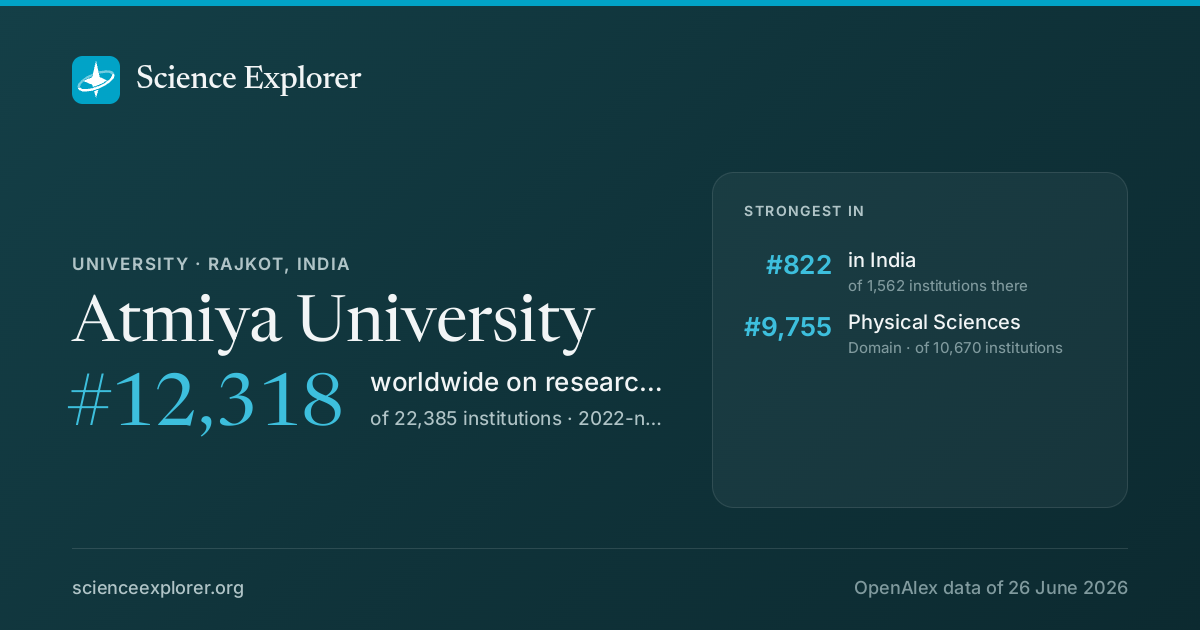
In research, Atmiya University stands highest in Physical Sciences (#9,755 of 10,670 worldwide), 2022-now. Relative to its size it is most specialised in Organic Chemistry (Organic Chemistry is 9.2× its share of world research).
- World rank, 2022-now
- #12,318 of 22,385 · #17,879 all time
- Rank in India
- #822 of 1,562
- Research works
- 532 ▲ 169% vs 2018-21
- Citations
- 2.2k 4.2 per fractional work
- Top-10% rate
- 3.9% all institutions 10.0%
- vs its own fields
- 0.88× 1.00× is exactly expected
- Open access
- 46% world 40%
- International
- 5% world 18%
What is Atmiya University known for in research?
The fields where it stands highest, 2022-now, ranked among every institution above the floor in each field.
| Field | World rank | Where that sits | Top-10% rate | Works | All time |
|---|---|---|---|---|---|
| Physical SciencesDomain | #9,755 of 10,670 | 2.1% | 128 | #11587 |
Each strip is that field's whole ranked pool, with the notch where Atmiya University sits in it, in the colour of the band that rank falls in. The track under the rate is the rate itself: it carries no average mark, because the average differs by field (from about 6% in Dentistry to 21% in Economics).
Which fields of science does Atmiya University work in?
In 2022-now, 52% of research at Atmiya University is in Physical Sciences, 21% in Life Sciences. Its largest fields are Computer Science (23%), Engineering (12%), Agricultural and Biological Sciences (9%). It does 1.6× the world's share of Life Sciences.
Each ring splits the one inside it: the four domains of science, their fields, their subfields. Size is fractional works in 2022-now. Every slice is a page; the interactive view zooms down to single topics and colours each by how much more of it this institution does than the world.
Its 4 domains and 26 fields, with their numbers
- Physical Sciences15552.1%
- Computer Science6822.8%
- Engineering3612.0%
- Chemistry279.1%
- Materials Science103.4%
- Environmental Science92.9%
- Energy20.6%
- Mathematics20.5%
- Earth and Planetary Sciences10.4%
- Chemical Engineering10.2%
- Physics and Astronomy00.2%
- Life Sciences6321.2%
- Social Sciences5016.7%
- Health Sciences3010.1%
- Medicine227.5%
- Health Professions72.4%
- Nursing00.1%
- Veterinary00.1%
- Dentistry00.0%
What does Atmiya University specialise in?
Where its research is concentrated relative to its size: Organic Chemistry takes 9.2× the share of its output that it takes of world research.
- Organic ChemistrySubfield · 20.6 works9.2×
Location quotient, a volume reading rather than an impact one. It surfaces small, lopsided specialities.
Field profile
Location quotient across every field it publishes in: outside the ring is more than an institution of this size would be expected to publish, inside it is less.
Rings at 0.5×, 1× and 2×. Widest outward: Pharmacology, Toxicology and Pharmaceutics, 6.0×. Every wedge is a field page.
All 26 fields, with their numbers
- Pharmacology, Toxicology and Pharmaceutics6.05×6 works
- Chemistry5.83×27 works
- Computer Science2.93×68 works
- Agricultural and Biological Sciences1.96×28 works
- Decision Sciences1.67×5 works
- Biochemistry, Genetics and Molecular Biology1.56×25 works
- Business, Management and Accounting1.46×14 works
- Economics, Econometrics and Finance1.08×7 works
- Materials Science0.99×10 works
- Health Professions0.90×7 works
- Veterinary0.82×0 works
- Engineering0.80×36 works
- Immunology and Microbiology0.68×2 works
- Energy0.67×2 works
- Chemical Engineering0.65×1 works
- Environmental Science0.58×9 works
- Psychology0.58×5 works
- Social Sciences0.45×17 works
- Neuroscience0.44×2 works
- Mathematics0.43×2 works
- Medicine0.39×22 works
- Earth and Planetary Sciences0.23×1 works
- Nursing0.23×0 works
- Arts and Humanities0.19×2 works
- Physics and Astronomy0.08×0 works
- Dentistry0.08×0 works
- Pharmacology, Toxicology and Pharmaceutics 6.0×
- Chemistry 5.8×
- Computer Science 2.9×
- Agricultural and Biological Sciences 2.0×
- Decision Sciences 1.7×
- Biochemistry, Genetics and Molecular Biology 1.6×
- Business, Management and Accounting 1.5×
- Economics, Econometrics and Finance 1.1×
- Materials Science 1.0×
- Health Professions 0.9×
- Veterinary 0.8×
- Engineering 0.8×
- Immunology and Microbiology 0.7×
- Energy 0.7×
- Chemical Engineering 0.7×
- Environmental Science 0.6×
- Psychology 0.6×
- Social Sciences 0.5×
- Neuroscience 0.4×
- Mathematics 0.4×
- Medicine 0.4×
- Earth and Planetary Sciences 0.2×
- Nursing 0.2×
- Arts and Humanities 0.2×
- Physics and Astronomy 0.1×
- Dentistry 0.1×
Who are the top researchers at Atmiya University?
Ranked on the quality score, Mousumi Das, Ashish M. Kothari and Shiv Kumar Tripathi lead among researchers whose main affiliation is Atmiya University.
- 1
Mousumi Das
 India · #1,896,484 worldwide
317 citations · 36 works
- 2
Ashish M. Kothari
India · #3,257,941 worldwide
416 citations · 84 works
- 3
Shiv Kumar Tripathi
India · #3,496,285 worldwide
864 citations · 72 works
- 4
Kevin Garala
India · #4,117,598 worldwide
973 citations · 52 works
- 5
Jaydeep Patel
India · #4,304,966 worldwide
817 citations · 47 works
- 6
Chitra Bhattacharya
India · #4,520,464 worldwide
14 citations · 15 works
- 7
Sheetal S. Buddhadev
India · #5,050,377 worldwide
116 citations · 20 works
- 8
Nutan Prakash Vishwakarma
India · #5,127,644 worldwide
103 citations · 18 works
- 9
Divyang D. Vyas
India · #5,218,599 worldwide
18 citations · 19 works
- 10
Manojkumar V. Sheladiya
India · #5,335,654 worldwide
29 citations · 16 works
Which keywords describe research at Atmiya University?
By fractional works in 2022-now, weighted toward what it does more of than the world: Deep Learning, Machine Learning, Medicinal Chemistry, Drug Discovery, Anticancer Agents, Healthcare, Heterocyclic Compounds and Big Data Analytics.
- Biological Evaluation
- Internet of Things (IoT)
- Anticancer
- Career Development
- Classification Models
- Smart Cities
- Cybersecurity
- Feature Selection
- Educational Data Mining
- Antioxidant
- Tubulin Inhibitors
- Wireless Sensor Networks
- Big Data Analytics
- Security
- Internet of Things
- Online Learning
- Anticancer Agents
- Neural Networks
- Medicinal Chemistry
- Machine Learning
- Deep Learning
- Healthcare
- Artificial Intelligence
- Drug Discovery
- Convolutional Neural Networks
- Data Mining
- Heterocyclic Compounds
- Student Engagement
- Synthesis
- Learning Analytics
- Vascular Targeting Agents
- Antimicrobial
- Massive Open Online Courses
- Biosynthesis
- Molecular Docking
- Genetic Variation
- Medical Diagnosis
- Smart Farming
- Click Chemistry
- Plant Disease Detection
Size is fractional works in 2022-now in the topics tagged with each word; colour is the word's share of this institution's work against its share of the world's. The 40 words are chosen for being large and distinctive. Each links to the topic it comes from most.
All 40 words, with their numbers
- Deep Learning35▲ 3.4×46 topics
- Machine Learning35▲ 3.5×40 topics
- Healthcare12▲ 3.6×8 topics
- Medicinal Chemistry10▲ 13×6 topics
- Artificial Intelligence10▲ 2.4×15 topics
- Neural Networks10▲ 2.2×14 topics
- Drug Discovery10▲ 15×8 topics
- Anticancer Agents9▲ 21×9 topics
- Convolutional Neural Networks9▲ 4.3×11 topics
- Online Learning8▲ 3.4×5 topics
- Data Mining8▲ 3.8×9 topics
- Internet of Things8▲ 3.2×11 topics
- Heterocyclic Compounds8▲ 31×4 topics
- Security8▲ 3.9×11 topics
- Student Engagement8▲ 6.3×3 topics
- Big Data Analytics7▲ 11×3 topics
- Synthesis7▲ 6.4×16 topics
- Wireless Sensor Networks7▲ 5.3×4 topics
- Learning Analytics6▲ 18×2 topics
- Tubulin Inhibitors6▲ 47×1 topic
- Vascular Targeting Agents6▲ 47×1 topic
- Antioxidant6▲ 2.9×17 topics
- Antimicrobial6▲ 7.0×8 topics
- Educational Data Mining5▲ 21×1 topic
- Massive Open Online Courses5▲ 21×1 topic
- Feature Selection5▲ 8.2×3 topics
- Biosynthesis5▲ 10×5 topics
- Cybersecurity5▲ 6.3×3 topics
- Molecular Docking5▲ 13×3 topics
- Smart Cities4▲ 5.6×4 topics
- Genetic Variation4▲ 6.6×5 topics
- Classification Models4▲ 16×1 topic
- Medical Diagnosis4▲ 15×1 topic
- Career Development4▲ 12×5 topics
- Smart Farming4▲ 12×2 topics
- Anticancer4▲ 8.2×8 topics
- Click Chemistry4▲ 24×3 topics
- Internet of Things (IoT)4▲ 11×1 topic
- Plant Disease Detection4▲ 13×1 topic
- Biological Evaluation4▲ 23×5 topics
Which research topics does Atmiya University publish most on?
By volume in 2022-now: Synthesis and biological activity, Online Learning and Analytics, Artificial Intelligence in Healthcare and Smart Agriculture and AI.
Area is fractional works; colour is the subfield each topic belongs to.
- 1 Synthesis and biological activity Organic Chemistry 6 works
- 2 Online Learning and Analytics Computer Science Applications 5 works
- 3 Artificial Intelligence in Healthcare Health Information Management 4 works
- 4 Smart Agriculture and AI Plant Science 4 works
- 5 Click Chemistry and Applications Organic Chemistry 4 works
- 6 Internet of Things and AI Information Systems 3 works
- 7 Enzyme Production and Characterization Biotechnology 2 works
- 8 Plant-Microbe Interactions and Immunity Plant Science 2 works
- 9 Analytical Methods in Pharmaceuticals Analytical Chemistry 2 works
- 10 Computational Drug Discovery Methods Computational Theory and Mathematics 2 works
How open and international is its research?
Against the world's own shares: the tick on each track. Both are shares of its output, so they sit on one scale and can be read against each other as well as against the world.
World: 40% of research is openly available.
World: 18% is written across borders.
How has Atmiya University's research output changed?
Output in 2022-2025 was 169% higher than in 2018-2021.
The same series as a ribbon: one cell per year, darker for more. The line above answers how much; this answers when.
Its share of all research
Growing output can still be a shrinking share: all of science grows. This is Atmiya University as a percentage of every work published that year, 0.0014% in 2024.
Fractional works of Atmiya University over all fractional works that year. How the balance of science has shifted.
How much of it reaches the world top 10%
Year by year, against all institutions in the same year.
Of each year's output, the share that reached the world's 10% most cited for its field and year. Peak 4.3% in 2021.
Other research institutions in Rajkot
Share Atmiya University's ranking
Badges for a website1Each links back here and updates with every snapshot

Research measures only: rankings here say nothing about teaching, admissions or student experience. Comparable institutions and collaboration partners have tabs of their own, above.
Discussion
Ask a question or share a note about Atmiya University. Posts are plain text and can be reported.