Science Explorer Back to mapMap
Discussion

Autodesk (United States)

In research, Autodesk (United States) stands highest in Physical Sciences (#3,751 of 10,670 worldwide), 2022-now.

World rank, 2022-now
#8,886
of 22,385 · #5,543 all time
Rank in United States
#1,199
of 3,332
Research works
693
▲ 20% vs 2018-21
Citations
8.6k
12.4 per fractional work
Top-10% rate
12.5%
all institutions 10.0%
vs its own fields
1.13×
1.00× is exactly expected
Open access
45%
world 40%
International
37%
world 18%

What is Autodesk (United States) known for in research?

The fields where it stands highest, 2022-now, ranked among every institution above the floor in each field.

FieldWorld rankWhere that sitsTop-10% rateWorksAll time
Physical SciencesDomain #3,751 of 10,670 17.1%82 #2797

Each strip is that field's whole ranked pool, with the notch where Autodesk (United States) sits in it, in the colour of the band that rank falls in. The track under the rate is the rate itself: it carries no average mark, because the average differs by field (from about 6% in Dentistry to 21% in Economics).

Which fields of science does Autodesk (United States) work in?

In 2022-now, 55% of research at Autodesk (United States) is in Physical Sciences, 35% in Social Sciences. Its largest fields are Engineering (27%), Computer Science (20%), Social Sciences (19%). It does 1.4× the world's share of Physical Sciences.

Physical Sciences: 94 fractional works · 54.7% of its workEngineering: 47 fractional works · 27.4% of its workBuilding and Construction: 10 fractional works · 6.0% of its workIndustrial and Manufacturing Engineering: 8 fractional works · 4.8% of its workMechanical Engineering: 5 fractional works · 2.8% of its workControl and Systems Engineering: 4 fractional works · 2.4% of its workComputational Mechanics: 4 fractional works · 2.2% of its workCivil and Structural Engineering: 3 fractional works · 2.0% of its workAutomotive Engineering: 3 fractional works · 1.9% of its workElectrical and Electronic Engineering: 2 fractional works · 1.2% of its workArchitecture: 2 fractional works · 0.9% of its workOcean Engineering: 1 fractional works · 0.7% of its workMedia Technology: 1 fractional works · 0.7% of its workBiomedical Engineering: 1 fractional works · 0.6% of its workMechanics of Materials: 1 fractional works · 0.5% of its workAerospace Engineering: 1 fractional works · 0.4% of its workSafety, Risk, Reliability and Quality: 0 fractional works · 0.2% of its workComputer Science: 34 fractional works · 19.6% of its workComputer Vision and Pattern Recognition: 8 fractional works · 4.8% of its workArtificial Intelligence: 7 fractional works · 4.3% of its workInformation Systems: 5 fractional works · 3.2% of its workComputer Networks and Communications: 4 fractional works · 2.3% of its workHuman-Computer Interaction: 3 fractional works · 1.5% of its workComputer Science Applications: 2 fractional works · 1.0% of its workComputer Graphics and Computer-Aided Design: 2 fractional works · 1.0% of its workHardware and Architecture: 1 fractional works · 0.6% of its workSoftware: 1 fractional works · 0.5% of its workComputational Theory and Mathematics: 1 fractional works · 0.3% of its workSignal Processing: 0 fractional works · 0.3% of its workEnvironmental Science: 5 fractional works · 3.1% of its workEnvironmental Engineering: 2 fractional works · 0.9% of its workEcology: 1 fractional works · 0.8% of its workHealth, Toxicology and Mutagenesis: 1 fractional works · 0.8% of its workManagement, Monitoring, Policy and Law: 0 fractional works · 0.2% of its workSmaller subfields together: 1 fractional works · 0.3% of its workMaterials Science: 3 fractional works · 1.5% of its workMaterials Chemistry: 1 fractional works · 0.7% of its workBiomaterials: 0 fractional works · 0.3% of its workSurfaces, Coatings and Films: 0 fractional works · 0.2% of its workPolymers and Plastics: 0 fractional works · 0.2% of its workSmaller subfields together: 0 fractional works · 0.1% of its workChemistry: 1 fractional works · 0.8% of its workInorganic Chemistry: 0 fractional works · 0.3% of its workOrganic Chemistry: 0 fractional works · 0.3% of its workSmaller subfields together: 0 fractional works · 0.3% of its workMathematics: 1 fractional works · 0.6% of its workPhysics and Astronomy: 1 fractional works · 0.6% of its workAstronomy and Astrophysics: 1 fractional works · 0.4% of its workSmaller subfields together: 0 fractional works · 0.2% of its workEnergy: 1 fractional works · 0.5% of its workRenewable Energy, Sustainability and the Environment: 1 fractional works · 0.5% of its workEarth and Planetary Sciences: 1 fractional works · 0.4% of its workGeology: 0 fractional works · 0.2% of its workSmaller subfields together: 0 fractional works · 0.2% of its workSocial Sciences: 60 fractional works · 34.7% of its workSocial Sciences: 33 fractional works · 19.2% of its workSociology and Political Science: 12 fractional works · 7.3% of its workEducation: 4 fractional works · 2.5% of its workAnthropology: 3 fractional works · 1.7% of its workPolitical Science and International Relations: 3 fractional works · 1.5% of its workUrban Studies: 2 fractional works · 1.3% of its workCultural Studies: 2 fractional works · 1.1% of its workSafety Research: 1 fractional works · 0.7% of its workLaw: 1 fractional works · 0.6% of its workTransportation: 1 fractional works · 0.5% of its workCommunication: 1 fractional works · 0.4% of its workDevelopment: 1 fractional works · 0.3% of its workDemography: 1 fractional works · 0.3% of its workLinguistics and Language: 0 fractional works · 0.3% of its workGender Studies: 0 fractional works · 0.3% of its workHealth: 0 fractional works · 0.3% of its workSmaller subfields together: 0 fractional works · 0.2% of its workArts and Humanities: 9 fractional works · 5.3% of its workHistory: 2 fractional works · 0.9% of its workLiterature and Literary Theory: 1 fractional works · 0.8% of its workLanguage and Linguistics: 1 fractional works · 0.8% of its workConservation: 1 fractional works · 0.6% of its workGeneral Arts and Humanities: 1 fractional works · 0.5% of its workMuseology: 1 fractional works · 0.5% of its workHistory and Philosophy of Science: 1 fractional works · 0.5% of its workPhilosophy: 1 fractional works · 0.4% of its workArcheology: 1 fractional works · 0.3% of its workBusiness, Management and Accounting: 7 fractional works · 3.9% of its workManagement of Technology and Innovation: 2 fractional works · 1.3% of its workStrategy and Management: 2 fractional works · 1.1% of its workOrganizational Behavior and Human Resource Management: 1 fractional works · 0.6% of its workManagement Information Systems: 1 fractional works · 0.6% of its workSmaller subfields together: 1 fractional works · 0.3% of its workPsychology: 6 fractional works · 3.7% of its workSocial Psychology: 3 fractional works · 1.5% of its workClinical Psychology: 2 fractional works · 1.2% of its workExperimental and Cognitive Psychology: 1 fractional works · 0.5% of its workDevelopmental and Educational Psychology: 1 fractional works · 0.3% of its workSmaller subfields together: 0 fractional works · 0.1% of its workDecision Sciences: 3 fractional works · 1.5% of its workManagement Science and Operations Research: 1 fractional works · 0.7% of its workInformation Systems and Management: 1 fractional works · 0.4% of its workStatistics, Probability and Uncertainty: 1 fractional works · 0.3% of its workEconomics, Econometrics and Finance: 2 fractional works · 1.1% of its workEconomics and Econometrics: 2 fractional works · 1.1% of its workHealth Sciences: 15 fractional works · 8.5% of its workMedicine: 8 fractional works · 4.8% of its workPublic Health, Environmental and Occupational Health: 1 fractional works · 0.8% of its workSurgery: 1 fractional works · 0.7% of its workOrthopedics and Sports Medicine: 1 fractional works · 0.5% of its workRheumatology: 0 fractional works · 0.3% of its workNeurology: 0 fractional works · 0.3% of its workRehabilitation: 0 fractional works · 0.3% of its workReproductive Medicine: 0 fractional works · 0.2% of its workPathology and Forensic Medicine: 0 fractional works · 0.2% of its workSmaller subfields together: 3 fractional works · 1.6% of its workHealth Professions: 6 fractional works · 3.5% of its workGeneral Health Professions: 4 fractional works · 2.5% of its workPharmacy: 1 fractional works · 0.5% of its workSmaller subfields together: 1 fractional works · 0.5% of its workDentistry: 0 fractional works · 0.1% of its workNursing: 0 fractional works · 0.0% of its workLife Sciences: 4 fractional works · 2.1% of its workBiochemistry, Genetics and Molecular Biology: 2 fractional works · 1.0% of its workMolecular Biology: 1 fractional works · 0.5% of its workSmaller subfields together: 1 fractional works · 0.4% of its workAgricultural and Biological Sciences: 1 fractional works · 0.7% of its workPlant Science: 0 fractional works · 0.3% of its workSmaller subfields together: 1 fractional works · 0.4% of its workNeuroscience: 1 fractional works · 0.4% of its workCognitive Neuroscience: 1 fractional works · 0.4% of its workALL ITS WORKAutodesk (UnitedStates)172fractional works, 2022-now
Life Sciences2%Physical Sciences55%Health Sciences8%Social Sciences35%

Each ring splits the one inside it: the four domains of science, their fields, their subfields. Size is fractional works in 2022-now. Every slice is a page; the interactive view zooms down to single topics and colours each by how much more of it this institution does than the world.

Its 4 domains and 23 fields, with their numbers
    1. Engineering4727.4%
    2. Computer Science3419.6%
    3. Environmental Science53.1%
    4. Materials Science31.5%
    5. Chemistry10.8%
    6. Mathematics10.6%
    7. Physics and Astronomy10.6%
    8. Energy10.5%
    9. Earth and Planetary Sciences10.4%
    1. Social Sciences3319.2%
    2. Arts and Humanities95.3%
    3. Business, Management and Accounting73.9%
    4. Psychology63.7%
    5. Decision Sciences31.5%
    6. Economics, Econometrics and Finance21.1%
    1. Medicine84.8%
    2. Health Professions63.5%
    3. Dentistry00.1%
    4. Nursing00.0%
    1. Biochemistry, Genetics and Molecular Biology21.0%
    2. Agricultural and Biological Sciences10.7%
    3. Neuroscience10.4%
    4. Pharmacology, Toxicology and Pharmaceutics00.0%
All of science, and how each field's share has moved since 1950: the Science domain explorer

Field profile

Location quotient across every field it publishes in: outside the ring is more than an institution of this size would be expected to publish, inside it is less.

Agricultural and Biological Sciences: 0.14× its world share, 1 worksAgricultural and Bio…Biochemistry, Genetics and Molecular Biology: 0.18× its world share, 2 worksBiochemistry, Geneti…Neuroscience: 0.27× its world share, 1 worksNeurosciencePharmacology, Toxicology and Pharmaceutics: 0.06× its world share, 0 worksPharmacology, Toxico…Chemistry: 0.54× its world share, 1 worksChemistryComputer Science: 2.52× its world share, 34 worksComputer ScienceEarth and Planetary Sciences: 0.25× its world share, 1 worksEarth and Planetary …Energy: 0.58× its world share, 1 worksEnergyEngineering: 1.83× its world share, 47 worksEngineeringEnvironmental Science: 0.62× its world share, 5 worksEnvironmental ScienceMaterials Science: 0.44× its world share, 3 worksMaterials ScienceMathematics: 0.54× its world share, 1 worksMathematicsPhysics and Astronomy: 0.28× its world share, 1 worksPhysics and AstronomyDentistry: 0.25× its world share, 0 worksDentistryHealth Professions: 1.32× its world share, 6 worksHealth ProfessionsMedicine: 0.25× its world share, 8 worksMedicineNursing: 0.05× its world share, 0 worksNursingArts and Humanities: 1.83× its world share, 9 worksArts and HumanitiesBusiness, Management and Accounting: 1.22× its world share, 7 worksBusiness, Management…Decision Sciences: 1.51× its world share, 2 worksDecision SciencesEconomics, Econometrics and Finance: 0.54× its world share, 2 worksEconomics, Econometr…Psychology: 1.21× its world share, 6 worksPsychologySocial Sciences: 1.52× its world share, 33 worksSocial Sciences1×world share
more than its size predictsabout as predictedless

Rings at 0.5×, 1× and 2×. Widest outward: Computer Science, 2.5×. Every wedge is a field page.

All 23 fields, with their numbers
  1. Computer Science2.52×34 works
  2. Engineering1.83×47 works
  3. Arts and Humanities1.83×9 works
  4. Social Sciences1.52×33 works
  5. Decision Sciences1.51×2 works
  6. Health Professions1.32×6 works
  7. Business, Management and Accounting1.22×7 works
  8. Psychology1.21×6 works
  9. Environmental Science0.62×5 works
  10. Energy0.58×1 works
  11. Chemistry0.54×1 works
  12. Mathematics0.54×1 works
  13. Economics, Econometrics and Finance0.54×2 works
  14. Materials Science0.44×3 works
  15. Physics and Astronomy0.28×1 works
  16. Neuroscience0.27×1 works
  17. Earth and Planetary Sciences0.25×1 works
  18. Dentistry0.25×0 works
  19. Medicine0.25×8 works
  20. Biochemistry, Genetics and Molecular Biology0.18×2 works
  21. Agricultural and Biological Sciences0.14×1 works
  22. Pharmacology, Toxicology and Pharmaceutics0.06×0 works
  23. Nursing0.05×0 works

Who are the top researchers at Autodesk (United States)?

Ranked on the quality score, Jos Stam, Karl D. D. Willis and Erik R. Denlinger lead among researchers whose main affiliation is Autodesk (United States).

  1. 1 Jos Stam United States · #67,019 worldwide 6.3k citations · 57 works
  2. 2 Karl D. D. Willis United States · #167,755 worldwide 1.9k citations · 63 works
  3. 3 Erik R. Denlinger United States · #255,805 worldwide 2.8k citations · 25 works
  4. 4 Joseph G. Lambourne United States · #533,536 worldwide 814 citations · 34 works
  5. 5 Pradeep Kumar Jayaraman United States · #655,222 worldwide 644 citations · 53 works
  6. 6 Michael Gouge United States · #665,305 worldwide 1.1k citations · 20 works
  7. 7 Eric Haines United States · #890,263 worldwide 2.5k citations · 80 works
  8. 8 Aditya Sanghi United States · #904,756 worldwide 499 citations · 27 works
  9. 9 Jieliang Luo United States · #965,126 worldwide 493 citations · 39 works
  10. 10 Kai-Hung Chang United States · #1,133,379 worldwide 772 citations · 17 works
All ranked researchers at Autodesk (United States)

What are the most cited papers from Autodesk (United States)?

The most cited paper from Autodesk (United States) is "Retargetting motion to new characters" (Michael Gleicher, 1998), with 858 citations. Next come "Learning hatching for pen-and-ink illustration of surfaces" (649) and "Active Printed Materials for Complex Self-Evolving Deformations" (565).

Most cited papers
#PaperReleasedCitations
1 Retargetting motion to new characters Michael Gleicher Conference paper 1998 858
2 Learning hatching for pen-and-ink illustration of surfaces Evangelos Kalogerakis, Derek Nowrouzezahrai, Simon Breslav et al. · ACM Transactions on Graphics 2012 649
3 Active Printed Materials for Complex Self-Evolving Deformations Dan Raviv, Wei Dong Zhao, Carrie McKnelly et al. · Scientific Reports Open access 18 Dec 2014 565
4 Convolutional wasserstein distances Justin Solomon, Fernando de Goes, Gabriel Peyré et al. · ACM Transactions on Graphics Open access 27 Jul 2015 492
5 Residual stress mapping in Inconel 625 fabricated through additive manufacturing: Method for neutron diffraction measurements to validate thermomechanical model predictions Zhuqing Wang, Erik R. Denlinger, Panagiotis Michaleris et al. · Materials & Design Open access 8 Oct 2016 355
All 62 most cited papers, with filters and sorting

Which keywords describe research at Autodesk (United States)?

By fractional works in 2022-now, weighted toward what it does more of than the world: Deep Learning, Sustainability, Risk Management, Facilities Management, RFID Technology, BIM, Construction and Assembly Planning.

▲ more of its work than of the world's◆ about the world's share▼ less than the world's

Size is fractional works in 2022-now in the topics tagged with each word; colour is the word's share of this institution's work against its share of the world's. The 40 words are chosen for being large and distinctive. Each links to the topic it comes from most.

All 40 words, with their numbers
  1. Deep Learning16▲ 2.7×34 topics
  2. Sustainability14▲ 3.2×21 topics
  3. Machine Learning8▲ 1.33×28 topics
  4. Risk Management7▲ 8.8×5 topics
  5. Facilities Management7▲ 51×2 topics
  6. BIM7▲ 63×1 topic
  7. Construction7▲ 29×1 topic
  8. RFID Technology7▲ 22×2 topics
  9. Big Data6▲ 3.6×15 topics
  10. Mental Health5▲ 2.2×13 topics
  11. Assembly Planning5▲ 44×1 topic
  12. Design for Manufacture5▲ 44×1 topic
  13. Innovation5▲ 3.0×10 topics
  14. Neural Networks5▲ 1.98×14 topics
  15. Artificial Intelligence5▲ 2.0×18 topics
  16. Globalization5▲ 1.47×16 topics
  17. Knowledge Management4▲ 4.3×9 topics
  18. Convolutional Neural Networks4▲ 3.0×10 topics
  19. Internet of Things4▲ 2.5×13 topics
  20. Gender Studies4▲ 13×4 topics
  21. Creativity3▲ 33×2 topics
  22. Engineering Design3▲ 29×2 topics
  23. Virtual Reality3▲ 4.0×7 topics
  24. 3D Reconstruction3▲ 21×2 topics
  25. Literature3▲ 3.5×9 topics
  26. Point Clouds3▲ 21×2 topics
  27. Biomimetics3▲ 69×1 topic
  28. Community Engagement3▲ 5.4×4 topics
  29. Design Thinking3▲ 69×1 topic
  30. Educational Policies3▲ 16×3 topics
  31. Mesh Segmentation3▲ 55×1 topic
  32. Shape Representation3▲ 55×1 topic
  33. Additive Manufacturing3▲ 5.2×4 topics
  34. Health Promotion3▲ 4.9×6 topics
  35. Digital Fabrication2▲ 20×2 topics
  36. 3D Printing2▲ 6.2×4 topics
  37. Sociological Analysis2▲ 25×2 topics
  38. Territorial Governance2▲ 12×3 topics
  39. Local Development2▲ 13×2 topics
  40. Urban Morphology2▲ 30×2 topics

Which research topics does Autodesk (United States) publish most on?

By volume in 2022-now: BIM and Construction Integration, Manufacturing Process and Optimization, Design Education and Practice and 3D Shape Modeling and Analysis.

  1. 1 BIM and Construction Integration Building and Construction 7 works
  2. 2 Manufacturing Process and Optimization Industrial and Manufacturing Engineering 5 works
  3. 3 Design Education and Practice Mechanical Engineering 3 works
  4. 4 3D Shape Modeling and Analysis Computational Mechanics 3 works
  5. 5 Education, sociology, and vocational training Sociology and Political Science 2 works
  6. 6 Health and Lifestyle Studies General Health Professions 2 works
  7. 7 Architecture and Computational Design Architecture 2 works
  8. 8 Infrastructure Maintenance and Monitoring Civil and Structural Engineering 2 works
  9. 9 French Urban and Social Studies Sociology and Political Science 2 works
  10. 10 Robot Manipulation and Learning Control and Systems Engineering 2 works

How open and international is its research?

Against the world's own shares: the tick on each track. Both are shares of its output, so they sit on one scale and can be read against each other as well as against the world.

openly available45.3%not open54.7%

World: 40% of research is openly available.

with international co-authors37.3%domestic only62.7%

World: 18% is written across borders.

How has Autodesk (United States)'s research output changed?

Output in 2022-2025 was 20% higher than in 2018-2021.

still counting1990200020102020
grewheldshrank

The same series as a ribbon: one cell per year, darker for more. The line above answers how much; this answers when.

Its share of all research

Growing output can still be a shrinking share: all of science grows. This is Autodesk (United States) as a percentage of every work published that year, 0.00062% in 2024.

still counting0.0010%0.0020%0.0030%Autodesk (United States)0.00089% in 202519801990200020102020

Fractional works of Autodesk (United States) over all fractional works that year. How the balance of science has shifted.

How much of it reaches the world top 10%

Year by year, against all institutions in the same year.

still counting10%20%Autodesk (United States)10.0% in 2025all institutions10.0% in 202520102020

Of each year's output, the share that reached the world's 10% most cited for its field and year. Peak 18.5% in 2014.

Other research institutions in San Francisco

All research institutions in San Francisco

Share Autodesk (United States)'s ranking
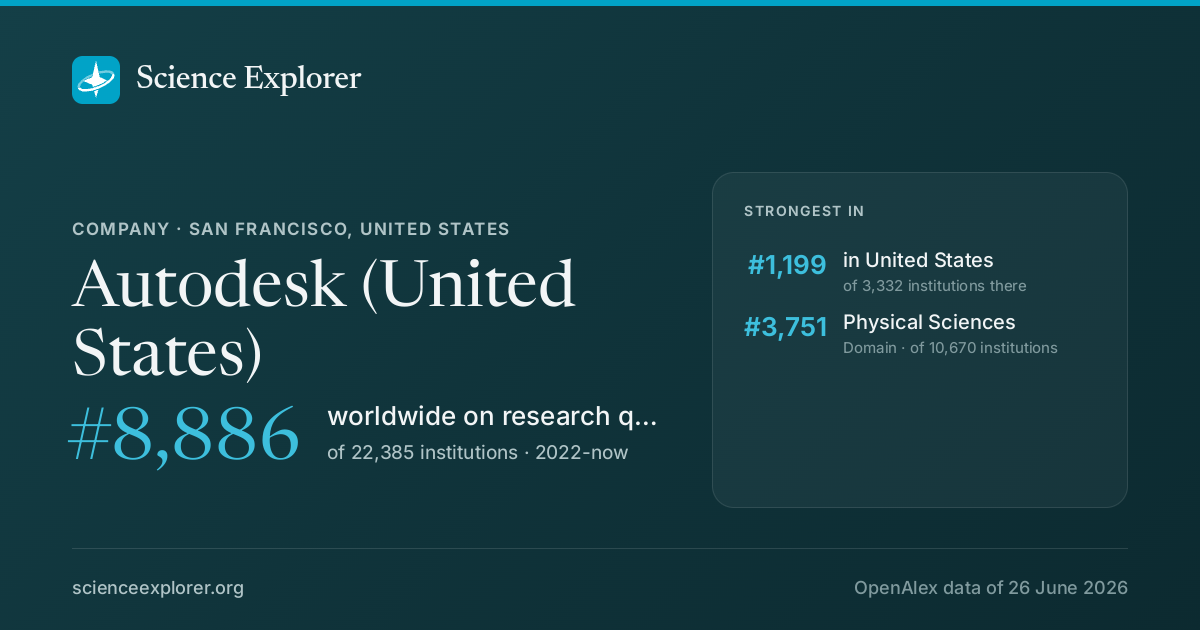
Autodesk (United States) on Science Explorer

A card with Autodesk (United States)'s standing and the fields it leads in, for a post or a slide. A link to this page previews as the same card.

Download the card

1200 × 630 PNG, sized for social posts, drawn from the latest snapshot.

Badges for a website1Each links back here and updates with every snapshot

Research measures only: rankings here say nothing about teaching, admissions or student experience. Comparable institutions and collaboration partners have tabs of their own, above.

Discussion

Ask a question or share a note about Autodesk (United States). Posts are plain text and can be reported.