Science Explorer Back to mapMap
University · Pul-e Khumrī · Afghanistan

Baghlan University

World rank, 2022-now
#20,565
of 22,385
Rank in Afghanistan
#19
of 19
Research works
96
▲ 230% vs 2018-21
Citations
168
1.8 per fractional work
Top-10% rate
7.6%
all institutions 10.0%
vs its own fields
0.96×
1.00× is exactly expected
Open access
95%
world 40%
International
26%
world 18%

Which fields of science does Baghlan University work in?

In 2022-now, 58% of research at Baghlan University is in Social Sciences, 20% in Physical Sciences. Its largest fields are Social Sciences (40%), Agricultural and Biological Sciences (16%), Arts and Humanities (8%). It does 2.2× the world's share of Social Sciences.

Social Sciences: 43 fractional works · 58.3% of its workSocial Sciences: 30 fractional works · 40.3% of its workPolitical Science and International Relations: 9 fractional works · 11.9% of its workEducation: 8 fractional works · 10.6% of its workSociology and Political Science: 6 fractional works · 8.4% of its workCommunication: 3 fractional works · 4.5% of its workTransportation: 1 fractional works · 1.2% of its workSafety Research: 1 fractional works · 1.1% of its workUrban Studies: 0 fractional works · 0.7% of its workAnthropology: 0 fractional works · 0.4% of its workDevelopment: 0 fractional works · 0.4% of its workLinguistics and Language: 0 fractional works · 0.4% of its workGender Studies: 0 fractional works · 0.3% of its workSmaller subfields together: 0 fractional works · 0.3% of its workArts and Humanities: 6 fractional works · 7.7% of its workLiterature and Literary Theory: 2 fractional works · 2.9% of its workArcheology: 1 fractional works · 1.4% of its workLanguage and Linguistics: 1 fractional works · 1.1% of its workMuseology: 0 fractional works · 0.7% of its workPhilosophy: 0 fractional works · 0.7% of its workHistory and Philosophy of Science: 0 fractional works · 0.4% of its workReligious studies: 0 fractional works · 0.4% of its workBusiness, Management and Accounting: 5 fractional works · 6.3% of its workAccounting: 2 fractional works · 3.2% of its workStrategy and Management: 1 fractional works · 1.7% of its workManagement Information Systems: 0 fractional works · 0.4% of its workManagement of Technology and Innovation: 0 fractional works · 0.4% of its workOrganizational Behavior and Human Resource Management: 0 fractional works · 0.4% of its workPsychology: 2 fractional works · 2.0% of its workSocial Psychology: 1 fractional works · 1.1% of its workClinical Psychology: 0 fractional works · 0.7% of its workExperimental and Cognitive Psychology: 0 fractional works · 0.2% of its workEconomics, Econometrics and Finance: 1 fractional works · 1.6% of its workEconomics and Econometrics: 1 fractional works · 1.0% of its workGeneral Economics, Econometrics and Finance: 0 fractional works · 0.4% of its workSmaller subfields together: 0 fractional works · 0.2% of its workDecision Sciences: 0 fractional works · 0.4% of its workManagement Science and Operations Research: 0 fractional works · 0.4% of its workPhysical Sciences: 15 fractional works · 19.8% of its workEnvironmental Science: 5 fractional works · 6.3% of its workGlobal and Planetary Change: 1 fractional works · 1.4% of its workHealth, Toxicology and Mutagenesis: 1 fractional works · 1.4% of its workEcology: 1 fractional works · 0.9% of its workEnvironmental Chemistry: 0 fractional works · 0.6% of its workEnvironmental Engineering: 0 fractional works · 0.6% of its workManagement, Monitoring, Policy and Law: 0 fractional works · 0.6% of its workWater Science and Technology: 0 fractional works · 0.4% of its workNature and Landscape Conservation: 0 fractional works · 0.2% of its workSmaller subfields together: 0 fractional works · 0.2% of its workEngineering: 4 fractional works · 5.9% of its workMechanical Engineering: 1 fractional works · 1.5% of its workAerospace Engineering: 1 fractional works · 0.9% of its workControl and Systems Engineering: 0 fractional works · 0.7% of its workCivil and Structural Engineering: 0 fractional works · 0.4% of its workElectrical and Electronic Engineering: 0 fractional works · 0.4% of its workOcean Engineering: 0 fractional works · 0.4% of its workBiomedical Engineering: 0 fractional works · 0.4% of its workMechanics of Materials: 0 fractional works · 0.4% of its workSafety, Risk, Reliability and Quality: 0 fractional works · 0.3% of its workSmaller subfields together: 0 fractional works · 0.3% of its workComputer Science: 3 fractional works · 4.6% of its workInformation Systems: 2 fractional works · 2.7% of its workArtificial Intelligence: 1 fractional works · 0.8% of its workComputer Science Applications: 0 fractional works · 0.7% of its workComputer Networks and Communications: 0 fractional works · 0.4% of its workMathematics: 1 fractional works · 1.2% of its workStatistics and Probability: 1 fractional works · 0.9% of its workGeometry and Topology: 0 fractional works · 0.2% of its workSmaller subfields together: 0 fractional works · 0.1% of its workEnergy: 0 fractional works · 0.6% of its workRenewable Energy, Sustainability and the Environment: 0 fractional works · 0.4% of its workFuel Technology: 0 fractional works · 0.2% of its workEarth and Planetary Sciences: 0 fractional works · 0.4% of its workAtmospheric Science: 0 fractional works · 0.2% of its workEarth-Surface Processes: 0 fractional works · 0.2% of its workPhysics and Astronomy: 0 fractional works · 0.4% of its workStatistical and Nonlinear Physics: 0 fractional works · 0.4% of its workMaterials Science: 0 fractional works · 0.3% of its workMaterials Chemistry: 0 fractional works · 0.3% of its workLife Sciences: 13 fractional works · 17.4% of its workAgricultural and Biological Sciences: 12 fractional works · 16.2% of its workPlant Science: 4 fractional works · 5.6% of its workGeneral Agricultural and Biological Sciences: 3 fractional works · 3.7% of its workAgronomy and Crop Science: 2 fractional works · 2.0% of its workSoil Science: 1 fractional works · 1.9% of its workFood Science: 1 fractional works · 1.4% of its workAnimal Science and Zoology: 0 fractional works · 0.7% of its workInsect Science: 0 fractional works · 0.6% of its workAquatic Science: 0 fractional works · 0.2% of its workSmaller subfields together: 0 fractional works · 0.1% of its workBiochemistry, Genetics and Molecular Biology: 1 fractional works · 1.1% of its workMolecular Biology: 1 fractional works · 0.9% of its workGenetics: 0 fractional works · 0.2% of its workImmunology and Microbiology: 0 fractional works · 0.1% of its workHealth Sciences: 3 fractional works · 4.5% of its workMedicine: 2 fractional works · 2.7% of its workPublic Health, Environmental and Occupational Health: 1 fractional works · 1.3% of its workEpidemiology: 1 fractional works · 0.8% of its workComplementary and alternative medicine: 0 fractional works · 0.4% of its workSmaller subfields together: 0 fractional works · 0.2% of its workNursing: 1 fractional works · 1.4% of its workNutrition and Dietetics: 1 fractional works · 1.4% of its workHealth Professions: 0 fractional works · 0.4% of its workGeneral Health Professions: 0 fractional works · 0.4% of its workALL ITS WORKBaghlanUniversity74fractional works, 2022-now
Life Sciences17%Physical Sciences20%Health Sciences4%Social Sciences58%

Each ring splits the one inside it: the four domains of science, their fields, their subfields. Size is fractional works in 2022-now. Every slice is a page; the interactive view zooms down to single topics and colours each by how much more of it this institution does than the world.

Its 4 domains and 20 fields, with their numbers
    1. Social Sciences3040.3%
    2. Arts and Humanities67.7%
    3. Business, Management and Accounting56.3%
    4. Psychology22.0%
    5. Economics, Econometrics and Finance11.6%
    6. Decision Sciences00.4%
    1. Environmental Science56.3%
    2. Engineering45.9%
    3. Computer Science34.6%
    4. Mathematics11.2%
    5. Energy00.6%
    6. Earth and Planetary Sciences00.4%
    7. Physics and Astronomy00.4%
    8. Materials Science00.3%
    1. Agricultural and Biological Sciences1216.2%
    2. Biochemistry, Genetics and Molecular Biology11.1%
    3. Immunology and Microbiology00.1%
    1. Medicine22.7%
    2. Nursing11.4%
    3. Health Professions00.4%
All of science, and how each field's share has moved since 1950: the Science domain explorer

Field profile

Location quotient across every field it publishes in: outside the ring is more than an institution of this size would be expected to publish, inside it is less.

Agricultural and Biological Sciences: 3.42× its world share, 12 worksAgricultural and Bio…Biochemistry, Genetics and Molecular Biology: 0.21× its world share, 1 worksBiochemistry, Geneti…Immunology and Microbiology: 0.06× its world share, 0 worksImmunology and Micro…Computer Science: 0.59× its world share, 3 worksComputer ScienceEarth and Planetary Sciences: 0.29× its world share, 0 worksEarth and Planetary …Energy: 0.66× its world share, 0 worksEnergyEngineering: 0.39× its world share, 4 worksEngineeringEnvironmental Science: 1.28× its world share, 5 worksEnvironmental ScienceMaterials Science: 0.09× its world share, 0 worksMaterials ScienceMathematics: 1.03× its world share, 1 worksMathematicsPhysics and Astronomy: 0.17× its world share, 0 worksPhysics and AstronomyHealth Professions: 0.17× its world share, 0 worksHealth ProfessionsMedicine: 0.14× its world share, 2 worksMedicineNursing: 2.78× its world share, 1 worksNursingArts and Humanities: 2.67× its world share, 6 worksArts and HumanitiesBusiness, Management and Accounting: 1.95× its world share, 5 worksBusiness, Management…Decision Sciences: 0.43× its world share, 0 worksDecision SciencesEconomics, Econometrics and Finance: 0.74× its world share, 1 worksEconomics, Econometr…Psychology: 0.67× its world share, 2 worksPsychologySocial Sciences: 3.18× its world share, 30 worksSocial Sciences1×world share
more than its size predictsabout as predictedless

Rings at 0.5×, 1× and 2×. Widest outward: Agricultural and Biological Sciences, 3.4×. Every wedge is a field page.

All 20 fields, with their numbers
  1. Agricultural and Biological Sciences3.42×12 works
  2. Social Sciences3.18×30 works
  3. Nursing2.78×1 works
  4. Arts and Humanities2.67×6 works
  5. Business, Management and Accounting1.95×5 works
  6. Environmental Science1.28×5 works
  7. Mathematics1.03×1 works
  8. Economics, Econometrics and Finance0.74×1 works
  9. Psychology0.67×2 works
  10. Energy0.66×0 works
  11. Computer Science0.59×3 works
  12. Decision Sciences0.43×0 works
  13. Engineering0.39×4 works
  14. Earth and Planetary Sciences0.29×0 works
  15. Biochemistry, Genetics and Molecular Biology0.21×1 works
  16. Physics and Astronomy0.17×0 works
  17. Health Professions0.17×0 works
  18. Medicine0.14×2 works
  19. Materials Science0.09×0 works
  20. Immunology and Microbiology0.06×0 works

Who are the top researchers at Baghlan University?

Ranked on the quality score, Habibullah Rezaei lead among researchers whose main affiliation is Baghlan University.

  1. 1 Habibullah Rezaei Afghanistan · #3,865,034 worldwide 16 citations · 15 works
All ranked researchers at Baghlan University

What are the most cited papers from Baghlan University?

The most cited paper from Baghlan University is "Evaluation of NASA POWER Climatic Data against Ground-Based Observations in The Mediterranean and Continental Regions of Turkey" (Abdul Hasib HALİMİ, Cihan Karaca, Dursun Büyüktaş, 2023), with 21 citations. Next come "Effect of Integrated Nutrient Management on Growth, Yield Attributes and Yield of Wheat" (16) and "Productivity of mungbean (Vigna radiata) as influenced by phosphorus fertilizer" (14).

Most cited papers
#PaperReleasedCitations
1 Evaluation of NASA POWER Climatic Data against Ground-Based Observations in The Mediterranean and Continental Regions of Turkey Abdul Hasib HALİMİ, Cihan Karaca, Dursun Büyüktaş · Tekirdağ Ziraat Fakültesi Dergisi Open access 2 Jan 2023 21
2 Effect of Integrated Nutrient Management on Growth, Yield Attributes and Yield of Wheat Tamim Fazily · International Journal of Advances in Agricultural Science and Technology Open access 30 Jan 2021 16
3 Productivity of mungbean (Vigna radiata) as influenced by phosphorus fertilizer Khalilullah Khaleeq, Ahmad Munir Amini, Mohammad Alim Behzad et al. · Journal of Agriculture and Ecology Open access 10 Nov 2023 14
4 Effect of Sowing Dates and Seed Rates on Growth and Yield of Different Wheat Varieties: A Review Tamim Fazily · International Journal of Advances in Agricultural Science and Technology Open access 19 Mar 2021 13
5 Evaluation of Nitrogen and Phosphorus Responses on Yield, Quality and Economic Advantage of Winter Wheat (Triticum aestivum, L.) under Four Different Agro-Climatic Zones in Afghanistan Qudratullah Soofizada, Antonio Pescatore, Rahmatullah Atefi et al. · Agronomy Open access 25 Jan 2023 12
All 93 most cited papers, with filters and sorting

Which keywords describe research at Baghlan University?

By fractional works in 2022-now, weighted toward what it does more of than the world: Conflict, Security, Pedagogy, Central Asia, Globalization, Afghanistan, Pakistan and Food Security.

▲ more of its work than of the world's◆ about the world's share▼ less than the world's

Size is fractional works in 2022-now in the topics tagged with each word; colour is the word's share of this institution's work against its share of the world's. The 40 words are chosen for being large and distinctive. Each links to the topic it comes from most.

All 40 words, with their numbers
  1. Globalization7▲ 4.6×12 topics
  2. Conflict6▲ 54×3 topics
  3. Climate Change6▲ 2.9×18 topics
  4. Security6▲ 11×3 topics
  5. Central Asia5▲ 102×2 topics
  6. Pedagogy5▲ 14×4 topics
  7. Sustainable Development5▲ 4.6×11 topics
  8. Afghanistan5▲ 284×1 topic
  9. Pakistan5▲ 284×1 topic
  10. Food Security4▲ 11×7 topics
  11. Ethnicity4▲ 15×4 topics
  12. Islamic Education4▲ 16×2 topics
  13. Madrasa4▲ 70×1 topic
  14. Muslim Students4▲ 70×1 topic
  15. Social Media4▲ 3.4×10 topics
  16. Human Rights3▲ 4.4×6 topics
  17. Risk Management3▲ 8.7×3 topics
  18. Literature3▲ 7.5×4 topics
  19. Agriculture3▲ 9.9×5 topics
  20. Culture3▲ 6.9×3 topics
  21. Islamic Banking2▲ 9.1×2 topics
  22. Development2▲ 8.9×3 topics
  23. Ethical Identity2▲ 27×1 topic
  24. Finance2▲ 17×1 topic
  25. History2▲ 4.6×2 topics
  26. Information Technology2▲ 6.7×2 topics
  27. Gender Equality2▲ 10×3 topics
  28. Feminism2▲ 9.6×3 topics
  29. Online Communication2▲ 18×2 topics
  30. Poverty Reduction2▲ 22×4 topics
  31. Digital Divide2▲ 11×1 topic
  32. Digital Education2▲ 18×2 topics
  33. Islam2▲ 13×1 topic
  34. Political Participation2▲ 32×1 topic
  35. Social Influence2▲ 13×1 topic
  36. Economic Analysis2▲ 17×2 topics
  37. Policy2▲ 11×2 topics
  38. Sustainable Agriculture2▲ 7.8×4 topics
  39. Islamic reform2▲ 53×1 topic
  40. Production2▲ 29×1 topic

Which research topics does Baghlan University publish most on?

By volume in 2022-now: Politics and Conflicts in Afghanistan, Pakistan, and Middle East, Education and Islamic Studies, Islamic Finance and Banking Studies and Linguistic, Cultural, and Literary Studies.

  1. 1 Politics and Conflicts in Afghanistan, Pakistan, and Middle East Political Science and International Relations 5 works
  2. 2 Education and Islamic Studies Education 4 works
  3. 3 Islamic Finance and Banking Studies Accounting 2 works
  4. 4 Linguistic, Cultural, and Literary Studies Sociology and Political Science 2 works
  5. 5 Social Media and Politics Communication 2 works
  6. 6 Agricultural Economics and Practices General Agricultural and Biological Sciences 2 works
  7. 7 Islamic Studies and History Political Science and International Relations 2 works
  8. 8 South Asian Studies and Conflicts Political Science and International Relations 1 works
  9. 9 Effects and risks of endocrine disrupting chemicals Health, Toxicology and Mutagenesis 1 works
  10. 10 Education, Psychology, and Social Research Education 1 works

How open and international is its research?

Against the world's own shares: the tick on each track. Both are shares of its output, so they sit on one scale and can be read against each other as well as against the world.

openly available94.9%not open5.1%

World: 40% of research is openly available.

with international co-authors25.5%domestic only74.5%

World: 18% is written across borders.

How has Baghlan University's research output changed?

Output in 2022-2025 was 230% higher than in 2018-2021.

still counting2010201520202025
grewheldshrank

The same series as a ribbon: one cell per year, darker for more. The line above answers how much; this answers when.

Its share of all research

Growing output can still be a shrinking share: all of science grows. This is Baghlan University as a percentage of every work published that year, 0.00042% in 2024.

still counting0.00020%0.00040%0.00060%Baghlan University0.00024% in 202520102020

Fractional works of Baghlan University over all fractional works that year. How the balance of science has shifted.

Share Baghlan University's ranking
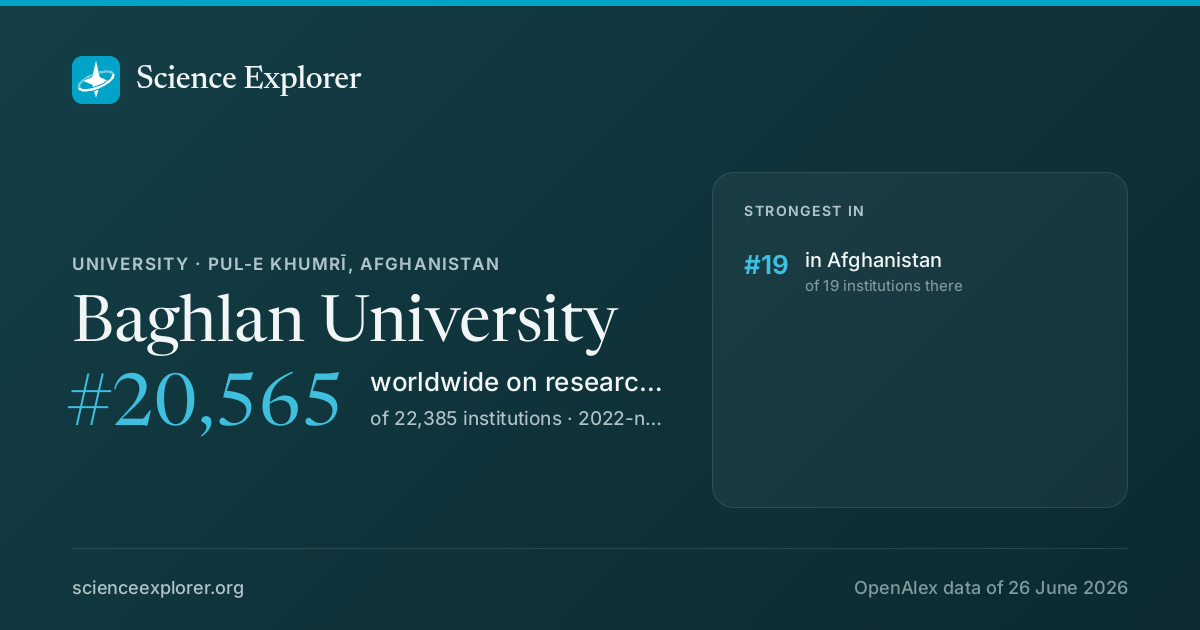
Baghlan University on Science Explorer

A card with Baghlan University's standing and the fields it leads in, for a post or a slide. A link to this page previews as the same card.

Download the card

1200 × 630 PNG, sized for social posts, drawn from the latest snapshot.

Badges for a website1Each links back here and updates with every snapshot

Research measures only: rankings here say nothing about teaching, admissions or student experience. Comparable institutions and collaboration partners have tabs of their own, above.

Discussion

Ask a question or share a note about Baghlan University. Posts are plain text and can be reported.