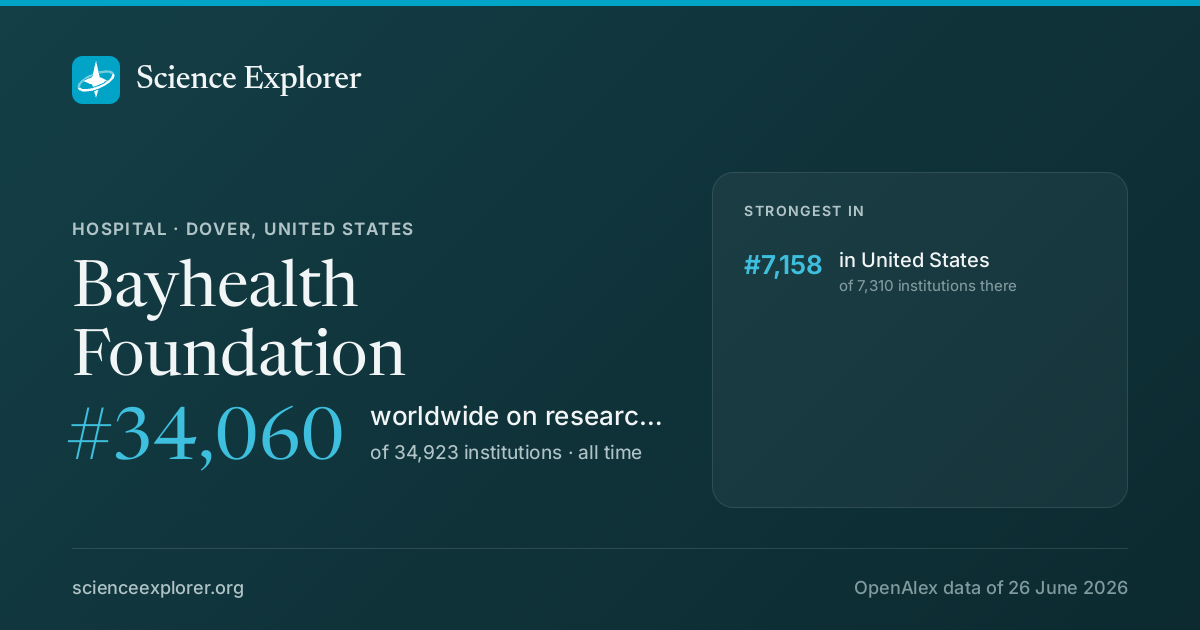
- World rank, all time
- #34,060 of 34,923
- Rank in United States
- #7,158 of 7,310
- Research works
- 138 ▲ 627% vs 2018-21
- Citations
- 683 4.9 per fractional work
- Top-10% rate
- 7.1% all institutions 10.0%
- vs its own fields
- 0.87× 1.00× is exactly expected
- Open access
- 47% world 40%
- International
- 11% world 18%
Which fields of science does Bayhealth Foundation work in?
In 2022-now, 84% of research at Bayhealth Foundation is in Health Sciences, 8% in Life Sciences. Its largest fields are Medicine (76%), Biochemistry, Genetics and Molecular Biology (7%), Health Professions (5%). It does 3.2× the world's share of Health Sciences.
Each ring splits the one inside it: the four domains of science, their fields, their subfields. Size is fractional works in 2022-now. Every slice is a page; the interactive view zooms down to single topics and colours each by how much more of it this institution does than the world.
Its 4 domains and 18 fields, with their numbers
- Health Sciences6083.8%
- Medicine5476.3%
- Health Professions45.0%
- Nursing11.7%
- Veterinary00.5%
- Dentistry00.2%
- Life Sciences67.8%
- Social Sciences56.7%
- Physical Sciences11.7%
- Engineering10.9%
- Computer Science10.8%
- Environmental Science00.1%
Field profile
Location quotient across every field it publishes in: outside the ring is more than an institution of this size would be expected to publish, inside it is less.
Rings at 0.5×, 1× and 2×. Widest outward: Medicine, 4.0×. Every wedge is a field page.
All 18 fields, with their numbers
- Medicine3.97×54 works
- Nursing3.44×1 works
- Veterinary3.44×0 works
- Health Professions1.91×4 works
- Biochemistry, Genetics and Molecular Biology1.31×5 works
- Economics, Econometrics and Finance1.07×2 works
- Dentistry0.48×0 works
- Decision Sciences0.48×0 works
- Pharmacology, Toxicology and Pharmaceutics0.33×0 works
- Psychology0.32×1 works
- Immunology and Microbiology0.30×0 works
- Business, Management and Accounting0.29×1 works
- Neuroscience0.17×0 works
- Social Sciences0.16×2 works
- Computer Science0.10×0 works
- Engineering0.06×1 works
- Agricultural and Biological Sciences0.02×0 works
- Environmental Science0.02×0 works
- Medicine 4.0×
- Nursing 3.4×
- Veterinary 3.4×
- Health Professions 1.9×
- Biochemistry, Genetics and Molecular Biology 1.3×
- Economics, Econometrics and Finance 1.1×
- Dentistry 0.5×
- Decision Sciences 0.5×
- Pharmacology, Toxicology and Pharmaceutics 0.3×
- Psychology 0.3×
- Immunology and Microbiology 0.3×
- Business, Management and Accounting 0.3×
- Neuroscience 0.2×
- Social Sciences 0.2×
- Computer Science 0.1×
- Engineering 0.1×
- Agricultural and Biological Sciences 0.0×
- Environmental Science 0.0×
Who are the top researchers at Bayhealth Foundation?
Ranked on the quality score, Rishi Sawhney, Rohab Sohail and Ridda Khattak lead among researchers whose main affiliation is Bayhealth Foundation.
- 1
Rishi Sawhney
 United States · #3,170,998 worldwide
458 citations · 25 works
- 2
Rohab Sohail
United States · #3,357,785 worldwide
379 citations · 48 works
- 3
Ridda Khattak
United States · #4,550,463 worldwide
0 citations · 19 works
- 4
Kelly Gardner
United States · #4,718,878 worldwide
79 citations · 41 works
Which keywords describe research at Bayhealth Foundation?
By fractional works in 2022-now, weighted toward what it does more of than the world: Diagnosis, Epidemiology, Complications, Management, Prognosis, Chemotherapy, Surgical Management and Immunotherapy.
- Antifungal Therapy
- Critical Care
- Quality Improvement
- Breast Cancer
- Pancreatic Cancer
- Echocardiography
- Parkinson's Disease
- Ion Channels
- Pregnancy
- Survival Analysis
- Genetic Mutations
- Endoscopic Stenting
- Heart Failure
- Prognostic Factors
- Primary Care
- Treatment
- Prognosis
- Chemotherapy
- Complications
- Diagnosis
- Epidemiology
- Inflammation
- Management
- Immunotherapy
- Surgical Management
- Risk Factors
- Clinical Trials
- Tumor Microenvironment
- Surgery
- Esophageal Perforation
- Targeted Therapy
- Guidelines
- Children
- Neuroimaging
- Sudden Cardiac Death
- Neoadjuvant Therapy
- Arrhythmias
- Diabetes Mellitus
- Thrombosis
- Genetic Testing
Size is fractional works in 2022-now in the topics tagged with each word; colour is the word's share of this institution's work against its share of the world's. The 40 words are chosen for being large and distinctive. Each links to the topic it comes from most.
All 40 words, with their numbers
- Epidemiology7▲ 2.4×33 topics
- Diagnosis5▲ 7.0×14 topics
- Inflammation4▲ 2.9×18 topics
- Complications4▲ 10×11 topics
- Management4▲ 6.4×12 topics
- Chemotherapy3▲ 6.2×11 topics
- Immunotherapy3▲ 6.0×9 topics
- Prognosis3▲ 12×7 topics
- Surgical Management3▲ 9.7×6 topics
- Treatment3▲ 3.2×13 topics
- Risk Factors3▲ 3.3×14 topics
- Primary Care2▲ 9.6×5 topics
- Clinical Trials2▲ 4.9×8 topics
- Prognostic Factors2▲ 7.5×7 topics
- Tumor Microenvironment2▲ 7.0×5 topics
- Heart Failure2▲ 6.8×7 topics
- Surgery2▲ 9.0×7 topics
- Endoscopic Stenting2▲ 63×1 topic
- Esophageal Perforation2▲ 63×1 topic
- Genetic Mutations2▲ 6.5×6 topics
- Targeted Therapy2▲ 12×3 topics
- Survival Analysis2▲ 9.1×4 topics
- Guidelines2▲ 5.0×6 topics
- Pregnancy2▲ 11×5 topics
- Children2▲ 10×2 topics
- Ion Channels2▲ 20×3 topics
- Neuroimaging2▲ 8.1×6 topics
- Parkinson's Disease2▲ 8.9×5 topics
- Sudden Cardiac Death2▲ 26×2 topics
- Echocardiography2▲ 7.5×4 topics
- Neoadjuvant Therapy2▲ 9.1×5 topics
- Pancreatic Cancer2▲ 19×2 topics
- Arrhythmias1▲ 21×2 topics
- Breast Cancer1▲ 7.6×5 topics
- Diabetes Mellitus1▲ 9.4×4 topics
- Quality Improvement1▲ 10×3 topics
- Thrombosis1▲ 7.0×5 topics
- Critical Care1▲ 7.7×4 topics
- Genetic Testing1▲ 16×2 topics
- Antifungal Therapy1▲ 20×3 topics
Which research topics does Bayhealth Foundation publish most on?
By volume in 2022-now: Esophageal and GI Pathology, Cardiac electrophysiology and arrhythmias, Nutrition and Health in Aging and Primary Care and Health Outcomes.
Area is fractional works; colour is the subfield each topic belongs to.
- 1 Esophageal and GI Pathology Surgery 2 works
- 2 Cardiac electrophysiology and arrhythmias Cardiology and Cardiovascular Medicine 1 works
- 3 Nutrition and Health in Aging Physiology 1 works
- 4 Primary Care and Health Outcomes General Health Professions 1 works
- 5 Healthcare Policy and Management Economics and Econometrics 1 works
- 6 Gastrointestinal disorders and treatments Surgery 1 works
- 7 Cancer Genomics and Diagnostics Cancer Research 1 works
- 8 Tracheal and airway disorders Pulmonary and Respiratory Medicine 1 works
- 9 Gastrointestinal Bleeding Diagnosis and Treatment Gastroenterology 1 works
- 10 Gastrointestinal Tumor Research and Treatment Gastroenterology 1 works
How open and international is its research?
Against the world's own shares: the tick on each track. Both are shares of its output, so they sit on one scale and can be read against each other as well as against the world.
World: 40% of research is openly available.
World: 18% is written across borders.
How has Bayhealth Foundation's research output changed?
Output in 2022-2025 was 627% higher than in 2018-2021.
The same series as a ribbon: one cell per year, darker for more. The line above answers how much; this answers when.
Its share of all research
Growing output can still be a shrinking share: all of science grows. This is Bayhealth Foundation as a percentage of every work published that year, 0.00029% in 2024.
Fractional works of Bayhealth Foundation over all fractional works that year. How the balance of science has shifted.
Other research institutions in Dover
- Delaware State University
- Delaware Division of Libraries
- Wesley College
- ILC Dover (United States)
- Delaware Division of Public Health
- Delaware Technical Community College
- Delaware Department of Natural Resources and Environmental Control
- Delaware General Assembly


Share Bayhealth Foundation's ranking
Badges for a website1Each links back here and updates with every snapshot

Research measures only: rankings here say nothing about teaching, admissions or student experience. Comparable institutions and collaboration partners have tabs of their own, above.
Discussion
Ask a question or share a note about Bayhealth Foundation. Keep it to the research: no personal attacks, advertising or links. Any reader can report a post, which collapses it for everyone until it is opened.