Science Explorer Back to mapMap
Discussion
Company · San Jose · United States

Brocade (United States)

In research, Brocade (United States) stands highest in Physical Sciences (#16,252 of 17,446 worldwide), over all time.

World rank, all time
#21,707
of 34,923
Rank in United States
#4,497
of 7,310
Research works
351
▲ 32% vs 2018-21
Citations
5.7k
16.2 per fractional work
Top-10% rate
7.5%
all institutions 10.0%
vs its own fields
0.87×
1.00× is exactly expected
Open access
26%
world 40%
International
35%
world 18%

What is Brocade (United States) known for in research?

The fields where it stands highest, over all time, ranked among every institution above the floor in each field.

FieldWorld rankWhere that sitsTop-10% rateWorks
Physical SciencesDomain #16,252 of 17,446 9.1%138

Each strip is that field's whole ranked pool, with the notch where Brocade (United States) sits in it, in the colour of the band that rank falls in. The track under the rate is the rate itself: it carries no average mark, because the average differs by field (from about 6% in Dentistry to 21% in Economics).

Which fields of science does Brocade (United States) work in?

In 2022-now, 48% of research at Brocade (United States) is in Social Sciences, 24% in Health Sciences. Its largest fields are Social Sciences (27%), Medicine (18%), Arts and Humanities (11%). It does 1.7× the world's share of Social Sciences.

Social Sciences: 16 fractional works · 47.7% of its workSocial Sciences: 9 fractional works · 26.6% of its workSociology and Political Science: 2 fractional works · 6.6% of its workPolitical Science and International Relations: 2 fractional works · 5.7% of its workEducation: 2 fractional works · 4.9% of its workDemography: 1 fractional works · 3.0% of its workGeneral Social Sciences: 1 fractional works · 2.0% of its workAnthropology: 1 fractional works · 1.7% of its workUrban Studies: 0 fractional works · 1.3% of its workLaw: 0 fractional works · 0.5% of its workDevelopment: 0 fractional works · 0.3% of its workTransportation: 0 fractional works · 0.3% of its workSmaller subfields together: 0 fractional works · 0.1% of its workArts and Humanities: 4 fractional works · 10.8% of its workLanguage and Linguistics: 1 fractional works · 3.0% of its workVisual Arts and Performing Arts: 1 fractional works · 2.5% of its workHistory and Philosophy of Science: 1 fractional works · 1.7% of its workMuseology: 0 fractional works · 1.3% of its workMusic: 0 fractional works · 1.0% of its workLiterature and Literary Theory: 0 fractional works · 0.6% of its workHistory: 0 fractional works · 0.4% of its workPhilosophy: 0 fractional works · 0.4% of its workPsychology: 2 fractional works · 5.5% of its workSocial Psychology: 1 fractional works · 3.0% of its workExperimental and Cognitive Psychology: 0 fractional works · 1.3% of its workDevelopmental and Educational Psychology: 0 fractional works · 1.0% of its workClinical Psychology: 0 fractional works · 0.3% of its workSmaller subfields together: 0 fractional works · 0.0% of its workBusiness, Management and Accounting: 1 fractional works · 3.0% of its workManagement Information Systems: 1 fractional works · 3.0% of its workEconomics, Econometrics and Finance: 0 fractional works · 1.1% of its workEconomics and Econometrics: 0 fractional works · 1.1% of its workDecision Sciences: 0 fractional works · 0.7% of its workInformation Systems and Management: 0 fractional works · 0.4% of its workStatistics, Probability and Uncertainty: 0 fractional works · 0.3% of its workSmaller subfields together: 0 fractional works · 0.0% of its workHealth Sciences: 8 fractional works · 24.5% of its workMedicine: 6 fractional works · 18.5% of its workCardiology and Cardiovascular Medicine: 2 fractional works · 4.4% of its workEpidemiology: 1 fractional works · 4.0% of its workPublic Health, Environmental and Occupational Health: 1 fractional works · 2.5% of its workPulmonary and Respiratory Medicine: 1 fractional works · 2.2% of its workReproductive Medicine: 0 fractional works · 1.0% of its workSurgery: 0 fractional works · 0.9% of its workDermatology: 0 fractional works · 0.8% of its workPhysiology: 0 fractional works · 0.7% of its workNeurology: 0 fractional works · 0.4% of its workPsychiatry and Mental health: 0 fractional works · 0.4% of its workComplementary and alternative medicine: 0 fractional works · 0.3% of its workGenetics: 0 fractional works · 0.2% of its workImmunology and Allergy: 0 fractional works · 0.2% of its workUrology: 0 fractional works · 0.2% of its workSmaller subfields together: 0 fractional works · 0.2% of its workHealth Professions: 2 fractional works · 5.6% of its workGeneral Health Professions: 2 fractional works · 4.9% of its workHealth Information Management: 0 fractional works · 0.7% of its workDentistry: 0 fractional works · 0.4% of its workOral Surgery: 0 fractional works · 0.4% of its workPhysical Sciences: 7 fractional works · 19.8% of its workEnvironmental Science: 2 fractional works · 6.7% of its workManagement, Monitoring, Policy and Law: 1 fractional works · 3.7% of its workEcology: 1 fractional works · 1.9% of its workIndustrial and Manufacturing Engineering: 0 fractional works · 0.7% of its workNature and Landscape Conservation: 0 fractional works · 0.3% of its workEngineering: 2 fractional works · 5.2% of its workElectrical and Electronic Engineering: 1 fractional works · 1.9% of its workControl and Systems Engineering: 0 fractional works · 1.0% of its workMechanical Engineering: 0 fractional works · 0.7% of its workComputational Mechanics: 0 fractional works · 0.4% of its workBuilding and Construction: 0 fractional works · 0.3% of its workCivil and Structural Engineering: 0 fractional works · 0.3% of its workIndustrial and Manufacturing Engineering: 0 fractional works · 0.3% of its workBiomedical Engineering: 0 fractional works · 0.3% of its workSmaller subfields together: 0 fractional works · 0.0% of its workMaterials Science: 1 fractional works · 2.6% of its workElectronic, Optical and Magnetic Materials: 0 fractional works · 1.0% of its workMaterials Chemistry: 0 fractional works · 0.8% of its workPolymers and Plastics: 0 fractional works · 0.7% of its workSmaller subfields together: 0 fractional works · 0.1% of its workComputer Science: 1 fractional works · 2.4% of its workHuman-Computer Interaction: 0 fractional works · 1.0% of its workArtificial Intelligence: 0 fractional works · 0.5% of its workComputer Networks and Communications: 0 fractional works · 0.5% of its workInformation Systems: 0 fractional works · 0.4% of its workEnergy: 1 fractional works · 1.7% of its workRenewable Energy, Sustainability and the Environment: 0 fractional works · 1.3% of its workGeneral Energy: 0 fractional works · 0.4% of its workSmaller subfields together: 0 fractional works · 0.0% of its workEarth and Planetary Sciences: 0 fractional works · 1.0% of its workGeophysics: 0 fractional works · 0.7% of its workAtmospheric Science: 0 fractional works · 0.3% of its workChemistry: 0 fractional works · 0.3% of its workElectrochemistry: 0 fractional works · 0.3% of its workLife Sciences: 3 fractional works · 8.0% of its workAgricultural and Biological Sciences: 1 fractional works · 2.5% of its workFood Science: 0 fractional works · 1.0% of its workGeneral Agricultural and Biological Sciences: 0 fractional works · 0.8% of its workForestry: 0 fractional works · 0.5% of its workSmaller subfields together: 0 fractional works · 0.1% of its workNeuroscience: 1 fractional works · 2.2% of its workCognitive Neuroscience: 1 fractional works · 2.0% of its workSmaller subfields together: 0 fractional works · 0.2% of its workImmunology and Microbiology: 1 fractional works · 2.0% of its workParasitology: 0 fractional works · 1.5% of its workImmunology: 0 fractional works · 0.5% of its workBiochemistry, Genetics and Molecular Biology: 0 fractional works · 1.4% of its workCell Biology: 0 fractional works · 0.7% of its workMolecular Biology: 0 fractional works · 0.7% of its workALL ITS WORKBrocade (UnitedStates)34fractional works, 2022-now
Life Sciences8%Physical Sciences20%Health Sciences24%Social Sciences48%

Each ring splits the one inside it: the four domains of science, their fields, their subfields. Size is fractional works in 2022-now. Every slice is a page; the interactive view zooms down to single topics and colours each by how much more of it this institution does than the world.

Its 4 domains and 20 fields, with their numbers
    1. Social Sciences926.6%
    2. Arts and Humanities410.8%
    3. Psychology25.5%
    4. Business, Management and Accounting13.0%
    5. Economics, Econometrics and Finance01.1%
    6. Decision Sciences00.7%
    1. Medicine618.5%
    2. Health Professions25.6%
    3. Dentistry00.4%
    1. Environmental Science26.7%
    2. Engineering25.2%
    3. Materials Science12.6%
    4. Computer Science12.4%
    5. Energy11.7%
    6. Earth and Planetary Sciences01.0%
    7. Chemistry00.3%
    1. Agricultural and Biological Sciences12.5%
    2. Neuroscience12.2%
    3. Immunology and Microbiology12.0%
    4. Biochemistry, Genetics and Molecular Biology01.4%
All of science, and how each field's share has moved since 1950: the Science domain explorer

Field profile

Location quotient across every field it publishes in: outside the ring is more than an institution of this size would be expected to publish, inside it is less.

Agricultural and Biological Sciences: 0.51× its world share, 1 worksAgricultural and Bio…Biochemistry, Genetics and Molecular Biology: 0.26× its world share, 0 worksBiochemistry, Geneti…Immunology and Microbiology: 1.99× its world share, 1 worksImmunology and Micro…Neuroscience: 1.34× its world share, 1 worksNeuroscienceChemistry: 0.21× its world share, 0 worksChemistryComputer Science: 0.31× its world share, 1 worksComputer ScienceEarth and Planetary Sciences: 0.63× its world share, 0 worksEarth and Planetary …Energy: 1.83× its world share, 1 worksEnergyEngineering: 0.34× its world share, 2 worksEngineeringEnvironmental Science: 1.34× its world share, 2 worksEnvironmental ScienceMaterials Science: 0.74× its world share, 1 worksMaterials ScienceDentistry: 0.81× its world share, 0 worksDentistryHealth Professions: 2.13× its world share, 2 worksHealth ProfessionsMedicine: 0.96× its world share, 6 worksMedicineArts and Humanities: 3.74× its world share, 4 worksArts and HumanitiesBusiness, Management and Accounting: 0.92× its world share, 1 worksBusiness, Management…Decision Sciences: 0.72× its world share, 0 worksDecision SciencesEconomics, Econometrics and Finance: 0.52× its world share, 0 worksEconomics, Econometr…Psychology: 1.82× its world share, 2 worksPsychologySocial Sciences: 2.10× its world share, 9 worksSocial Sciences1×world share
more than its size predictsabout as predictedless

Rings at 0.5×, 1× and 2×. Widest outward: Arts and Humanities, 3.7×. Every wedge is a field page.

All 20 fields, with their numbers
  1. Arts and Humanities3.74×4 works
  2. Health Professions2.13×2 works
  3. Social Sciences2.10×9 works
  4. Immunology and Microbiology1.99×1 works
  5. Energy1.83×1 works
  6. Psychology1.82×2 works
  7. Neuroscience1.34×1 works
  8. Environmental Science1.34×2 works
  9. Medicine0.96×6 works
  10. Business, Management and Accounting0.92×1 works
  11. Dentistry0.81×0 works
  12. Materials Science0.74×1 works
  13. Decision Sciences0.72×0 works
  14. Earth and Planetary Sciences0.63×0 works
  15. Economics, Econometrics and Finance0.52×0 works
  16. Agricultural and Biological Sciences0.51×1 works
  17. Engineering0.34×2 works
  18. Computer Science0.31×1 works
  19. Biochemistry, Genetics and Molecular Biology0.26×0 works
  20. Chemistry0.21×0 works

Who are the top researchers at Brocade (United States)?

Ranked on the quality score, H. J. Kooreman, Jaap R. G. Gootjes and A. J. Zwart Voorspuij lead among researchers whose main affiliation is Brocade (United States).

  1. 1 H. J. Kooreman United States · #3,303,714 worldwide 220 citations · 16 works
  2. 2 Jaap R. G. Gootjes United States · #4,676,392 worldwide 334 citations · 39 works
  3. 3 A. J. Zwart Voorspuij United States · #4,883,909 worldwide 34 citations · 14 works
  4. 4 K.D. Jaitly United States · #5,374,263 worldwide 116 citations · 18 works
  5. 5 D.W.R. Hall United States · #5,451,483 worldwide 198 citations · 18 works
  6. 6 W. Hespe United States · #5,491,949 worldwide 566 citations · 41 works
  7. 7 Sunil Gopakumar United States · #5,701,600 worldwide 75 citations · 21 works
  8. 8 C. van der Stelt United States · #5,814,509 worldwide 94 citations · 26 works
All ranked researchers at Brocade (United States)

What are the most cited papers from Brocade (United States)?

The most cited paper from Brocade (United States) is "Penicillin Acylase in the Industrial Production of β-Lactam Antibiotics" (Alle Bruggink, Eric C. Roos, Erik de Vroom, 1998), with 315 citations. Next come "Scheduling and feedback co-design for networked control systems" (265) and "Glucose Uptake Kinetics and Transcription of HXTGenes in Chemostat Cultures of Saccharomyces cerevisiae" (254).

Most cited papers
#PaperReleasedCitations
1 Penicillin Acylase in the Industrial Production of β-Lactam Antibiotics Alle Bruggink, Eric C. Roos, Erik de Vroom · Organic Process Research & Development 28 Feb 1998 315
2 Scheduling and feedback co-design for networked control systems Michael S. Branicky, Stephen M. Phillips, Wei Zhang Conference paper 27 Aug 2003 265
3 Glucose Uptake Kinetics and Transcription of HXTGenes in Chemostat Cultures of Saccharomyces cerevisiae Jasper A. Diderich, Mike Schepper, Pim van Hoek et al. · Journal of Biological Chemistry Open access May 1999 254
4 PACP: An Efficient Pseudonymous Authentication-Based Conditional Privacy Protocol for VANETs Dijiang Huang, Satyajayant Misra, Mayank Verma et al. · IEEE Transactions on Intelligent Transportation Systems Sep 2011 241
5 IRIS – A Tool for Strategic Security Allocation in Transportation Networks Jason Tsai, Shyamsunder Rathi, Christopher D. Kiekintveld et al. · Cambridge University Press eBooks Book chapter 12 Dec 2011 217
All 60 most cited papers, with filters and sorting

Which keywords describe research at Brocade (United States)?

By fractional works in 2022-now, weighted toward what it does more of than the world: Public Health, Globalization, Sustainability, Healthcare Access, Rural Development, Neuroscience, Neoliberalism and Psychological Outcomes.

▲ more of its work than of the world's◆ about the world's share▼ less than the world's

Size is fractional works in 2022-now in the topics tagged with each word; colour is the word's share of this institution's work against its share of the world's. The 28 words are chosen for being large and distinctive. Each links to the topic it comes from most.

All 28 words, with their numbers
  1. Globalization3▲ 4.9×14 topics
  2. Public Health3▲ 6.5×11 topics
  3. Sustainability3▲ 3.6×11 topics
  4. Healthcare Access2▲ 17×3 topics
  5. Epidemiology1◆ 1.00×9 topics
  6. Rural Development1▲ 11×5 topics
  7. Biodiversity1▲ 4.7×5 topics
  8. Neoliberalism1▲ 9.6×4 topics
  9. Neuroscience1▲ 11×3 topics
  10. Global Burden1▲ 6.0×2 topics
  11. Organizational Culture1▲ 8.2×2 topics
  12. Patient Satisfaction1▲ 10×2 topics
  13. Psychological Outcomes1▲ 74×2 topics
  14. Teacher Training1▲ 5.5×4 topics
  15. Analytics1▲ 34×1 topic
  16. Barriers1▲ 36×1 topic
  17. Big Data1▲ 3.1×1 topic
  18. Chronic Hepatitis B1▲ 90×1 topic
  19. Cultural Diversity1▲ 13×1 topic
  20. Education1▲ 1.77×5 topics
  21. Educational Leadership1▲ 23×1 topic
  22. Educational Reform1▲ 25×2 topics
  23. Hepatitis B Virus1▲ 90×1 topic
  24. Innovation1▲ 2.9×4 topics
  25. Intergovernmental Relations1▲ 245×1 topic
  26. Multinational Federations1▲ 348×1 topic
  27. Public Policy1▲ 6.4×3 topics
  28. Quality of Service1▲ 31×1 topic

Which research topics does Brocade (United States) publish most on?

By volume in 2022-now: Hepatitis B Virus Studies, Healthcare Quality and Satisfaction, Political Systems and Governance and Big Data and Business Intelligence.

  1. 1 Hepatitis B Virus Studies Epidemiology 1 works
  2. 2 Healthcare Quality and Satisfaction General Health Professions 1 works
  3. 3 Political Systems and Governance Political Science and International Relations 1 works
  4. 4 Big Data and Business Intelligence Management Information Systems 1 works
  5. 5 Educational Leadership and Practices Education 1 works
  6. 6 Terrorism, Counterterrorism, and Political Violence Sociology and Political Science 1 works
  7. 7 Environmental Sustainability and Education Management, Monitoring, Policy and Law 1 works
  8. 8 ECG Monitoring and Analysis Cardiology and Cardiovascular Medicine 1 works
  9. 9 Atrial Fibrillation Management and Outcomes Cardiology and Cardiovascular Medicine 1 works
  10. 10 Music Therapy and Health Social Psychology 1 works

How open and international is its research?

Against the world's own shares: the tick on each track. Both are shares of its output, so they sit on one scale and can be read against each other as well as against the world.

openly available26.5%not open73.5%

World: 40% of research is openly available.

with international co-authors34.9%domestic only65.1%

World: 18% is written across borders.

How has Brocade (United States)'s research output changed?

Output in 2022-2025 was 32% higher than in 2018-2021.

still counting1990200020102020
grewheldshrank

The same series as a ribbon: one cell per year, darker for more. The line above answers how much; this answers when.

Its share of all research

Growing output can still be a shrinking share: all of science grows. This is Brocade (United States) as a percentage of every work published that year, 0.00015% in 2024.

still counting0.0010%0.0020%Brocade (United States)0.00011% in 202519801990200020102020

Fractional works of Brocade (United States) over all fractional works that year. How the balance of science has shifted.

Other research institutions in San Jose

All research institutions in San Jose

Share Brocade (United States)'s ranking
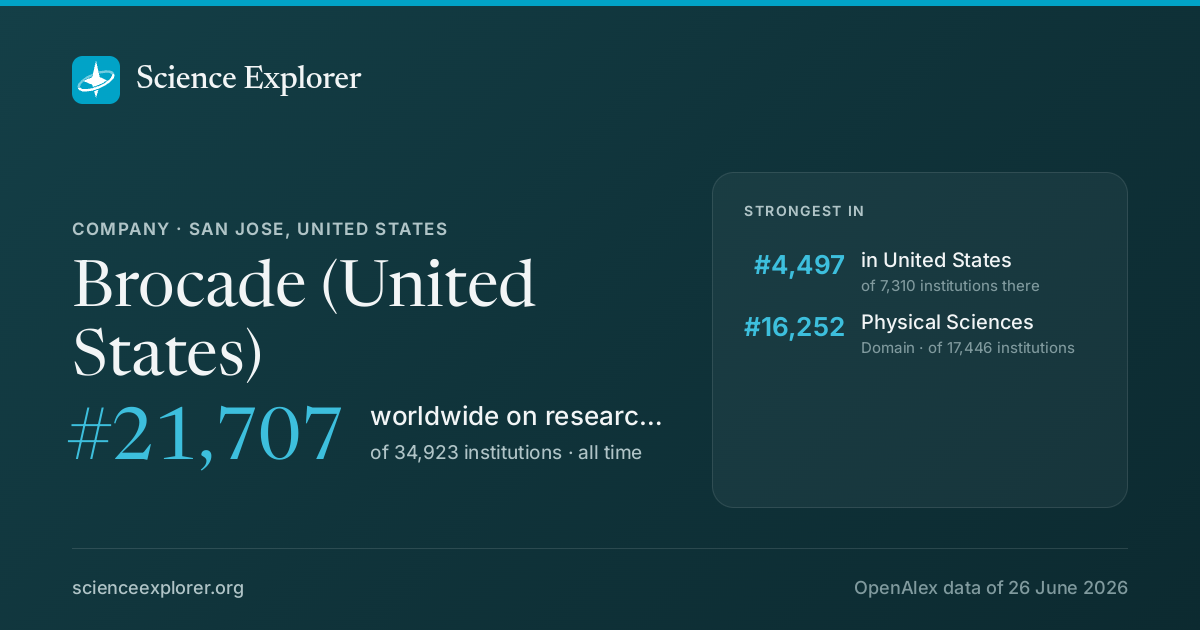
Brocade (United States) on Science Explorer

A card with Brocade (United States)'s standing and the fields it leads in, for a post or a slide. A link to this page previews as the same card.

Download the card

1200 × 630 PNG, sized for social posts, drawn from the latest snapshot.

Badges for a website1Each links back here and updates with every snapshot

Research measures only: rankings here say nothing about teaching, admissions or student experience. Comparable institutions and collaboration partners have tabs of their own, above.

Discussion

Ask a question or share a note about Brocade (United States). Keep it to the research: no personal attacks, advertising or links. Any reader can report a post, which collapses it for everyone until it is opened.