Science Explorer Back to mapMap
Discussion
Nonprofit · Brooklyn · United States

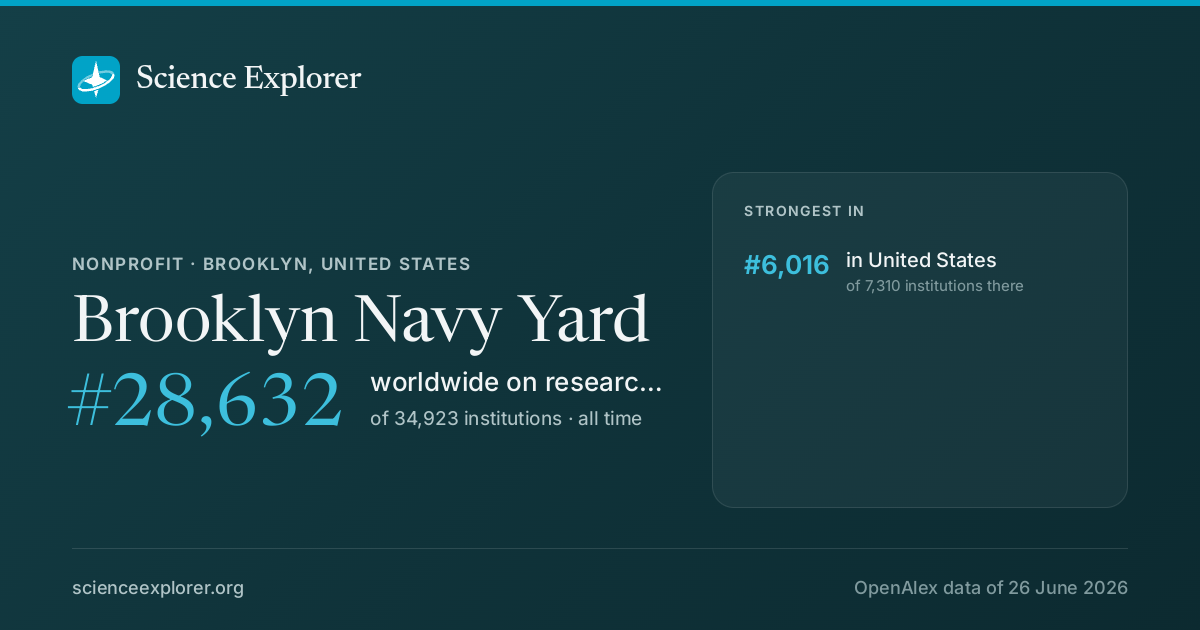
Brooklyn Navy Yard

World rank, all time
#28,632
of 34,923
Rank in United States
#6,016
of 7,310
Research works
153
▲ 129% vs 2018-21
Citations
1k
6.7 per fractional work
Top-10% rate
7.5%
all institutions 10.0%
vs its own fields
0.86×
1.00× is exactly expected
Open access
20%
world 40%
International
8%
world 18%

Which fields of science does Brooklyn Navy Yard work in?

In 2022-now, 47% of research at Brooklyn Navy Yard is in Social Sciences, 22% in Health Sciences. Its largest fields are Social Sciences (16%), Medicine (15%), Computer Science (11%). It does 1.6× the world's share of Social Sciences.

Social Sciences: 10 fractional works · 47.0% of its workSocial Sciences: 3 fractional works · 15.8% of its workSociology and Political Science: 2 fractional works · 8.0% of its workPolitical Science and International Relations: 1 fractional works · 5.8% of its workSafety Research: 0 fractional works · 1.2% of its workTransportation: 0 fractional works · 0.8% of its workEconomics, Econometrics and Finance: 2 fractional works · 8.6% of its workEconomics and Econometrics: 2 fractional works · 7.4% of its workFinance: 0 fractional works · 1.2% of its workArts and Humanities: 1 fractional works · 6.3% of its workHistory: 1 fractional works · 3.3% of its workArcheology: 0 fractional works · 2.5% of its workMuseology: 0 fractional works · 0.5% of its workPsychology: 1 fractional works · 6.3% of its workSocial Psychology: 1 fractional works · 4.6% of its workClinical Psychology: 0 fractional works · 1.6% of its workSmaller subfields together: 0 fractional works · 0.0% of its workDecision Sciences: 1 fractional works · 6.2% of its workManagement Science and Operations Research: 1 fractional works · 6.2% of its workBusiness, Management and Accounting: 1 fractional works · 3.8% of its workManagement Information Systems: 0 fractional works · 2.1% of its workStrategy and Management: 0 fractional works · 0.9% of its workAccounting: 0 fractional works · 0.8% of its workHealth Sciences: 4 fractional works · 21.6% of its workMedicine: 3 fractional works · 15.3% of its workPulmonary and Respiratory Medicine: 1 fractional works · 3.0% of its workOrthopedics and Sports Medicine: 0 fractional works · 2.5% of its workOncology: 0 fractional works · 2.3% of its workPublic Health, Environmental and Occupational Health: 0 fractional works · 1.5% of its workRheumatology: 0 fractional works · 1.4% of its workHematology: 0 fractional works · 1.1% of its workReproductive Medicine: 0 fractional works · 0.8% of its workCardiology and Cardiovascular Medicine: 0 fractional works · 0.5% of its workObstetrics and Gynecology: 0 fractional works · 0.5% of its workPediatrics, Perinatology and Child Health: 0 fractional works · 0.5% of its workDermatology: 0 fractional works · 0.3% of its workGenetics: 0 fractional works · 0.3% of its workRehabilitation: 0 fractional works · 0.2% of its workSmaller subfields together: 0 fractional works · 0.1% of its workHealth Professions: 1 fractional works · 5.8% of its workGeneral Health Professions: 1 fractional works · 2.9% of its workPhysical Therapy, Sports Therapy and Rehabilitation: 0 fractional works · 2.5% of its workOccupational Therapy: 0 fractional works · 0.3% of its workHealth Information Management: 0 fractional works · 0.2% of its workNursing: 0 fractional works · 0.5% of its workNutrition and Dietetics: 0 fractional works · 0.5% of its workPhysical Sciences: 4 fractional works · 21.1% of its workComputer Science: 2 fractional works · 10.7% of its workComputer Networks and Communications: 1 fractional works · 4.9% of its workArtificial Intelligence: 1 fractional works · 2.9% of its workInformation Systems: 0 fractional works · 1.6% of its workComputer Vision and Pattern Recognition: 0 fractional works · 0.8% of its workSoftware: 0 fractional works · 0.4% of its workEngineering: 2 fractional works · 9.0% of its workControl and Systems Engineering: 1 fractional works · 2.9% of its workAerospace Engineering: 0 fractional works · 1.6% of its workBuilding and Construction: 0 fractional works · 1.1% of its workAutomotive Engineering: 0 fractional works · 0.8% of its workIndustrial and Manufacturing Engineering: 0 fractional works · 0.8% of its workBiomedical Engineering: 0 fractional works · 0.7% of its workOcean Engineering: 0 fractional works · 0.5% of its workElectrical and Electronic Engineering: 0 fractional works · 0.4% of its workSmaller subfields together: 0 fractional works · 0.0% of its workEnvironmental Science: 0 fractional works · 1.3% of its workHealth, Toxicology and Mutagenesis: 0 fractional works · 0.8% of its workManagement, Monitoring, Policy and Law: 0 fractional works · 0.5% of its workEarth and Planetary Sciences: 0 fractional works · 0.0% of its workLife Sciences: 2 fractional works · 10.3% of its workBiochemistry, Genetics and Molecular Biology: 1 fractional works · 5.0% of its workMolecular Biology: 0 fractional works · 1.9% of its workCancer Research: 0 fractional works · 1.9% of its workGenetics: 0 fractional works · 1.0% of its workSmaller subfields together: 0 fractional works · 0.2% of its workNeuroscience: 1 fractional works · 4.9% of its workCognitive Neuroscience: 1 fractional works · 4.9% of its workImmunology and Microbiology: 0 fractional works · 0.3% of its workImmunology: 0 fractional works · 0.3% of its workALL ITS WORKBrooklyn NavyYard20fractional works, 2022-now
Life Sciences10%Physical Sciences21%Health Sciences22%Social Sciences47%

Each ring splits the one inside it: the four domains of science, their fields, their subfields. Size is fractional works in 2022-now. Every slice is a page; the interactive view zooms down to single topics and colours each by how much more of it this institution does than the world.

Its 4 domains and 16 fields, with their numbers
    1. Social Sciences315.8%
    2. Economics, Econometrics and Finance28.6%
    3. Arts and Humanities16.3%
    4. Psychology16.3%
    5. Decision Sciences16.2%
    6. Business, Management and Accounting13.8%
    1. Medicine315.3%
    2. Health Professions15.8%
    3. Nursing00.5%
    1. Computer Science210.7%
    2. Engineering29.0%
    3. Environmental Science01.3%
    4. Earth and Planetary Sciences00.0%
    1. Biochemistry, Genetics and Molecular Biology15.0%
    2. Neuroscience14.9%
    3. Immunology and Microbiology00.3%
All of science, and how each field's share has moved since 1950: the Science domain explorer

Field profile

Location quotient across every field it publishes in: outside the ring is more than an institution of this size would be expected to publish, inside it is less.

Biochemistry, Genetics and Molecular Biology: 0.95× its world share, 1 worksBiochemistry, Geneti…Immunology and Microbiology: 0.27× its world share, 0 worksImmunology and Micro…Neuroscience: 3.04× its world share, 1 worksNeuroscienceComputer Science: 1.38× its world share, 2 worksComputer ScienceEarth and Planetary Sciences: 0.03× its world share, 0 worksEarth and Planetary …Engineering: 0.60× its world share, 2 worksEngineeringEnvironmental Science: 0.27× its world share, 0 worksEnvironmental ScienceHealth Professions: 2.21× its world share, 1 worksHealth ProfessionsMedicine: 0.79× its world share, 3 worksMedicineNursing: 1.12× its world share, 0 worksNursingArts and Humanities: 2.19× its world share, 1 worksArts and HumanitiesBusiness, Management and Accounting: 1.18× its world share, 1 worksBusiness, Management…Decision Sciences: 6.39× its world share, 1 worksDecision SciencesEconomics, Econometrics and Finance: 4.04× its world share, 2 worksEconomics, Econometr…Psychology: 2.07× its world share, 1 worksPsychologySocial Sciences: 1.25× its world share, 3 worksSocial Sciences1×world share
more than its size predictsabout as predictedless

Rings at 0.5×, 1× and 2×. Widest outward: Decision Sciences, 6.4×. Every wedge is a field page.

All 16 fields, with their numbers
  1. Decision Sciences6.39×1 works
  2. Economics, Econometrics and Finance4.04×2 works
  3. Neuroscience3.04×1 works
  4. Health Professions2.21×1 works
  5. Arts and Humanities2.19×1 works
  6. Psychology2.07×1 works
  7. Computer Science1.38×2 works
  8. Social Sciences1.25×3 works
  9. Business, Management and Accounting1.18×1 works
  10. Nursing1.12×0 works
  11. Biochemistry, Genetics and Molecular Biology0.95×1 works
  12. Medicine0.79×3 works
  13. Engineering0.60×2 works
  14. Immunology and Microbiology0.27×0 works
  15. Environmental Science0.27×0 works
  16. Earth and Planetary Sciences0.03×0 works

Who are the top researchers at Brooklyn Navy Yard?

Ranked on the quality score, Alvin D. Delman, C. Huey and T.I. Monahan lead among researchers whose main affiliation is Brooklyn Navy Yard.

  1. 1 Alvin D. Delman United States · #2,968,764 worldwide 348 citations · 23 works
  2. 2 C. Huey United States · #4,071,165 worldwide 156 citations · 34 works
  3. 3 T.I. Monahan United States · #4,539,092 worldwide 75 citations · 17 works
  4. 4 W.L. Derksen United States · #4,701,881 worldwide 71 citations · 18 works
All ranked researchers at Brooklyn Navy Yard

What are the most cited papers from Brooklyn Navy Yard?

The most cited paper from Brooklyn Navy Yard is "Privacy and authentication: An introduction to cryptography" (Whitfield Diffie, Martin E. Hellman, 1979), with 472 citations. Next come "Uncovering productive morphosyntax in French-learning toddlers: a multidimensional methodology perspective" (45) and "Complexes of nickel(II) with substituted thioureas" (37).

Most cited papers
#PaperReleasedCitations
1 Privacy and authentication: An introduction to cryptography Whitfield Diffie, Martin E. Hellman · Proceedings of the IEEE 1979 472
2 Uncovering productive morphosyntax in French-learning toddlers: a multidimensional methodology perspective Isabelle Barrière, Louise Goyet, Sarah Kresh et al. · Journal of Child Language 21 Oct 2015 45
3 Complexes of nickel(II) with substituted thioureas R. A. Bailey, Terry Roy Peterson · Canadian Journal of Chemistry Open access 15 Oct 1968 37
4 Synthesis and Thermal Stability of Structurally Related Aromatic Schiff Bases and Acid Amides Alvin D. Delman, A. A. Stein, Bernard B. Simms · Journal of Macromolecular Science Part A - Chemistry 1967 33
5 Automatic Recording Reflectometer for Measuring Diffuse Reflectance in the Visible and Infrared Regions W.L. Derksen, T.I. Monahan, Alfred J. Lawes · Journal of the Optical Society of America Nov 1957 29
All 60 most cited papers, with filters and sorting

Which keywords describe research at Brooklyn Navy Yard?

By fractional works in 2022-now, weighted toward what it does more of than the world: Risk Management, Supply Chain Management, Ethnicity, Economic Growth, Catastrophe Bonds, Construction Projects, Insurance and Project Success.

▲ more of its work than of the world's◆ about the world's share▼ less than the world's

Size is fractional works in 2022-now in the topics tagged with each word; colour is the word's share of this institution's work against its share of the world's. The 14 words are chosen for being large and distinctive. Each links to the topic it comes from most.

All 14 words, with their numbers
  1. Risk Management2▲ 21×2 topics
  2. Deep Learning1▲ 1.91×4 topics
  3. Supply Chain Management1▲ 7.3×2 topics
  4. Economic Growth1▲ 7.1×2 topics
  5. Ethnicity1▲ 15×2 topics
  6. Big Data1▲ 5.6×4 topics
  7. Catastrophe Bonds1▲ 127×1 topic
  8. Construction Projects1▲ 111×1 topic
  9. Identity1▲ 6.8×1 topic
  10. Insurance1▲ 66×1 topic
  11. Machine Learning1▲ 1.48×3 topics
  12. Project Success1▲ 125×1 topic
  13. Sustainable Development1▲ 3.2×4 topics
  14. Youth1▲ 35×1 topic

Which research topics does Brooklyn Navy Yard publish most on?

By volume in 2022-now: Insurance and Financial Risk Management, Sociopolitical Dynamics in Russia, Construction Project Management and Performance and Network Security and Intrusion Detection.

  1. 1 Insurance and Financial Risk Management Economics and Econometrics 1 works
  2. 2 Sociopolitical Dynamics in Russia Sociology and Political Science 1 works
  3. 3 Construction Project Management and Performance Management Science and Operations Research 1 works
  4. 4 Network Security and Intrusion Detection Computer Networks and Communications 1 works
  5. 5 Sports Performance and Training Orthopedics and Sports Medicine 0 works
  6. 6 Sports and Physical Education Research Physical Therapy, Sports Therapy and Rehabilitation 0 works
  7. 7 EEG and Brain-Computer Interfaces Cognitive Neuroscience 0 works
  8. 8 Psychology of Moral and Emotional Judgment Cognitive Neuroscience 0 works
  9. 9 Cancer Genomics and Diagnostics Cancer Research 0 works
  10. 10 Central Asia Education and Culture Political Science and International Relations 0 works

How open and international is its research?

Against the world's own shares: the tick on each track. Both are shares of its output, so they sit on one scale and can be read against each other as well as against the world.

openly available20.3%not open79.7%

World: 40% of research is openly available.

with international co-authors8.4%domestic only91.6%

World: 18% is written across borders.

How has Brooklyn Navy Yard's research output changed?

Output in 2022-2025 was 129% higher than in 2018-2021.

still counting1990200020102020
grewheldshrank

The same series as a ribbon: one cell per year, darker for more. The line above answers how much; this answers when.

Its share of all research

Growing output can still be a shrinking share: all of science grows. This is Brooklyn Navy Yard as a percentage of every work published that year, 0.000069% in 2024.

still counting0.0010%0.0020%Brooklyn Navy Yard0.00012% in 202519801990200020102020

Fractional works of Brooklyn Navy Yard over all fractional works that year. How the balance of science has shifted.

Other research institutions in Brooklyn

All research institutions in Brooklyn

Share Brooklyn Navy Yard's ranking

Brooklyn Navy Yard on Science Explorer

A card with Brooklyn Navy Yard's standing and the fields it leads in, for a post or a slide. A link to this page previews as the same card.

Download the card

1200 × 630 PNG, sized for social posts, drawn from the latest snapshot.

Badges for a website1Each links back here and updates with every snapshot

Research measures only: rankings here say nothing about teaching, admissions or student experience. Comparable institutions and collaboration partners have tabs of their own, above.

Discussion

Ask a question or share a note about Brooklyn Navy Yard. Posts are plain text and can be reported.