Science Explorer Back to mapMap
Company · Montreal · Canada

CAE (Canada)

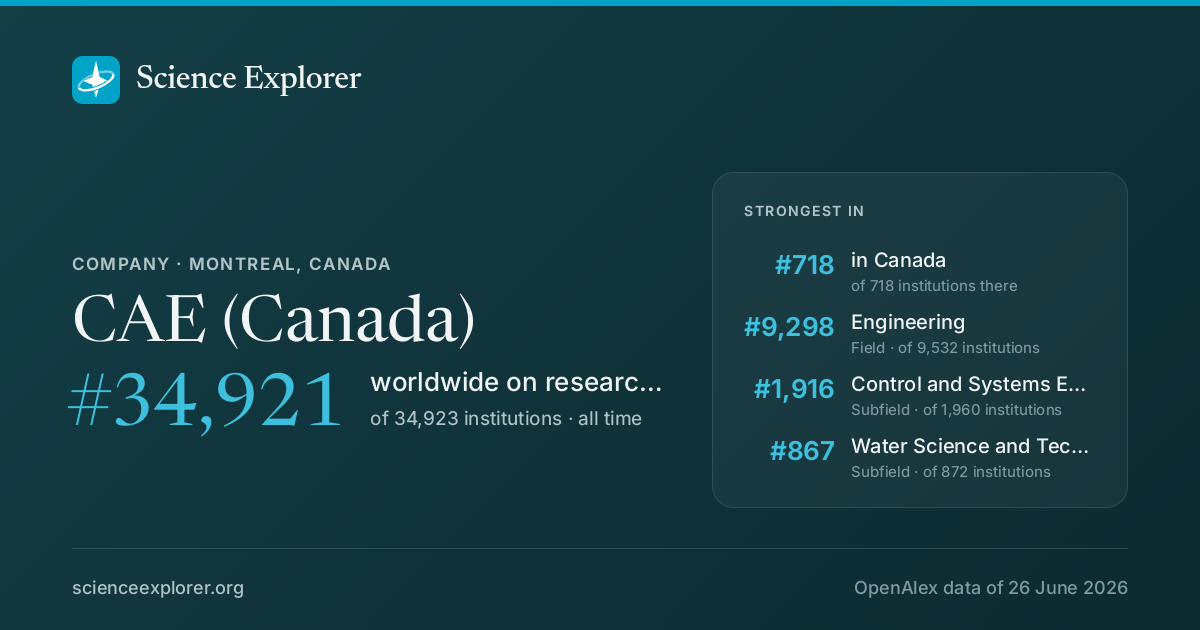
In research, CAE (Canada) stands highest in Engineering (#9,298 of 9,532 worldwide), Control and Systems Engineering (#1,916 of 1,960 worldwide) and Water Science and Technology (#867 of 872 worldwide), over all time.

World rank, all time
#34,921
of 34,923
Rank in Canada
#718
of 718
Research works
10k
▲ 16% vs 2018-21
Citations
12k
1.2 per fractional work
Top-10% rate
8.6%
all institutions 10.0%
vs its own fields
0.08×
1.00× is exactly expected
Open access
1%
world 40%
International
2%
world 18%

What is CAE (Canada) known for in research?

The fields where it stands highest, over all time, ranked among every institution above the floor in each field.

FieldWorld rankWhere that sitsTop-10% rateWorks
EngineeringField #9,298 of 9,532 7.7%2,795
Control and Systems EngineeringSubfield #1,916 of 1,960 5.3%558
Water Science and TechnologySubfield #867 of 872 6.9%168
Mechanics of MaterialsSubfield #1,469 of 1,474 9.4%249
Safety, Risk, Reliability and QualitySubfield #423 of 424 7.8%130
Complementary and alternative medicineSubfield #469 of 470 8.3%159
Aerospace EngineeringSubfield #1,599 of 1,601 8.2%150
Mechanical EngineeringSubfield #2,523 of 2,525 8.6%387
Biomedical EngineeringSubfield #2,562 of 2,564 7.8%255
Materials ChemistrySubfield #2,611 of 2,613 8.0%340

Each strip is that field's whole ranked pool, with the notch where CAE (Canada) sits in it, in the colour of the band that rank falls in. The track under the rate is the rate itself: it carries no average mark, because the average differs by field (from about 6% in Dentistry to 21% in Economics).

Which fields of science does CAE (Canada) work in?

In 2022-now, 48% of research at CAE (Canada) is in Health Sciences, 27% in Physical Sciences. Its largest fields are Medicine (44%), Engineering (10%), Biochemistry, Genetics and Molecular Biology (8%). It does 1.8× the world's share of Health Sciences.

Health Sciences: 17 fractional works · 47.7% of its workMedicine: 15 fractional works · 44.2% of its workSurgery: 2 fractional works · 6.8% of its workCardiology and Cardiovascular Medicine: 2 fractional works · 4.3% of its workOncology: 1 fractional works · 3.6% of its workEpidemiology: 1 fractional works · 3.4% of its workPulmonary and Respiratory Medicine: 1 fractional works · 2.7% of its workRadiology, Nuclear Medicine and Imaging: 1 fractional works · 2.2% of its workComplementary and alternative medicine: 1 fractional works · 2.0% of its workNeurology: 1 fractional works · 1.7% of its workInfectious Diseases: 0 fractional works · 1.3% of its workObstetrics and Gynecology: 0 fractional works · 1.2% of its workReproductive Medicine: 0 fractional works · 1.2% of its workPhysiology: 0 fractional works · 1.2% of its workEmergency Medicine: 0 fractional works · 0.9% of its workCritical Care and Intensive Care Medicine: 0 fractional works · 0.9% of its workPsychiatry and Mental health: 0 fractional works · 0.9% of its workNephrology: 0 fractional works · 0.7% of its workOphthalmology: 0 fractional works · 0.7% of its workRheumatology: 0 fractional works · 0.7% of its workRehabilitation: 0 fractional works · 0.7% of its workPathology and Forensic Medicine: 0 fractional works · 0.7% of its workPediatrics, Perinatology and Child Health: 0 fractional works · 0.6% of its workUrology: 0 fractional works · 0.6% of its workPharmacology: 0 fractional works · 0.5% of its workPublic Health, Environmental and Occupational Health: 0 fractional works · 0.5% of its workEndocrinology, Diabetes and Metabolism: 0 fractional works · 0.5% of its workHematology: 0 fractional works · 0.5% of its workInternal Medicine: 0 fractional works · 0.5% of its workOtorhinolaryngology: 0 fractional works · 0.5% of its workHepatology: 0 fractional works · 0.5% of its workOrthopedics and Sports Medicine: 0 fractional works · 0.4% of its workDermatology: 0 fractional works · 0.3% of its workGeriatrics and Gerontology: 0 fractional works · 0.2% of its workSmaller subfields together: 0 fractional works · 0.5% of its workHealth Professions: 1 fractional works · 2.4% of its workGeneral Health Professions: 0 fractional works · 1.0% of its workEmergency Medical Services: 0 fractional works · 0.9% of its workPhysical Therapy, Sports Therapy and Rehabilitation: 0 fractional works · 0.4% of its workNursing: 0 fractional works · 0.8% of its workNutrition and Dietetics: 0 fractional works · 0.8% of its workVeterinary: 0 fractional works · 0.3% of its workSmall Animals: 0 fractional works · 0.3% of its workPhysical Sciences: 9 fractional works · 26.5% of its workEngineering: 4 fractional works · 10.4% of its workAerospace Engineering: 1 fractional works · 3.1% of its workCivil and Structural Engineering: 1 fractional works · 1.9% of its workBiomedical Engineering: 1 fractional works · 1.6% of its workMechanical Engineering: 0 fractional works · 1.3% of its workMechanics of Materials: 0 fractional works · 0.9% of its workSafety, Risk, Reliability and Quality: 0 fractional works · 0.9% of its workElectrical and Electronic Engineering: 0 fractional works · 0.3% of its workOcean Engineering: 0 fractional works · 0.3% of its workEnvironmental Science: 3 fractional works · 7.9% of its workEcology: 1 fractional works · 3.0% of its workEnvironmental Engineering: 0 fractional works · 1.3% of its workEnvironmental Chemistry: 0 fractional works · 0.9% of its workManagement, Monitoring, Policy and Law: 0 fractional works · 0.9% of its workHealth, Toxicology and Mutagenesis: 0 fractional works · 0.6% of its workPollution: 0 fractional works · 0.6% of its workSmaller subfields together: 0 fractional works · 0.4% of its workPhysics and Astronomy: 1 fractional works · 2.5% of its workNuclear and High Energy Physics: 0 fractional works · 1.4% of its workAstronomy and Astrophysics: 0 fractional works · 0.4% of its workAtomic and Molecular Physics, and Optics: 0 fractional works · 0.3% of its workSmaller subfields together: 0 fractional works · 0.4% of its workComputer Science: 1 fractional works · 2.3% of its workComputational Theory and Mathematics: 1 fractional works · 1.9% of its workHuman-Computer Interaction: 0 fractional works · 0.2% of its workSmaller subfields together: 0 fractional works · 0.1% of its workMaterials Science: 1 fractional works · 1.8% of its workMaterials Chemistry: 0 fractional works · 0.8% of its workBiomaterials: 0 fractional works · 0.5% of its workPolymers and Plastics: 0 fractional works · 0.5% of its workChemistry: 1 fractional works · 1.7% of its workOrganic Chemistry: 0 fractional works · 1.2% of its workAnalytical Chemistry: 0 fractional works · 0.5% of its workLife Sciences: 6 fractional works · 18.2% of its workBiochemistry, Genetics and Molecular Biology: 3 fractional works · 8.5% of its workMolecular Biology: 1 fractional works · 4.1% of its workCancer Research: 1 fractional works · 2.0% of its workAging: 0 fractional works · 0.8% of its workGenetics: 0 fractional works · 0.7% of its workBiotechnology: 0 fractional works · 0.4% of its workBiochemistry: 0 fractional works · 0.3% of its workSmaller subfields together: 0 fractional works · 0.2% of its workAgricultural and Biological Sciences: 2 fractional works · 7.0% of its workAnimal Science and Zoology: 1 fractional works · 3.1% of its workEcology, Evolution, Behavior and Systematics: 0 fractional works · 1.4% of its workInsect Science: 0 fractional works · 0.8% of its workPlant Science: 0 fractional works · 0.8% of its workAgronomy and Crop Science: 0 fractional works · 0.5% of its workFood Science: 0 fractional works · 0.4% of its workSmaller subfields together: 0 fractional works · 0.1% of its workNeuroscience: 0 fractional works · 1.2% of its workCellular and Molecular Neuroscience: 0 fractional works · 0.3% of its workCognitive Neuroscience: 0 fractional works · 0.2% of its workEndocrine and Autonomic Systems: 0 fractional works · 0.2% of its workSmaller subfields together: 0 fractional works · 0.4% of its workImmunology and Microbiology: 0 fractional works · 1.1% of its workImmunology: 0 fractional works · 1.1% of its workPharmacology, Toxicology and Pharmaceutics: 0 fractional works · 0.5% of its workPharmacology: 0 fractional works · 0.5% of its workSocial Sciences: 3 fractional works · 7.6% of its workSocial Sciences: 2 fractional works · 4.7% of its workSociology and Political Science: 1 fractional works · 2.2% of its workTransportation: 0 fractional works · 0.9% of its workHealth: 0 fractional works · 0.5% of its workDemography: 0 fractional works · 0.5% of its workCultural Studies: 0 fractional works · 0.3% of its workSmaller subfields together: 0 fractional works · 0.2% of its workPsychology: 1 fractional works · 2.4% of its workClinical Psychology: 1 fractional works · 1.8% of its workSocial Psychology: 0 fractional works · 0.2% of its workSmaller subfields together: 0 fractional works · 0.4% of its workEconomics, Econometrics and Finance: 0 fractional works · 0.5% of its workEconomics and Econometrics: 0 fractional works · 0.5% of its workSmaller subfields together: 0 fractional works · 0.1% of its workALL ITS WORKCAE (Canada)35fractional works, 2022-now
Life Sciences18%Physical Sciences27%Health Sciences48%Social Sciences8%

Each ring splits the one inside it: the four domains of science, their fields, their subfields. Size is fractional works in 2022-now. Every slice is a page; the interactive view zooms down to single topics and colours each by how much more of it this institution does than the world.

Its 4 domains and 18 fields, with their numbers
    1. Medicine1544.2%
    2. Health Professions12.4%
    3. Nursing00.8%
    4. Veterinary00.3%
    1. Engineering410.4%
    2. Environmental Science37.9%
    3. Physics and Astronomy12.5%
    4. Computer Science12.3%
    5. Materials Science11.8%
    6. Chemistry11.7%
    1. Biochemistry, Genetics and Molecular Biology38.5%
    2. Agricultural and Biological Sciences27.0%
    3. Neuroscience01.2%
    4. Immunology and Microbiology01.1%
    5. Pharmacology, Toxicology and Pharmaceutics00.5%
    1. Social Sciences24.7%
    2. Psychology12.4%
    3. Economics, Econometrics and Finance00.5%
All of science, and how each field's share has moved since 1950: the Science domain explorer

Field profile

Location quotient across every field it publishes in: outside the ring is more than an institution of this size would be expected to publish, inside it is less.

Agricultural and Biological Sciences: 1.47× its world share, 2 worksAgricultural and Bio…Biochemistry, Genetics and Molecular Biology: 1.59× its world share, 3 worksBiochemistry, Geneti…Immunology and Microbiology: 1.08× its world share, 0 worksImmunology and Micro…Neuroscience: 0.70× its world share, 0 worksNeurosciencePharmacology, Toxicology and Pharmaceutics: 1.40× its world share, 0 worksPharmacology, Toxico…Chemistry: 1.06× its world share, 1 worksChemistryComputer Science: 0.29× its world share, 1 worksComputer ScienceEngineering: 0.70× its world share, 4 worksEngineeringEnvironmental Science: 1.59× its world share, 3 worksEnvironmental ScienceMaterials Science: 0.51× its world share, 1 worksMaterials SciencePhysics and Astronomy: 1.12× its world share, 1 worksPhysics and AstronomyHealth Professions: 0.92× its world share, 1 worksHealth ProfessionsMedicine: 2.30× its world share, 15 worksMedicineNursing: 1.63× its world share, 0 worksNursingVeterinary: 2.12× its world share, 0 worksVeterinaryEconomics, Econometrics and Finance: 0.26× its world share, 0 worksEconomics, Econometr…Psychology: 0.78× its world share, 1 worksPsychologySocial Sciences: 0.37× its world share, 2 worksSocial Sciences1×world share
more than its size predictsabout as predictedless

Rings at 0.5×, 1× and 2×. Widest outward: Medicine, 2.3×. Every wedge is a field page.

All 18 fields, with their numbers
  1. Medicine2.30×15 works
  2. Veterinary2.12×0 works
  3. Nursing1.63×0 works
  4. Biochemistry, Genetics and Molecular Biology1.59×3 works
  5. Environmental Science1.59×3 works
  6. Agricultural and Biological Sciences1.47×2 works
  7. Pharmacology, Toxicology and Pharmaceutics1.40×0 works
  8. Physics and Astronomy1.12×1 works
  9. Immunology and Microbiology1.08×0 works
  10. Chemistry1.06×1 works
  11. Health Professions0.92×1 works
  12. Psychology0.78×1 works
  13. Neuroscience0.70×0 works
  14. Engineering0.70×4 works
  15. Materials Science0.51×1 works
  16. Social Sciences0.37×2 works
  17. Computer Science0.29×1 works
  18. Economics, Econometrics and Finance0.26×0 works

Who are the top researchers at CAE (Canada)?

Ranked on the quality score, Ronald V. Kruk, Zhang Dian-yi and DQ Zhu lead among researchers whose main affiliation is CAE (Canada).

  1. 1 Ronald V. Kruk Canada · #7,552,591 worldwide 273 citations · 26 works
  2. 2 Zhang Dian-yi Canada · #7,580,118 worldwide 0 citations · 15 works
  3. 3 DQ Zhu Canada · #7,581,513 worldwide 3 citations · 17 works
  4. 4 黄翰雄 Canada · #7,585,179 worldwide 1 citations · 19 works
  5. 5 汪保国 Canada · #7,586,323 worldwide 0 citations · 16 works
  6. 6 基之 熊倉 Canada · #7,586,684 worldwide 0 citations · 16 works
  7. 7 Feng Sl Canada · #7,588,355 worldwide 11 citations · 20 works
  8. 8 Bao HuiFang Canada · #7,590,382 worldwide 1 citations · 16 works
  9. 9 Xu Wen Canada · #7,608,380 worldwide 5 citations · 21 works
  10. 10 LM Zhou Canada · #7,618,238 worldwide 9 citations · 27 works
All ranked researchers at CAE (Canada)

What are the most cited papers from CAE (Canada)?

The most cited paper from CAE (Canada) is "Plasma MicroRNA Panel to Diagnose Hepatitis B Virus–Related Hepatocellular Carcinoma" (Jian Zhou, Lei Yu, Xue Jun Gao et al., 2011), with 646 citations. Next come "Randomized Phase III Trial of Induction Chemotherapy With Docetaxel, Cisplatin, and Fluorouracil Followed by Surgery Versus Up-Front Surgery in Locally Advanced Resectable Oral Squamous Cell Carcinoma" (399) and "Long-Term Follow-Up of a Community Assignment, One-Time Endoscopic Screening Study of Esophageal Cancer in China" (350).

Most cited papers
#PaperReleasedCitations
1 Plasma MicroRNA Panel to Diagnose Hepatitis B Virus–Related Hepatocellular Carcinoma Jian Zhou, Lei Yu, Xue Jun Gao et al. · Journal of Clinical Oncology Open access 22 Nov 2011 646
2 Randomized Phase III Trial of Induction Chemotherapy With Docetaxel, Cisplatin, and Fluorouracil Followed by Surgery Versus Up-Front Surgery in Locally Advanced Resectable Oral Squamous Cell Carcinoma Lai-ping Zhong et al. · Journal of Clinical Oncology Open access 6 Nov 2012 399
3 Long-Term Follow-Up of a Community Assignment, One-Time Endoscopic Screening Study of Esophageal Cancer in China Wenqiang Wei, Zhifeng Chen, Yutong He et al. · Journal of Clinical Oncology Open access 4 May 2015 350
4 Relative Abundance of EGFR Mutations Predicts Benefit From Gefitinib Treatment for Advanced Non–Small-Cell Lung Cancer Qing Hua Zhou, Xu‐Chao Zhang, Zhihong Chen et al. · Journal of Clinical Oncology 26 Jul 2011 248
5 Eight-Signature Classifier for Prediction of Nasopharyngeal Carcinoma Survival Haiyun Wang et al. · Journal of Clinical Oncology 25 Oct 2011 142
All 60 most cited papers, with filters and sorting

Which keywords describe research at CAE (Canada)?

By fractional works in 2022-now, weighted toward what it does more of than the world: Risk Assessment, Gut Microbiota, Amino Acids, Fuzzy Mathematics, Probiotics, Set Pair Analysis, Risk Factors and Inflammation.

▲ more of its work than of the world's◆ about the world's share▼ less than the world's

Size is fractional works in 2022-now in the topics tagged with each word; colour is the word's share of this institution's work against its share of the world's. The 12 words are chosen for being large and distinctive. Each links to the topic it comes from most.

All 12 words, with their numbers
  1. Epidemiology2▲ 1.54×25 topics
  2. Risk Assessment2▲ 7.7×4 topics
  3. Inflammation2▲ 2.4×20 topics
  4. Risk Factors1▲ 3.7×8 topics
  5. Cardiovascular Disease1▲ 3.2×10 topics
  6. Gut Microbiota1▲ 9.0×2 topics
  7. Management1▲ 3.9×11 topics
  8. Amino Acids1▲ 31×1 topic
  9. Fuzzy Mathematics1▲ 138×1 topic
  10. Oxidative Stress1▲ 1.83×9 topics
  11. Probiotics1▲ 12×1 topic
  12. Set Pair Analysis1▲ 138×1 topic

Which research topics does CAE (Canada) publish most on?

By volume in 2022-now: Animal Nutrition and Physiology, Research studies in Vietnam, Hip and Femur Fractures and Personality Traits and Psychology.

  1. 1 Animal Nutrition and Physiology Animal Science and Zoology 1 works
  2. 2 Research studies in Vietnam Ecology 1 works
  3. 3 Hip and Femur Fractures Surgery 1 works
  4. 4 Personality Traits and Psychology Clinical Psychology 0 works
  5. 5 Pancreatic and Hepatic Oncology Research Oncology 0 works
  6. 6 Aerospace and Aviation Technology Aerospace Engineering 0 works
  7. 7 Cardiovascular Issues in Pregnancy Cardiology and Cardiovascular Medicine 0 works
  8. 8 Hydraulic Fracturing and Reservoir Analysis Mechanical Engineering 0 works
  9. 9 Linguistic, Cultural, and Literary Studies Sociology and Political Science 0 works
  10. 10 Methane Hydrates and Related Phenomena Environmental Chemistry 0 works

How open and international is its research?

Against the world's own shares: the tick on each track. Both are shares of its output, so they sit on one scale and can be read against each other as well as against the world.

openly available1.2%not open98.8%

World: 40% of research is openly available.

with international co-authors1.6%domestic only98.4%

World: 18% is written across borders.

How has CAE (Canada)'s research output changed?

Output in 2022-2025 was 16% higher than in 2018-2021.

still counting1990200020102020
grewheldshrank

The same series as a ribbon: one cell per year, darker for more. The line above answers how much; this answers when.

Its share of all research

Growing output can still be a shrinking share: all of science grows. This is CAE (Canada) as a percentage of every work published that year, 0.00011% in 2024.

still counting0.025%0.050%0.075%CAE (Canada)0.00020% in 202519801990200020102020

Fractional works of CAE (Canada) over all fractional works that year. How the balance of science has shifted.

How much of it reaches the world top 10%

Year by year, against all institutions in the same year.

10%20%CAE (Canada)17.3% in 2014all institutions10.0% in 201420002010

Of each year's output, the share that reached the world's 10% most cited for its field and year. Peak 17.3% in 2014.

Other research institutions in Montreal

All research institutions in Montreal

Share CAE (Canada)'s ranking

CAE (Canada) on Science Explorer

A card with CAE (Canada)'s standing and the fields it leads in, for a post or a slide. A link to this page previews as the same card.

Download the card

1200 × 630 PNG, sized for social posts, drawn from the latest snapshot.

Badges for a website1Each links back here and updates with every snapshot

Research measures only: rankings here say nothing about teaching, admissions or student experience. Comparable institutions and collaboration partners have tabs of their own, above.

Discussion

Ask a question or share a note about CAE (Canada). Posts are plain text and can be reported.