Science Explorer Back to mapMap
Discussion
Hospital / health system · Beverly Hills · United States

Cardiovascular Medical Group

In research, Cardiovascular Medical Group stands highest in Medicine (#3,806 of 14,558 worldwide) and Health Sciences (#4,564 of 16,688 worldwide), over all time.

World rank, all time
#19,894
of 34,923
Rank in United States
#4,126
of 7,310
Research works
319
▲ 35% vs 2018-21
Citations
14k
42.4 per fractional work
Top-10% rate
8.2%
all institutions 10.0%
vs its own fields
1.07×
1.00× is exactly expected
Open access
21%
world 40%
International
13%
world 18%

What is Cardiovascular Medical Group known for in research?

The fields where it stands highest, over all time, ranked among every institution above the floor in each field.

FieldWorld rankWhere that sitsTop-10% rateWorks
MedicineField #3,806 of 14,558 14.0%224
Health SciencesDomain #4,564 of 16,688 13.6%239

Each strip is that field's whole ranked pool, with the notch where Cardiovascular Medical Group sits in it, in the colour of the band that rank falls in. The track under the rate is the rate itself: it carries no average mark, because the average differs by field (from about 6% in Dentistry to 21% in Economics).

Which fields of science does Cardiovascular Medical Group work in?

In 2022-now, 76% of research at Cardiovascular Medical Group is in Health Sciences, 11% in Social Sciences. Its largest fields are Medicine (71%), Psychology (4%), Biochemistry, Genetics and Molecular Biology (4%). It does 2.8× the world's share of Health Sciences.

Health Sciences: 32 fractional works · 76.3% of its workMedicine: 30 fractional works · 70.9% of its workSurgery: 7 fractional works · 15.6% of its workRadiology, Nuclear Medicine and Imaging: 2 fractional works · 5.1% of its workEpidemiology: 2 fractional works · 5.0% of its workCardiology and Cardiovascular Medicine: 2 fractional works · 4.1% of its workOtorhinolaryngology: 1 fractional works · 3.2% of its workRheumatology: 1 fractional works · 2.9% of its workPulmonary and Respiratory Medicine: 1 fractional works · 2.8% of its workOphthalmology: 1 fractional works · 2.7% of its workDermatology: 1 fractional works · 2.6% of its workPublic Health, Environmental and Occupational Health: 1 fractional works · 2.6% of its workPathology and Forensic Medicine: 1 fractional works · 2.3% of its workUrology: 1 fractional works · 2.0% of its workNeurology: 1 fractional works · 2.0% of its workEmergency Medicine: 1 fractional works · 1.9% of its workGastroenterology: 1 fractional works · 1.9% of its workOncology: 1 fractional works · 1.8% of its workPhysiology: 1 fractional works · 1.7% of its workPharmacology: 1 fractional works · 1.6% of its workEndocrinology, Diabetes and Metabolism: 0 fractional works · 1.2% of its workRehabilitation: 0 fractional works · 0.8% of its workGenetics: 0 fractional works · 0.7% of its workHealth Informatics: 0 fractional works · 0.7% of its workCritical Care and Intensive Care Medicine: 0 fractional works · 0.7% of its workHematology: 0 fractional works · 0.7% of its workPsychiatry and Mental health: 0 fractional works · 0.6% of its workObstetrics and Gynecology: 0 fractional works · 0.6% of its workAnesthesiology and Pain Medicine: 0 fractional works · 0.5% of its workComplementary and alternative medicine: 0 fractional works · 0.5% of its workInfectious Diseases: 0 fractional works · 0.5% of its workNephrology: 0 fractional works · 0.5% of its workOrthopedics and Sports Medicine: 0 fractional works · 0.4% of its workFamily Practice: 0 fractional works · 0.3% of its workPediatrics, Perinatology and Child Health: 0 fractional works · 0.3% of its workReproductive Medicine: 0 fractional works · 0.3% of its workHealth Professions: 2 fractional works · 3.6% of its workSpeech and Hearing: 1 fractional works · 2.3% of its workPharmacy: 0 fractional works · 0.8% of its workGeneral Health Professions: 0 fractional works · 0.5% of its workSmaller subfields together: 0 fractional works · 0.0% of its workVeterinary: 0 fractional works · 0.8% of its workSmall Animals: 0 fractional works · 0.8% of its workDentistry: 0 fractional works · 0.6% of its workOral Surgery: 0 fractional works · 0.4% of its workOrthodontics: 0 fractional works · 0.3% of its workNursing: 0 fractional works · 0.4% of its workNutrition and Dietetics: 0 fractional works · 0.4% of its workSocial Sciences: 5 fractional works · 11.4% of its workPsychology: 2 fractional works · 4.3% of its workClinical Psychology: 1 fractional works · 2.9% of its workExperimental and Cognitive Psychology: 1 fractional works · 1.4% of its workSmaller subfields together: 0 fractional works · 0.0% of its workBusiness, Management and Accounting: 2 fractional works · 3.5% of its workManagement of Technology and Innovation: 1 fractional works · 3.1% of its workBusiness and International Management: 0 fractional works · 0.3% of its workSmaller subfields together: 0 fractional works · 0.1% of its workSocial Sciences: 1 fractional works · 3.1% of its workSociology and Political Science: 1 fractional works · 1.8% of its workHealth: 0 fractional works · 0.9% of its workSmaller subfields together: 0 fractional works · 0.4% of its workEconomics, Econometrics and Finance: 0 fractional works · 0.5% of its workEconomics and Econometrics: 0 fractional works · 0.3% of its workFinance: 0 fractional works · 0.3% of its workLife Sciences: 3 fractional works · 6.4% of its workBiochemistry, Genetics and Molecular Biology: 2 fractional works · 4.1% of its workMolecular Biology: 1 fractional works · 2.1% of its workGenetics: 0 fractional works · 1.0% of its workCell Biology: 0 fractional works · 0.5% of its workCancer Research: 0 fractional works · 0.3% of its workBiophysics: 0 fractional works · 0.2% of its workNeuroscience: 0 fractional works · 1.0% of its workCellular and Molecular Neuroscience: 0 fractional works · 0.5% of its workCognitive Neuroscience: 0 fractional works · 0.5% of its workImmunology and Microbiology: 0 fractional works · 0.8% of its workImmunology: 0 fractional works · 0.8% of its workAgricultural and Biological Sciences: 0 fractional works · 0.3% of its workFood Science: 0 fractional works · 0.3% of its workPharmacology, Toxicology and Pharmaceutics: 0 fractional works · 0.2% of its workPhysical Sciences: 3 fractional works · 6.0% of its workEngineering: 2 fractional works · 3.9% of its workOcean Engineering: 1 fractional works · 2.3% of its workBiomedical Engineering: 0 fractional works · 0.8% of its workCivil and Structural Engineering: 0 fractional works · 0.5% of its workMechanics of Materials: 0 fractional works · 0.3% of its workComputer Science: 1 fractional works · 1.3% of its workArtificial Intelligence: 0 fractional works · 1.0% of its workComputer Vision and Pattern Recognition: 0 fractional works · 0.2% of its workSmaller subfields together: 0 fractional works · 0.1% of its workEnvironmental Science: 0 fractional works · 0.4% of its workMaterials Science: 0 fractional works · 0.4% of its workBiomaterials: 0 fractional works · 0.3% of its workSmaller subfields together: 0 fractional works · 0.1% of its workALL ITS WORKCardiovascularMedical Group43fractional works, 2022-now
Life Sciences6%Physical Sciences6%Health Sciences76%Social Sciences11%

Each ring splits the one inside it: the four domains of science, their fields, their subfields. Size is fractional works in 2022-now. Every slice is a page; the interactive view zooms down to single topics and colours each by how much more of it this institution does than the world.

Its 4 domains and 18 fields, with their numbers
    1. Medicine3070.9%
    2. Health Professions23.6%
    3. Veterinary00.8%
    4. Dentistry00.6%
    5. Nursing00.4%
    1. Psychology24.3%
    2. Business, Management and Accounting23.5%
    3. Social Sciences13.1%
    4. Economics, Econometrics and Finance00.5%
    1. Biochemistry, Genetics and Molecular Biology24.1%
    2. Neuroscience01.0%
    3. Immunology and Microbiology00.8%
    4. Agricultural and Biological Sciences00.3%
    5. Pharmacology, Toxicology and Pharmaceutics00.2%
    1. Engineering23.9%
    2. Computer Science11.3%
    3. Environmental Science00.4%
    4. Materials Science00.4%
All of science, and how each field's share has moved since 1950: the Science domain explorer

Field profile

Location quotient across every field it publishes in: outside the ring is more than an institution of this size would be expected to publish, inside it is less.

Agricultural and Biological Sciences: 0.07× its world share, 0 worksAgricultural and Bio…Biochemistry, Genetics and Molecular Biology: 0.78× its world share, 2 worksBiochemistry, Geneti…Immunology and Microbiology: 0.78× its world share, 0 worksImmunology and Micro…Neuroscience: 0.61× its world share, 0 worksNeurosciencePharmacology, Toxicology and Pharmaceutics: 0.55× its world share, 0 worksPharmacology, Toxico…Computer Science: 0.17× its world share, 1 worksComputer ScienceEngineering: 0.26× its world share, 2 worksEngineeringEnvironmental Science: 0.08× its world share, 0 worksEnvironmental ScienceMaterials Science: 0.11× its world share, 0 worksMaterials ScienceDentistry: 1.31× its world share, 0 worksDentistryHealth Professions: 1.37× its world share, 2 worksHealth ProfessionsMedicine: 3.68× its world share, 30 worksMedicineNursing: 0.76× its world share, 0 worksNursingVeterinary: 5.76× its world share, 0 worksVeterinaryBusiness, Management and Accounting: 1.09× its world share, 2 worksBusiness, Management…Economics, Econometrics and Finance: 0.24× its world share, 0 worksEconomics, Econometr…Psychology: 1.41× its world share, 2 worksPsychologySocial Sciences: 0.24× its world share, 1 worksSocial Sciences1×world share
more than its size predictsabout as predictedless

Rings at 0.5×, 1× and 2×. Widest outward: Veterinary, 5.8×. Every wedge is a field page.

All 18 fields, with their numbers
  1. Veterinary5.76×0 works
  2. Medicine3.68×30 works
  3. Psychology1.41×2 works
  4. Health Professions1.37×2 works
  5. Dentistry1.31×0 works
  6. Business, Management and Accounting1.09×2 works
  7. Biochemistry, Genetics and Molecular Biology0.78×2 works
  8. Immunology and Microbiology0.78×0 works
  9. Nursing0.76×0 works
  10. Neuroscience0.61×0 works
  11. Pharmacology, Toxicology and Pharmaceutics0.55×0 works
  12. Engineering0.26×2 works
  13. Economics, Econometrics and Finance0.24×0 works
  14. Social Sciences0.24×1 works
  15. Computer Science0.17×1 works
  16. Materials Science0.11×0 works
  17. Environmental Science0.08×0 works
  18. Agricultural and Biological Sciences0.07×0 works

Who are the top researchers at Cardiovascular Medical Group?

Ranked on the quality score, James L. Sheehy, Mary A. Ambach and Eric F. Glassy lead among researchers whose main affiliation is Cardiovascular Medical Group.

  1. 1 James L. Sheehy United States · #641,154 worldwide 2.8k citations · 81 works
  2. 2 Mary A. Ambach United States · #966,594 worldwide 410 citations · 15 works
  3. 3 Eric F. Glassy United States · #973,638 worldwide 949 citations · 45 works
All ranked researchers at Cardiovascular Medical Group

What are the most cited papers from Cardiovascular Medical Group?

The most cited paper from Cardiovascular Medical Group is "Facial Nerve Grading System" (John W. House, Derald E. Brackmann, 1985), with 3,895 citations. Next come "Comparative Dose Efficacy Study of Atorvastatin Versus Simvastatin, Pravastatin, Lovastatin, and Fluvastatin in Patients With Hypercholesterolemia (The CURVES Study) fn1fn1This study was supported by Parke-Davis, Division of Warner Lambert Company, Morris Plains, New Jersey. Manuscript received August 20, 1997; revised manuscript received and accepted November 24, 1997." (1,079) and "A Biomechanical Study of Intrapeduncular Screw Fixation in the Lumbosacral Spine" (648).

Most cited papers
#PaperReleasedCitations
1 Facial Nerve Grading System John W. House, Derald E. Brackmann · Otolaryngology Apr 1985 3,895
2 Comparative Dose Efficacy Study of Atorvastatin Versus Simvastatin, Pravastatin, Lovastatin, and Fluvastatin in Patients With Hypercholesterolemia (The CURVES Study) fn1fn1This study was supported by Parke-Davis, Division of Warner Lambert Company, Morris Plains, New Jersey. Manuscript received August 20, 1997; revised manuscript received and accepted November 24, 1997. Peter J.H. Jones, Stephanie D. Kafonek, Irene Laurora et al. · The American Journal of Cardiology Mar 1998 1,079
3 A Biomechanical Study of Intrapeduncular Screw Fixation in the Lumbosacral Spine Michael R. Zindrick, Leon L. Wiltse, ERIC H. WIDELL et al. · Clinical Orthopaedics and Related Research Feb 1986 648
4 The demographics of pelvic floor disorders: Current observations and future projections Karl M. Luber, Sally Boero, Jennifer Y. Choe · American Journal of Obstetrics and Gynecology Jun 2001 562
5 Analysis of the Morphometric Characteristics of the Thoracic and Lumbar Pedicles Michael R. Zindrick, Leon L. Wiltse, ALBERT DOORNIK et al. · Spine Mar 1987 546
All 59 most cited papers, with filters and sorting

Which keywords describe research at Cardiovascular Medical Group?

By fractional works in 2022-now, weighted toward what it does more of than the world: Epidemiology, Complications, Endoscopic Surgery, Quality of Life, Intraocular Pressure, Inflammation, Radiotherapy and Stem Cells.

▲ more of its work than of the world's◆ about the world's share▼ less than the world's

Size is fractional works in 2022-now in the topics tagged with each word; colour is the word's share of this institution's work against its share of the world's. The 25 words are chosen for being large and distinctive. Each links to the topic it comes from most.

All 25 words, with their numbers
  1. Epidemiology5▲ 3.0×34 topics
  2. Inflammation3▲ 2.8×9 topics
  3. Quality of Life2▲ 4.0×9 topics
  4. Complications2▲ 9.6×9 topics
  5. Endoscopic Surgery2▲ 47×3 topics
  6. Intraocular Pressure2▲ 46×2 topics
  7. Diagnosis2▲ 3.7×9 topics
  8. Risk Factors2▲ 3.1×9 topics
  9. Radiotherapy1▲ 8.4×6 topics
  10. Regeneration1▲ 16×5 topics
  11. Stem Cells1▲ 12×6 topics
  12. Sustainable Development1▲ 2.2×3 topics
  13. Corneal Biomechanics1▲ 84×1 topic
  14. Keratoconus1▲ 84×1 topic
  15. Patient Satisfaction1▲ 8.8×4 topics
  16. Treatment1▲ 2.3×11 topics
  17. Climate Change1◆ 0.93×2 topics
  18. Enteric Nervous System1▲ 54×2 topics
  19. Glaucoma1▲ 17×2 topics
  20. Sustainability1◆ 1.07×2 topics
  21. Chemotherapy1▲ 3.5×5 topics
  22. Chondrosarcoma1▲ 101×1 topic
  23. Chordoma1▲ 101×1 topic
  24. Reservoir Operation1▲ 73×1 topic
  25. Water Resources1▲ 9.6×1 topic

Which research topics does Cardiovascular Medical Group publish most on?

By volume in 2022-now: Corneal surgery and disorders, Water resources management and optimization, Bone Tumor Diagnosis and Treatments and Sinusitis and nasal conditions.

  1. 1 Corneal surgery and disorders Radiology, Nuclear Medicine and Imaging 1 works
  2. 2 Water resources management and optimization Ocean Engineering 1 works
  3. 3 Bone Tumor Diagnosis and Treatments Rheumatology 1 works
  4. 4 Sinusitis and nasal conditions Otorhinolaryngology 1 works
  5. 5 Head and Neck Surgical Oncology Surgery 1 works
  6. 6 Gastrointestinal motility and disorders Gastroenterology 1 works
  7. 7 Nail Diseases and Treatments Epidemiology 1 works
  8. 8 Body Contouring and Surgery Surgery 1 works
  9. 9 Hair Growth and Disorders Urology 1 works
  10. 10 Intraocular Surgery and Lenses Ophthalmology 1 works

How open and international is its research?

Against the world's own shares: the tick on each track. Both are shares of its output, so they sit on one scale and can be read against each other as well as against the world.

openly available20.9%not open79.1%

World: 40% of research is openly available.

with international co-authors13.1%domestic only86.9%

World: 18% is written across borders.

How has Cardiovascular Medical Group's research output changed?

Output in 2022-2025 was 35% higher than in 2018-2021.

still counting1990200020102020
grewheldshrank

The same series as a ribbon: one cell per year, darker for more. The line above answers how much; this answers when.

Its share of all research

Growing output can still be a shrinking share: all of science grows. This is Cardiovascular Medical Group as a percentage of every work published that year, 0.00015% in 2024.

still counting0.0010%0.0020%0.0030%Cardiovascular Medical Group0.00020% in 202519801990200020102020

Fractional works of Cardiovascular Medical Group over all fractional works that year. How the balance of science has shifted.

Other research institutions in Beverly Hills

All research institutions in Beverly Hills

Share Cardiovascular Medical Group's ranking
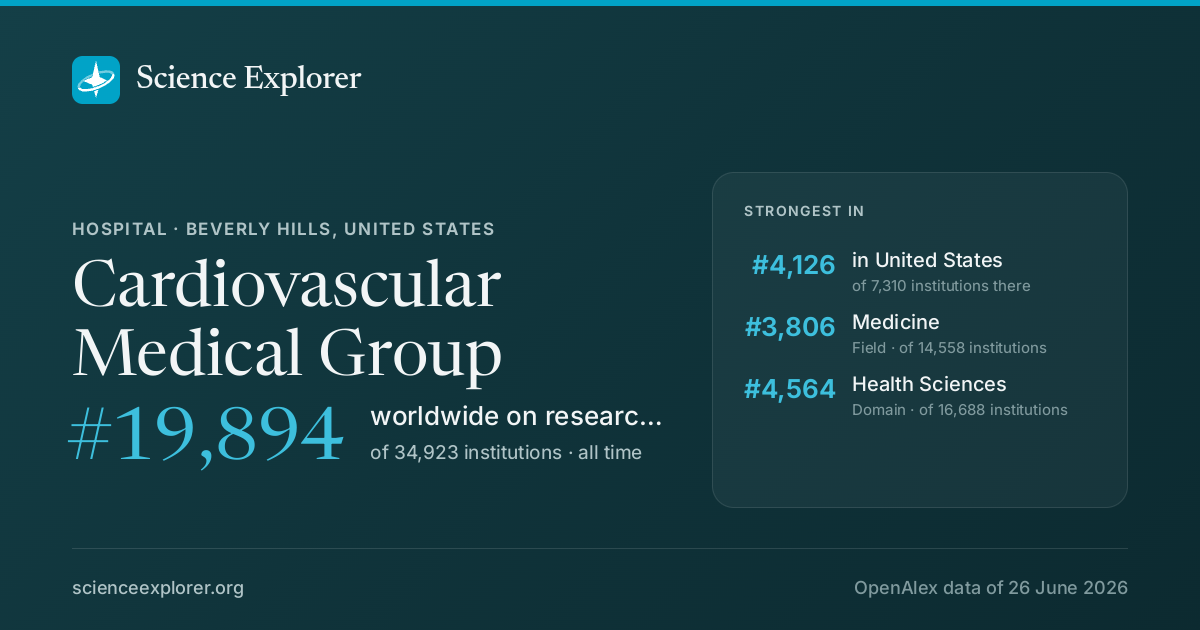
Cardiovascular Medical Group on Science Explorer

A card with Cardiovascular Medical Group's standing and the fields it leads in, for a post or a slide. A link to this page previews as the same card.

Download the card

1200 × 630 PNG, sized for social posts, drawn from the latest snapshot.

Badges for a website1Each links back here and updates with every snapshot

Research measures only: rankings here say nothing about teaching, admissions or student experience. Comparable institutions and collaboration partners have tabs of their own, above.

Discussion

Ask a question or share a note about Cardiovascular Medical Group. Keep it to the research: no personal attacks, advertising or links. Any reader can report a post, which collapses it for everyone until it is opened.
