Science Explorer Back to mapMap
Hospital / health system · Lynchburg · United States

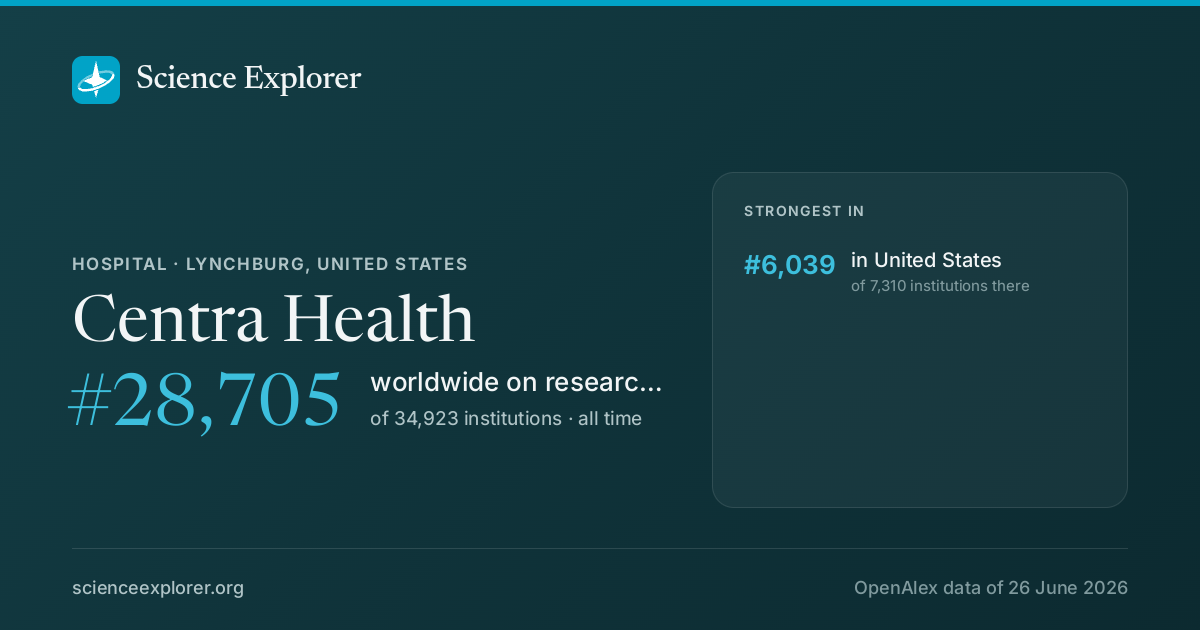
Centra Health

World rank, all time
#28,705
of 34,923
Rank in United States
#6,039
of 7,310
Research works
187
▲ 18% vs 2018-21
Citations
1.9k
10.1 per fractional work
Top-10% rate
8.8%
all institutions 10.0%
vs its own fields
0.84×
1.00× is exactly expected
Open access
34%
world 40%
International
20%
world 18%

Which fields of science does Centra Health work in?

In 2022-now, 60% of research at Centra Health is in Health Sciences, 19% in Physical Sciences. Its largest fields are Medicine (50%), Health Professions (9%), Computer Science (7%). It does 2.2× the world's share of Health Sciences.

Health Sciences: 25 fractional works · 60.3% of its workMedicine: 20 fractional works · 49.5% of its workCardiology and Cardiovascular Medicine: 3 fractional works · 8.4% of its workPsychiatry and Mental health: 2 fractional works · 6.1% of its workNeurology: 2 fractional works · 4.2% of its workEpidemiology: 1 fractional works · 3.4% of its workSurgery: 1 fractional works · 3.1% of its workPulmonary and Respiratory Medicine: 1 fractional works · 3.0% of its workPublic Health, Environmental and Occupational Health: 1 fractional works · 2.7% of its workRehabilitation: 1 fractional works · 2.5% of its workRadiology, Nuclear Medicine and Imaging: 1 fractional works · 1.8% of its workPhysiology: 1 fractional works · 1.7% of its workRheumatology: 1 fractional works · 1.6% of its workPharmacology: 1 fractional works · 1.4% of its workEmergency Medicine: 0 fractional works · 1.1% of its workObstetrics and Gynecology: 0 fractional works · 0.8% of its workGenetics: 0 fractional works · 0.8% of its workOtorhinolaryngology: 0 fractional works · 0.8% of its workNephrology: 0 fractional works · 0.8% of its workPediatrics, Perinatology and Child Health: 0 fractional works · 0.8% of its workOncology: 0 fractional works · 0.7% of its workInfectious Diseases: 0 fractional works · 0.7% of its workReproductive Medicine: 0 fractional works · 0.6% of its workAnesthesiology and Pain Medicine: 0 fractional works · 0.4% of its workHepatology: 0 fractional works · 0.4% of its workInternal Medicine: 0 fractional works · 0.4% of its workHematology: 0 fractional works · 0.3% of its workTransplantation: 0 fractional works · 0.3% of its workHealth Informatics: 0 fractional works · 0.2% of its workSmaller subfields together: 0 fractional works · 0.3% of its workHealth Professions: 4 fractional works · 8.7% of its workGeneral Health Professions: 2 fractional works · 4.9% of its workOccupational Therapy: 1 fractional works · 1.8% of its workRadiological and Ultrasound Technology: 0 fractional works · 0.8% of its workEmergency Medical Services: 0 fractional works · 0.4% of its workPharmacy: 0 fractional works · 0.4% of its workHealth Information Management: 0 fractional works · 0.3% of its workSmaller subfields together: 0 fractional works · 0.1% of its workNursing: 1 fractional works · 1.5% of its workIssues, ethics and legal aspects: 0 fractional works · 0.6% of its workResearch and Theory: 0 fractional works · 0.6% of its workNutrition and Dietetics: 0 fractional works · 0.4% of its workVeterinary: 0 fractional works · 0.3% of its workSmall Animals: 0 fractional works · 0.3% of its workDentistry: 0 fractional works · 0.2% of its workOral Surgery: 0 fractional works · 0.2% of its workPhysical Sciences: 8 fractional works · 18.5% of its workComputer Science: 3 fractional works · 6.6% of its workArtificial Intelligence: 1 fractional works · 2.7% of its workInformation Systems: 1 fractional works · 1.5% of its workComputer Networks and Communications: 1 fractional works · 1.4% of its workComputer Vision and Pattern Recognition: 0 fractional works · 0.8% of its workSmaller subfields together: 0 fractional works · 0.1% of its workPhysics and Astronomy: 2 fractional works · 5.7% of its workAstronomy and Astrophysics: 1 fractional works · 2.6% of its workStatistical and Nonlinear Physics: 1 fractional works · 1.3% of its workNuclear and High Energy Physics: 0 fractional works · 1.1% of its workAtomic and Molecular Physics, and Optics: 0 fractional works · 0.8% of its workEnvironmental Science: 2 fractional works · 4.5% of its workHealth, Toxicology and Mutagenesis: 2 fractional works · 4.5% of its workEngineering: 0 fractional works · 1.0% of its workElectrical and Electronic Engineering: 0 fractional works · 0.3% of its workMechanical Engineering: 0 fractional works · 0.3% of its workBiomedical Engineering: 0 fractional works · 0.2% of its workSmaller subfields together: 0 fractional works · 0.1% of its workMaterials Science: 0 fractional works · 0.5% of its workBiomaterials: 0 fractional works · 0.5% of its workEnergy: 0 fractional works · 0.2% of its workSocial Sciences: 6 fractional works · 15.0% of its workPsychology: 2 fractional works · 5.4% of its workNeuropsychology and Physiological Psychology: 1 fractional works · 2.5% of its workClinical Psychology: 1 fractional works · 1.6% of its workApplied Psychology: 0 fractional works · 0.7% of its workExperimental and Cognitive Psychology: 0 fractional works · 0.3% of its workSocial Psychology: 0 fractional works · 0.3% of its workSocial Sciences: 2 fractional works · 4.5% of its workDemography: 0 fractional works · 1.2% of its workPolitical Science and International Relations: 0 fractional works · 1.2% of its workSociology and Political Science: 0 fractional works · 0.9% of its workHealth: 0 fractional works · 0.7% of its workLaw: 0 fractional works · 0.4% of its workEconomics, Econometrics and Finance: 1 fractional works · 3.5% of its workEconomics and Econometrics: 1 fractional works · 3.5% of its workArts and Humanities: 0 fractional works · 1.2% of its workHistory: 0 fractional works · 0.8% of its workHistory and Philosophy of Science: 0 fractional works · 0.4% of its workBusiness, Management and Accounting: 0 fractional works · 0.4% of its workOrganizational Behavior and Human Resource Management: 0 fractional works · 0.3% of its workSmaller subfields together: 0 fractional works · 0.2% of its workLife Sciences: 2 fractional works · 6.1% of its workAgricultural and Biological Sciences: 1 fractional works · 2.3% of its workForestry: 0 fractional works · 0.7% of its workAgronomy and Crop Science: 0 fractional works · 0.4% of its workPlant Science: 0 fractional works · 0.4% of its workSoil Science: 0 fractional works · 0.4% of its workAnimal Science and Zoology: 0 fractional works · 0.2% of its workFood Science: 0 fractional works · 0.2% of its workNeuroscience: 1 fractional works · 2.0% of its workNeurology: 0 fractional works · 1.2% of its workSensory Systems: 0 fractional works · 0.8% of its workBiochemistry, Genetics and Molecular Biology: 0 fractional works · 1.1% of its workMolecular Biology: 0 fractional works · 0.5% of its workGenetics: 0 fractional works · 0.4% of its workSmaller subfields together: 0 fractional works · 0.1% of its workImmunology and Microbiology: 0 fractional works · 0.5% of its workImmunology: 0 fractional works · 0.4% of its workSmaller subfields together: 0 fractional works · 0.1% of its workPharmacology, Toxicology and Pharmaceutics: 0 fractional works · 0.2% of its workALL ITS WORKCentra Health41fractional works, 2022-now
Life Sciences6%Physical Sciences19%Health Sciences60%Social Sciences15%

Each ring splits the one inside it: the four domains of science, their fields, their subfields. Size is fractional works in 2022-now. Every slice is a page; the interactive view zooms down to single topics and colours each by how much more of it this institution does than the world.

Its 4 domains and 21 fields, with their numbers
    1. Medicine2049.5%
    2. Health Professions48.7%
    3. Nursing11.5%
    4. Veterinary00.3%
    5. Dentistry00.2%
    1. Computer Science36.6%
    2. Physics and Astronomy25.7%
    3. Environmental Science24.5%
    4. Engineering01.0%
    5. Materials Science00.5%
    6. Energy00.2%
    1. Psychology25.4%
    2. Social Sciences24.5%
    3. Economics, Econometrics and Finance13.5%
    4. Arts and Humanities01.2%
    5. Business, Management and Accounting00.4%
    1. Agricultural and Biological Sciences12.3%
    2. Neuroscience12.0%
    3. Biochemistry, Genetics and Molecular Biology01.1%
    4. Immunology and Microbiology00.5%
    5. Pharmacology, Toxicology and Pharmaceutics00.2%
All of science, and how each field's share has moved since 1950: the Science domain explorer

Field profile

Location quotient across every field it publishes in: outside the ring is more than an institution of this size would be expected to publish, inside it is less.

Agricultural and Biological Sciences: 0.49× its world share, 1 worksAgricultural and Bio…Biochemistry, Genetics and Molecular Biology: 0.20× its world share, 0 worksBiochemistry, Geneti…Immunology and Microbiology: 0.51× its world share, 0 worksImmunology and Micro…Neuroscience: 1.26× its world share, 1 worksNeurosciencePharmacology, Toxicology and Pharmaceutics: 0.46× its world share, 0 worksPharmacology, Toxico…Computer Science: 0.84× its world share, 3 worksComputer ScienceEnergy: 0.18× its world share, 0 worksEnergyEngineering: 0.07× its world share, 0 worksEngineeringEnvironmental Science: 0.91× its world share, 2 worksEnvironmental ScienceMaterials Science: 0.14× its world share, 0 worksMaterials SciencePhysics and Astronomy: 2.57× its world share, 2 worksPhysics and AstronomyDentistry: 0.43× its world share, 0 worksDentistryHealth Professions: 3.32× its world share, 4 worksHealth ProfessionsMedicine: 2.58× its world share, 20 worksMedicineNursing: 3.18× its world share, 1 worksNursingVeterinary: 2.26× its world share, 0 worksVeterinaryArts and Humanities: 0.43× its world share, 0 worksArts and HumanitiesBusiness, Management and Accounting: 0.14× its world share, 0 worksBusiness, Management…Economics, Econometrics and Finance: 1.66× its world share, 1 worksEconomics, Econometr…Psychology: 1.76× its world share, 2 worksPsychologySocial Sciences: 0.35× its world share, 2 worksSocial Sciences1×world share
more than its size predictsabout as predictedless

Rings at 0.5×, 1× and 2×. Widest outward: Health Professions, 3.3×. Every wedge is a field page.

All 21 fields, with their numbers
  1. Health Professions3.32×4 works
  2. Nursing3.18×1 works
  3. Medicine2.58×20 works
  4. Physics and Astronomy2.57×2 works
  5. Veterinary2.26×0 works
  6. Psychology1.76×2 works
  7. Economics, Econometrics and Finance1.66×1 works
  8. Neuroscience1.26×1 works
  9. Environmental Science0.91×2 works
  10. Computer Science0.84×3 works
  11. Immunology and Microbiology0.51×0 works
  12. Agricultural and Biological Sciences0.49×1 works
  13. Pharmacology, Toxicology and Pharmaceutics0.46×0 works
  14. Dentistry0.43×0 works
  15. Arts and Humanities0.43×0 works
  16. Social Sciences0.35×2 works
  17. Biochemistry, Genetics and Molecular Biology0.20×0 works
  18. Energy0.18×0 works
  19. Materials Science0.14×0 works
  20. Business, Management and Accounting0.14×0 works
  21. Engineering0.07×0 works

Who are the top researchers at Centra Health?

Ranked on the quality score, Richard S. Kuk, Matthew C. Sackett and Gustave Moynier lead among researchers whose main affiliation is Centra Health.

  1. 1 Richard S. Kuk United States · #903,133 worldwide 663 citations · 25 works
  2. 2 Matthew C. Sackett United States · #1,980,073 worldwide 391 citations · 34 works
  3. 3 Gustave Moynier United States · #2,163,324 worldwide 75 citations · 81 works
  4. 4 Ed. Odier United States · #2,346,813 worldwide 4 citations · 54 works
  5. 5 Brinder Kanda United States · #3,885,763 worldwide 121 citations · 16 works
  6. 6 Chinmaya Mareddy United States · #5,376,302 worldwide 68 citations · 28 works
All ranked researchers at Centra Health

What are the most cited papers from Centra Health?

The most cited paper from Centra Health is "Guideline for Reversal of Antithrombotics in Intracranial Hemorrhage" (Jennifer Ann Frontera, John J. Lewin, Alejandro A. Rabinstein et al., 2015), with 708 citations. Next come "The elevated temperature performance of the LiMn2O4/C system: failure and solutions" (287) and "Expanded Prostate Cancer Index Composite for Clinical Practice: Development and Validation of a Practical Health Related Quality of Life Instrument for Use in the Routine Clinical Care of Patients With Prostate Cancer" (197).

Most cited papers
#PaperReleasedCitations
1 Guideline for Reversal of Antithrombotics in Intracranial Hemorrhage Jennifer Ann Frontera, John J. Lewin, Alejandro A. Rabinstein et al. · Neurocritical Care 29 Dec 2015 708
2 The elevated temperature performance of the LiMn2O4/C system: failure and solutions Glenn G. Amatucci, A. Du Pasquier, A. Blyr et al. · Electrochimica Acta Sep 1999 287
3 Expanded Prostate Cancer Index Composite for Clinical Practice: Development and Validation of a Practical Health Related Quality of Life Instrument for Use in the Routine Clinical Care of Patients With Prostate Cancer Peter Chang, Konrad M. Szymanski, Rodney L. Dunn et al. · The Journal of Urology Open access 26 Jul 2011 197
4 Impact of Regionalization of ST-Segment–Elevation Myocardial Infarction Care on Treatment Times and Outcomes for Emergency Medical Services–Transported Patients Presenting to Hospitals With Percutaneous Coronary Intervention James G. Jollis, Hussein R. Al‐Khalidi, Mayme Lou Roettig et al. · Circulation 15 Nov 2017 141
5 Nitroglycerin infusion during upright tilt: A new test for the diagnosis of vasovagal syncope Antonio Raviele, GIANNI GASPARINI, Francesco Di Pede et al. · American Heart Journal 1994 139
All 60 most cited papers, with filters and sorting

Which keywords describe research at Centra Health?

By fractional works in 2022-now, weighted toward what it does more of than the world: Medical Education, Patient Satisfaction, Healthcare, Clinical Practice, Gender Differences, Empathy, Physician and Depression.

▲ more of its work than of the world's◆ about the world's share▼ less than the world's

Size is fractional works in 2022-now in the topics tagged with each word; colour is the word's share of this institution's work against its share of the world's. The 22 words are chosen for being large and distinctive. Each links to the topic it comes from most.

All 22 words, with their numbers
  1. Epidemiology3▲ 1.91×24 topics
  2. Medical Education3▲ 25×4 topics
  3. Healthcare2▲ 5.1×5 topics
  4. Patient Satisfaction2▲ 18×4 topics
  5. Public Health2▲ 3.7×10 topics
  6. Clinical Practice2▲ 31×2 topics
  7. Depression2▲ 5.3×9 topics
  8. Quality of Life2▲ 3.2×7 topics
  9. Gender Differences2▲ 12×2 topics
  10. Empathy2▲ 35×1 topic
  11. Physician2▲ 151×1 topic
  12. Mortality2▲ 6.5×4 topics
  13. Neural Plasticity1▲ 18×3 topics
  14. Catheter Ablation1▲ 25×2 topics
  15. Cognition1▲ 23×2 topics
  16. Aging1▲ 4.9×3 topics
  17. Oxidative Stress1▲ 1.68×4 topics
  18. Primary Care1▲ 7.4×8 topics
  19. Cost-effectiveness Analysis1▲ 31×1 topic
  20. Emotion1▲ 12×1 topic
  21. Health Utility Measures1▲ 31×1 topic
  22. Successful Aging1▲ 94×1 topic

Which research topics does Centra Health publish most on?

By volume in 2022-now: Empathy and Medical Education, Aging and Gerontology Research, Health Systems, Economic Evaluations, Quality of Life and Stroke Rehabilitation and Recovery.

  1. 1 Empathy and Medical Education Psychiatry and Mental health 2 works
  2. 2 Aging and Gerontology Research Neuropsychology and Physiological Psychology 1 works
  3. 3 Health Systems, Economic Evaluations, Quality of Life Economics and Econometrics 1 works
  4. 4 Stroke Rehabilitation and Recovery Rehabilitation 1 works
  5. 5 Atrial Fibrillation Management and Outcomes Cardiology and Cardiovascular Medicine 1 works
  6. 6 Climate Change and Health Impacts Health, Toxicology and Mutagenesis 1 works
  7. 7 Traumatic Brain Injury Research Epidemiology 1 works
  8. 8 History of Medical Practice Neurology 0 works
  9. 9 Heavy Metal Exposure and Toxicity Health, Toxicology and Mutagenesis 0 works
  10. 10 Myasthenia Gravis and Thymoma Neurology 0 works

How open and international is its research?

Against the world's own shares: the tick on each track. Both are shares of its output, so they sit on one scale and can be read against each other as well as against the world.

openly available33.6%not open66.4%

World: 40% of research is openly available.

with international co-authors19.5%domestic only80.5%

World: 18% is written across borders.

How has Centra Health's research output changed?

Output in 2022-2025 was 18% higher than in 2018-2021.

still counting1990200020102020
grewheldshrank

The same series as a ribbon: one cell per year, darker for more. The line above answers how much; this answers when.

Its share of all research

Growing output can still be a shrinking share: all of science grows. This is Centra Health as a percentage of every work published that year, 0.00023% in 2024.

still counting0.00025%0.00050%0.00075%Centra Health0.00016% in 202519801990200020102020

Fractional works of Centra Health over all fractional works that year. How the balance of science has shifted.

Other research institutions in Lynchburg

All research institutions in Lynchburg

Share Centra Health's ranking

Centra Health on Science Explorer

A card with Centra Health's standing and the fields it leads in, for a post or a slide. A link to this page previews as the same card.

Download the card

1200 × 630 PNG, sized for social posts, drawn from the latest snapshot.

Badges for a website1Each links back here and updates with every snapshot

Research measures only: rankings here say nothing about teaching, admissions or student experience. Comparable institutions and collaboration partners have tabs of their own, above.

Discussion

Ask a question or share a note about Centra Health. Posts are plain text and can be reported.