Science Explorer Back to mapMap
Discussion
Research facility · Fort Myers · United States

Clinical Physiology Associates

In research, Clinical Physiology Associates stands highest in Health Sciences (#9,970 of 16,688 worldwide), over all time.

World rank, all time
#16,424
of 34,923
Rank in United States
#3,408
of 7,310
Research works
281
▲ 18% vs 2018-21
Citations
3.7k
13.0 per fractional work
Top-10% rate
7.3%
all institutions 10.0%
vs its own fields
0.87×
1.00× is exactly expected
Open access
20%
world 40%
International
10%
world 18%

What is Clinical Physiology Associates known for in research?

The fields where it stands highest, over all time, ranked among every institution above the floor in each field.

FieldWorld rankWhere that sitsTop-10% rateWorks
Health SciencesDomain #9,970 of 16,688 7.4%130

Each strip is that field's whole ranked pool, with the notch where Clinical Physiology Associates sits in it, in the colour of the band that rank falls in. The track under the rate is the rate itself: it carries no average mark, because the average differs by field (from about 6% in Dentistry to 21% in Economics).

Which fields of science does Clinical Physiology Associates work in?

In 2022-now, 52% of research at Clinical Physiology Associates is in Health Sciences, 22% in Physical Sciences. Its largest fields are Medicine (45%), Social Sciences (14%), Environmental Science (8%). It does 2.0× the world's share of Health Sciences.

Health Sciences: 24 fractional works · 51.7% of its workMedicine: 21 fractional works · 45.3% of its workSurgery: 3 fractional works · 6.7% of its workEpidemiology: 2 fractional works · 5.4% of its workCardiology and Cardiovascular Medicine: 2 fractional works · 4.3% of its workOncology: 2 fractional works · 4.0% of its workPublic Health, Environmental and Occupational Health: 1 fractional works · 3.1% of its workRheumatology: 1 fractional works · 2.9% of its workRadiology, Nuclear Medicine and Imaging: 1 fractional works · 2.5% of its workPulmonary and Respiratory Medicine: 1 fractional works · 2.2% of its workPhysiology: 1 fractional works · 1.9% of its workEndocrinology, Diabetes and Metabolism: 1 fractional works · 1.7% of its workPathology and Forensic Medicine: 1 fractional works · 1.5% of its workPsychiatry and Mental health: 1 fractional works · 1.3% of its workNeurology: 0 fractional works · 0.9% of its workOphthalmology: 0 fractional works · 0.9% of its workCritical Care and Intensive Care Medicine: 0 fractional works · 0.8% of its workRehabilitation: 0 fractional works · 0.8% of its workAnesthesiology and Pain Medicine: 0 fractional works · 0.7% of its workHematology: 0 fractional works · 0.7% of its workGeriatrics and Gerontology: 0 fractional works · 0.4% of its workDermatology: 0 fractional works · 0.4% of its workEmergency Medicine: 0 fractional works · 0.4% of its workTransplantation: 0 fractional works · 0.4% of its workHepatology: 0 fractional works · 0.3% of its workSmaller subfields together: 0 fractional works · 1.0% of its workHealth Professions: 3 fractional works · 6.0% of its workGeneral Health Professions: 3 fractional works · 5.9% of its workSmaller subfields together: 0 fractional works · 0.1% of its workVeterinary: 0 fractional works · 0.5% of its workSmall Animals: 0 fractional works · 0.5% of its workPhysical Sciences: 10 fractional works · 22.2% of its workEnvironmental Science: 4 fractional works · 7.7% of its workHealth, Toxicology and Mutagenesis: 1 fractional works · 2.9% of its workWater Science and Technology: 1 fractional works · 2.2% of its workEnvironmental Engineering: 0 fractional works · 0.7% of its workGlobal and Planetary Change: 0 fractional works · 0.7% of its workEnvironmental Chemistry: 0 fractional works · 0.6% of its workEcology: 0 fractional works · 0.4% of its workIndustrial and Manufacturing Engineering: 0 fractional works · 0.2% of its workEngineering: 3 fractional works · 7.4% of its workBiomedical Engineering: 1 fractional works · 1.2% of its workCivil and Structural Engineering: 0 fractional works · 1.1% of its workAerospace Engineering: 0 fractional works · 0.9% of its workArchitecture: 0 fractional works · 0.7% of its workBuilding and Construction: 0 fractional works · 0.7% of its workComputational Mechanics: 0 fractional works · 0.7% of its workMechanical Engineering: 0 fractional works · 0.7% of its workElectrical and Electronic Engineering: 0 fractional works · 0.5% of its workSafety, Risk, Reliability and Quality: 0 fractional works · 0.4% of its workAutomotive Engineering: 0 fractional works · 0.3% of its workSmaller subfields together: 0 fractional works · 0.2% of its workComputer Science: 1 fractional works · 2.4% of its workInformation Systems: 1 fractional works · 1.5% of its workArtificial Intelligence: 0 fractional works · 0.8% of its workSmaller subfields together: 0 fractional works · 0.1% of its workPhysics and Astronomy: 1 fractional works · 2.4% of its workAstronomy and Astrophysics: 1 fractional works · 2.2% of its workSmaller subfields together: 0 fractional works · 0.2% of its workEarth and Planetary Sciences: 1 fractional works · 1.5% of its workGeology: 0 fractional works · 0.7% of its workSpace and Planetary Science: 0 fractional works · 0.7% of its workSmaller subfields together: 0 fractional works · 0.1% of its workMaterials Science: 0 fractional works · 0.7% of its workMaterials Chemistry: 0 fractional works · 0.4% of its workSurfaces, Coatings and Films: 0 fractional works · 0.4% of its workSocial Sciences: 9 fractional works · 20.2% of its workSocial Sciences: 7 fractional works · 14.2% of its workAnthropology: 2 fractional works · 3.6% of its workSociology and Political Science: 1 fractional works · 3.1% of its workPolitical Science and International Relations: 1 fractional works · 2.9% of its workEducation: 1 fractional works · 2.2% of its workGender Studies: 0 fractional works · 0.8% of its workGeneral Social Sciences: 0 fractional works · 0.7% of its workSafety Research: 0 fractional works · 0.7% of its workHealth: 0 fractional works · 0.2% of its workArts and Humanities: 2 fractional works · 4.2% of its workHistory and Philosophy of Science: 1 fractional works · 2.7% of its workConservation: 0 fractional works · 0.7% of its workHistory: 0 fractional works · 0.7% of its workSmaller subfields together: 0 fractional works · 0.1% of its workDecision Sciences: 0 fractional works · 1.1% of its workManagement Science and Operations Research: 0 fractional works · 0.7% of its workStatistics, Probability and Uncertainty: 0 fractional works · 0.4% of its workPsychology: 0 fractional works · 0.5% of its workClinical Psychology: 0 fractional works · 0.2% of its workSmaller subfields together: 0 fractional works · 0.3% of its workEconomics, Econometrics and Finance: 0 fractional works · 0.2% of its workLife Sciences: 3 fractional works · 5.8% of its workAgricultural and Biological Sciences: 1 fractional works · 2.5% of its workPlant Science: 0 fractional works · 1.1% of its workSoil Science: 0 fractional works · 0.8% of its workGeneral Agricultural and Biological Sciences: 0 fractional works · 0.4% of its workAgronomy and Crop Science: 0 fractional works · 0.2% of its workBiochemistry, Genetics and Molecular Biology: 1 fractional works · 2.1% of its workMolecular Biology: 0 fractional works · 1.0% of its workGenetics: 0 fractional works · 0.5% of its workStructural Biology: 0 fractional works · 0.4% of its workBiotechnology: 0 fractional works · 0.2% of its workSmaller subfields together: 0 fractional works · 0.1% of its workNeuroscience: 0 fractional works · 0.6% of its workNeurology: 0 fractional works · 0.4% of its workSmaller subfields together: 0 fractional works · 0.2% of its workImmunology and Microbiology: 0 fractional works · 0.4% of its workImmunology: 0 fractional works · 0.3% of its workSmaller subfields together: 0 fractional works · 0.1% of its workPharmacology, Toxicology and Pharmaceutics: 0 fractional works · 0.2% of its workALL ITS WORKClinicalPhysiology…46fractional works, 2022-now
Life Sciences6%Physical Sciences22%Health Sciences52%Social Sciences20%

Each ring splits the one inside it: the four domains of science, their fields, their subfields. Size is fractional works in 2022-now. Every slice is a page; the interactive view zooms down to single topics and colours each by how much more of it this institution does than the world.

Its 4 domains and 19 fields, with their numbers
    1. Medicine2145.3%
    2. Health Professions36.0%
    3. Veterinary00.5%
    1. Environmental Science47.7%
    2. Engineering37.4%
    3. Computer Science12.4%
    4. Physics and Astronomy12.4%
    5. Earth and Planetary Sciences11.5%
    6. Materials Science00.7%
    1. Social Sciences714.2%
    2. Arts and Humanities24.2%
    3. Decision Sciences01.1%
    4. Psychology00.5%
    5. Economics, Econometrics and Finance00.2%
    1. Agricultural and Biological Sciences12.5%
    2. Biochemistry, Genetics and Molecular Biology12.1%
    3. Neuroscience00.6%
    4. Immunology and Microbiology00.4%
    5. Pharmacology, Toxicology and Pharmaceutics00.2%
All of science, and how each field's share has moved since 1950: the Science domain explorer

Field profile

Location quotient across every field it publishes in: outside the ring is more than an institution of this size would be expected to publish, inside it is less.

Agricultural and Biological Sciences: 0.53× its world share, 1 worksAgricultural and Bio…Biochemistry, Genetics and Molecular Biology: 0.40× its world share, 1 worksBiochemistry, Geneti…Immunology and Microbiology: 0.39× its world share, 0 worksImmunology and Micro…Neuroscience: 0.37× its world share, 0 worksNeurosciencePharmacology, Toxicology and Pharmaceutics: 0.51× its world share, 0 worksPharmacology, Toxico…Computer Science: 0.31× its world share, 1 worksComputer ScienceEarth and Planetary Sciences: 0.99× its world share, 1 worksEarth and Planetary …Engineering: 0.49× its world share, 3 worksEngineeringEnvironmental Science: 1.56× its world share, 4 worksEnvironmental ScienceMaterials Science: 0.21× its world share, 0 worksMaterials SciencePhysics and Astronomy: 1.07× its world share, 1 worksPhysics and AstronomyHealth Professions: 2.28× its world share, 3 worksHealth ProfessionsMedicine: 2.35× its world share, 21 worksMedicineVeterinary: 3.55× its world share, 0 worksVeterinaryArts and Humanities: 1.45× its world share, 2 worksArts and HumanitiesDecision Sciences: 1.12× its world share, 0 worksDecision SciencesEconomics, Econometrics and Finance: 0.08× its world share, 0 worksEconomics, Econometr…Psychology: 0.17× its world share, 0 worksPsychologySocial Sciences: 1.12× its world share, 7 worksSocial Sciences1×world share
more than its size predictsabout as predictedless

Rings at 0.5×, 1× and 2×. Widest outward: Veterinary, 3.5×. Every wedge is a field page.

All 19 fields, with their numbers
  1. Veterinary3.55×0 works
  2. Medicine2.35×21 works
  3. Health Professions2.28×3 works
  4. Environmental Science1.56×4 works
  5. Arts and Humanities1.45×2 works
  6. Decision Sciences1.12×0 works
  7. Social Sciences1.12×7 works
  8. Physics and Astronomy1.07×1 works
  9. Earth and Planetary Sciences0.99×1 works
  10. Agricultural and Biological Sciences0.53×1 works
  11. Pharmacology, Toxicology and Pharmaceutics0.51×0 works
  12. Engineering0.49×3 works
  13. Biochemistry, Genetics and Molecular Biology0.40×1 works
  14. Immunology and Microbiology0.39×0 works
  15. Neuroscience0.37×0 works
  16. Computer Science0.31×1 works
  17. Materials Science0.21×0 works
  18. Psychology0.17×0 works
  19. Economics, Econometrics and Finance0.08×0 works

Who are the top researchers at Clinical Physiology Associates?

Ranked on the quality score, Anthony F. Fransway, Samuel W. Boellner and Stephen R. Zellner lead among researchers whose main affiliation is Clinical Physiology Associates.

  1. 1 Anthony F. Fransway United States · #931,780 worldwide 4.3k citations · 113 works
  2. 2 Samuel W. Boellner United States · #2,424,810 worldwide 1.5k citations · 22 works
  3. 3 Stephen R. Zellner United States · #2,554,921 worldwide 887 citations · 22 works
  4. 4 Zdenek Hejzlar United States · #2,642,767 worldwide 31 citations · 43 works
  5. 5 David D. Michie United States · #3,212,490 worldwide 526 citations · 32 works
  6. 6 Eduard W. Krahé United States · #3,835,652 worldwide 90 citations · 26 works
  7. 7 Lisa Chamberlain James United States · #5,135,496 worldwide 27 citations · 30 works
All ranked researchers at Clinical Physiology Associates

What are the most cited papers from Clinical Physiology Associates?

The most cited paper from Clinical Physiology Associates is "American Society of Hematology 2018 guidelines for management of venous thromboembolism: diagnosis of venous thromboembolism" (Wendy Lim, Grégoire Le Gal, Shannon M. Bates et al., 2018), with 423 citations. Next come "Antiretroviral Activity, Pharmacokinetics, and Tolerability of MK-0518, a Novel Inhibitor of HIV-1 Integrase, Dosed As Monotherapy for 10 Days in Treatment-Naive HIV-1-Infected Individuals" (367) and "Lisdexamfetamine Dimesylate and Mixed Amphetamine Salts Extended-Release in Children with ADHD: A Double-Blind, Placebo-Controlled, Crossover Analog Classroom Study" (358).

Most cited papers
#PaperReleasedCitations
1 American Society of Hematology 2018 guidelines for management of venous thromboembolism: diagnosis of venous thromboembolism Wendy Lim, Grégoire Le Gal, Shannon M. Bates et al. · Blood Advances Open access 27 Nov 2018 423
2 Antiretroviral Activity, Pharmacokinetics, and Tolerability of MK-0518, a Novel Inhibitor of HIV-1 Integrase, Dosed As Monotherapy for 10 Days in Treatment-Naive HIV-1-Infected Individuals Martin H. Markowitz, Javier O Morales-Ramirez, Bach‐Yen Nguyen et al. · JAIDS Journal of Acquired Immune Deficiency Syndromes 13 Nov 2006 367
3 Lisdexamfetamine Dimesylate and Mixed Amphetamine Salts Extended-Release in Children with ADHD: A Double-Blind, Placebo-Controlled, Crossover Analog Classroom Study Joseph Biederman, Samuel W. Boellner, Ann Catherine Childress et al. · Biological Psychiatry 13 Jul 2007 358
4 Assessing Improvement in Detection of Breast Cancer with Three-dimensional Automated Breast US in Women with Dense Breast Tissue: The SomoInsight Study Rachel F. Brem, László K. Tabár, Stephen William Duffy et al. · Radiology 20 Oct 2014 355
5 Serum prostate-specific antigen concentration is a powerful predictor of acute urinary retention and need for surgery in men with clinical benign prostatic hyperplasia Claus G. Roehrborn, John D. McConnell, Michael M. Lieber et al. · Urology Mar 1999 336
All 61 most cited papers, with filters and sorting

Which keywords describe research at Clinical Physiology Associates?

By fractional works in 2022-now, weighted toward what it does more of than the world: Mortality, Cultural Heritage, Risk Factors, Climate Change, Medical Education, Neuroprotection, Clinical Outcomes and Public Health.

▲ more of its work than of the world's◆ about the world's share▼ less than the world's

Size is fractional works in 2022-now in the topics tagged with each word; colour is the word's share of this institution's work against its share of the world's. The 39 words are chosen for being large and distinctive. Each links to the topic it comes from most.

All 39 words, with their numbers
  1. Mortality3▲ 13×6 topics
  2. Climate Change3▲ 2.3×8 topics
  3. Epidemiology3▲ 1.50×26 topics
  4. Risk Factors2▲ 4.5×9 topics
  5. Public Health2▲ 3.1×9 topics
  6. Cultural Heritage2▲ 8.1×3 topics
  7. Healthcare2▲ 3.0×4 topics
  8. Clinical Trials2▲ 5.0×4 topics
  9. Medical Education2▲ 12×3 topics
  10. Clinical Outcomes1▲ 14×2 topics
  11. Neuroprotection1▲ 8.6×3 topics
  12. Sustainability1▲ 1.27×6 topics
  13. Ethics1▲ 5.6×6 topics
  14. Ischemic Stroke1▲ 19×2 topics
  15. Traditional Irrigation1▲ 623×1 topic
  16. Vulnerability1▲ 12×2 topics
  17. Water Sustainability1▲ 623×1 topic
  18. COVID-191▲ 2.0×4 topics
  19. Echocardiography1▲ 9.5×6 topics
  20. Endovascular Therapy1▲ 39×1 topic
  21. Globalization1▲ 1.38×3 topics
  22. Inflammation1▲ 1.21×10 topics
  23. Publication1▲ 222×1 topic
  24. Scientific Writing1▲ 222×1 topic
  25. Thrombolysis1▲ 39×1 topic
  26. Cancer1▲ 1.79×2 topics
  27. Pandemic1▲ 2.4×2 topics
  28. Collagenase Clostridium Histolyticum1▲ 385×1 topic
  29. Education1▲ 1.29×4 topics
  30. Emergency Department Visits1▲ 42×1 topic
  31. Fasciectomy1▲ 385×1 topic
  32. Global Warming1▲ 5.3×2 topics
  33. Heat Waves1▲ 34×1 topic
  34. Human Health1▲ 14×1 topic
  35. Hydrological Modeling1▲ 9.1×1 topic
  36. Information Warfare1▲ 63×2 topics
  37. Oncology1▲ 42×1 topic
  38. Surgery1▲ 6.3×2 topics
  39. Water Resources1▲ 8.9×1 topic

Which research topics does Clinical Physiology Associates publish most on?

By volume in 2022-now: Academic Writing and Publishing, Archaeology and Natural History, Acute Ischemic Stroke Management and COVID-19 and healthcare impacts.

  1. 1 Academic Writing and Publishing History and Philosophy of Science 1 works
  2. 2 Archaeology and Natural History Anthropology 1 works
  3. 3 Acute Ischemic Stroke Management Epidemiology 1 works
  4. 4 COVID-19 and healthcare impacts Oncology 1 works
  5. 5 Dupuytren's Contracture and Treatments Rheumatology 1 works
  6. 6 Climate Change and Health Impacts Health, Toxicology and Mutagenesis 1 works
  7. 7 Hydrology and Watershed Management Studies Water Science and Technology 1 works
  8. 8 Health and Medical Research Impacts Public Health, Environmental and Occupational Health 1 works
  9. 9 Cybersecurity and Cyber Warfare Studies Political Science and International Relations 1 works
  10. 10 Employment and Welfare Studies General Health Professions 1 works

How open and international is its research?

Against the world's own shares: the tick on each track. Both are shares of its output, so they sit on one scale and can be read against each other as well as against the world.

openly available19.9%not open80.1%

World: 40% of research is openly available.

with international co-authors10.3%domestic only89.7%

World: 18% is written across borders.

How has Clinical Physiology Associates's research output changed?

Output in 2022-2025 was 18% higher than in 2018-2021.

still counting1990200020102020
grewheldshrank

The same series as a ribbon: one cell per year, darker for more. The line above answers how much; this answers when.

Its share of all research

Growing output can still be a shrinking share: all of science grows. This is Clinical Physiology Associates as a percentage of every work published that year, 0.00020% in 2024.

still counting0.00050%0.0010%Clinical Physiology Associates0.00022% in 202519801990200020102020

Fractional works of Clinical Physiology Associates over all fractional works that year. How the balance of science has shifted.

Other research institutions in Fort Myers

All research institutions in Fort Myers

Share Clinical Physiology Associates's ranking
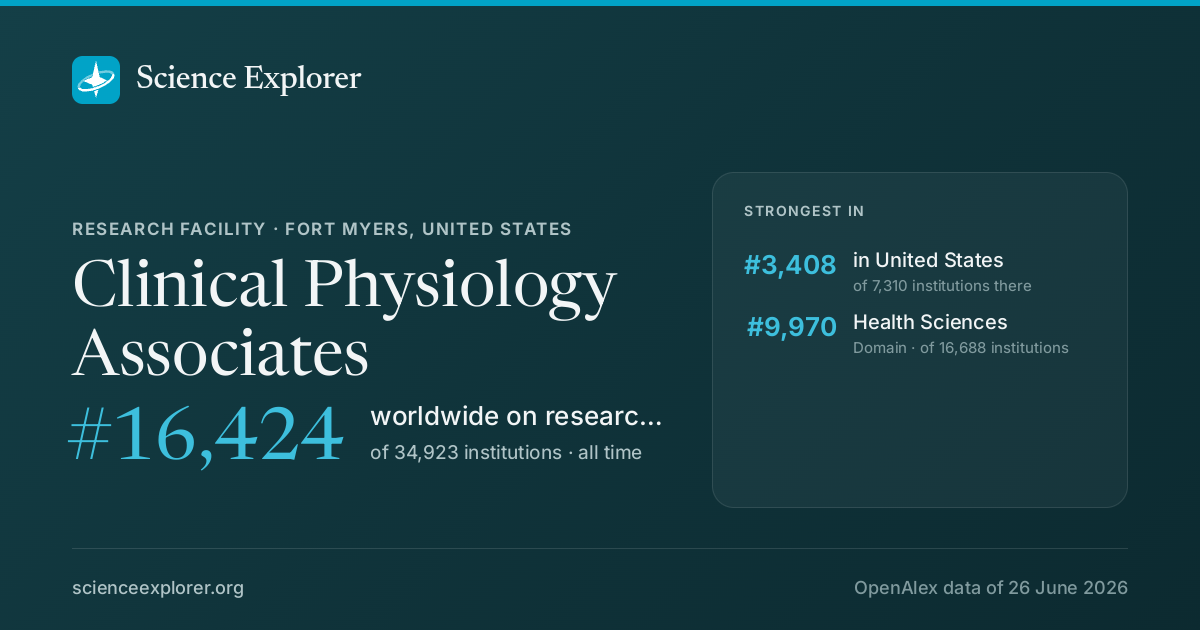
Clinical Physiology Associates on Science Explorer

A card with Clinical Physiology Associates's standing and the fields it leads in, for a post or a slide. A link to this page previews as the same card.

Download the card

1200 × 630 PNG, sized for social posts, drawn from the latest snapshot.

Badges for a website1Each links back here and updates with every snapshot

Research measures only: rankings here say nothing about teaching, admissions or student experience. Comparable institutions and collaboration partners have tabs of their own, above.

Discussion

Ask a question or share a note about Clinical Physiology Associates. Keep it to the research: no personal attacks, advertising or links. Any reader can report a post, which collapses it for everyone until it is opened.