Science Explorer Back to mapMap
Discussion
Company · Cambridge · United States

Dimagi (United States)

World rank, all time
#19,902
of 34,923
Rank in United States
#4,127
of 7,310
Research works
226
▼ 12% vs 2018-21
Citations
3.4k
15.1 per fractional work
Top-10% rate
19.3%
all institutions 10.0%
vs its own fields
0.94×
1.00× is exactly expected
Open access
18%
world 40%
International
8%
world 18%

Which fields of science does Dimagi (United States) work in?

In all years, 35% of research at Dimagi (United States) is in Social Sciences, 26% in Physical Sciences. Its largest fields are Medicine (19%), Psychology (11%), Biochemistry, Genetics and Molecular Biology (9%). It does 1.6× the world's share of Social Sciences.

Social Sciences: 79 fractional works · 34.8% of its workPsychology: 26 fractional works · 11.5% of its workClinical Psychology: 13 fractional works · 5.5% of its workExperimental and Cognitive Psychology: 6 fractional works · 2.8% of its workSocial Psychology: 5 fractional works · 2.1% of its workApplied Psychology: 1 fractional works · 0.5% of its workNeuropsychology and Physiological Psychology: 1 fractional works · 0.4% of its workSmaller subfields together: 0 fractional works · 0.1% of its workSocial Sciences: 18 fractional works · 7.8% of its workSociology and Political Science: 10 fractional works · 4.5% of its workPolitical Science and International Relations: 3 fractional works · 1.2% of its workHealth: 2 fractional works · 0.7% of its workEducation: 1 fractional works · 0.3% of its workAnthropology: 1 fractional works · 0.3% of its workSmaller subfields together: 2 fractional works · 0.9% of its workArts and Humanities: 16 fractional works · 7.2% of its workPhilosophy: 4 fractional works · 2.0% of its workLiterature and Literary Theory: 4 fractional works · 1.6% of its workHistory and Philosophy of Science: 3 fractional works · 1.3% of its workHistory: 1 fractional works · 0.6% of its workReligious studies: 1 fractional works · 0.5% of its workArcheology: 1 fractional works · 0.4% of its workMuseology: 1 fractional works · 0.3% of its workLanguage and Linguistics: 1 fractional works · 0.3% of its workSmaller subfields together: 0 fractional works · 0.1% of its workEconomics, Econometrics and Finance: 16 fractional works · 7.1% of its workEconomics and Econometrics: 12 fractional works · 5.3% of its workGeneral Economics, Econometrics and Finance: 3 fractional works · 1.2% of its workFinance: 1 fractional works · 0.6% of its workBusiness, Management and Accounting: 2 fractional works · 0.7% of its workManagement of Technology and Innovation: 1 fractional works · 0.5% of its workManagement Information Systems: 0 fractional works · 0.2% of its workSmaller subfields together: 0 fractional works · 0.0% of its workDecision Sciences: 1 fractional works · 0.5% of its workInformation Systems and Management: 1 fractional works · 0.4% of its workSmaller subfields together: 0 fractional works · 0.1% of its workPhysical Sciences: 59 fractional works · 26.3% of its workComputer Science: 17 fractional works · 7.6% of its workComputational Theory and Mathematics: 5 fractional works · 2.1% of its workArtificial Intelligence: 5 fractional works · 2.1% of its workComputer Vision and Pattern Recognition: 4 fractional works · 1.6% of its workInformation Systems: 3 fractional works · 1.2% of its workComputer Networks and Communications: 1 fractional works · 0.2% of its workSignal Processing: 0 fractional works · 0.2% of its workSmaller subfields together: 0 fractional works · 0.1% of its workEngineering: 16 fractional works · 6.9% of its workBiomedical Engineering: 5 fractional works · 2.1% of its workCivil and Structural Engineering: 2 fractional works · 1.1% of its workMechanical Engineering: 2 fractional works · 0.8% of its workElectrical and Electronic Engineering: 2 fractional works · 0.7% of its workArchitecture: 1 fractional works · 0.4% of its workAerospace Engineering: 1 fractional works · 0.4% of its workBuilding and Construction: 1 fractional works · 0.3% of its workControl and Systems Engineering: 1 fractional works · 0.3% of its workMedia Technology: 0 fractional works · 0.2% of its workOcean Engineering: 0 fractional works · 0.2% of its workSmaller subfields together: 1 fractional works · 0.3% of its workChemistry: 8 fractional works · 3.7% of its workPhysical and Theoretical Chemistry: 4 fractional works · 2.0% of its workSpectroscopy: 2 fractional works · 0.7% of its workAnalytical Chemistry: 1 fractional works · 0.5% of its workElectrochemistry: 1 fractional works · 0.3% of its workSmaller subfields together: 0 fractional works · 0.2% of its workEnvironmental Science: 6 fractional works · 2.6% of its workEcology: 1 fractional works · 0.6% of its workEnvironmental Chemistry: 1 fractional works · 0.5% of its workEnvironmental Engineering: 1 fractional works · 0.4% of its workWater Science and Technology: 1 fractional works · 0.4% of its workIndustrial and Manufacturing Engineering: 0 fractional works · 0.2% of its workManagement, Monitoring, Policy and Law: 0 fractional works · 0.2% of its workSmaller subfields together: 0 fractional works · 0.2% of its workPhysics and Astronomy: 3 fractional works · 1.5% of its workAstronomy and Astrophysics: 2 fractional works · 0.8% of its workAtomic and Molecular Physics, and Optics: 1 fractional works · 0.5% of its workSmaller subfields together: 0 fractional works · 0.2% of its workMaterials Science: 3 fractional works · 1.2% of its workMaterials Chemistry: 3 fractional works · 1.2% of its workMathematics: 3 fractional works · 1.2% of its workMathematical Physics: 1 fractional works · 0.6% of its workSmaller subfields together: 1 fractional works · 0.6% of its workEarth and Planetary Sciences: 2 fractional works · 0.9% of its workGeophysics: 1 fractional works · 0.4% of its workOceanography: 1 fractional works · 0.4% of its workEnergy: 1 fractional works · 0.6% of its workRenewable Energy, Sustainability and the Environment: 1 fractional works · 0.6% of its workChemical Engineering: 0 fractional works · 0.2% of its workHealth Sciences: 51 fractional works · 22.6% of its workMedicine: 42 fractional works · 18.8% of its workPublic Health, Environmental and Occupational Health: 6 fractional works · 2.7% of its workSurgery: 5 fractional works · 2.1% of its workEpidemiology: 4 fractional works · 1.9% of its workOncology: 3 fractional works · 1.2% of its workPediatrics, Perinatology and Child Health: 2 fractional works · 0.9% of its workInfectious Diseases: 2 fractional works · 0.8% of its workRadiology, Nuclear Medicine and Imaging: 2 fractional works · 0.8% of its workPsychiatry and Mental health: 2 fractional works · 0.8% of its workPathology and Forensic Medicine: 2 fractional works · 0.7% of its workReproductive Medicine: 1 fractional works · 0.6% of its workGenetics: 1 fractional works · 0.5% of its workObstetrics and Gynecology: 1 fractional works · 0.5% of its workCritical Care and Intensive Care Medicine: 1 fractional works · 0.5% of its workCardiology and Cardiovascular Medicine: 1 fractional works · 0.5% of its workNephrology: 1 fractional works · 0.4% of its workPharmacology: 1 fractional works · 0.4% of its workHematology: 1 fractional works · 0.3% of its workNeurology: 1 fractional works · 0.3% of its workOphthalmology: 1 fractional works · 0.3% of its workPhysiology: 1 fractional works · 0.3% of its workPulmonary and Respiratory Medicine: 1 fractional works · 0.3% of its workAnesthesiology and Pain Medicine: 1 fractional works · 0.3% of its workGeriatrics and Gerontology: 0 fractional works · 0.2% of its workDermatology: 0 fractional works · 0.2% of its workSmaller subfields together: 3 fractional works · 1.3% of its workHealth Professions: 8 fractional works · 3.5% of its workGeneral Health Professions: 6 fractional works · 2.6% of its workSpeech and Hearing: 1 fractional works · 0.6% of its workSmaller subfields together: 1 fractional works · 0.3% of its workNursing: 1 fractional works · 0.3% of its workNutrition and Dietetics: 1 fractional works · 0.3% of its workLife Sciences: 37 fractional works · 16.3% of its workBiochemistry, Genetics and Molecular Biology: 21 fractional works · 9.3% of its workMolecular Biology: 15 fractional works · 6.5% of its workGenetics: 2 fractional works · 0.9% of its workCell Biology: 2 fractional works · 0.8% of its workCancer Research: 1 fractional works · 0.6% of its workBiotechnology: 1 fractional works · 0.3% of its workSmaller subfields together: 0 fractional works · 0.2% of its workAgricultural and Biological Sciences: 9 fractional works · 3.9% of its workPlant Science: 7 fractional works · 3.3% of its workEcology, Evolution, Behavior and Systematics: 1 fractional works · 0.4% of its workSmaller subfields together: 0 fractional works · 0.2% of its workNeuroscience: 5 fractional works · 2.4% of its workCognitive Neuroscience: 4 fractional works · 1.7% of its workCellular and Molecular Neuroscience: 1 fractional works · 0.3% of its workSensory Systems: 1 fractional works · 0.3% of its workSmaller subfields together: 0 fractional works · 0.0% of its workImmunology and Microbiology: 2 fractional works · 0.7% of its workApplied Microbiology and Biotechnology: 1 fractional works · 0.4% of its workSmaller subfields together: 1 fractional works · 0.2% of its workALL ITS WORKDimagi (UnitedStates)226fractional works, all years
Life Sciences16%Physical Sciences26%Health Sciences23%Social Sciences35%

Each ring splits the one inside it: the four domains of science, their fields, their subfields. Size is fractional works in all years. Every slice is a page; the interactive view zooms down to single topics and colours each by how much more of it this institution does than the world.

Its 4 domains and 23 fields, with their numbers
    1. Psychology2611.5%
    2. Social Sciences187.8%
    3. Arts and Humanities167.2%
    4. Economics, Econometrics and Finance167.1%
    5. Business, Management and Accounting20.7%
    6. Decision Sciences10.5%
    1. Computer Science177.6%
    2. Engineering166.9%
    3. Chemistry83.7%
    4. Environmental Science62.6%
    5. Physics and Astronomy31.5%
    6. Materials Science31.2%
    7. Mathematics31.2%
    8. Earth and Planetary Sciences20.9%
    9. Energy10.6%
    10. Chemical Engineering00.2%
    1. Medicine4218.8%
    2. Health Professions83.5%
    3. Nursing10.3%
    1. Biochemistry, Genetics and Molecular Biology219.3%
    2. Agricultural and Biological Sciences93.9%
    3. Neuroscience52.4%
    4. Immunology and Microbiology20.7%
All of science, and how each field's share has moved since 1950: the Science domain explorer

Field profile

Location quotient across every field it publishes in: outside the ring is more than an institution of this size would be expected to publish, inside it is less.

Biochemistry, Genetics and Molecular Biology: 0.38× its world share, 0 worksBiochemistry, Geneti…Immunology and Microbiology: 1.15× its world share, 0 worksImmunology and Micro…Chemical Engineering: 3.31× its world share, 0 worksChemical EngineeringComputer Science: 2.54× its world share, 2 worksComputer ScienceEnergy: 0.54× its world share, 0 worksEnergyEngineering: 0.13× its world share, 0 worksEngineeringEnvironmental Science: 0.74× its world share, 0 worksEnvironmental ScienceMaterials Science: 1.33× its world share, 0 worksMaterials ScienceMathematics: 1.40× its world share, 0 worksMathematicsHealth Professions: 3.15× its world share, 1 worksHealth ProfessionsMedicine: 0.63× its world share, 1 worksMedicineEconomics, Econometrics and Finance: 2.84× its world share, 1 worksEconomics, Econometr…Psychology: 7.10× its world share, 2 worksPsychologySocial Sciences: 1.21× its world share, 2 worksSocial Sciences1×world share
more than its size predictsabout as predictedless

Rings at 0.5×, 1× and 2×. Widest outward: Psychology, 7.1×. Every wedge is a field page.

All 14 fields, with their numbers
  1. Psychology7.10×2 works
  2. Chemical Engineering3.31×0 works
  3. Health Professions3.15×1 works
  4. Economics, Econometrics and Finance2.84×1 works
  5. Computer Science2.54×2 works
  6. Mathematics1.40×0 works
  7. Materials Science1.33×0 works
  8. Social Sciences1.21×2 works
  9. Immunology and Microbiology1.15×0 works
  10. Environmental Science0.74×0 works
  11. Medicine0.63×1 works
  12. Energy0.54×0 works
  13. Biochemistry, Genetics and Molecular Biology0.38×0 works
  14. Engineering0.13×0 works

Who are the top researchers at Dimagi (United States)?

Ranked on the quality score, Louis Agassiz, Christal Whelan and Francis James Child lead among researchers whose main affiliation is Dimagi (United States).

  1. 1 Louis Agassiz United States · #1,520,064 worldwide 3.2k citations · 257 works
  2. 2 Christal Whelan United States · #2,794,683 worldwide 81 citations · 22 works
  3. 3 Francis James Child United States · #3,305,510 worldwide 127 citations · 19 works
  4. 4 Rose Rand United States · #3,445,918 worldwide 21 citations · 15 works
  5. 5 Ralf Norrman United States · #3,903,548 worldwide 117 citations · 32 works
  6. 6 Yun Xian Ho United States · #4,011,733 worldwide 86 citations · 16 works
  7. 7 W Wilde United States · #5,112,525 worldwide 29 citations · 24 works
All ranked researchers at Dimagi (United States)

What are the most cited papers from Dimagi (United States)?

The most cited paper from Dimagi (United States) is "The power of positive deviance" (David Russell Marsh, Dirk G. Schroeder, Kirk A. Dearden et al., 2004), with 807 citations. Next come "Light-scattering in physical chemistry" (200) and "Randomized Controlled Trial of a Personalized Cellular Phone Reminder System to Enhance Adherence to Antiretroviral Therapy" (196).

Most cited papers
#PaperReleasedCitations
1 The power of positive deviance David Russell Marsh, Dirk G. Schroeder, Kirk A. Dearden et al. · BMJ Open access 11 Nov 2004 807
2 Light-scattering in physical chemistry John T. Edsall · Archives of Biochemistry and Biophysics Jul 1957 200
3 Randomized Controlled Trial of a Personalized Cellular Phone Reminder System to Enhance Adherence to Antiretroviral Therapy Hélène Hardy, Vikram Sheel Kumar, Gheorghe D. Doros et al. · AIDS Patient Care and STDs Open access 16 Feb 2011 196
4 Using electronic technology to improve clinical care – results from a before-after cluster trial to evaluate assessment and classification of sick children according to Integrated Management of Childhood Illness (IMCI) protocol in Tanzania Marc D. Mitchell, Bethany Hedt‐Gauthier, Daniel F. Msellemu et al. · BMC Medical Informatics and Decision Making Open access 27 Aug 2013 173
5 Radiotracer methodology in biological science George Wolf · Archives of Biochemistry and Biophysics Aug 1965 171
All 60 most cited papers, with filters and sorting

Which keywords describe research at Dimagi (United States)?

By fractional works in all years, weighted toward what it does more of than the world: Economic Policy, Financial Crisis, Cognitive Science, Public Health, Mobile Health, Cognition, Chronic Disease Management and Ethical Considerations.

▲ more of its work than of the world's◆ about the world's share▼ less than the world's

Size is fractional works in all years in the topics tagged with each word; colour is the word's share of this institution's work against its share of the world's. The 40 words are chosen for being large and distinctive. Each links to the topic it comes from most.

All 40 words, with their numbers
  1. Epidemiology11▲ 1.18×25 topics
  2. Public Health8▲ 2.6×15 topics
  3. Economic Policy6▲ 43×2 topics
  4. Artificial Intelligence6▲ 3.3×8 topics
  5. Genetics6▲ 3.3×7 topics
  6. Economic Growth6▲ 3.3×6 topics
  7. COVID-196▲ 3.6×8 topics
  8. Financial Crisis5▲ 16×2 topics
  9. Cognitive Science5▲ 31×2 topics
  10. Cognition5▲ 13×3 topics
  11. Ethical Considerations5▲ 6.5×6 topics
  12. Mobile Health5▲ 26×3 topics
  13. Neuroscience4▲ 6.3×7 topics
  14. Chronic Disease Management4▲ 13×4 topics
  15. Prevalence4▲ 4.9×5 topics
  16. Adherence4▲ 31×2 topics
  17. Behavior Change4▲ 17×3 topics
  18. Embodiment4▲ 11×3 topics
  19. Financial Stability4▲ 13×2 topics
  20. Patient Engagement4▲ 21×3 topics
  21. Language4▲ 7.9×3 topics
  22. European Union4▲ 6.6×2 topics
  23. Medical Education4▲ 6.9×7 topics
  24. Community Health Workers4▲ 23×2 topics
  25. Green Chemistry4▲ 5.3×3 topics
  26. Digital Health4▲ 19×2 topics
  27. Integrated Care3▲ 31×2 topics
  28. Crisis Resolution3▲ 63×1 topic
  29. Home Treatment3▲ 63×1 topic
  30. Human-Computer Interaction3▲ 11×2 topics
  31. Macroeconomic Stability3▲ 48×1 topic
  32. Wealth Effects3▲ 329×1 topic
  33. International Trade3▲ 9.7×1 topic
  34. Metaphor3▲ 31×1 topic
  35. Organizational Economics3▲ 101×1 topic
  36. Time3▲ 29×1 topic
  37. Health Apps3▲ 43×1 topic
  38. mHealth3▲ 43×1 topic
  39. Modal Logic3▲ 24×2 topics
  40. Neurobiological Correlates3▲ 14×3 topics

Which research topics does Dimagi (United States) publish most on?

By volume in 2022-now: Psychotherapy Techniques and Applications, Digital Economy and Work Transformation, Digital Mental Health Interventions and Mobile Health and mHealth Applications.

  1. 1 Psychotherapy Techniques and Applications Clinical Psychology 1 works
  2. 2 Digital Economy and Work Transformation Sociology and Political Science 1 works
  3. 3 Digital Mental Health Interventions Applied Psychology 1 works
  4. 4 Mobile Health and mHealth Applications General Health Professions 1 works
  5. 5 AI in Service Interactions Artificial Intelligence 1 works
  6. 6 Speech and dialogue systems Artificial Intelligence 0 works
  7. 7 Natural Language Processing Techniques Artificial Intelligence 0 works
  8. 8 Topic Modeling Artificial Intelligence 0 works
  9. 9 Artificial Intelligence in Healthcare and Education Health Informatics 0 works
  10. 10 International Maritime Law Issues Management, Monitoring, Policy and Law 0 works

How open and international is its research?

Against the world's own shares: the tick on each track. Both are shares of its output, so they sit on one scale and can be read against each other as well as against the world.

openly available18.2%not open81.8%

World: 40% of research is openly available.

with international co-authors7.6%domestic only92.4%

World: 18% is written across borders.

How has Dimagi (United States)'s research output changed?

Output in 2022-2025 was 12% lower than in 2018-2021.

still counting1990200020102020
grewheldshrank

The same series as a ribbon: one cell per year, darker for more. The line above answers how much; this answers when.

Its share of all research

Growing output can still be a shrinking share: all of science grows. This is Dimagi (United States) as a percentage of every work published that year, 0.000053% in 2024.

still counting0.0010%0.0020%0.0030%Dimagi (United States)0.000032% in 202519801990200020102020

Fractional works of Dimagi (United States) over all fractional works that year. How the balance of science has shifted.

Other research institutions in Cambridge

All research institutions in Cambridge

Share Dimagi (United States)'s ranking
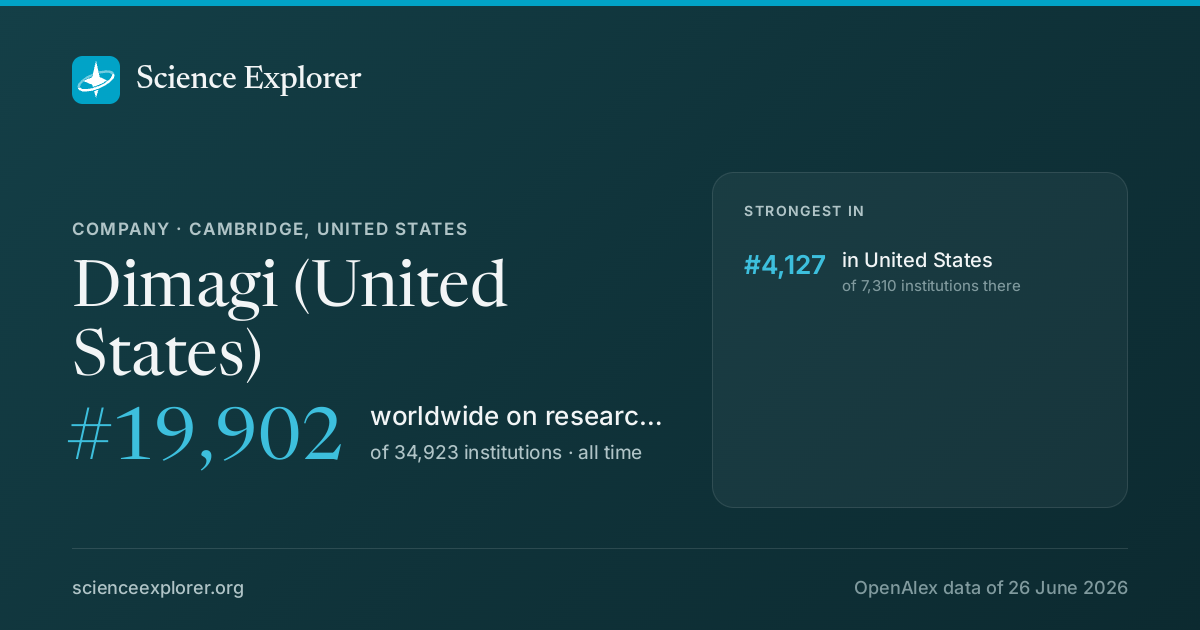
Dimagi (United States) on Science Explorer

A card with Dimagi (United States)'s standing and the fields it leads in, for a post or a slide. A link to this page previews as the same card.

Download the card

1200 × 630 PNG, sized for social posts, drawn from the latest snapshot.

Badges for a website1Each links back here and updates with every snapshot

Research measures only: rankings here say nothing about teaching, admissions or student experience. Comparable institutions and collaboration partners have tabs of their own, above.

Discussion

Ask a question or share a note about Dimagi (United States). Posts are plain text and can be reported.