Science Explorer Back to mapMap
Discussion
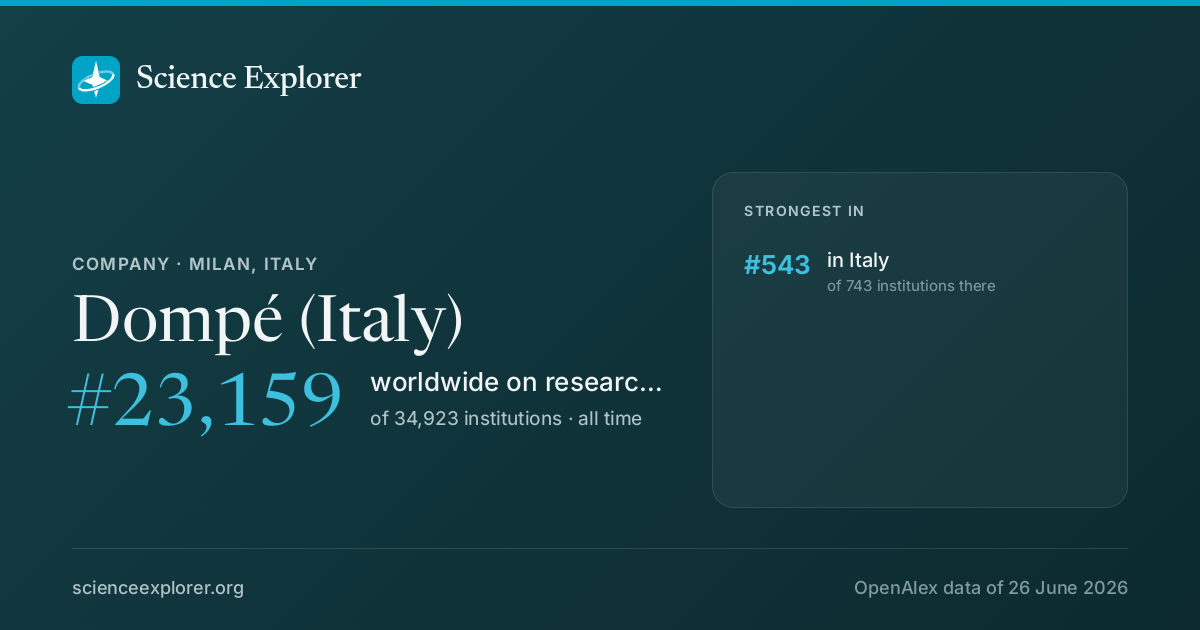
Company · Milan · Italy

Dompé (Italy)

World rank, all time
#23,159
of 34,923
Rank in Italy
#543
of 743
Research works
233
▲ 85% vs 2018-21
Citations
5k
21.4 per fractional work
Top-10% rate
15.7%
all institutions 10.0%
vs its own fields
0.94×
1.00× is exactly expected
Open access
38%
world 40%
International
22%
world 18%

Which fields of science does Dompé (Italy) work in?

In 2022-now, 35% of research at Dompé (Italy) is in Health Sciences, 34% in Life Sciences. Its largest fields are Medicine (34%), Biochemistry, Genetics and Molecular Biology (19%), Computer Science (10%). It does 2.1× the world's share of Life Sciences.

Health Sciences: 17 fractional works · 35.3% of its workMedicine: 17 fractional works · 34.4% of its workOncology: 2 fractional works · 4.3% of its workInfectious Diseases: 2 fractional works · 4.0% of its workRadiology, Nuclear Medicine and Imaging: 2 fractional works · 3.5% of its workPulmonary and Respiratory Medicine: 1 fractional works · 2.9% of its workPhysiology: 1 fractional works · 2.8% of its workPharmacology: 1 fractional works · 2.5% of its workPublic Health, Environmental and Occupational Health: 1 fractional works · 1.7% of its workEpidemiology: 1 fractional works · 1.4% of its workSurgery: 1 fractional works · 1.1% of its workNeurology: 0 fractional works · 1.0% of its workPsychiatry and Mental health: 0 fractional works · 1.0% of its workEndocrinology, Diabetes and Metabolism: 0 fractional works · 0.9% of its workGenetics: 0 fractional works · 0.9% of its workObstetrics and Gynecology: 0 fractional works · 0.7% of its workPediatrics, Perinatology and Child Health: 0 fractional works · 0.7% of its workReproductive Medicine: 0 fractional works · 0.7% of its workOtorhinolaryngology: 0 fractional works · 0.5% of its workRheumatology: 0 fractional works · 0.5% of its workCardiology and Cardiovascular Medicine: 0 fractional works · 0.4% of its workPathology and Forensic Medicine: 0 fractional works · 0.4% of its workOphthalmology: 0 fractional works · 0.4% of its workHematology: 0 fractional works · 0.3% of its workImmunology and Allergy: 0 fractional works · 0.3% of its workDermatology: 0 fractional works · 0.3% of its workNephrology: 0 fractional works · 0.3% of its workCritical Care and Intensive Care Medicine: 0 fractional works · 0.2% of its workSmaller subfields together: 0 fractional works · 0.8% of its workHealth Professions: 0 fractional works · 0.8% of its workEmergency Medical Services: 0 fractional works · 0.4% of its workMedical Laboratory Technology: 0 fractional works · 0.3% of its workNursing: 0 fractional works · 0.2% of its workLife Sciences: 17 fractional works · 33.7% of its workBiochemistry, Genetics and Molecular Biology: 9 fractional works · 19.0% of its workMolecular Biology: 8 fractional works · 15.6% of its workGenetics: 0 fractional works · 1.0% of its workBiophysics: 0 fractional works · 0.7% of its workCell Biology: 0 fractional works · 0.6% of its workBiochemistry: 0 fractional works · 0.4% of its workCancer Research: 0 fractional works · 0.3% of its workStructural Biology: 0 fractional works · 0.2% of its workSmaller subfields together: 0 fractional works · 0.2% of its workNeuroscience: 3 fractional works · 6.5% of its workCellular and Molecular Neuroscience: 2 fractional works · 4.0% of its workBehavioral Neuroscience: 0 fractional works · 0.8% of its workSensory Systems: 0 fractional works · 0.8% of its workCognitive Neuroscience: 0 fractional works · 0.3% of its workNeurology: 0 fractional works · 0.3% of its workEndocrine and Autonomic Systems: 0 fractional works · 0.2% of its workSmaller subfields together: 0 fractional works · 0.1% of its workImmunology and Microbiology: 2 fractional works · 4.4% of its workImmunology: 2 fractional works · 4.0% of its workMicrobiology: 0 fractional works · 0.3% of its workPharmacology, Toxicology and Pharmaceutics: 2 fractional works · 3.3% of its workPharmaceutical Science: 1 fractional works · 2.1% of its workPharmacology: 1 fractional works · 1.3% of its workAgricultural and Biological Sciences: 0 fractional works · 0.4% of its workInsect Science: 0 fractional works · 0.2% of its workSmaller subfields together: 0 fractional works · 0.2% of its workPhysical Sciences: 12 fractional works · 23.5% of its workComputer Science: 5 fractional works · 9.8% of its workComputational Theory and Mathematics: 4 fractional works · 7.5% of its workArtificial Intelligence: 0 fractional works · 0.7% of its workHardware and Architecture: 0 fractional works · 0.5% of its workInformation Systems: 0 fractional works · 0.4% of its workHuman-Computer Interaction: 0 fractional works · 0.3% of its workComputer Networks and Communications: 0 fractional works · 0.3% of its workSmaller subfields together: 0 fractional works · 0.1% of its workEngineering: 2 fractional works · 4.9% of its workBiomedical Engineering: 1 fractional works · 1.8% of its workMechanical Engineering: 1 fractional works · 1.2% of its workElectrical and Electronic Engineering: 0 fractional works · 0.9% of its workComputational Mechanics: 0 fractional works · 0.7% of its workSmaller subfields together: 0 fractional works · 0.3% of its workMaterials Science: 2 fractional works · 3.6% of its workMaterials Chemistry: 1 fractional works · 2.7% of its workBiomaterials: 0 fractional works · 0.8% of its workSmaller subfields together: 0 fractional works · 0.1% of its workChemistry: 1 fractional works · 2.8% of its workOrganic Chemistry: 1 fractional works · 1.1% of its workPhysical and Theoretical Chemistry: 0 fractional works · 0.9% of its workInorganic Chemistry: 0 fractional works · 0.3% of its workAnalytical Chemistry: 0 fractional works · 0.2% of its workSmaller subfields together: 0 fractional works · 0.2% of its workPhysics and Astronomy: 1 fractional works · 1.1% of its workAtomic and Molecular Physics, and Optics: 0 fractional works · 0.6% of its workStatistical and Nonlinear Physics: 0 fractional works · 0.4% of its workEnvironmental Science: 0 fractional works · 0.7% of its workEcology: 0 fractional works · 0.4% of its workEnvironmental Chemistry: 0 fractional works · 0.3% of its workEnergy: 0 fractional works · 0.7% of its workEnergy Engineering and Power Technology: 0 fractional works · 0.7% of its workSocial Sciences: 4 fractional works · 7.4% of its workSocial Sciences: 2 fractional works · 3.2% of its workSociology and Political Science: 1 fractional works · 2.3% of its workEducation: 0 fractional works · 0.7% of its workDemography: 0 fractional works · 0.2% of its workSmaller subfields together: 0 fractional works · 0.0% of its workDecision Sciences: 1 fractional works · 2.6% of its workInformation Systems and Management: 1 fractional works · 1.7% of its workManagement Science and Operations Research: 0 fractional works · 0.7% of its workStatistics, Probability and Uncertainty: 0 fractional works · 0.2% of its workSmaller subfields together: 0 fractional works · 0.0% of its workPsychology: 0 fractional works · 1.0% of its workSocial Psychology: 0 fractional works · 0.6% of its workDevelopmental and Educational Psychology: 0 fractional works · 0.3% of its workSmaller subfields together: 0 fractional works · 0.1% of its workArts and Humanities: 0 fractional works · 0.7% of its workHistory: 0 fractional works · 0.7% of its workALL ITS WORKDompé (Italy)49fractional works, 2022-now
Life Sciences34%Physical Sciences24%Health Sciences35%Social Sciences7%

Each ring splits the one inside it: the four domains of science, their fields, their subfields. Size is fractional works in 2022-now. Every slice is a page; the interactive view zooms down to single topics and colours each by how much more of it this institution does than the world.

Its 4 domains and 19 fields, with their numbers
    1. Medicine1734.4%
    2. Health Professions00.8%
    3. Nursing00.2%
    1. Biochemistry, Genetics and Molecular Biology919.0%
    2. Neuroscience36.5%
    3. Immunology and Microbiology24.4%
    4. Pharmacology, Toxicology and Pharmaceutics23.3%
    5. Agricultural and Biological Sciences00.4%
    1. Computer Science59.8%
    2. Engineering24.9%
    3. Materials Science23.6%
    4. Chemistry12.8%
    5. Physics and Astronomy11.1%
    6. Environmental Science00.7%
    7. Energy00.7%
    1. Social Sciences23.2%
    2. Decision Sciences12.6%
    3. Psychology01.0%
    4. Arts and Humanities00.7%
All of science, and how each field's share has moved since 1950: the Science domain explorer

Field profile

Location quotient across every field it publishes in: outside the ring is more than an institution of this size would be expected to publish, inside it is less.

Agricultural and Biological Sciences: 0.09× its world share, 0 worksAgricultural and Bio…Biochemistry, Genetics and Molecular Biology: 3.56× its world share, 9 worksBiochemistry, Geneti…Immunology and Microbiology: 4.33× its world share, 2 worksImmunology and Micro…Neuroscience: 4.03× its world share, 3 worksNeurosciencePharmacology, Toxicology and Pharmaceutics: 9.51× its world share, 2 worksPharmacology, Toxico…Chemistry: 1.76× its world share, 1 worksChemistryComputer Science: 1.26× its world share, 5 worksComputer ScienceEnergy: 0.74× its world share, 0 worksEnergyEngineering: 0.33× its world share, 2 worksEngineeringEnvironmental Science: 0.14× its world share, 0 worksEnvironmental ScienceMaterials Science: 1.03× its world share, 2 worksMaterials SciencePhysics and Astronomy: 0.48× its world share, 0 worksPhysics and AstronomyHealth Professions: 0.30× its world share, 0 worksHealth ProfessionsMedicine: 1.79× its world share, 17 worksMedicineNursing: 0.34× its world share, 0 worksNursingArts and Humanities: 0.23× its world share, 0 worksArts and HumanitiesDecision Sciences: 2.70× its world share, 1 worksDecision SciencesPsychology: 0.32× its world share, 0 worksPsychologySocial Sciences: 0.25× its world share, 2 worksSocial Sciences1×world share
more than its size predictsabout as predictedless

Rings at 0.5×, 1× and 2×. Widest outward: Pharmacology, Toxicology and Pharmaceutics, 9.5×. Every wedge is a field page.

All 19 fields, with their numbers
  1. Pharmacology, Toxicology and Pharmaceutics9.51×2 works
  2. Immunology and Microbiology4.33×2 works
  3. Neuroscience4.03×3 works
  4. Biochemistry, Genetics and Molecular Biology3.56×9 works
  5. Decision Sciences2.70×1 works
  6. Medicine1.79×17 works
  7. Chemistry1.76×1 works
  8. Computer Science1.26×5 works
  9. Materials Science1.03×2 works
  10. Energy0.74×0 works
  11. Physics and Astronomy0.48×0 works
  12. Nursing0.34×0 works
  13. Engineering0.33×2 works
  14. Psychology0.32×0 works
  15. Health Professions0.30×0 works
  16. Social Sciences0.25×2 works
  17. Arts and Humanities0.23×0 works
  18. Environmental Science0.14×0 works
  19. Agricultural and Biological Sciences0.09×0 works

Who are the top researchers at Dompé (Italy)?

Ranked on the quality score, Marcello Allegretti, Pier Adelchi Ruffini and Andrea R. Beccari lead among researchers whose main affiliation is Dompé (Italy).

  1. 1 Marcello Allegretti Italy · #332,696 worldwide 7k citations · 215 works
  2. 2 Pier Adelchi Ruffini Italy · #434,458 worldwide 3.3k citations · 76 works
  3. 3 Andrea R. Beccari Italy · #463,538 worldwide 3.2k citations · 168 works
  4. 4 Daniela Iaconis Italy · #500,593 worldwide 1.5k citations · 50 works
  5. 5 Maria De Pizzol Italy · #734,091 worldwide 2.7k citations · 36 works
  6. 6 Riccardo Bertini Italy · #1,295,664 worldwide 5.5k citations · 90 works
  7. 7 Carmine Talarico Italy · #1,332,038 worldwide 1.4k citations · 102 works
  8. 8 Francesco De Blasio Italy · #1,369,047 worldwide 1.5k citations · 88 works
  9. 9 Vito Di Cioccio Italy · #1,447,174 worldwide 1.2k citations · 20 works
  10. 10 Laura Brandolini Italy · #1,452,041 worldwide 1.9k citations · 97 works
All ranked researchers at Dompé (Italy)

What are the most cited papers from Dompé (Italy)?

The most cited paper from Dompé (Italy) is "CXCR1 and CXCR2 Chemokine Receptor Agonists Produced by Tumors Induce Neutrophil Extracellular Traps that Interfere with Immune Cytotoxicity" (Álvaro Teijeira et al., 2020), with 802 citations. Next come "Multimer Formation and Ligand Recognition by the Long Pentraxin PTX3" (386) and "X-ray screening identifies active site and allosteric inhibitors of SARS-CoV-2 main protease" (377).

Most cited papers
#PaperReleasedCitations
1 CXCR1 and CXCR2 Chemokine Receptor Agonists Produced by Tumors Induce Neutrophil Extracellular Traps that Interfere with Immune Cytotoxicity Álvaro Teijeira et al. · Immunity Open access 13 Apr 2020 802
2 Multimer Formation and Ligand Recognition by the Long Pentraxin PTX3 Barbara Bottazzi, Valérie Vouret‐Craviari, Antonio Bastone et al. · Journal of Biological Chemistry Open access Dec 1997 386
3 X-ray screening identifies active site and allosteric inhibitors of SARS-CoV-2 main protease Sebastian Günther et al. · Science Open access104 authors 2 Apr 2021 377
4 Italian version of the Epworth sleepiness scale: external validity Luca Vignatelli, Giuseppe Plazzi, Alfredo Barbato et al. · Neurological Sciences Open access Feb 2003 372
5 Topical Recombinant Human Nerve Growth Factor (Cenegermin) for Neurotrophic Keratopathy Stephen Carl Pflugfelder, Mina Massaro‐Giordano, Victor L. Perez et al. · Ophthalmology Open access 26 Aug 2019 284
All 60 most cited papers, with filters and sorting

Which keywords describe research at Dompé (Italy)?

By fractional works in 2022-now, weighted toward what it does more of than the world: Pharmacokinetics, Medicinal Chemistry, Molecular Docking, Virtual Screening, Machine Learning, Inflammation, SARS-CoV-2 and Neuronal Plasticity.

▲ more of its work than of the world's◆ about the world's share▼ less than the world's

Size is fractional works in 2022-now in the topics tagged with each word; colour is the word's share of this institution's work against its share of the world's. The 40 words are chosen for being large and distinctive. Each links to the topic it comes from most.

All 40 words, with their numbers
  1. Machine Learning5▲ 3.3×7 topics
  2. Inflammation4▲ 4.0×27 topics
  3. Medicinal Chemistry4▲ 32×5 topics
  4. Pharmacokinetics4▲ 32×4 topics
  5. Molecular Docking4▲ 61×1 topic
  6. Virtual Screening4▲ 82×1 topic
  7. Epidemiology3▲ 1.49×16 topics
  8. Depression2▲ 5.5×5 topics
  9. Pandemic2▲ 4.8×5 topics
  10. SARS-CoV-22▲ 15×3 topics
  11. Cancer2▲ 3.3×13 topics
  12. Neuronal Plasticity2▲ 77×2 topics
  13. Genomics2▲ 15×4 topics
  14. ACE2 Receptor2▲ 17×2 topics
  15. Bioinformatics2▲ 34×3 topics
  16. Immunity2▲ 8.8×6 topics
  17. Molecular Dynamics2▲ 21×3 topics
  18. Education2▲ 1.95×2 topics
  19. Protein2▲ 26×3 topics
  20. Synaptic Plasticity2▲ 15×2 topics
  21. BDNF2▲ 141×1 topic
  22. Neurotrophins2▲ 141×1 topic
  23. Spinal Cord Injury2▲ 68×2 topics
  24. Big Data1▲ 3.0×2 topics
  25. Oxidative Stress1▲ 1.76×11 topics
  26. Quality of Life1▲ 2.0×7 topics
  27. Thrombosis1▲ 10×3 topics
  28. Curriculum1▲ 26×1 topic
  29. Mutation1▲ 14×3 topics
  30. Training1▲ 13×1 topic
  31. Wound Healing1▲ 9.7×2 topics
  32. COVID-191▲ 1.85×6 topics
  33. Corneal Regeneration1▲ 85×1 topic
  34. Limbal Stem Cells1▲ 85×1 topic
  35. Stem Cell Therapy1▲ 27×2 topics
  36. Tissue Engineering1▲ 4.0×2 topics
  37. Coronavirus1▲ 11×1 topic
  38. Immune Response1▲ 3.9×3 topics
  39. Vaccine1▲ 5.6×2 topics
  40. spike protein1▲ 22×1 topic

Which research topics does Dompé (Italy) publish most on?

By volume in 2022-now: Computational Drug Discovery Methods, Nerve injury and regeneration, Genetics, Bioinformatics, and Biomedical Research and Corneal Surgery and Treatments.

  1. 1 Computational Drug Discovery Methods Computational Theory and Mathematics 4 works
  2. 2 Nerve injury and regeneration Cellular and Molecular Neuroscience 2 works
  3. 3 Genetics, Bioinformatics, and Biomedical Research Molecular Biology 1 works
  4. 4 Corneal Surgery and Treatments Radiology, Nuclear Medicine and Imaging 1 works
  5. 5 SARS-CoV-2 and COVID-19 Research Infectious Diseases 1 works
  6. 6 Protein Structure and Dynamics Molecular Biology 1 works
  7. 7 COVID-19 Clinical Research Studies Infectious Diseases 1 works
  8. 8 Machine Learning in Materials Science Materials Chemistry 1 works
  9. 9 Ocular Surface and Contact Lens Public Health, Environmental and Occupational Health 1 works
  10. 10 Pain Mechanisms and Treatments Physiology 1 works

How open and international is its research?

Against the world's own shares: the tick on each track. Both are shares of its output, so they sit on one scale and can be read against each other as well as against the world.

openly available38.5%not open61.5%

World: 40% of research is openly available.

with international co-authors22.0%domestic only78.0%

World: 18% is written across borders.

How has Dompé (Italy)'s research output changed?

Output in 2022-2025 was 85% higher than in 2018-2021.

still counting1990200020102020
grewheldshrank

The same series as a ribbon: one cell per year, darker for more. The line above answers how much; this answers when.

Its share of all research

Growing output can still be a shrinking share: all of science grows. This is Dompé (Italy) as a percentage of every work published that year, 0.00019% in 2024.

still counting0.00050%0.0010%0.0015%Dompé (Italy)0.00013% in 202519801990200020102020

Fractional works of Dompé (Italy) over all fractional works that year. How the balance of science has shifted.

Other research institutions in Milan

All research institutions in Milan

Share Dompé (Italy)'s ranking

Dompé (Italy) on Science Explorer

A card with Dompé (Italy)'s standing and the fields it leads in, for a post or a slide. A link to this page previews as the same card.

Download the card

1200 × 630 PNG, sized for social posts, drawn from the latest snapshot.

Badges for a website1Each links back here and updates with every snapshot

Research measures only: rankings here say nothing about teaching, admissions or student experience. Comparable institutions and collaboration partners have tabs of their own, above.

Discussion

Ask a question or share a note about Dompé (Italy). Keep it to the research: no personal attacks, advertising or links. Any reader can report a post, which collapses it for everyone until it is opened.