Science Explorer Back to mapMap
Discussion
Company · Friedrichshafen · Germany

Dornier Flugzeugwerke (Germany)

In research, Dornier Flugzeugwerke (Germany) stands highest in Physical Sciences (#5,942 of 17,446 worldwide), Engineering (#3,905 of 9,532 worldwide) and Aerospace Engineering (#1,018 of 1,601 worldwide), over all time.

World rank, all time
#10,067
of 34,923
Rank in Germany
#500
of 1,603
Research works
783
▼ 2% vs 2018-21
Citations
9.7k
12.4 per fractional work
Top-10% rate
9.2%
all institutions 10.0%
vs its own fields
1.01×
1.00× is exactly expected
Open access
9%
world 40%
International
15%
world 18%

What is Dornier Flugzeugwerke (Germany) known for in research?

The fields where it stands highest, over all time, ranked among every institution above the floor in each field.

FieldWorld rankWhere that sitsTop-10% rateWorks
Physical SciencesDomain #5,942 of 17,446 5.1%630
EngineeringField #3,905 of 9,532 5.0%418
Aerospace EngineeringSubfield #1,018 of 1,601 4.3%147

Each strip is that field's whole ranked pool, with the notch where Dornier Flugzeugwerke (Germany) sits in it, in the colour of the band that rank falls in. The track under the rate is the rate itself: it carries no average mark, because the average differs by field (from about 6% in Dentistry to 21% in Economics).

Which fields of science does Dornier Flugzeugwerke (Germany) work in?

In all years, 80% of research at Dornier Flugzeugwerke (Germany) is in Physical Sciences, 10% in Social Sciences. Its largest fields are Engineering (53%), Physics and Astronomy (7%), Medicine (6%). It does 2.0× the world's share of Physical Sciences.

Physical Sciences: 630 fractional works · 80.4% of its workEngineering: 418 fractional works · 53.3% of its workAerospace Engineering: 147 fractional works · 18.8% of its workElectrical and Electronic Engineering: 56 fractional works · 7.1% of its workComputational Mechanics: 51 fractional works · 6.5% of its workMechanical Engineering: 43 fractional works · 5.5% of its workBiomedical Engineering: 22 fractional works · 2.8% of its workMechanics of Materials: 20 fractional works · 2.5% of its workControl and Systems Engineering: 20 fractional works · 2.5% of its workCivil and Structural Engineering: 15 fractional works · 1.9% of its workOcean Engineering: 11 fractional works · 1.4% of its workIndustrial and Manufacturing Engineering: 11 fractional works · 1.4% of its workAutomotive Engineering: 9 fractional works · 1.2% of its workMedia Technology: 4 fractional works · 0.5% of its workSafety, Risk, Reliability and Quality: 4 fractional works · 0.5% of its workBuilding and Construction: 3 fractional works · 0.4% of its workPhysics and Astronomy: 57 fractional works · 7.3% of its workAstronomy and Astrophysics: 24 fractional works · 3.1% of its workAtomic and Molecular Physics, and Optics: 17 fractional works · 2.2% of its workCondensed Matter Physics: 4 fractional works · 0.5% of its workRadiation: 3 fractional works · 0.4% of its workInstrumentation: 3 fractional works · 0.4% of its workStatistical and Nonlinear Physics: 2 fractional works · 0.3% of its workNuclear and High Energy Physics: 2 fractional works · 0.3% of its workMaterials Science: 44 fractional works · 5.6% of its workMaterials Chemistry: 28 fractional works · 3.6% of its workCeramics and Composites: 4 fractional works · 0.5% of its workElectronic, Optical and Magnetic Materials: 3 fractional works · 0.4% of its workGeneral Materials Science: 3 fractional works · 0.4% of its workSurfaces, Coatings and Films: 2 fractional works · 0.3% of its workPolymers and Plastics: 2 fractional works · 0.3% of its workSmaller subfields together: 1 fractional works · 0.1% of its workComputer Science: 39 fractional works · 5.0% of its workComputer Networks and Communications: 10 fractional works · 1.3% of its workHardware and Architecture: 7 fractional works · 0.9% of its workArtificial Intelligence: 5 fractional works · 0.7% of its workComputer Vision and Pattern Recognition: 4 fractional works · 0.5% of its workComputational Theory and Mathematics: 4 fractional works · 0.5% of its workInformation Systems: 3 fractional works · 0.4% of its workSoftware: 3 fractional works · 0.4% of its workSignal Processing: 2 fractional works · 0.3% of its workSmaller subfields together: 2 fractional works · 0.2% of its workEarth and Planetary Sciences: 20 fractional works · 2.5% of its workOceanography: 9 fractional works · 1.2% of its workAtmospheric Science: 7 fractional works · 0.9% of its workGeophysics: 2 fractional works · 0.2% of its workSmaller subfields together: 2 fractional works · 0.2% of its workEnvironmental Science: 17 fractional works · 2.2% of its workGlobal and Planetary Change: 6 fractional works · 0.7% of its workEnvironmental Engineering: 5 fractional works · 0.6% of its workPollution: 2 fractional works · 0.3% of its workWater Science and Technology: 2 fractional works · 0.2% of its workSmaller subfields together: 3 fractional works · 0.4% of its workEnergy: 12 fractional works · 1.5% of its workRenewable Energy, Sustainability and the Environment: 9 fractional works · 1.2% of its workEnergy Engineering and Power Technology: 2 fractional works · 0.3% of its workSmaller subfields together: 0 fractional works · 0.0% of its workMathematics: 11 fractional works · 1.4% of its workApplied Mathematics: 8 fractional works · 1.0% of its workSmaller subfields together: 3 fractional works · 0.4% of its workChemistry: 6 fractional works · 0.8% of its workSpectroscopy: 3 fractional works · 0.3% of its workInorganic Chemistry: 2 fractional works · 0.3% of its workSmaller subfields together: 1 fractional works · 0.2% of its workChemical Engineering: 6 fractional works · 0.8% of its workCatalysis: 3 fractional works · 0.3% of its workBioengineering: 2 fractional works · 0.3% of its workSmaller subfields together: 1 fractional works · 0.2% of its workSocial Sciences: 77 fractional works · 9.8% of its workSocial Sciences: 24 fractional works · 3.0% of its workSociology and Political Science: 7 fractional works · 0.9% of its workPolitical Science and International Relations: 4 fractional works · 0.6% of its workTransportation: 4 fractional works · 0.5% of its workAnthropology: 2 fractional works · 0.3% of its workSmaller subfields together: 6 fractional works · 0.8% of its workPsychology: 17 fractional works · 2.2% of its workClinical Psychology: 9 fractional works · 1.1% of its workExperimental and Cognitive Psychology: 6 fractional works · 0.7% of its workSocial Psychology: 2 fractional works · 0.3% of its workSmaller subfields together: 1 fractional works · 0.1% of its workArts and Humanities: 16 fractional works · 2.0% of its workLiterature and Literary Theory: 3 fractional works · 0.4% of its workHistory and Philosophy of Science: 3 fractional works · 0.4% of its workPhilosophy: 3 fractional works · 0.4% of its workMuseology: 2 fractional works · 0.2% of its workSmaller subfields together: 4 fractional works · 0.6% of its workBusiness, Management and Accounting: 9 fractional works · 1.1% of its workStrategy and Management: 3 fractional works · 0.4% of its workManagement of Technology and Innovation: 3 fractional works · 0.4% of its workSmaller subfields together: 2 fractional works · 0.3% of its workDecision Sciences: 8 fractional works · 1.0% of its workStatistics, Probability and Uncertainty: 4 fractional works · 0.6% of its workManagement Science and Operations Research: 3 fractional works · 0.3% of its workSmaller subfields together: 1 fractional works · 0.1% of its workEconomics, Econometrics and Finance: 3 fractional works · 0.4% of its workEconomics and Econometrics: 3 fractional works · 0.4% of its workSmaller subfields together: 0 fractional works · 0.0% of its workHealth Sciences: 58 fractional works · 7.3% of its workMedicine: 47 fractional works · 6.1% of its workSurgery: 12 fractional works · 1.5% of its workPhysiology: 6 fractional works · 0.7% of its workPulmonary and Respiratory Medicine: 5 fractional works · 0.7% of its workPublic Health, Environmental and Occupational Health: 4 fractional works · 0.6% of its workEpidemiology: 2 fractional works · 0.3% of its workPathology and Forensic Medicine: 2 fractional works · 0.3% of its workPsychiatry and Mental health: 2 fractional works · 0.3% of its workRadiology, Nuclear Medicine and Imaging: 2 fractional works · 0.2% of its workSmaller subfields together: 12 fractional works · 1.5% of its workHealth Professions: 8 fractional works · 1.1% of its workGeneral Health Professions: 5 fractional works · 0.7% of its workPhysical Therapy, Sports Therapy and Rehabilitation: 2 fractional works · 0.2% of its workSmaller subfields together: 2 fractional works · 0.2% of its workDentistry: 1 fractional works · 0.2% of its workLife Sciences: 19 fractional works · 2.5% of its workBiochemistry, Genetics and Molecular Biology: 10 fractional works · 1.2% of its workMolecular Biology: 4 fractional works · 0.5% of its workPhysiology: 2 fractional works · 0.3% of its workSmaller subfields together: 3 fractional works · 0.4% of its workAgricultural and Biological Sciences: 4 fractional works · 0.6% of its workPlant Science: 4 fractional works · 0.5% of its workSmaller subfields together: 1 fractional works · 0.1% of its workNeuroscience: 3 fractional works · 0.4% of its workCognitive Neuroscience: 2 fractional works · 0.2% of its workSmaller subfields together: 1 fractional works · 0.2% of its workPharmacology, Toxicology and Pharmaceutics: 1 fractional works · 0.1% of its workImmunology and Microbiology: 1 fractional works · 0.1% of its workALL ITS WORKDornierFlugzeugwerke…783fractional works, all years
Life Sciences2%Physical Sciences80%Health Sciences7%Social Sciences10%

Each ring splits the one inside it: the four domains of science, their fields, their subfields. Size is fractional works in all years. Every slice is a page; the interactive view zooms down to single topics and colours each by how much more of it this institution does than the world.

Its 4 domains and 26 fields, with their numbers
    1. Engineering41853.3%
    2. Physics and Astronomy577.3%
    3. Materials Science445.6%
    4. Computer Science395.0%
    5. Earth and Planetary Sciences202.5%
    6. Environmental Science172.2%
    7. Energy121.5%
    8. Mathematics111.4%
    9. Chemistry60.8%
    10. Chemical Engineering60.8%
    1. Social Sciences243.0%
    2. Psychology172.2%
    3. Arts and Humanities162.0%
    4. Business, Management and Accounting91.1%
    5. Decision Sciences81.0%
    6. Economics, Econometrics and Finance30.4%
    1. Medicine476.1%
    2. Health Professions81.1%
    3. Dentistry10.2%
    4. Nursing00.0%
    5. Veterinary00.0%
    1. Biochemistry, Genetics and Molecular Biology101.2%
    2. Agricultural and Biological Sciences40.6%
    3. Neuroscience30.4%
    4. Pharmacology, Toxicology and Pharmaceutics10.1%
    5. Immunology and Microbiology10.1%
All of science, and how each field's share has moved since 1950: the Science domain explorer

Field profile

Location quotient across every field it publishes in: outside the ring is more than an institution of this size would be expected to publish, inside it is less.

Agricultural and Biological Sciences: 0.19× its world share, 0 worksAgricultural and Bio…Biochemistry, Genetics and Molecular Biology: 0.65× its world share, 1 worksBiochemistry, Geneti…Neuroscience: 0.31× its world share, 0 worksNeuroscienceChemistry: 0.10× its world share, 0 worksChemistryComputer Science: 0.36× its world share, 0 worksComputer ScienceEarth and Planetary Sciences: 1.97× its world share, 1 worksEarth and Planetary …Energy: 3.23× its world share, 1 worksEnergyEngineering: 0.55× its world share, 2 worksEngineeringEnvironmental Science: 0.14× its world share, 0 worksEnvironmental ScienceMaterials Science: 0.20× its world share, 0 worksMaterials SciencePhysics and Astronomy: 0.64× its world share, 0 worksPhysics and AstronomyHealth Professions: 1.15× its world share, 1 worksHealth ProfessionsMedicine: 0.86× its world share, 3 worksMedicineArts and Humanities: 9.01× its world share, 5 worksArts and HumanitiesPsychology: 0.91× its world share, 0 worksPsychologySocial Sciences: 2.10× its world share, 5 worksSocial Sciences1×world share
more than its size predictsabout as predictedless

Rings at 0.5×, 1× and 2×. Widest outward: Arts and Humanities, 9.0×. Every wedge is a field page.

All 16 fields, with their numbers
  1. Arts and Humanities9.01×5 works
  2. Energy3.23×1 works
  3. Social Sciences2.10×5 works
  4. Earth and Planetary Sciences1.97×1 works
  5. Health Professions1.15×1 works
  6. Psychology0.91×0 works
  7. Medicine0.86×3 works
  8. Biochemistry, Genetics and Molecular Biology0.65×1 works
  9. Physics and Astronomy0.64×0 works
  10. Engineering0.55×2 works
  11. Computer Science0.36×0 works
  12. Neuroscience0.31×0 works
  13. Materials Science0.20×0 works
  14. Agricultural and Biological Sciences0.19×0 works
  15. Environmental Science0.14×0 works
  16. Chemistry0.10×0 works

Who are the top researchers at Dornier Flugzeugwerke (Germany)?

Ranked on the quality score, Werner Haase, W. Gerhard and Carsten Plog lead among researchers whose main affiliation is Dornier Flugzeugwerke (Germany).

  1. 1 Werner Haase Germany · #2,061,806 worldwide 956 citations · 88 works
  2. 2 W. Gerhard Germany · #2,262,959 worldwide 433 citations · 20 works
  3. 3 Carsten Plog Germany · #2,542,425 worldwide 1.4k citations · 53 works
  4. 4 Martin Kirscht Germany · #3,276,771 worldwide 260 citations · 20 works
  5. 5 Bernhard Specht Germany · #3,282,424 worldwide 205 citations · 25 works
  6. 6 Rudolf Zahn Germany · #3,282,668 worldwide 429 citations · 29 works
  7. 7 Harald Klingelhöller Germany · #3,413,793 worldwide 6 citations · 19 works
  8. 8 Francisco González Díaz Germany · #4,122,868 worldwide 4 citations · 36 works
  9. 9 Helmut Funke Germany · #4,592,494 worldwide 198 citations · 37 works
  10. 10 Ch. Stenzel Germany · #4,640,122 worldwide 350 citations · 37 works
All ranked researchers at Dornier Flugzeugwerke (Germany)

What are the most cited papers from Dornier Flugzeugwerke (Germany)?

The most cited paper from Dornier Flugzeugwerke (Germany) is "Numerical solution of the Euler equations by finite volume methods using Runge Kutta time stepping schemes" (A. Jameson, Wolfgang M. Schmidt, Eli Turkel, 1981), with 2,334 citations. Next come "First Clinical Experience with Extracorporeally Induced Destruction of Kidney Stones by Shock Waves" (779) and "Advanced ceramic matrix composite materials for current and future propulsion technology applications" (614).

Most cited papers
#PaperReleasedCitations
1 Numerical solution of the Euler equations by finite volume methods using Runge Kutta time stepping schemes A. Jameson, Wolfgang M. Schmidt, Eli Turkel Conference paper 23 Jun 1981 2,334
2 First Clinical Experience with Extracorporeally Induced Destruction of Kidney Stones by Shock Waves CHRISTIAN G. CHAUSSY, EGBERT SCHMIEDT, Bieter Jocham et al. · The Journal of Urology Mar 1982 779
3 Advanced ceramic matrix composite materials for current and future propulsion technology applications Stephan Schmidt, Steffen Beyer, H. Knabe et al. · Acta Astronautica Aug 2004 614
4 SCIAMACHY—scanning imaging absorption spectrometer for atmospheric chartography John P. Burrows, Erhard Hölzle, A.P.H. Goede et al. · Acta Astronautica Apr 1995 542
5 Metallic bipolar plates for PEM fuel cells Jordan Wind, Richard Späh, Werner M. Kaiser et al. · Journal of Power Sources Mar 2002 419
All 59 most cited papers, with filters and sorting

Which keywords describe research at Dornier Flugzeugwerke (Germany)?

By fractional works in all years, weighted toward what it does more of than the world: Thermal Analysis, CubeSat, small satellite, Heat Transfer, Vibration Analysis, Thermodynamic Modeling, Cryogenic Storage and Liquefied Natural Gas (LNG).

▲ more of its work than of the world's◆ about the world's share▼ less than the world's

Size is fractional works in all years in the topics tagged with each word; colour is the word's share of this institution's work against its share of the world's. The 40 words are chosen for being large and distinctive. Each links to the topic it comes from most.

All 40 words, with their numbers
  1. Thermal Analysis32▲ 28×5 topics
  2. CubeSat30▲ 153×1 topic
  3. small satellite30▲ 153×1 topic
  4. Heat Transfer26▲ 6.7×13 topics
  5. Mechanical Properties22▲ 3.0×20 topics
  6. Vibration Analysis20▲ 8.5×7 topics
  7. Thermodynamic Modeling20▲ 15×2 topics
  8. Cryogenic Storage20▲ 70×1 topic
  9. Liquefied Natural Gas (LNG)20▲ 70×1 topic
  10. Renewable Energy19▲ 2.5×14 topics
  11. Large-Eddy Simulation17▲ 8.9×5 topics
  12. Thermal Management17▲ 7.4×7 topics
  13. Adaptive Mesh Refinement14▲ 20×2 topics
  14. High-Order Schemes14▲ 20×2 topics
  15. Radial Basis Functions14▲ 18×2 topics
  16. Vortex Dynamics13▲ 10×3 topics
  17. Turbulent Flows13▲ 13×3 topics
  18. Shock-Wave Interactions13▲ 29×1 topic
  19. Turbulence Modeling13▲ 29×1 topic
  20. Boundary Layer Transition12▲ 16×1 topic
  21. Particle Image Velocimetry12▲ 16×1 topic
  22. Control Systems12▲ 5.9×7 topics
  23. Simulation11▲ 4.4×8 topics
  24. Numerical Simulation11▲ 4.3×11 topics
  25. Finite Element Method10▲ 9.8×5 topics
  26. Fluid Dynamics10▲ 8.3×4 topics
  27. Orbit Determination9▲ 28×2 topics
  28. Hydrological Modeling9▲ 5.7×2 topics
  29. Kinetic Theory9▲ 18×2 topics
  30. Fracture Mechanics8▲ 13×2 topics
  31. Mars8▲ 22×1 topic
  32. Martian Surface8▲ 22×1 topic
  33. Numerical Methods8▲ 9.3×2 topics
  34. Combustion Instabilities8▲ 14×2 topics
  35. Boltzmann Equation8▲ 29×1 topic
  36. Rarefied Flows8▲ 29×1 topic
  37. Materials Science8▲ 12×2 topics
  38. Two-Phase Flow8▲ 11×3 topics
  39. Mathematical Modeling7▲ 8.3×2 topics
  40. Hybrid Rocket Propulsion7▲ 33×1 topic

Which research topics does Dornier Flugzeugwerke (Germany) publish most on?

By volume in 2022-now: Historical Studies and Socio-cultural Analysis, Medical and Health Sciences Research, French Urban and Social Studies and Linguistics and Discourse Analysis.

  1. 1 Historical Studies and Socio-cultural Analysis History and Philosophy of Science 1 works
  2. 2 Medical and Health Sciences Research Public Health, Environmental and Occupational Health 1 works
  3. 3 French Urban and Social Studies Sociology and Political Science 1 works
  4. 4 Linguistics and Discourse Analysis Philosophy 1 works
  5. 5 Caribbean and African Literature and Culture Religious studies 0 works
  6. 6 Digitalization, Law, and Regulation Law 0 works
  7. 7 Freedom of Expression and Defamation Law 0 works
  8. 8 Cutaneous lymphoproliferative disorders research Dermatology 0 works
  9. 9 Lymphatic System and Diseases Oncology 0 works
  10. 10 Privacy, Security, and Data Protection Sociology and Political Science 0 works

How open and international is its research?

Against the world's own shares: the tick on each track. Both are shares of its output, so they sit on one scale and can be read against each other as well as against the world.

openly available9.3%not open90.7%

World: 40% of research is openly available.

with international co-authors15.4%domestic only84.6%

World: 18% is written across borders.

How has Dornier Flugzeugwerke (Germany)'s research output changed?

Output in 2022-2025 was 2% lower than in 2018-2021.

still counting1990200020102020
grewheldshrank

The same series as a ribbon: one cell per year, darker for more. The line above answers how much; this answers when.

Its share of all research

Growing output can still be a shrinking share: all of science grows. This is Dornier Flugzeugwerke (Germany) as a percentage of every work published that year, 0.000099% in 2024.

still counting0.0025%0.0050%0.0075%Dornier Flugzeugwerke (Germany)0.0000063% in 202519801990200020102020

Fractional works of Dornier Flugzeugwerke (Germany) over all fractional works that year. How the balance of science has shifted.

How much of it reaches the world top 10%

Year by year, against all institutions in the same year.

5%10%15%all institutions10.0% in 2005Dornier Flugzeugwerke (Germany)3.2% in 20052000

Of each year's output, the share that reached the world's 10% most cited for its field and year. Peak 8.8% in 1990.

Other research institutions in Friedrichshafen

All research institutions in Friedrichshafen

Share Dornier Flugzeugwerke (Germany)'s ranking
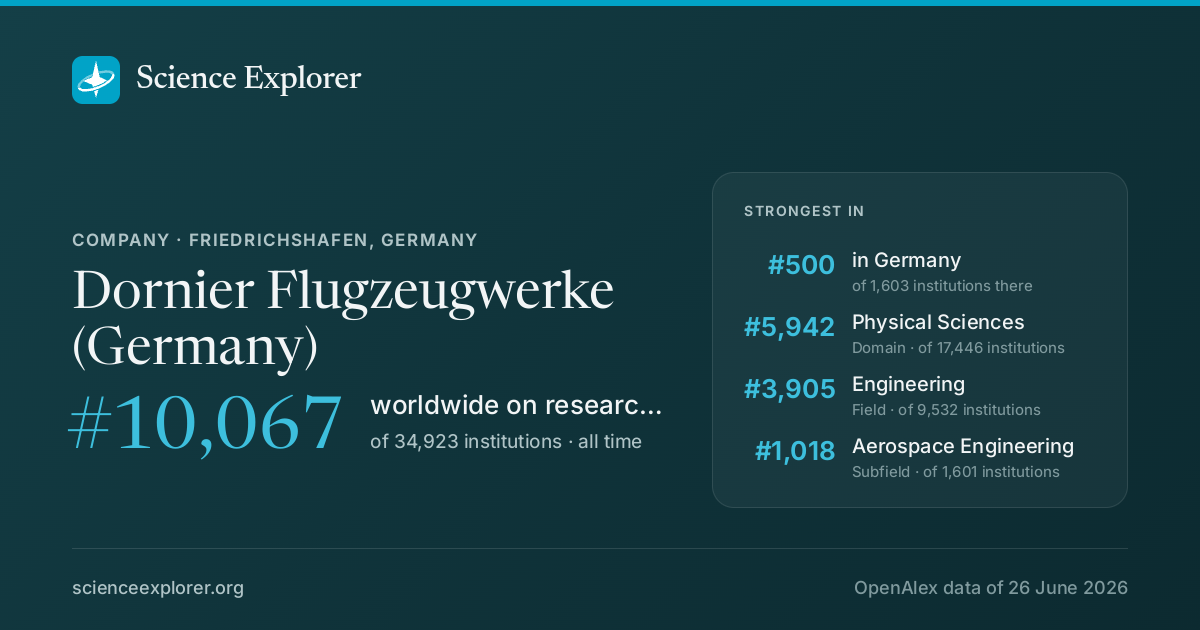
Dornier Flugzeugwerke (Germany) on Science Explorer

A card with Dornier Flugzeugwerke (Germany)'s standing and the fields it leads in, for a post or a slide. A link to this page previews as the same card.

Download the card

1200 × 630 PNG, sized for social posts, drawn from the latest snapshot.

Badges for a website1Each links back here and updates with every snapshot

Research measures only: rankings here say nothing about teaching, admissions or student experience. Comparable institutions and collaboration partners have tabs of their own, above.

Discussion

Ask a question or share a note about Dornier Flugzeugwerke (Germany). Posts are plain text and can be reported.