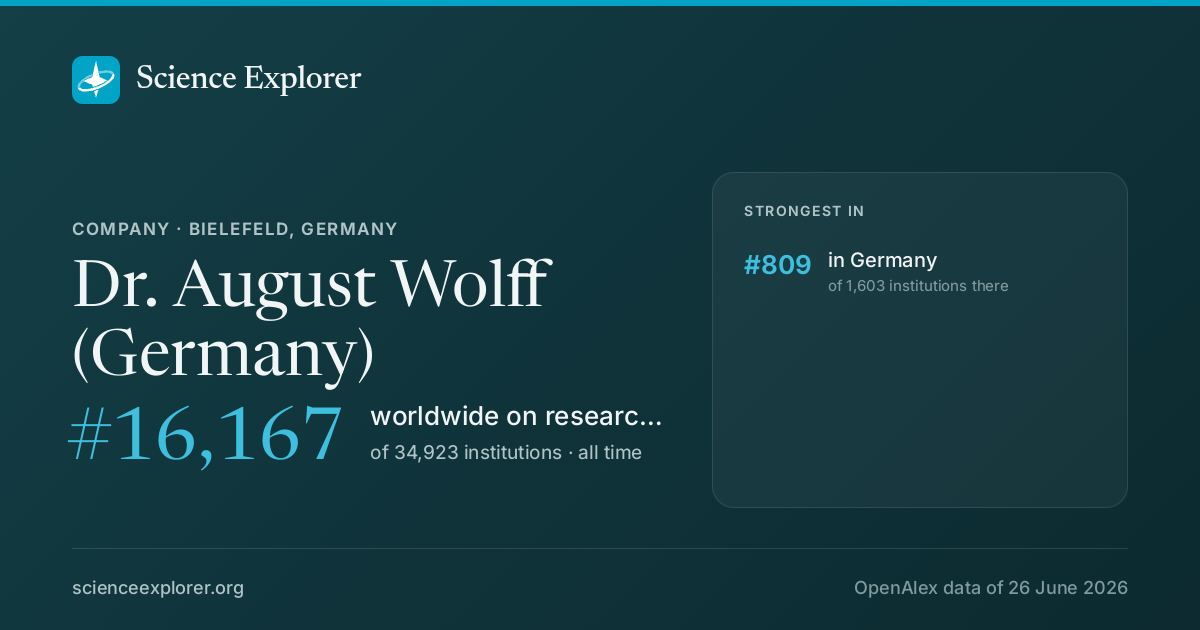
- World rank, all time
- #16,167 of 34,923
- Rank in Germany
- #809 of 1,603
- Research works
- 220 ▼ 20% vs 2018-21
- Citations
- 4.4k 20.1 per fractional work
- Top-10% rate
- 15.1% all institutions 10.0%
- vs its own fields
- 1.10× 1.00× is exactly expected
- Open access
- 32% world 40%
- International
- 26% world 18%
Which fields of science does Dr. August Wolff (Germany) work in?
In 2022-now, 43% of research at Dr. August Wolff (Germany) is in Health Sciences, 28% in Social Sciences. Its largest fields are Medicine (23%), Business, Management and Accounting (19%), Dentistry (17%). It does 1.7× the world's share of Health Sciences.
Each ring splits the one inside it: the four domains of science, their fields, their subfields. Size is fractional works in 2022-now. Every slice is a page; the interactive view zooms down to single topics and colours each by how much more of it this institution does than the world.
Its 4 domains and 17 fields, with their numbers
- Health Sciences1942.7%
- Medicine1123.5%
- Dentistry816.7%
- Health Professions12.6%
- Social Sciences1327.7%
- Physical Sciences919.0%
- Engineering37.3%
- Computer Science24.5%
- Materials Science13.0%
- Chemistry12.9%
- Environmental Science11.4%
- Life Sciences510.5%
Field profile
Location quotient across every field it publishes in: outside the ring is more than an institution of this size would be expected to publish, inside it is less.
Rings at 0.5×, 1× and 2×. Widest outward: Dentistry, 34.4×. Every wedge is a field page.
All 17 fields, with their numbers
- Dentistry34.37×8 works
- Business, Management and Accounting6.02×9 works
- Pharmacology, Toxicology and Pharmaceutics5.02×1 works
- Decision Sciences3.66×2 works
- Neuroscience2.11×2 works
- Chemistry1.88×1 works
- Medicine1.22×11 works
- Health Professions0.97×1 works
- Immunology and Microbiology0.95×0 works
- Materials Science0.86×1 works
- Biochemistry, Genetics and Molecular Biology0.64×2 works
- Computer Science0.57×2 works
- Engineering0.48×3 works
- Social Sciences0.35×2 works
- Environmental Science0.28×1 works
- Agricultural and Biological Sciences0.19×0 works
- Economics, Econometrics and Finance0.19×0 works
- Dentistry 34.4×
- Business, Management and Accounting 6.0×
- Pharmacology, Toxicology and Pharmaceutics 5.0×
- Decision Sciences 3.7×
- Neuroscience 2.1×
- Chemistry 1.9×
- Medicine 1.2×
- Health Professions 1.0×
- Immunology and Microbiology 0.9×
- Materials Science 0.9×
- Biochemistry, Genetics and Molecular Biology 0.6×
- Computer Science 0.6×
- Engineering 0.5×
- Social Sciences 0.3×
- Environmental Science 0.3×
- Agricultural and Biological Sciences 0.2×
- Economics, Econometrics and Finance 0.2×
Who are the top researchers at Dr. August Wolff (Germany)?
Ranked on the quality score, Frederic Meyer, Joachim Enax and Erik Schulze zur Wiesche lead among researchers whose main affiliation is Dr. August Wolff (Germany).
- 1
Frederic Meyer
 Germany · #119,982 worldwide
1.8k citations · 55 works
- 2
Joachim Enax
Germany · #180,858 worldwide
2.3k citations · 86 works
- 3
Erik Schulze zur Wiesche
Germany · #1,084,979 worldwide
464 citations · 62 works
- 4
Ana Kilić
Germany · #1,920,310 worldwide
1.7k citations · 57 works
- 5
Clarissa Masur
Germany · #2,109,605 worldwide
956 citations · 39 works
- 6
Hermann Lutz
Germany · #2,259,180 worldwide
129 citations · 17 works
- 7
Matthias Rasztar
Germany · #2,475,087 worldwide
24 citations · 31 works
- 8
Christoph Abels
Germany · #2,482,047 worldwide
5.4k citations · 215 works
- 9
Sascha Stürze
Germany · #2,746,745 worldwide
7 citations · 27 works
- 10
Ulrich Knie
Germany · #2,822,927 worldwide
633 citations · 35 works
Which keywords describe research at Dr. August Wolff (Germany)?
By fractional works in 2022-now, weighted toward what it does more of than the world: Customer Relationship Management, Information Technology, Big Data, Dental Caries, Dental Erosion, Tooth Whitening, Digital Capital and Value Chains.
- Neuroenhancement
- IMC
- Customer Equity
- Cognitive Enhancement
- Biomineralization
- Restorative Dentistry
- Dental Materials
- Oral Microbiome
- Menopause
- Business Models
- Mobile Health
- Customer Experience
- Supply Chain Management
- Electronic Word-of-Mouth
- Artificial Intelligence
- Value Chains
- Tooth Whitening
- Dental Caries
- Big Data
- Epidemiology
- Customer Relationship Management
- Information Technology
- Quality of Life
- Dental Erosion
- Digital Capital
- Risk Factors
- E-commerce
- Social Media
- Fluoride
- Global Burden
- Oral Health
- Digital Transformation
- Staphylococcus aureus
- Periodontal Diseases
- Ionic Liquids
- Agile Manufacturing
- Churn Prediction
- Collaborative Networks
- Data Cleaning
- Integrated Marketing Communication
Size is fractional works in 2022-now in the topics tagged with each word; colour is the word's share of this institution's work against its share of the world's. The 40 words are chosen for being large and distinctive. Each links to the topic it comes from most.
All 40 words, with their numbers
- Customer Relationship Management4▲ 71×2 topics
- Epidemiology4▲ 1.97×14 topics
- Information Technology4▲ 16×2 topics
- Big Data3▲ 7.7×5 topics
- Quality of Life3▲ 4.6×8 topics
- Dental Caries3▲ 61×2 topics
- Dental Erosion3▲ 272×1 topic
- Tooth Whitening3▲ 272×1 topic
- Digital Capital2▲ 315×1 topic
- Value Chains2▲ 315×1 topic
- Risk Factors2▲ 4.6×4 topics
- Artificial Intelligence2▲ 3.1×3 topics
- E-commerce2▲ 7.7×2 topics
- Electronic Word-of-Mouth2▲ 36×1 topic
- Social Media2▲ 3.2×1 topic
- Supply Chain Management2▲ 4.9×4 topics
- Fluoride2▲ 73×2 topics
- Customer Experience2▲ 25×2 topics
- Global Burden2▲ 6.4×1 topic
- Mobile Health2▲ 24×2 topics
- Oral Health2▲ 59×1 topic
- Business Models2▲ 45×1 topic
- Digital Transformation2▲ 6.1×1 topic
- Menopause1▲ 58×2 topics
- Staphylococcus aureus1▲ 37×2 topics
- Oral Microbiome1▲ 45×1 topic
- Periodontal Diseases1▲ 45×1 topic
- Dental Materials1▲ 45×1 topic
- Ionic Liquids1▲ 8.4×4 topics
- Restorative Dentistry1▲ 45×1 topic
- Agile Manufacturing1▲ 115×1 topic
- Biomineralization1▲ 30×3 topics
- Churn Prediction1▲ 124×1 topic
- Cognitive Enhancement1▲ 47×1 topic
- Collaborative Networks1▲ 115×1 topic
- Customer Equity1▲ 124×1 topic
- Data Cleaning1▲ 76×1 topic
- IMC1▲ 255×1 topic
- Integrated Marketing Communication1▲ 255×1 topic
- Neuroenhancement1▲ 107×1 topic
Which research topics does Dr. August Wolff (Germany) publish most on?
By volume in 2022-now: Dental Erosion and Treatment, Corporate Governance and Management, Digital Marketing and Social Media and Dental Health and Care Utilization.
Area is fractional works; colour is the subfield each topic belongs to.
- 1 Dental Erosion and Treatment Orthodontics 3 works
- 2 Corporate Governance and Management Strategy and Management 2 works
- 3 Digital Marketing and Social Media Sociology and Political Science 2 works
- 4 Dental Health and Care Utilization Periodontics 2 works
- 5 Digital Innovation in Industries Management of Technology and Innovation 2 works
- 6 Oral microbiology and periodontitis research Periodontics 1 works
- 7 Dental materials and restorations Orthodontics 1 works
- 8 Collaboration in agile enterprises Management of Technology and Innovation 1 works
- 9 Outsourcing and Supply Chain Management Management Information Systems 1 works
- 10 Data Quality and Management Management Science and Operations Research 1 works
How open and international is its research?
Against the world's own shares: the tick on each track. Both are shares of its output, so they sit on one scale and can be read against each other as well as against the world.
World: 40% of research is openly available.
World: 18% is written across borders.
How has Dr. August Wolff (Germany)'s research output changed?
Output in 2022-2025 was 20% lower than in 2018-2021.
The same series as a ribbon: one cell per year, darker for more. The line above answers how much; this answers when.
Its share of all research
Growing output can still be a shrinking share: all of science grows. This is Dr. August Wolff (Germany) as a percentage of every work published that year, 0.00012% in 2024.
Fractional works of Dr. August Wolff (Germany) over all fractional works that year. How the balance of science has shifted.
Other research institutions in Bielefeld
- Bielefeld University
- Hochschule Bielefeld
- Klinikum Bielefeld
- Evangelisches Krankenhaus Bielefeld
- Fachhochschule des Mittelstands
- Francis Hospital
- v. Bodelschwing Foundation Bethel
- Fachhochschule der Diakonie
Share Dr. August Wolff (Germany)'s ranking
Badges for a website1Each links back here and updates with every snapshot

Research measures only: rankings here say nothing about teaching, admissions or student experience. Comparable institutions and collaboration partners have tabs of their own, above.
Discussion
Ask a question or share a note about Dr. August Wolff (Germany). Posts are plain text and can be reported.