Science Explorer Back to mapMap
Discussion
University · Algiers · Algeria

École Nationale d'Administration

World rank, all time
#26,107
of 34,923
Rank in Algeria
#79
of 89
Research works
171
▼ 47% vs 2018-21
Citations
404
2.4 per fractional work
Top-10% rate
10.3%
all institutions 10.0%
vs its own fields
0.99×
1.00× is exactly expected
Open access
48%
world 40%
International
35%
world 18%

Which fields of science does École Nationale d'Administration work in?

In 2022-now, 42% of research at École Nationale d'Administration is in Physical Sciences, 33% in Social Sciences. Its largest fields are Social Sciences (17%), Engineering (13%), Medicine (11%).

Physical Sciences: 9 fractional works · 41.5% of its workEngineering: 3 fractional works · 12.7% of its workControl and Systems Engineering: 1 fractional works · 4.6% of its workMechanics of Materials: 1 fractional works · 3.2% of its workAerospace Engineering: 0 fractional works · 1.4% of its workMechanical Engineering: 0 fractional works · 1.0% of its workIndustrial and Manufacturing Engineering: 0 fractional works · 0.9% of its workComputational Mechanics: 0 fractional works · 0.8% of its workElectrical and Electronic Engineering: 0 fractional works · 0.5% of its workBiomedical Engineering: 0 fractional works · 0.3% of its workEnvironmental Science: 2 fractional works · 9.2% of its workHealth, Toxicology and Mutagenesis: 1 fractional works · 4.7% of its workWater Science and Technology: 1 fractional works · 4.4% of its workComputer Science: 2 fractional works · 8.6% of its workArtificial Intelligence: 1 fractional works · 3.1% of its workComputer Networks and Communications: 0 fractional works · 2.2% of its workInformation Systems: 0 fractional works · 1.5% of its workComputer Vision and Pattern Recognition: 0 fractional works · 1.2% of its workComputer Science Applications: 0 fractional works · 0.3% of its workSignal Processing: 0 fractional works · 0.3% of its workMaterials Science: 1 fractional works · 4.0% of its workElectronic, Optical and Magnetic Materials: 0 fractional works · 1.5% of its workPolymers and Plastics: 0 fractional works · 1.5% of its workMaterials Chemistry: 0 fractional works · 1.0% of its workSmaller subfields together: 0 fractional works · 0.0% of its workEnergy: 1 fractional works · 3.3% of its workRenewable Energy, Sustainability and the Environment: 1 fractional works · 3.3% of its workMathematics: 1 fractional works · 3.0% of its workApplied Mathematics: 0 fractional works · 1.5% of its workStatistics and Probability: 0 fractional works · 1.5% of its workSmaller subfields together: 0 fractional works · 0.0% of its workEarth and Planetary Sciences: 0 fractional works · 0.8% of its workAtmospheric Science: 0 fractional works · 0.8% of its workSocial Sciences: 7 fractional works · 32.7% of its workSocial Sciences: 4 fractional works · 16.9% of its workPolitical Science and International Relations: 1 fractional works · 4.4% of its workEducation: 1 fractional works · 3.7% of its workGeneral Social Sciences: 1 fractional works · 2.3% of its workSociology and Political Science: 0 fractional works · 2.2% of its workGender Studies: 0 fractional works · 1.9% of its workSafety Research: 0 fractional works · 1.2% of its workCultural Studies: 0 fractional works · 0.8% of its workLaw: 0 fractional works · 0.3% of its workBusiness, Management and Accounting: 1 fractional works · 6.5% of its workStrategy and Management: 1 fractional works · 5.9% of its workMarketing: 0 fractional works · 0.3% of its workOrganizational Behavior and Human Resource Management: 0 fractional works · 0.3% of its workArts and Humanities: 1 fractional works · 3.5% of its workPhilosophy: 0 fractional works · 1.4% of its workArcheology: 0 fractional works · 1.0% of its workVisual Arts and Performing Arts: 0 fractional works · 0.5% of its workConservation: 0 fractional works · 0.3% of its workHistory: 0 fractional works · 0.3% of its workPsychology: 1 fractional works · 2.6% of its workClinical Psychology: 0 fractional works · 1.5% of its workSocial Psychology: 0 fractional works · 0.8% of its workNeuropsychology and Physiological Psychology: 0 fractional works · 0.4% of its workDecision Sciences: 0 fractional works · 2.2% of its workGeneral Decision Sciences: 0 fractional works · 1.5% of its workStatistics, Probability and Uncertainty: 0 fractional works · 0.4% of its workManagement Science and Operations Research: 0 fractional works · 0.3% of its workEconomics, Econometrics and Finance: 0 fractional works · 1.0% of its workFinance: 0 fractional works · 0.8% of its workEconomics and Econometrics: 0 fractional works · 0.3% of its workHealth Sciences: 5 fractional works · 20.4% of its workMedicine: 2 fractional works · 11.0% of its workEpidemiology: 0 fractional works · 2.2% of its workCritical Care and Intensive Care Medicine: 0 fractional works · 1.8% of its workFamily Practice: 0 fractional works · 1.5% of its workInfectious Diseases: 0 fractional works · 1.5% of its workPhysiology: 0 fractional works · 1.5% of its workPublic Health, Environmental and Occupational Health: 0 fractional works · 1.3% of its workHealth Informatics: 0 fractional works · 0.5% of its workSurgery: 0 fractional works · 0.5% of its workGastroenterology: 0 fractional works · 0.3% of its workHealth Professions: 2 fractional works · 9.4% of its workOccupational Therapy: 1 fractional works · 3.7% of its workGeneral Health Professions: 1 fractional works · 3.2% of its workEmergency Medical Services: 0 fractional works · 1.5% of its workRadiological and Ultrasound Technology: 0 fractional works · 0.8% of its workHealth Information Management: 0 fractional works · 0.3% of its workLife Sciences: 1 fractional works · 5.4% of its workAgricultural and Biological Sciences: 1 fractional works · 3.9% of its workEcology, Evolution, Behavior and Systematics: 0 fractional works · 1.1% of its workForestry: 0 fractional works · 1.1% of its workSoil Science: 0 fractional works · 1.1% of its workPlant Science: 0 fractional works · 0.6% of its workImmunology and Microbiology: 0 fractional works · 1.5% of its workApplied Microbiology and Biotechnology: 0 fractional works · 1.5% of its workALL ITS WORKÉcole Nationaled'Administration23fractional works, 2022-now
Life Sciences5%Physical Sciences42%Health Sciences20%Social Sciences33%

Each ring splits the one inside it: the four domains of science, their fields, their subfields. Size is fractional works in 2022-now. Every slice is a page; the interactive view zooms down to single topics and colours each by how much more of it this institution does than the world.

Its 4 domains and 17 fields, with their numbers
    1. Engineering312.7%
    2. Environmental Science29.2%
    3. Computer Science28.6%
    4. Materials Science14.0%
    5. Energy13.3%
    6. Mathematics13.0%
    7. Earth and Planetary Sciences00.8%
    1. Social Sciences416.9%
    2. Business, Management and Accounting16.5%
    3. Arts and Humanities13.5%
    4. Psychology12.6%
    5. Decision Sciences02.2%
    6. Economics, Econometrics and Finance01.0%
    1. Medicine211.0%
    2. Health Professions29.4%
    1. Agricultural and Biological Sciences13.9%
    2. Immunology and Microbiology01.5%
All of science, and how each field's share has moved since 1950: the Science domain explorer

Field profile

Location quotient across every field it publishes in: outside the ring is more than an institution of this size would be expected to publish, inside it is less.

Agricultural and Biological Sciences: 0.82× its world share, 1 worksAgricultural and Bio…Immunology and Microbiology: 1.47× its world share, 0 worksImmunology and Micro…Computer Science: 1.11× its world share, 2 worksComputer ScienceEarth and Planetary Sciences: 0.47× its world share, 0 worksEarth and Planetary …Energy: 3.61× its world share, 1 worksEnergyEngineering: 0.85× its world share, 3 worksEngineeringEnvironmental Science: 1.84× its world share, 2 worksEnvironmental ScienceMaterials Science: 1.14× its world share, 1 worksMaterials ScienceMathematics: 2.51× its world share, 1 worksMathematicsHealth Professions: 3.56× its world share, 2 worksHealth ProfessionsMedicine: 0.57× its world share, 2 worksMedicineArts and Humanities: 1.21× its world share, 1 worksArts and HumanitiesBusiness, Management and Accounting: 2.01× its world share, 2 worksBusiness, Management…Decision Sciences: 2.29× its world share, 0 worksDecision SciencesEconomics, Econometrics and Finance: 0.48× its world share, 0 worksEconomics, Econometr…Psychology: 0.85× its world share, 1 worksPsychologySocial Sciences: 1.34× its world share, 4 worksSocial Sciences1×world share
more than its size predictsabout as predictedless

Rings at 0.5×, 1× and 2×. Widest outward: Energy, 3.6×. Every wedge is a field page.

All 17 fields, with their numbers
  1. Energy3.61×1 works
  2. Health Professions3.56×2 works
  3. Mathematics2.51×1 works
  4. Decision Sciences2.29×0 works
  5. Business, Management and Accounting2.01×2 works
  6. Environmental Science1.84×2 works
  7. Immunology and Microbiology1.47×0 works
  8. Social Sciences1.34×4 works
  9. Arts and Humanities1.21×1 works
  10. Materials Science1.14×1 works
  11. Computer Science1.11×2 works
  12. Engineering0.85×3 works
  13. Psychology0.85×1 works
  14. Agricultural and Biological Sciences0.82×1 works
  15. Medicine0.57×2 works
  16. Economics, Econometrics and Finance0.48×0 works
  17. Earth and Planetary Sciences0.47×0 works

Who are the top researchers at École Nationale d'Administration?

Ranked on the quality score, Taib Essaid lead among researchers whose main affiliation is École Nationale d'Administration.

  1. 1 Taib Essaid Algeria · #4,536,162 worldwide 0 citations · 16 works
All ranked researchers at École Nationale d'Administration

What are the most cited papers from École Nationale d'Administration?

The most cited paper from École Nationale d'Administration is "Biomarkers of meat tenderness: Present knowledge and perspectives in regards to our current understanding of the mechanisms involved" (Ahmed Amine Ouali, Mohammed Gagaoua, Yasmine Boudida et al., 2013), with 290 citations. Next come "A review of Algerian medicinal plants used in the treatment of diabetes" (98) and "Green synthesis of CuO nanoparticles using Malva sylvestris leaf extract with different copper precursors and their effect on nitrocellulose thermal behavior" (74).

Most cited papers
#PaperReleasedCitations
1 Biomarkers of meat tenderness: Present knowledge and perspectives in regards to our current understanding of the mechanisms involved Ahmed Amine Ouali, Mohammed Gagaoua, Yasmine Boudida et al. · Meat Science Open access 29 May 2013 290
2 A review of Algerian medicinal plants used in the treatment of diabetes Nawel Hamza, Bénédicte Berke, Anwar Umar et al. · Journal of Ethnopharmacology Open access 5 Apr 2019 98
3 Green synthesis of CuO nanoparticles using Malva sylvestris leaf extract with different copper precursors and their effect on nitrocellulose thermal behavior Abdenacer Benhammada, Djalal Trache · Journal of Thermal Analysis and Calorimetry 4 Feb 2021 74
4 Hydrothermal Synthesis of Hematite Nanoparticles Decorated on Carbon Mesospheres and Their Synergetic Action on the Thermal Decomposition of Nitrocellulose Abdenacer Benhammada, Djalal Trache, Mohamed Kesraoui et al. · Nanomaterials Open access 18 May 2020 68
5 Potentialities of steady-state and transient thermography in breast tumour depth detection: A numerical study Amina Amri, Susan Helen Pulko, Anthony James Wilkinson · Computer Methods and Programs in Biomedicine 25 Sep 2015 57
All 101 most cited papers, with filters and sorting

Which keywords describe research at École Nationale d'Administration?

By fractional works in 2022-now, weighted toward what it does more of than the world: Sustainability, Environmental Management, Public Health, Climate Change, Public Policy, Gender, Religion and Small and Medium Enterprises.

▲ more of its work than of the world's◆ about the world's share▼ less than the world's

Size is fractional works in 2022-now in the topics tagged with each word; colour is the word's share of this institution's work against its share of the world's. The 21 words are chosen for being large and distinctive. Each links to the topic it comes from most.

All 21 words, with their numbers
  1. Sustainability3▲ 5.4×6 topics
  2. Climate Change2▲ 3.4×5 topics
  3. Environmental Management2▲ 22×2 topics
  4. Public Health2▲ 6.0×4 topics
  5. Epidemiology2▲ 1.65×5 topics
  6. Gender1▲ 11×3 topics
  7. Public Policy1▲ 12×3 topics
  8. Sustainable Development1▲ 3.7×2 topics
  9. Religion1▲ 12×2 topics
  10. Healthcare Access1▲ 17×1 topic
  11. Human Rights1▲ 4.6×2 topics
  12. Latin America1▲ 25×2 topics
  13. Small and Medium Enterprises1▲ 29×3 topics
  14. Water Quality1▲ 12×1 topic
  15. Family Law1▲ 102×1 topic
  16. Health Promotion1▲ 14×2 topics
  17. Integration1▲ 31×1 topic
  18. Management Systems1▲ 502×1 topic
  19. Reform1▲ 70×1 topic
  20. Resource Management1▲ 26×1 topic
  21. Water Governance1▲ 479×1 topic

Which research topics does École Nationale d'Administration publish most on?

By volume in 2022-now: Public Health and Environmental Issues, Water Resource Management and Quality, Multiculturalism, Politics, Migration, Gender and Quality and Management Systems.

  1. 1 Public Health and Environmental Issues Health, Toxicology and Mutagenesis 1 works
  2. 2 Water Resource Management and Quality Water Science and Technology 1 works
  3. 3 Multiculturalism, Politics, Migration, Gender Political Science and International Relations 1 works
  4. 4 Quality and Management Systems Strategy and Management 1 works
  5. 5 Global Energy and Sustainability Research Renewable Energy, Sustainability and the Environment 1 works
  6. 6 Breastfeeding Practices and Influences Epidemiology 0 works
  7. 7 Occupational Health and Safety in Workplaces Occupational Therapy 0 works
  8. 8 Health and Medical Education General Health Professions 0 works
  9. 9 Process Optimization and Integration Control and Systems Engineering 0 works
  10. 10 Nosocomial Infections in ICU Critical Care and Intensive Care Medicine 0 works

How open and international is its research?

Against the world's own shares: the tick on each track. Both are shares of its output, so they sit on one scale and can be read against each other as well as against the world.

openly available48.5%not open51.5%

World: 40% of research is openly available.

with international co-authors34.8%domestic only65.2%

World: 18% is written across borders.

How has École Nationale d'Administration's research output changed?

Output in 2022-2025 was 47% lower than in 2018-2021.

still counting1990200020102020
grewheldshrank

The same series as a ribbon: one cell per year, darker for more. The line above answers how much; this answers when.

Its share of all research

Growing output can still be a shrinking share: all of science grows. This is École Nationale d'Administration as a percentage of every work published that year, 0.000024% in 2024.

still counting0.00020%0.00040%0.00060%École Nationale d'Administration0.000080% in 202519801990200020102020

Fractional works of École Nationale d'Administration over all fractional works that year. How the balance of science has shifted.

Other research institutions in Algiers

All research institutions in Algiers

Share École Nationale d'Administration's ranking
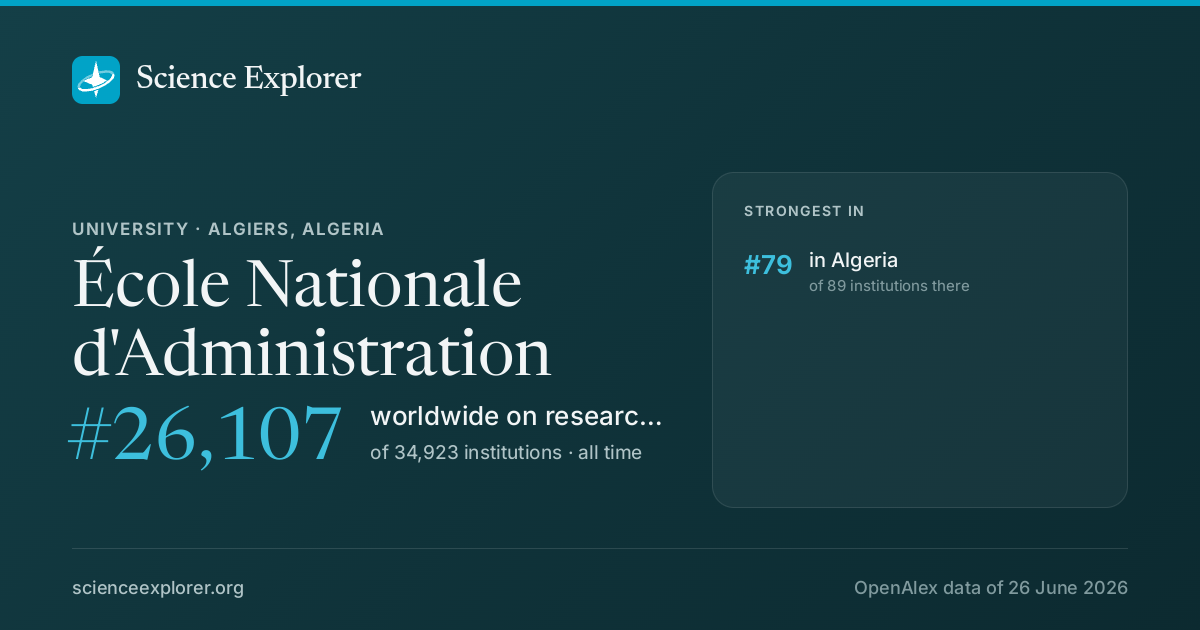
École Nationale d'Administration on Science Explorer

A card with École Nationale d'Administration's standing and the fields it leads in, for a post or a slide. A link to this page previews as the same card.

Download the card

1200 × 630 PNG, sized for social posts, drawn from the latest snapshot.

Badges for a website1Each links back here and updates with every snapshot

Research measures only: rankings here say nothing about teaching, admissions or student experience. Comparable institutions and collaboration partners have tabs of their own, above.

Discussion

Ask a question or share a note about École Nationale d'Administration. Posts are plain text and can be reported.