Environment Park
In research, Environment Park stands highest in Physical Sciences (#7,428 of 17,446 worldwide), over all time.
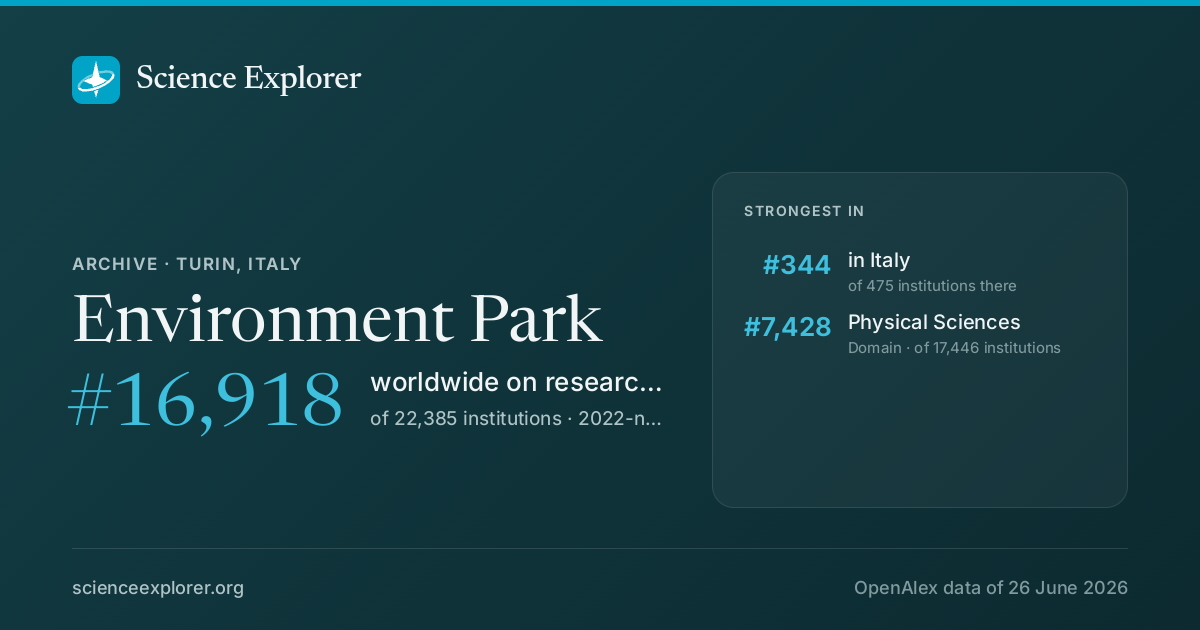
- World rank, 2022-now
- #16,918 of 22,385 · #13,395 all time
- Rank in Italy
- #344 of 475
- Research works
- 317 ▲ 32% vs 2018-21
- Citations
- 6.9k 21.8 per fractional work
- Top-10% rate
- 12.4% all institutions 10.0%
- vs its own fields
- 1.08× 1.00× is exactly expected
- Open access
- 54% world 40%
- International
- 28% world 18%
What is Environment Park known for in research?
The fields where it stands highest, over all time, ranked among every institution above the floor in each field.
| Field | World rank | Where that sits | Top-10% rate | Works |
|---|---|---|---|---|
| Physical SciencesDomain | #7,428 of 17,446 | 11.1% | 167 |
Each strip is that field's whole ranked pool, with the notch where Environment Park sits in it, in the colour of the band that rank falls in. The track under the rate is the rate itself: it carries no average mark, because the average differs by field (from about 6% in Dentistry to 21% in Economics).
Which fields of science does Environment Park work in?
In 2022-now, 64% of research at Environment Park is in Physical Sciences, 14% in Social Sciences. Its largest fields are Engineering (23%), Environmental Science (21%), Earth and Planetary Sciences (7%). It does 1.6× the world's share of Physical Sciences.
Each ring splits the one inside it: the four domains of science, their fields, their subfields. Size is fractional works in 2022-now. Every slice is a page; the interactive view zooms down to single topics and colours each by how much more of it this institution does than the world.
Its 4 domains and 26 fields, with their numbers
- Physical Sciences4964.5%
- Engineering1823.3%
- Environmental Science1620.7%
- Earth and Planetary Sciences56.7%
- Materials Science34.0%
- Computer Science22.8%
- Physics and Astronomy22.4%
- Chemistry11.7%
- Energy11.5%
- Chemical Engineering11.3%
- Mathematics00.1%
- Social Sciences1114.0%
- Life Sciences1013.2%
- Health Sciences68.3%
- Medicine56.2%
- Health Professions11.0%
- Veterinary00.6%
- Dentistry00.4%
- Nursing00.1%
Field profile
Location quotient across every field it publishes in: outside the ring is more than an institution of this size would be expected to publish, inside it is less.
Rings at 0.5×, 1× and 2×. Widest outward: Veterinary, 4.7×. Every wedge is a field page.
All 26 fields, with their numbers
- Veterinary4.67×0 works
- Earth and Planetary Sciences4.28×5 works
- Environmental Science4.16×16 works
- Chemical Engineering3.63×1 works
- Decision Sciences2.40×2 works
- Energy1.62×1 works
- Engineering1.56×18 works
- Agricultural and Biological Sciences1.31×5 works
- Materials Science1.15×3 works
- Chemistry1.09×1 works
- Physics and Astronomy1.07×2 works
- Pharmacology, Toxicology and Pharmaceutics1.05×0 works
- Biochemistry, Genetics and Molecular Biology0.91×4 works
- Immunology and Microbiology0.84×1 works
- Dentistry0.79×0 works
- Psychology0.67×2 works
- Economics, Econometrics and Finance0.66×1 works
- Arts and Humanities0.57×1 works
- Neuroscience0.54×1 works
- Social Sciences0.43×4 works
- Health Professions0.40×1 works
- Business, Management and Accounting0.37×1 works
- Computer Science0.36×2 works
- Medicine0.32×5 works
- Nursing0.18×0 works
- Mathematics0.09×0 works
- Veterinary 4.7×
- Earth and Planetary Sciences 4.3×
- Environmental Science 4.2×
- Chemical Engineering 3.6×
- Decision Sciences 2.4×
- Energy 1.6×
- Engineering 1.6×
- Agricultural and Biological Sciences 1.3×
- Materials Science 1.1×
- Chemistry 1.1×
- Physics and Astronomy 1.1×
- Pharmacology, Toxicology and Pharmaceutics 1.1×
- Biochemistry, Genetics and Molecular Biology 0.9×
- Immunology and Microbiology 0.8×
- Dentistry 0.8×
- Psychology 0.7×
- Economics, Econometrics and Finance 0.7×
- Arts and Humanities 0.6×
- Neuroscience 0.5×
- Social Sciences 0.4×
- Health Professions 0.4×
- Business, Management and Accounting 0.4×
- Computer Science 0.4×
- Medicine 0.3×
- Nursing 0.2×
- Mathematics 0.1×
Who are the top researchers at Environment Park?
Ranked on the quality score, Ramona Viterbi, Bruno Bassano and Domenico D’Angelo lead among researchers whose main affiliation is Environment Park.
- 1
Ramona Viterbi
 Italy · #1,341,333 worldwide
842 citations · 35 works
- 2
Bruno Bassano
Italy · #1,543,992 worldwide
3k citations · 126 works
- 3
Domenico D’Angelo
Italy · #3,680,595 worldwide
545 citations · 29 works
- 4
Paola Zitella
Italy · #4,246,453 worldwide
190 citations · 19 works
- 5
Teodoro Piliego
Italy · #4,398,461 worldwide
270 citations · 17 works
- 6
Sabina Fiorot
Italy · #4,703,440 worldwide
306 citations · 26 works
- 7
Dante Vailati
Italy · #5,078,716 worldwide
141 citations · 24 works
- 8
Giulio Gecchele
Italy · #5,101,049 worldwide
2 citations · 30 works
- 9
Pier Mauro Giachino
Italy · #6,809,959 worldwide
439 citations · 93 works
Which keywords describe research at Environment Park?
By fractional works in 2022-now, weighted toward what it does more of than the world: Climate Change, Invasive Species, Biodiversity, Population Dynamics, Conservation, Lithium-ion Batteries, Habitat Selection and Trophic Cascades.
- Thermal Management
- Education
- Biological Invasions
- Mechanical Properties
- Battery Recycling
- Risk Assessment
- Energy Transition
- Greenhouse Gas Emissions
- Bioinformatics
- Heat Transfer
- Remote Sensing
- Circular Economy
- Metal Recovery
- Habitat Fragmentation
- Animal Movement
- Renewable Energy
- Lithium-ion Batteries
- Population Dynamics
- Biodiversity
- Invasive Species
- Climate Change
- Sustainability
- Environmental Impact
- Conservation
- Habitat Selection
- Trophic Cascades
- Occupancy Rates
- Deep Learning
- Sustainable Development
- Cultural Heritage
- Global Change
- Hydrological Modeling
- Conservation Biology
- Combustion
- Recycling
- Species Richness
- Energy Storage
- Rare Earth Elements
- Colonialism
- Land Use
Size is fractional works in 2022-now in the topics tagged with each word; colour is the word's share of this institution's work against its share of the world's. The 40 words are chosen for being large and distinctive. Each links to the topic it comes from most.
All 40 words, with their numbers
- Climate Change9▲ 4.4×43 topics
- Invasive Species4▲ 11×9 topics
- Sustainability3▲ 1.86×15 topics
- Biodiversity3▲ 5.8×10 topics
- Environmental Impact3▲ 2.5×13 topics
- Population Dynamics3▲ 15×4 topics
- Conservation3▲ 8.2×11 topics
- Lithium-ion Batteries2▲ 8.0×3 topics
- Habitat Selection2▲ 40×2 topics
- Renewable Energy2▲ 1.93×11 topics
- Trophic Cascades2▲ 30×2 topics
- Animal Movement2▲ 53×1 topic
- Occupancy Rates2▲ 53×1 topic
- Habitat Fragmentation2▲ 11×3 topics
- Deep Learning2▼ 0.64×10 topics
- Metal Recovery2▲ 12×3 topics
- Sustainable Development2▲ 1.41×8 topics
- Circular Economy2▲ 7.6×4 topics
- Cultural Heritage2▲ 4.1×7 topics
- Remote Sensing2▲ 1.70×13 topics
- Global Change2▲ 7.3×3 topics
- Heat Transfer2▲ 4.0×8 topics
- Hydrological Modeling1▲ 7.7×5 topics
- Bioinformatics1▲ 15×2 topics
- Conservation Biology1▲ 16×2 topics
- Greenhouse Gas Emissions1▲ 6.5×5 topics
- Combustion1▲ 26×2 topics
- Energy Transition1▲ 11×3 topics
- Recycling1▲ 4.0×4 topics
- Risk Assessment1▲ 2.4×5 topics
- Species Richness1▲ 25×2 topics
- Battery Recycling1▲ 19×1 topic
- Energy Storage1▲ 2.2×3 topics
- Mechanical Properties1▲ 1.43×6 topics
- Rare Earth Elements1▲ 10×1 topic
- Biological Invasions1▲ 15×2 topics
- Colonialism1▲ 2.8×2 topics
- Education1▼ 0.81×4 topics
- Land Use1▲ 25×3 topics
- Thermal Management1▲ 4.2×3 topics
Which research topics does Environment Park publish most on?
By volume in 2022-now: Wildlife Ecology and Conservation, Extraction and Separation Processes, Ecology and Vegetation Dynamics Studies and Species Distribution and Climate Change.
Area is fractional works; colour is the subfield each topic belongs to.
- 1 Wildlife Ecology and Conservation Ecology 2 works
- 2 Extraction and Separation Processes Mechanical Engineering 1 works
- 3 Ecology and Vegetation Dynamics Studies Nature and Landscape Conservation 1 works
- 4 Species Distribution and Climate Change Ecological Modeling 1 works
- 5 Advancements in Battery Materials Electrical and Electronic Engineering 1 works
- 6 GNSS positioning and interference Aerospace Engineering 1 works
- 7 Nuclear reactor physics and engineering Aerospace Engineering 1 works
- 8 Astronomical Observations and Instrumentation Computational Mechanics 1 works
- 9 Mathematics, Computing, and Information Processing Computational Theory and Mathematics 1 works
- 10 Precipitation Measurement and Analysis Atmospheric Science 1 works
How open and international is its research?
Against the world's own shares: the tick on each track. Both are shares of its output, so they sit on one scale and can be read against each other as well as against the world.
World: 40% of research is openly available.
World: 18% is written across borders.
How has Environment Park's research output changed?
Output in 2022-2025 was 32% higher than in 2018-2021.
The same series as a ribbon: one cell per year, darker for more. The line above answers how much; this answers when.
Its share of all research
Growing output can still be a shrinking share: all of science grows. This is Environment Park as a percentage of every work published that year, 0.00024% in 2024.
Fractional works of Environment Park over all fractional works that year. How the balance of science has shifted.
Other research institutions in Turin
- University of Turin
- Politecnico di Torino
- Istituto Nazionale di Ricerca Metrologica
- Tecnologie Avanzate (Italy)
- Ospedale Regina Margherita
- Torino e-district
- Telecom Italia Lab
- Fondazione Ricerca Molinette
Share Environment Park's ranking
Badges for a website1Each links back here and updates with every snapshot

Research measures only: rankings here say nothing about teaching, admissions or student experience. Comparable institutions and collaboration partners have tabs of their own, above.
Discussion
Ask a question or share a note about Environment Park. Keep it to the research: no personal attacks, advertising or links. Any reader can report a post, which collapses it for everyone until it is opened.