Science Explorer Back to mapMap
Discussion
University · Kohat · Pakistan

FATA University

World rank, all time
#29,482
of 34,923
Rank in Pakistan
#195
of 248
Research works
151
▼ 12% vs 2018-21
Citations
1.9k
12.4 per fractional work
Top-10% rate
7.9%
all institutions 10.0%
vs its own fields
0.92×
1.00× is exactly expected
Open access
72%
world 40%
International
42%
world 18%

Which fields of science does FATA University work in?

In 2022-now, 59% of research at FATA University is in Social Sciences, 28% in Physical Sciences. Its largest fields are Social Sciences (23%), Arts and Humanities (15%), Computer Science (10%). It does 2.2× the world's share of Social Sciences.

Social Sciences: 42 fractional works · 59.1% of its workSocial Sciences: 16 fractional works · 22.7% of its workSociology and Political Science: 5 fractional works · 7.0% of its workEducation: 4 fractional works · 5.8% of its workPolitical Science and International Relations: 3 fractional works · 3.7% of its workGender Studies: 1 fractional works · 1.7% of its workSafety Research: 1 fractional works · 1.4% of its workLinguistics and Language: 1 fractional works · 1.1% of its workLaw: 0 fractional works · 0.6% of its workGeography, Planning and Development: 0 fractional works · 0.4% of its workCommunication: 0 fractional works · 0.3% of its workSmaller subfields together: 1 fractional works · 0.8% of its workArts and Humanities: 11 fractional works · 15.5% of its workLiterature and Literary Theory: 5 fractional works · 6.9% of its workLanguage and Linguistics: 3 fractional works · 4.5% of its workVisual Arts and Performing Arts: 1 fractional works · 1.9% of its workPhilosophy: 1 fractional works · 1.0% of its workMuseology: 0 fractional works · 0.7% of its workSmaller subfields together: 0 fractional works · 0.5% of its workBusiness, Management and Accounting: 6 fractional works · 9.1% of its workAccounting: 2 fractional works · 3.2% of its workMarketing: 2 fractional works · 2.2% of its workOrganizational Behavior and Human Resource Management: 2 fractional works · 2.1% of its workManagement of Technology and Innovation: 0 fractional works · 0.6% of its workStrategy and Management: 0 fractional works · 0.5% of its workManagement Information Systems: 0 fractional works · 0.4% of its workSmaller subfields together: 0 fractional works · 0.2% of its workPsychology: 5 fractional works · 6.4% of its workSocial Psychology: 2 fractional works · 2.9% of its workClinical Psychology: 1 fractional works · 1.3% of its workExperimental and Cognitive Psychology: 1 fractional works · 1.3% of its workApplied Psychology: 1 fractional works · 0.7% of its workSmaller subfields together: 0 fractional works · 0.2% of its workEconomics, Econometrics and Finance: 3 fractional works · 4.8% of its workEconomics and Econometrics: 3 fractional works · 4.1% of its workFinance: 0 fractional works · 0.4% of its workGeneral Economics, Econometrics and Finance: 0 fractional works · 0.3% of its workDecision Sciences: 0 fractional works · 0.6% of its workManagement Science and Operations Research: 0 fractional works · 0.6% of its workPhysical Sciences: 20 fractional works · 27.5% of its workComputer Science: 7 fractional works · 9.8% of its workInformation Systems: 3 fractional works · 3.6% of its workArtificial Intelligence: 3 fractional works · 3.5% of its workHuman-Computer Interaction: 1 fractional works · 1.1% of its workComputer Networks and Communications: 1 fractional works · 1.0% of its workComputer Vision and Pattern Recognition: 0 fractional works · 0.4% of its workSmaller subfields together: 0 fractional works · 0.1% of its workEarth and Planetary Sciences: 4 fractional works · 5.7% of its workGeophysics: 3 fractional works · 3.7% of its workEarth-Surface Processes: 1 fractional works · 1.0% of its workGeochemistry and Petrology: 0 fractional works · 0.5% of its workPaleontology: 0 fractional works · 0.2% of its workSmaller subfields together: 0 fractional works · 0.3% of its workEngineering: 3 fractional works · 4.4% of its workElectrical and Electronic Engineering: 1 fractional works · 1.1% of its workMechanics of Materials: 1 fractional works · 1.0% of its workMedia Technology: 0 fractional works · 0.7% of its workCivil and Structural Engineering: 0 fractional works · 0.4% of its workBiomedical Engineering: 0 fractional works · 0.4% of its workSafety, Risk, Reliability and Quality: 0 fractional works · 0.2% of its workSmaller subfields together: 0 fractional works · 0.6% of its workEnvironmental Science: 2 fractional works · 2.6% of its workManagement, Monitoring, Policy and Law: 1 fractional works · 1.4% of its workPollution: 0 fractional works · 0.6% of its workSmaller subfields together: 0 fractional works · 0.6% of its workPhysics and Astronomy: 1 fractional works · 1.8% of its workAtomic and Molecular Physics, and Optics: 1 fractional works · 0.9% of its workAstronomy and Astrophysics: 0 fractional works · 0.3% of its workStatistical and Nonlinear Physics: 0 fractional works · 0.3% of its workNuclear and High Energy Physics: 0 fractional works · 0.2% of its workMathematics: 1 fractional works · 1.7% of its workModeling and Simulation: 0 fractional works · 0.6% of its workGeometry and Topology: 0 fractional works · 0.5% of its workApplied Mathematics: 0 fractional works · 0.4% of its workSmaller subfields together: 0 fractional works · 0.2% of its workMaterials Science: 1 fractional works · 0.8% of its workMaterials Chemistry: 0 fractional works · 0.4% of its workElectronic, Optical and Magnetic Materials: 0 fractional works · 0.3% of its workSmaller subfields together: 0 fractional works · 0.1% of its workEnergy: 0 fractional works · 0.4% of its workRenewable Energy, Sustainability and the Environment: 0 fractional works · 0.3% of its workSmaller subfields together: 0 fractional works · 0.1% of its workChemistry: 0 fractional works · 0.3% of its workHealth Sciences: 5 fractional works · 7.0% of its workHealth Professions: 3 fractional works · 3.8% of its workGeneral Health Professions: 2 fractional works · 2.1% of its workRadiological and Ultrasound Technology: 1 fractional works · 0.9% of its workOccupational Therapy: 0 fractional works · 0.3% of its workHealth Information Management: 0 fractional works · 0.2% of its workSmaller subfields together: 0 fractional works · 0.1% of its workMedicine: 2 fractional works · 3.0% of its workPediatrics, Perinatology and Child Health: 1 fractional works · 0.9% of its workRehabilitation: 0 fractional works · 0.3% of its workPublic Health, Environmental and Occupational Health: 0 fractional works · 0.3% of its workEpidemiology: 0 fractional works · 0.2% of its workSmaller subfields together: 1 fractional works · 1.3% of its workNursing: 0 fractional works · 0.3% of its workNutrition and Dietetics: 0 fractional works · 0.3% of its workLife Sciences: 4 fractional works · 6.3% of its workAgricultural and Biological Sciences: 4 fractional works · 5.3% of its workGeneral Agricultural and Biological Sciences: 2 fractional works · 2.5% of its workPlant Science: 1 fractional works · 1.0% of its workEcology, Evolution, Behavior and Systematics: 0 fractional works · 0.5% of its workFood Science: 0 fractional works · 0.5% of its workSoil Science: 0 fractional works · 0.5% of its workForestry: 0 fractional works · 0.2% of its workNeuroscience: 0 fractional works · 0.5% of its workCognitive Neuroscience: 0 fractional works · 0.5% of its workSmaller subfields together: 0 fractional works · 0.1% of its workBiochemistry, Genetics and Molecular Biology: 0 fractional works · 0.4% of its workALL ITS WORKFATA University72fractional works, 2022-now
Life Sciences6%Physical Sciences28%Health Sciences7%Social Sciences59%

Each ring splits the one inside it: the four domains of science, their fields, their subfields. Size is fractional works in 2022-now. Every slice is a page; the interactive view zooms down to single topics and colours each by how much more of it this institution does than the world.

Its 4 domains and 21 fields, with their numbers
    1. Social Sciences1622.7%
    2. Arts and Humanities1115.5%
    3. Business, Management and Accounting69.1%
    4. Psychology56.4%
    5. Economics, Econometrics and Finance34.8%
    6. Decision Sciences00.6%
    1. Computer Science79.8%
    2. Earth and Planetary Sciences45.7%
    3. Engineering34.4%
    4. Environmental Science22.6%
    5. Physics and Astronomy11.8%
    6. Mathematics11.7%
    7. Materials Science10.8%
    8. Energy00.4%
    9. Chemistry00.3%
    1. Health Professions33.8%
    2. Medicine23.0%
    3. Nursing00.3%
    1. Agricultural and Biological Sciences45.3%
    2. Neuroscience00.5%
    3. Biochemistry, Genetics and Molecular Biology00.4%
All of science, and how each field's share has moved since 1950: the Science domain explorer

Field profile

Location quotient across every field it publishes in: outside the ring is more than an institution of this size would be expected to publish, inside it is less.

Agricultural and Biological Sciences: 1.12× its world share, 4 worksAgricultural and Bio…Biochemistry, Genetics and Molecular Biology: 0.08× its world share, 0 worksBiochemistry, Geneti…Neuroscience: 0.33× its world share, 0 worksNeuroscienceChemistry: 0.20× its world share, 0 worksChemistryComputer Science: 1.26× its world share, 7 worksComputer ScienceEarth and Planetary Sciences: 3.65× its world share, 4 worksEarth and Planetary …Energy: 0.42× its world share, 0 worksEnergyEngineering: 0.30× its world share, 3 worksEngineeringEnvironmental Science: 0.52× its world share, 2 worksEnvironmental ScienceMaterials Science: 0.21× its world share, 0 worksMaterials ScienceMathematics: 1.45× its world share, 1 worksMathematicsPhysics and Astronomy: 0.80× its world share, 1 worksPhysics and AstronomyHealth Professions: 1.43× its world share, 3 worksHealth ProfessionsMedicine: 0.15× its world share, 2 worksMedicineNursing: 0.67× its world share, 0 worksNursingArts and Humanities: 5.36× its world share, 11 worksArts and HumanitiesBusiness, Management and Accounting: 2.81× its world share, 6 worksBusiness, Management…Decision Sciences: 0.66× its world share, 0 worksDecision SciencesEconomics, Econometrics and Finance: 2.26× its world share, 4 worksEconomics, Econometr…Psychology: 2.11× its world share, 5 worksPsychologySocial Sciences: 1.79× its world share, 16 worksSocial Sciences1×world share
more than its size predictsabout as predictedless

Rings at 0.5×, 1× and 2×. Widest outward: Arts and Humanities, 5.4×. Every wedge is a field page.

All 21 fields, with their numbers
  1. Arts and Humanities5.36×11 works
  2. Earth and Planetary Sciences3.65×4 works
  3. Business, Management and Accounting2.81×6 works
  4. Economics, Econometrics and Finance2.26×4 works
  5. Psychology2.11×5 works
  6. Social Sciences1.79×16 works
  7. Mathematics1.45×1 works
  8. Health Professions1.43×3 works
  9. Computer Science1.26×7 works
  10. Agricultural and Biological Sciences1.12×4 works
  11. Physics and Astronomy0.80×1 works
  12. Nursing0.67×0 works
  13. Decision Sciences0.66×0 works
  14. Environmental Science0.52×2 works
  15. Energy0.42×0 works
  16. Neuroscience0.33×0 works
  17. Engineering0.30×3 works
  18. Materials Science0.21×0 works
  19. Chemistry0.20×0 works
  20. Medicine0.15×2 works
  21. Biochemistry, Genetics and Molecular Biology0.08×0 works

Who are the top researchers at FATA University?

Ranked on the quality score, Alamzeb Aamir, Nasir Ali Khan and Maqsood Haider lead among researchers whose main affiliation is FATA University.

  1. 1 Alamzeb Aamir Pakistan · #837,275 worldwide 879 citations · 37 works
  2. 2 Nasir Ali Khan Pakistan · #978,441 worldwide 1.1k citations · 72 works
  3. 3 Maqsood Haider Pakistan · #1,244,723 worldwide 345 citations · 17 works
  4. 4 Asad Khan Pakistan · #2,114,819 worldwide 280 citations · 37 works
  5. 5 Sharif Ullah Jan Pakistan · #3,868,212 worldwide 64 citations · 26 works
  6. 6 Rima Ajeng Rahmawati Pakistan · #4,121,540 worldwide 6 citations · 17 works
  7. 7 Wajid Mehmood Pakistan · #4,304,067 worldwide 16 citations · 15 works
  8. 8 Akbar Ali Pakistan · #4,856,353 worldwide 32 citations · 22 works
  9. 9 Mustafa Yar Pakistan · #5,097,734 worldwide 52 citations · 15 works
  10. 10 Fazal Hanan Pakistan · #5,454,786 worldwide 35 citations · 32 works
All ranked researchers at FATA University

What are the most cited papers from FATA University?

The most cited paper from FATA University is "Deep learning in big data Analytics: A comparative study" (Bilal Jan, Haleem Farman, Murad Khan et al., 2017), with 260 citations. Next come "The relationship among urbanization, economic growth, renewable energy consumption, and environmental degradation: A comparative view of European and Asian emerging economies" (166) and "Designing a Smart Transportation System: An Internet of Things and Big Data Approach" (139).

Most cited papers
#PaperReleasedCitations
1 Deep learning in big data Analytics: A comparative study Bilal Jan, Haleem Farman, Murad Khan et al. · Computers & Electrical Engineering 13 Dec 2017 260
2 The relationship among urbanization, economic growth, renewable energy consumption, and environmental degradation: A comparative view of European and Asian emerging economies Florian Marcel Nuţă, Sharafat Ali, Olivier Joseph Abban et al. · Gondwana Research 30 Nov 2023 166
3 Designing a Smart Transportation System: An Internet of Things and Big Data Approach Bilal Jan, Haleem Farman, Murad Khan et al. · IEEE Wireless Communications Aug 2019 139
4 Hankel and Toeplitz Determinants for a Subclass of q-Starlike Functions Associated with a General Conic Domain H. M. Srivastava, Qazi Zahoor Ahmad, Nasir Ali Khan et al. · Mathematics Open access 15 Feb 2019 127
5 A generic internet of things architecture for controlling electrical energy consumption in smart homes Javed Iqbal, Murad Khan, Muhammad Talha et al. · Sustainable Cities and Society 17 Sep 2018 123
All 57 most cited papers, with filters and sorting

Which keywords describe research at FATA University?

By fractional works in 2022-now, weighted toward what it does more of than the world: Social Interaction, Curriculum Development, Globalization, Language Teaching, Stock Market, Second Language Acquisition, Islamic Education and Discourse Analysis.

▲ more of its work than of the world's◆ about the world's share▼ less than the world's

Size is fractional works in 2022-now in the topics tagged with each word; colour is the word's share of this institution's work against its share of the world's. The 40 words are chosen for being large and distinctive. Each links to the topic it comes from most.

All 40 words, with their numbers
  1. Social Interaction4▲ 16×5 topics
  2. Globalization4▲ 2.8×14 topics
  3. Sustainability3▲ 1.94×16 topics
  4. Curriculum Development3▲ 6.7×7 topics
  5. Community Empowerment2▲ 4.4×4 topics
  6. Consumer Behavior2▲ 5.0×3 topics
  7. Digital Transformation2▲ 5.6×3 topics
  8. Language Teaching2▲ 12×3 topics
  9. Security2▲ 4.6×4 topics
  10. Digital Learning2▲ 5.7×3 topics
  11. Second Language Acquisition2▲ 31×2 topics
  12. Stock Market2▲ 13×3 topics
  13. Islamic Education2▲ 8.4×3 topics
  14. Academic Writing2▲ 70×1 topic
  15. Critical Discourse2▲ 79×1 topic
  16. Discourse Analysis2▲ 11×2 topics
  17. Teacher Training2▲ 4.4×3 topics
  18. Agriculture2▲ 6.7×4 topics
  19. Conflict2▲ 15×3 topics
  20. Learning Outcomes2▲ 6.0×4 topics
  21. Plate Tectonics2▲ 17×2 topics
  22. Rural Development2▲ 7.3×3 topics
  23. Stress2▲ 6.8×4 topics
  24. Corrective Feedback2▲ 32×1 topic
  25. Financial Markets2▲ 20×2 topics
  26. Food Supply Chain2▲ 21×1 topic
  27. L2 Motivation2▲ 32×1 topic
  28. business impact2▲ 26×1 topic
  29. Feminism2▲ 7.4×4 topics
  30. Language2▲ 9.1×4 topics
  31. Organizational Behavior2▲ 14×2 topics
  32. Quality of Service2▲ 23×2 topics
  33. Barriers2▲ 26×1 topic
  34. Healthcare Access2▲ 7.7×1 topic
  35. Tectonics2▲ 18×2 topics
  36. Workplace2▲ 23×3 topics
  37. Afghanistan1▲ 85×1 topic
  38. Content Analysis1▲ 16×2 topics
  39. Customer Experience1▲ 12×2 topics
  40. Embodiment1▲ 11×3 topics

Which research topics does FATA University publish most on?

By volume in 2022-now: Discourse Analysis in Language Studies, COVID-19 Pandemic Impacts, EFL/ESL Teaching and Learning and Healthcare Quality and Satisfaction.

  1. 1 Discourse Analysis in Language Studies Literature and Literary Theory 2 works
  2. 2 COVID-19 Pandemic Impacts Economics and Econometrics 2 works
  3. 3 EFL/ESL Teaching and Learning Language and Linguistics 2 works
  4. 4 Healthcare Quality and Satisfaction General Health Professions 2 works
  5. 5 Politics and Conflicts in Afghanistan, Pakistan, and Middle East Political Science and International Relations 1 works
  6. 6 Geological and Geochemical Analysis Geophysics 1 works
  7. 7 Emotional Intelligence and Performance Social Psychology 1 works
  8. 8 Food Security and Socioeconomic Dynamics General Agricultural and Biological Sciences 1 works
  9. 9 Education and Character Development Education 1 works
  10. 10 Islamic Finance and Banking Studies Accounting 1 works

How open and international is its research?

Against the world's own shares: the tick on each track. Both are shares of its output, so they sit on one scale and can be read against each other as well as against the world.

openly available71.8%not open28.2%

World: 40% of research is openly available.

with international co-authors42.0%domestic only58.0%

World: 18% is written across borders.

How has FATA University's research output changed?

Output in 2022-2025 was 12% lower than in 2018-2021.

still counting200020102020
grewheldshrank

The same series as a ribbon: one cell per year, darker for more. The line above answers how much; this answers when.

Its share of all research

Growing output can still be a shrinking share: all of science grows. This is FATA University as a percentage of every work published that year, 0.00024% in 2024.

still counting0.00020%0.00040%0.00060%FATA University0.00030% in 202519801990200020102020

Fractional works of FATA University over all fractional works that year. How the balance of science has shifted.

Other research institutions in Kohat

All research institutions in Kohat

Share FATA University's ranking
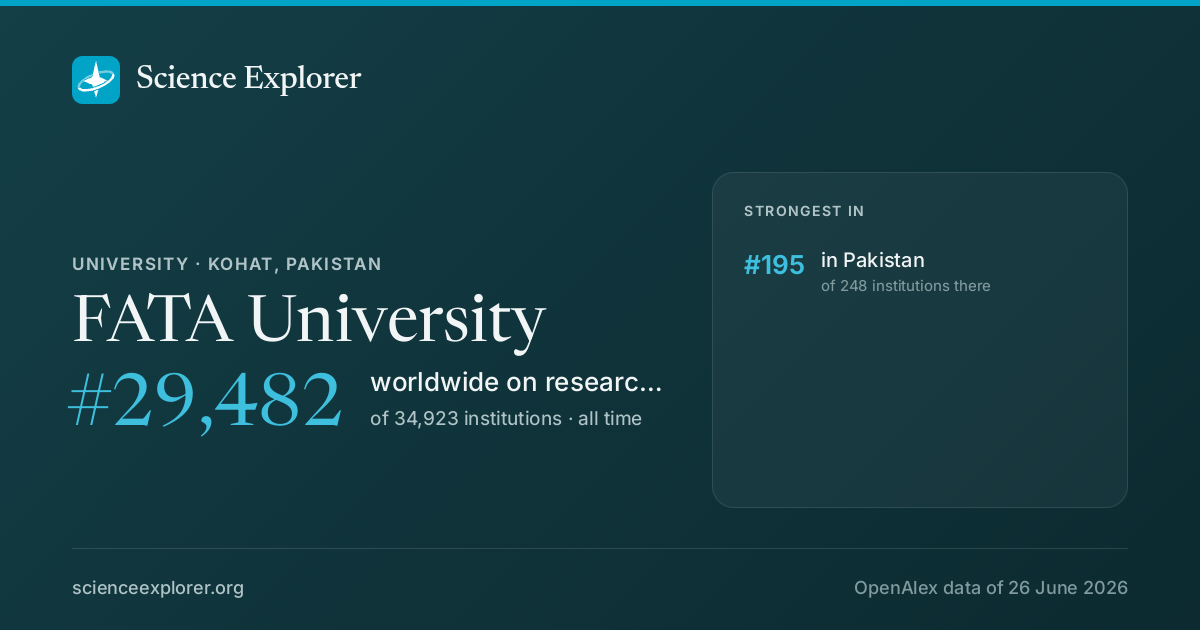
FATA University on Science Explorer

A card with FATA University's standing and the fields it leads in, for a post or a slide. A link to this page previews as the same card.

Download the card

1200 × 630 PNG, sized for social posts, drawn from the latest snapshot.

Badges for a website1Each links back here and updates with every snapshot

Research measures only: rankings here say nothing about teaching, admissions or student experience. Comparable institutions and collaboration partners have tabs of their own, above.

Discussion

Ask a question or share a note about FATA University. Posts are plain text and can be reported.