Finnish Defence Forces

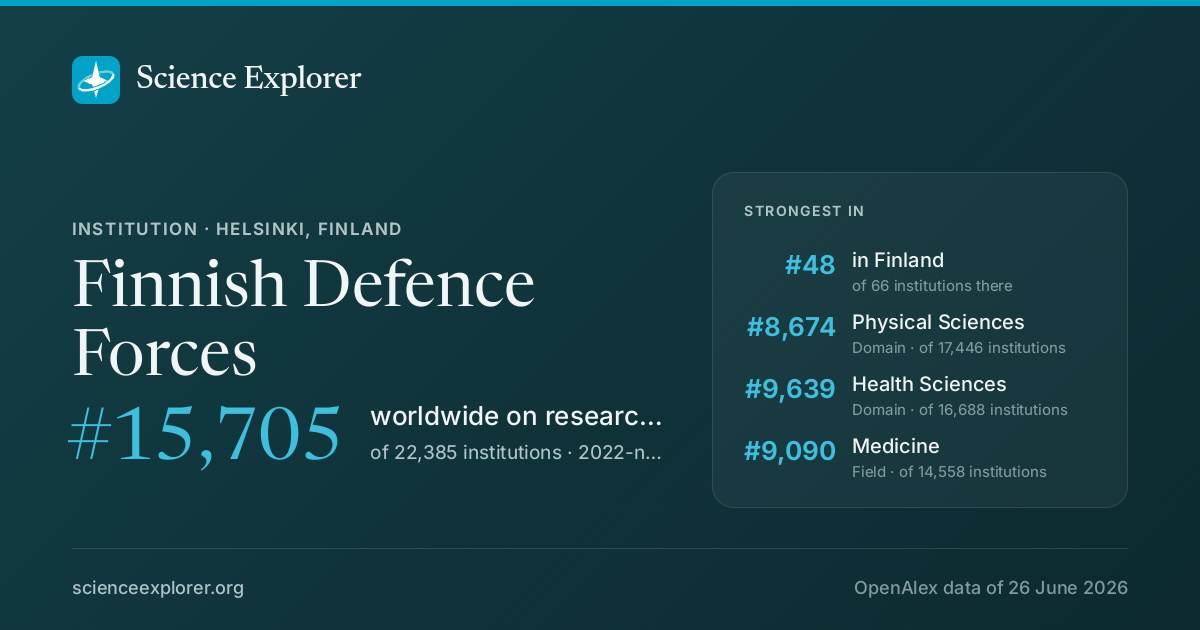
In research, Finnish Defence Forces stands highest in Physical Sciences (#8,674 of 17,446 worldwide), Health Sciences (#9,639 of 16,688 worldwide) and Medicine (#9,090 of 14,558 worldwide), over all time.
- World rank, 2022-now
- #15,705 of 22,385 · #8,958 all time
- Rank in Finland
- #48 of 66
- Research works
- 718 ▲ 50% vs 2018-21
- Citations
- 13k 18.4 per fractional work
- Top-10% rate
- 6.7% all institutions 10.0%
- vs its own fields
- 1.00× 1.00× is exactly expected
- Open access
- 22% world 40%
- International
- 14% world 18%
What is Finnish Defence Forces known for in research?
The fields where it stands highest, over all time, ranked among every institution above the floor in each field.
| Field | World rank | Where that sits | Top-10% rate | Works |
|---|---|---|---|---|
| Physical SciencesDomain | #8,674 of 17,446 | 7.0% | 274 | |
| Health SciencesDomain | #9,639 of 16,688 | 9.0% | 215 | |
| MedicineField | #9,090 of 14,558 | 9.7% | 152 | |
| EngineeringField | #6,725 of 9,532 | 6.2% | 127 | |
| Social SciencesDomain | #11,384 of 14,833 | 4.3% | 171 |
Each strip is that field's whole ranked pool, with the notch where Finnish Defence Forces sits in it, in the colour of the band that rank falls in. The track under the rate is the rate itself: it carries no average mark, because the average differs by field (from about 6% in Dentistry to 21% in Economics).
Which fields of science does Finnish Defence Forces work in?
In 2022-now, 35% of research at Finnish Defence Forces is in Physical Sciences, 30% in Social Sciences. Its largest fields are Engineering (18%), Social Sciences (17%), Medicine (13%).
Each ring splits the one inside it: the four domains of science, their fields, their subfields. Size is fractional works in 2022-now. Every slice is a page; the interactive view zooms down to single topics and colours each by how much more of it this institution does than the world.
Its 4 domains and 24 fields, with their numbers
- Physical Sciences2935.2%
- Engineering1518.5%
- Computer Science77.9%
- Physics and Astronomy33.9%
- Environmental Science22.4%
- Mathematics10.8%
- Energy10.8%
- Materials Science00.5%
- Earth and Planetary Sciences00.4%
- Chemistry00.2%
- Social Sciences2529.5%
- Health Sciences2328.0%
- Medicine1112.8%
- Dentistry78.2%
- Health Professions66.9%
- Nursing00.2%
- Life Sciences67.3%
Field profile
Location quotient across every field it publishes in: outside the ring is more than an institution of this size would be expected to publish, inside it is less.
Rings at 0.5×, 1× and 2×. Widest outward: Dentistry, 16.8×. Every wedge is a field page.
All 24 fields, with their numbers
- Dentistry16.82×7 works
- Health Professions2.61×6 works
- Decision Sciences1.79×1 works
- Physics and Astronomy1.73×3 works
- Psychology1.63×4 works
- Immunology and Microbiology1.54×1 works
- Social Sciences1.32×14 works
- Engineering1.23×15 works
- Economics, Econometrics and Finance1.21×2 works
- Computer Science1.02×7 works
- Pharmacology, Toxicology and Pharmaceutics0.95×0 works
- Business, Management and Accounting0.85×2 works
- Neuroscience0.83×1 works
- Energy0.83×1 works
- Mathematics0.69×1 works
- Medicine0.66×11 works
- Biochemistry, Genetics and Molecular Biology0.58×3 works
- Environmental Science0.48×2 works
- Nursing0.34×0 works
- Arts and Humanities0.29×1 works
- Earth and Planetary Sciences0.23×0 works
- Agricultural and Biological Sciences0.20×1 works
- Chemistry0.14×0 works
- Materials Science0.13×0 works
- Dentistry 16.8×
- Health Professions 2.6×
- Decision Sciences 1.8×
- Physics and Astronomy 1.7×
- Psychology 1.6×
- Immunology and Microbiology 1.5×
- Social Sciences 1.3×
- Engineering 1.2×
- Economics, Econometrics and Finance 1.2×
- Computer Science 1.0×
- Pharmacology, Toxicology and Pharmaceutics 0.9×
- Business, Management and Accounting 0.8×
- Neuroscience 0.8×
- Energy 0.8×
- Mathematics 0.7×
- Medicine 0.7×
- Biochemistry, Genetics and Molecular Biology 0.6×
- Environmental Science 0.5×
- Nursing 0.3×
- Arts and Humanities 0.3×
- Earth and Planetary Sciences 0.2×
- Agricultural and Biological Sciences 0.2×
- Chemistry 0.1×
- Materials Science 0.1×
Who are the top researchers at Finnish Defence Forces?
Ranked on the quality score, HARRI K. PIHLAJAMÄKI, Matti Mäntysaari and Ora Friberg lead among researchers whose main affiliation is Finnish Defence Forces.
- 1
HARRI K. PIHLAJAMÄKI
 Finland · #713,020 worldwide
10k citations · 175 works
- 2
Matti Mäntysaari
Finland · #1,680,309 worldwide
4k citations · 97 works
- 3
Ora Friberg
Finland · #2,099,830 worldwide
1.2k citations · 19 works
- 4
Martti J. Kiuru
Finland · #2,195,064 worldwide
2k citations · 40 works
- 5
Bernt M. Åkesson
Finland · #2,499,092 worldwide
524 citations · 22 works
- 6
Simo Siitonen
Finland · #2,716,579 worldwide
1.4k citations · 28 works
- 7
Simo Nikkari
Finland · #2,807,015 worldwide
3.8k citations · 106 works
- 8
Eero Lehmuskallio
Finland · #3,069,281 worldwide
639 citations · 15 works
- 9
Kai Pihlainen
Finland · #3,218,127 worldwide
934 citations · 68 works
- 10
Tommi Ojanen
Finland · #3,512,614 worldwide
751 citations · 59 works
Which keywords describe research at Finnish Defence Forces?
By fractional works in 2022-now, weighted toward what it does more of than the world: Cognitive Radio, Epidemiology, Ethics, Physical Layer Security, Wireless Communications, Physical Fitness, Disaster Management and LEO Satellite Constellation.
- Scale-Free Networks
- Resistance Training
- Cognitive Load
- Mineral Trioxide Aggregate
- Network Analysis
- Psychological Factors
- Social Influence
- International Relations
- UAV Networks
- Energy-Efficient Communication
- Social Sciences
- Qualitative Research
- Cancer Risk
- Trajectory Optimization
- Public Health
- Physical Fitness
- Wireless Communications
- Quality of Life
- Cognitive Radio
- Healthcare
- Epidemiology
- Ethics
- Education
- Physical Layer Security
- Disaster Management
- LEO Satellite Constellation
- Satellite Communications
- Communication
- Mobile Edge Computing
- Security and Privacy
- Emergency Responders
- Firefighters
- Security
- Network Dynamics
- Conflict
- High-Intensity Interval Training
- 5G Networks
- Root Canal Irrigants
- Refugees
- Community Structure
Size is fractional works in 2022-now in the topics tagged with each word; colour is the word's share of this institution's work against its share of the world's. The 40 words are chosen for being large and distinctive. Each links to the topic it comes from most.
All 40 words, with their numbers
- Epidemiology6▲ 1.83×33 topics
- Healthcare3▲ 3.2×5 topics
- Ethics3▲ 7.1×3 topics
- Cognitive Radio3▲ 99×2 topics
- Education3▲ 2.0×7 topics
- Quality of Life3▲ 2.4×9 topics
- Physical Layer Security3▲ 77×2 topics
- Wireless Communications3▲ 19×3 topics
- Disaster Management3▲ 20×2 topics
- Physical Fitness3▲ 22×2 topics
- LEO Satellite Constellation2▲ 103×1 topic
- Public Health2▲ 2.1×9 topics
- Satellite Communications2▲ 103×1 topic
- Trajectory Optimization2▲ 48×2 topics
- Communication2▲ 9.3×3 topics
- Cancer Risk2▲ 12×3 topics
- Mobile Edge Computing2▲ 17×2 topics
- Qualitative Research2▲ 3.0×1 topic
- Security and Privacy2▲ 14×2 topics
- Social Sciences2▲ 18×1 topic
- Emergency Responders2▲ 140×1 topic
- Energy-Efficient Communication2▲ 56×1 topic
- Firefighters2▲ 140×1 topic
- UAV Networks2▲ 56×1 topic
- Security2▲ 3.5×7 topics
- International Relations2▲ 8.8×6 topics
- Network Dynamics2▲ 21×2 topics
- Social Influence2▲ 9.6×2 topics
- Conflict2▲ 11×2 topics
- Psychological Factors2▲ 8.6×5 topics
- High-Intensity Interval Training1▲ 16×2 topics
- Network Analysis1▲ 15×2 topics
- 5G Networks1▲ 8.1×3 topics
- Mineral Trioxide Aggregate1▲ 38×1 topic
- Root Canal Irrigants1▲ 38×1 topic
- Cognitive Load1▲ 27×2 topics
- Refugees1▲ 10×2 topics
- Resistance Training1▲ 15×2 topics
- Community Structure1▲ 14×1 topic
- Scale-Free Networks1▲ 27×1 topic
Which research topics does Finnish Defence Forces publish most on?
By volume in 2022-now: Satellite Communication Systems, Research in Social Sciences, UAV Applications and Optimization and Occupational Health and Performance.
Area is fractional works; colour is the subfield each topic belongs to.
- 1 Satellite Communication Systems Aerospace Engineering 2 works
- 2 Research in Social Sciences Education 2 works
- 3 UAV Applications and Optimization Aerospace Engineering 2 works
- 4 Occupational Health and Performance Occupational Therapy 2 works
- 5 Endodontics and Root Canal Treatments Oral Surgery 1 works
- 6 Complex Network Analysis Techniques Statistical and Nonlinear Physics 1 works
- 7 Asian Geopolitics and Ethnography Political Science and International Relations 1 works
- 8 Human-Automation Interaction and Safety Social Psychology 1 works
- 9 Sports Performance and Training Orthopedics and Sports Medicine 1 works
- 10 Dental materials and restorations Orthodontics 1 works
How open and international is its research?
Against the world's own shares: the tick on each track. Both are shares of its output, so they sit on one scale and can be read against each other as well as against the world.
World: 40% of research is openly available.
World: 18% is written across borders.
How has Finnish Defence Forces's research output changed?
Output in 2022-2025 was 50% higher than in 2018-2021.
The same series as a ribbon: one cell per year, darker for more. The line above answers how much; this answers when.
Its share of all research
Growing output can still be a shrinking share: all of science grows. This is Finnish Defence Forces as a percentage of every work published that year, 0.00042% in 2024.
Fractional works of Finnish Defence Forces over all fractional works that year. How the balance of science has shifted.
How much of it reaches the world top 10%
Year by year, against all institutions in the same year.
Of each year's output, the share that reached the world's 10% most cited for its field and year. Peak 9.9% in 1996.
Other research institutions in Helsinki
- University of Helsinki
- Finnish Institute for Health and Welfare
- Finnish Institute of Occupational Health
- Natural Resources Institute Finland
- Finnish Society of Sciences and Letters
- Finnish Meteorological Institute
- Finnish Environment Institute
- Hospital District of Helsinki and Uusimaa

Share Finnish Defence Forces's ranking
Badges for a website1Each links back here and updates with every snapshot

Research measures only: rankings here say nothing about teaching, admissions or student experience. Comparable institutions and collaboration partners have tabs of their own, above.
Discussion
Ask a question or share a note about Finnish Defence Forces. Posts are plain text and can be reported.