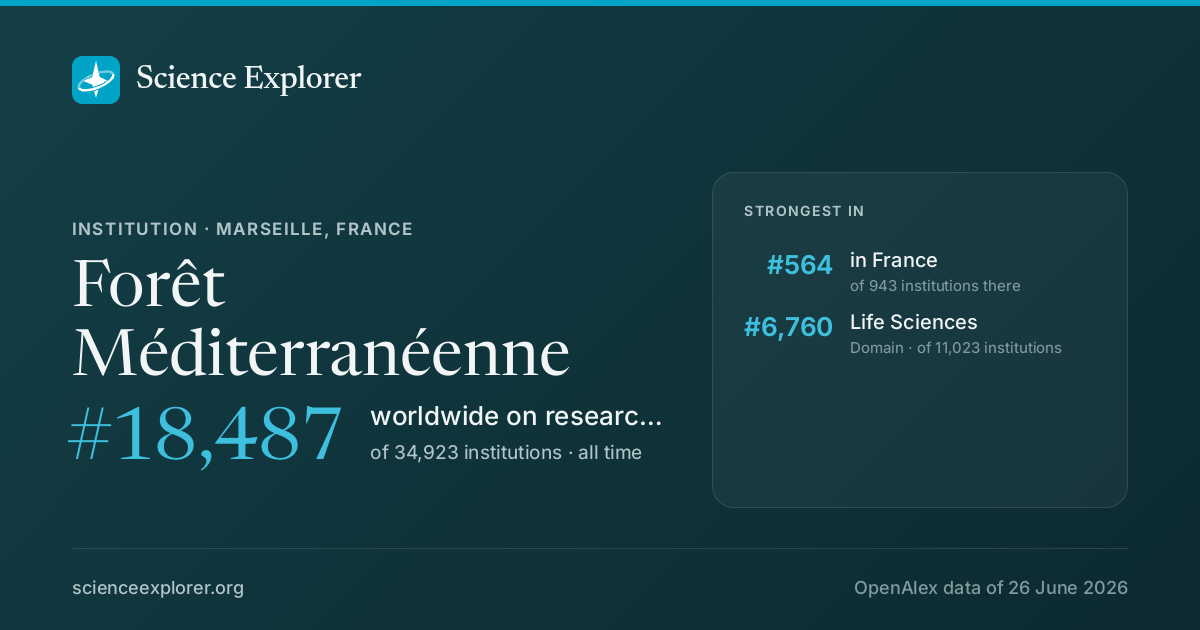
Forêt Méditerranéenne
In research, Forêt Méditerranéenne stands highest in Life Sciences (#6,760 of 11,023 worldwide), over all time.
- World rank, all time
- #18,487 of 34,923
- Rank in France
- #564 of 943
- Research works
- 288 ▼ 37% vs 2018-21
- Citations
- 3.5k 12.0 per fractional work
- Top-10% rate
- 10.2% all institutions 10.0%
- vs its own fields
- 1.00× 1.00× is exactly expected
- Open access
- 46% world 40%
- International
- 16% world 18%
What is Forêt Méditerranéenne known for in research?
The fields where it stands highest, over all time, ranked among every institution above the floor in each field.
| Field | World rank | Where that sits | Top-10% rate | Works |
|---|---|---|---|---|
| Life SciencesDomain | #6,760 of 11,023 | 5.5% | 122 |
Each strip is that field's whole ranked pool, with the notch where Forêt Méditerranéenne sits in it, in the colour of the band that rank falls in. The track under the rate is the rate itself: it carries no average mark, because the average differs by field (from about 6% in Dentistry to 21% in Economics).
Which fields of science does Forêt Méditerranéenne work in?
In all years, 42% of research at Forêt Méditerranéenne is in Life Sciences, 23% in Physical Sciences. Its largest fields are Agricultural and Biological Sciences (37%), Social Sciences (15%), Environmental Science (12%). It does 2.7× the world's share of Life Sciences.
Each ring splits the one inside it: the four domains of science, their fields, their subfields. Size is fractional works in all years. Every slice is a page; the interactive view zooms down to single topics and colours each by how much more of it this institution does than the world.
Its 4 domains and 25 fields, with their numbers
- Life Sciences12242.4%
- Physical Sciences6723.2%
- Environmental Science3612.4%
- Engineering186.3%
- Earth and Planetary Sciences51.7%
- Computer Science30.9%
- Mathematics10.5%
- Materials Science10.4%
- Energy10.4%
- Physics and Astronomy10.3%
- Chemistry10.3%
- Chemical Engineering00.0%
- Social Sciences6322.1%
- Social Sciences4214.7%
- Arts and Humanities103.6%
- Psychology41.5%
- Business, Management and Accounting31.1%
- Economics, Econometrics and Finance20.9%
- Decision Sciences10.3%
- Health Sciences3512.3%
- Medicine269.0%
- Health Professions82.9%
- Nursing10.4%
- Veterinary00.0%
Field profile
Location quotient across every field it publishes in: outside the ring is more than an institution of this size would be expected to publish, inside it is less.
Rings at 0.5×, 1× and 2×. Widest outward: Veterinary, 4.8×. Every wedge is a field page.
All 19 fields, with their numbers
- Veterinary4.81×0 works
- Agricultural and Biological Sciences4.21×3 works
- Environmental Science2.45×2 works
- Psychology2.09×1 works
- Earth and Planetary Sciences1.61×0 works
- Immunology and Microbiology1.44×0 works
- Social Sciences1.43×3 works
- Biochemistry, Genetics and Molecular Biology0.97×1 works
- Medicine0.88×3 works
- Arts and Humanities0.87×0 works
- Engineering0.73×2 works
- Chemical Engineering0.72×0 works
- Decision Sciences0.35×0 works
- Materials Science0.29×0 works
- Neuroscience0.21×0 works
- Business, Management and Accounting0.21×0 works
- Health Professions0.14×0 works
- Economics, Econometrics and Finance0.09×0 works
- Physics and Astronomy0.05×0 works
- Veterinary 4.8×
- Agricultural and Biological Sciences 4.2×
- Environmental Science 2.5×
- Psychology 2.1×
- Earth and Planetary Sciences 1.6×
- Immunology and Microbiology 1.4×
- Social Sciences 1.4×
- Biochemistry, Genetics and Molecular Biology 1.0×
- Medicine 0.9×
- Arts and Humanities 0.9×
- Engineering 0.7×
- Chemical Engineering 0.7×
- Decision Sciences 0.3×
- Materials Science 0.3×
- Neuroscience 0.2×
- Business, Management and Accounting 0.2×
- Health Professions 0.1×
- Economics, Econometrics and Finance 0.1×
- Physics and Astronomy 0.1×
Who are the top researchers at Forêt Méditerranéenne?
Ranked on the quality score, Joseph Pitton de Tournefort, M. Jappiot and C. Ripert lead among researchers whose main affiliation is Forêt Méditerranéenne.
- 1
Joseph Pitton de Tournefort
 France · #2,412,648 worldwide
559 citations · 58 works
- 2
M. Jappiot
France · #3,219,747 worldwide
1k citations · 58 works
- 3
C. Ripert
France · #4,107,445 worldwide
3 citations · 17 works
- 4
Estelle Morel
France · #4,433,325 worldwide
1 citations · 20 works
- 5
Caroline Gutleben
France · #4,449,524 worldwide
10 citations · 23 works
- 6
Patrick Pastuszka
France · #4,727,574 worldwide
16 citations · 24 works
- 7
Marielle Aulagnier
France · #5,106,862 worldwide
218 citations · 39 works
- 8
Jean Thévenet
France · #5,266,351 worldwide
775 citations · 56 works
- 9
Anne Sophie Brinquin
France · #5,388,013 worldwide
7 citations · 53 works
- 10
Marianne Corréard
France · #5,576,220 worldwide
610 citations · 41 works
Which keywords describe research at Forêt Méditerranéenne?
By fractional works in all years, weighted toward what it does more of than the world: Climate Change, Smallholder Farmers, Sustainability, Agricultural Development, Adaptation, Diversity, Multifunctionality and Livestock Farming.
- Forest Management
- Community Ecology
- Phylogeny
- Habitat Fragmentation
- Global Change
- Allometric Models
- Climate Change Impact
- Biomass Estimation
- Biodiversity
- Tree Domestication
- Sustainable Agriculture
- Environmental Participation
- Social Justice
- Public Policy
- Community Engagement
- Sustainable Development
- Livestock Farming
- Diversity
- Agricultural Development
- Smallholder Farmers
- Climate Change
- Sustainability
- Adaptation
- Multifunctionality
- Work Organization
- Biodiversity Conservation
- Local Development
- Territorial Governance
- Citizen Participation
- Agroforestry
- Indigenous Fruits
- Invasive Species
- Conservation
- Aboveground Biomass
- Tropical Forests
- Carbon Stocks
- Ecosystem Services
- Biological Invasions
- Ecosystem
- Vegetation
Size is fractional works in all years in the topics tagged with each word; colour is the word's share of this institution's work against its share of the world's. The 40 words are chosen for being large and distinctive. Each links to the topic it comes from most.
All 40 words, with their numbers
- Climate Change71▲ 9.2×39 topics
- Smallholder Farmers65▲ 165×3 topics
- Sustainability56▲ 11×21 topics
- Agricultural Development48▲ 153×3 topics
- Adaptation48▲ 57×6 topics
- Diversity48▲ 92×3 topics
- Multifunctionality47▲ 289×2 topics
- Livestock Farming47▲ 295×1 topic
- Work Organization47▲ 402×1 topic
- Sustainable Development28▲ 8.4×9 topics
- Biodiversity Conservation27▲ 34×8 topics
- Community Engagement26▲ 30×4 topics
- Local Development25▲ 65×2 topics
- Public Policy25▲ 20×4 topics
- Territorial Governance25▲ 61×2 topics
- Social Justice24▲ 17×3 topics
- Citizen Participation24▲ 73×1 topic
- Environmental Participation24▲ 91×1 topic
- Agroforestry21▲ 157×3 topics
- Sustainable Agriculture20▲ 25×6 topics
- Indigenous Fruits17▲ 334×1 topic
- Tree Domestication17▲ 334×1 topic
- Invasive Species17▲ 10×17 topics
- Biodiversity14▲ 6.5×18 topics
- Conservation10▲ 7.6×13 topics
- Biomass Estimation9▲ 27×3 topics
- Aboveground Biomass8▲ 40×2 topics
- Climate Change Impact8▲ 15×2 topics
- Tropical Forests8▲ 69×2 topics
- Allometric Models8▲ 56×1 topic
- Carbon Stocks8▲ 83×1 topic
- Global Change7▲ 8.2×6 topics
- Ecosystem Services7▲ 7.2×9 topics
- Habitat Fragmentation6▲ 7.6×3 topics
- Biological Invasions6▲ 20×3 topics
- Phylogeny6▲ 12×9 topics
- Ecosystem5▲ 13×4 topics
- Community Ecology5▲ 15×2 topics
- Vegetation5▲ 16×2 topics
- Forest Management4▲ 26×4 topics
Which research topics does Forêt Méditerranéenne publish most on?
By volume in 2022-now: French Urban and Social Studies, Education, sociology, and vocational training, Psychoanalysis and Psychopathology Research and Agriculture and Rural Development Research.
Area is fractional works; colour is the subfield each topic belongs to.
- 1 French Urban and Social Studies Sociology and Political Science 1 works
- 2 Education, sociology, and vocational training Sociology and Political Science 1 works
- 3 Psychoanalysis and Psychopathology Research Clinical Psychology 1 works
- 4 Agriculture and Rural Development Research Ecology, Evolution, Behavior and Systematics 1 works
- 5 Intraperitoneal and Appendiceal Malignancies Surgery 0 works
- 6 Urban Stormwater Management Solutions Environmental Engineering 0 works
- 7 Ethics and bioethics in healthcare Public Health, Environmental and Occupational Health 0 works
- 8 African Botany and Ecology Studies Forestry 0 works
- 9 Forest Insect Ecology and Management Ecology 0 works
- 10 Air Traffic Management and Optimization Aerospace Engineering 0 works
How open and international is its research?
Against the world's own shares: the tick on each track. Both are shares of its output, so they sit on one scale and can be read against each other as well as against the world.
World: 40% of research is openly available.
World: 18% is written across borders.
How has Forêt Méditerranéenne's research output changed?
Output in 2022-2025 was 37% lower than in 2018-2021.
The same series as a ribbon: one cell per year, darker for more. The line above answers how much; this answers when.
Its share of all research
Growing output can still be a shrinking share: all of science grows. This is Forêt Méditerranéenne as a percentage of every work published that year, 0.000043% in 2024.
Fractional works of Forêt Méditerranéenne over all fractional works that year. How the balance of science has shifted.
Other research institutions in Marseille
- Aix-Marseille Université
- Institut de Recherche pour le Développement
- Hôpital Nord
- Hôpital Sainte-Marguerite
- Hôpital Européen
- Hôpital de la Conception
- Institut Paoli-Calmettes
- Assistance Publique Hôpitaux de Marseille
Share Forêt Méditerranéenne's ranking
Badges for a website1Each links back here and updates with every snapshot

Research measures only: rankings here say nothing about teaching, admissions or student experience. Comparable institutions and collaboration partners have tabs of their own, above.
Discussion
Ask a question or share a note about Forêt Méditerranéenne. Posts are plain text and can be reported.