Science Explorer Back to mapMap
Discussion
University · Fukuyama · Japan

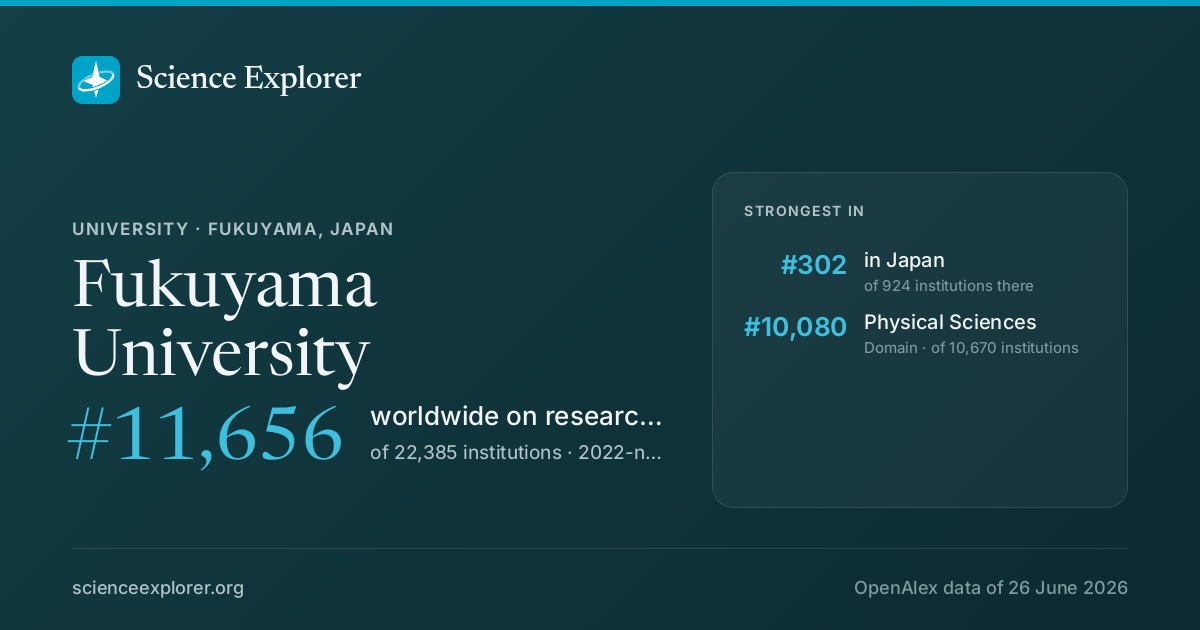
Fukuyama University

In research, Fukuyama University stands highest in Physical Sciences (#10,080 of 10,670 worldwide), 2022-now.

World rank, 2022-now
#11,656
of 22,385 · #25,115 all time
Rank in Japan
#302
of 924
Research works
2.3k
▼ 3% vs 2018-21
Citations
42k
18.1 per fractional work
Top-10% rate
3.3%
all institutions 10.0%
vs its own fields
0.81×
1.00× is exactly expected
Open access
48%
world 40%
International
9%
world 18%

What is Fukuyama University known for in research?

The fields where it stands highest, 2022-now, ranked among every institution above the floor in each field.

FieldWorld rankWhere that sitsTop-10% rateWorksAll time
Physical SciencesDomain #10,080 of 10,670 1.7%62 #16990

Each strip is that field's whole ranked pool, with the notch where Fukuyama University sits in it, in the colour of the band that rank falls in. The track under the rate is the rate itself: it carries no average mark, because the average differs by field (from about 6% in Dentistry to 21% in Economics).

Which fields of science does Fukuyama University work in?

In 2022-now, 30% of research at Fukuyama University is in Physical Sciences, 24% in Social Sciences. Its largest fields are Medicine (21%), Engineering (12%), Social Sciences (11%). It does 1.6× the world's share of Life Sciences.

Physical Sciences: 71 fractional works · 30.5% of its workEngineering: 28 fractional works · 12.2% of its workMechanical Engineering: 6 fractional works · 2.7% of its workElectrical and Electronic Engineering: 5 fractional works · 2.2% of its workControl and Systems Engineering: 4 fractional works · 1.9% of its workOcean Engineering: 2 fractional works · 1.1% of its workBiomedical Engineering: 2 fractional works · 1.0% of its workAerospace Engineering: 1 fractional works · 0.6% of its workCivil and Structural Engineering: 1 fractional works · 0.5% of its workComputational Mechanics: 1 fractional works · 0.5% of its workIndustrial and Manufacturing Engineering: 1 fractional works · 0.4% of its workSafety, Risk, Reliability and Quality: 1 fractional works · 0.4% of its workAutomotive Engineering: 1 fractional works · 0.3% of its workMedia Technology: 1 fractional works · 0.2% of its workSmaller subfields together: 1 fractional works · 0.4% of its workEnvironmental Science: 15 fractional works · 6.5% of its workEcology: 5 fractional works · 2.3% of its workGlobal and Planetary Change: 2 fractional works · 0.9% of its workNature and Landscape Conservation: 2 fractional works · 0.8% of its workHealth, Toxicology and Mutagenesis: 1 fractional works · 0.6% of its workManagement, Monitoring, Policy and Law: 1 fractional works · 0.5% of its workEcological Modeling: 1 fractional works · 0.4% of its workWater Science and Technology: 1 fractional works · 0.4% of its workIndustrial and Manufacturing Engineering: 1 fractional works · 0.3% of its workSmaller subfields together: 1 fractional works · 0.4% of its workComputer Science: 9 fractional works · 3.8% of its workInformation Systems: 3 fractional works · 1.3% of its workHuman-Computer Interaction: 2 fractional works · 0.7% of its workArtificial Intelligence: 1 fractional works · 0.5% of its workComputer Vision and Pattern Recognition: 1 fractional works · 0.4% of its workComputer Networks and Communications: 1 fractional works · 0.4% of its workComputer Science Applications: 1 fractional works · 0.2% of its workSmaller subfields together: 1 fractional works · 0.3% of its workChemistry: 6 fractional works · 2.6% of its workOrganic Chemistry: 4 fractional works · 1.6% of its workSpectroscopy: 2 fractional works · 0.6% of its workAnalytical Chemistry: 0 fractional works · 0.2% of its workSmaller subfields together: 0 fractional works · 0.2% of its workMaterials Science: 4 fractional works · 1.6% of its workElectronic, Optical and Magnetic Materials: 1 fractional works · 0.5% of its workBiomaterials: 1 fractional works · 0.5% of its workMaterials Chemistry: 1 fractional works · 0.5% of its workSmaller subfields together: 0 fractional works · 0.1% of its workEarth and Planetary Sciences: 4 fractional works · 1.5% of its workPaleontology: 2 fractional works · 0.9% of its workOceanography: 1 fractional works · 0.6% of its workSmaller subfields together: 0 fractional works · 0.1% of its workPhysics and Astronomy: 4 fractional works · 1.5% of its workAtomic and Molecular Physics, and Optics: 1 fractional works · 0.4% of its workStatistical and Nonlinear Physics: 1 fractional works · 0.4% of its workCondensed Matter Physics: 1 fractional works · 0.3% of its workSmaller subfields together: 1 fractional works · 0.3% of its workMathematics: 1 fractional works · 0.6% of its workApplied Mathematics: 1 fractional works · 0.4% of its workSmaller subfields together: 0 fractional works · 0.2% of its workEnergy: 0 fractional works · 0.1% of its workSocial Sciences: 56 fractional works · 24.0% of its workSocial Sciences: 26 fractional works · 11.3% of its workSociology and Political Science: 12 fractional works · 5.1% of its workHealth: 3 fractional works · 1.4% of its workEducation: 3 fractional works · 1.1% of its workGender Studies: 2 fractional works · 1.0% of its workPolitical Science and International Relations: 1 fractional works · 0.6% of its workSafety Research: 1 fractional works · 0.5% of its workDemography: 1 fractional works · 0.3% of its workCultural Studies: 1 fractional works · 0.3% of its workTransportation: 1 fractional works · 0.3% of its workSmaller subfields together: 2 fractional works · 0.7% of its workPsychology: 18 fractional works · 7.7% of its workClinical Psychology: 6 fractional works · 2.5% of its workSocial Psychology: 6 fractional works · 2.4% of its workExperimental and Cognitive Psychology: 3 fractional works · 1.4% of its workDevelopmental and Educational Psychology: 2 fractional works · 0.8% of its workApplied Psychology: 1 fractional works · 0.5% of its workEconomics, Econometrics and Finance: 4 fractional works · 1.6% of its workEconomics and Econometrics: 2 fractional works · 0.7% of its workGeneral Economics, Econometrics and Finance: 1 fractional works · 0.6% of its workFinance: 1 fractional works · 0.3% of its workBusiness, Management and Accounting: 4 fractional works · 1.6% of its workStrategy and Management: 1 fractional works · 0.4% of its workOrganizational Behavior and Human Resource Management: 1 fractional works · 0.4% of its workAccounting: 1 fractional works · 0.4% of its workSmaller subfields together: 1 fractional works · 0.4% of its workDecision Sciences: 2 fractional works · 1.0% of its workGeneral Decision Sciences: 2 fractional works · 0.7% of its workManagement Science and Operations Research: 1 fractional works · 0.3% of its workArts and Humanities: 2 fractional works · 0.8% of its workVisual Arts and Performing Arts: 1 fractional works · 0.3% of its workSmaller subfields together: 1 fractional works · 0.4% of its workHealth Sciences: 54 fractional works · 23.1% of its workMedicine: 48 fractional works · 20.7% of its workPublic Health, Environmental and Occupational Health: 4 fractional works · 1.9% of its workPathology and Forensic Medicine: 4 fractional works · 1.8% of its workOncology: 4 fractional works · 1.6% of its workSurgery: 4 fractional works · 1.6% of its workEpidemiology: 4 fractional works · 1.5% of its workPulmonary and Respiratory Medicine: 3 fractional works · 1.3% of its workPharmacology: 3 fractional works · 1.2% of its workPhysiology: 3 fractional works · 1.2% of its workCardiology and Cardiovascular Medicine: 2 fractional works · 0.7% of its workComplementary and alternative medicine: 2 fractional works · 0.7% of its workBiochemistry: 1 fractional works · 0.6% of its workNeurology: 1 fractional works · 0.6% of its workGeriatrics and Gerontology: 1 fractional works · 0.5% of its workRheumatology: 1 fractional works · 0.5% of its workPediatrics, Perinatology and Child Health: 1 fractional works · 0.5% of its workPsychiatry and Mental health: 1 fractional works · 0.5% of its workDermatology: 1 fractional works · 0.5% of its workInfectious Diseases: 1 fractional works · 0.4% of its workRadiology, Nuclear Medicine and Imaging: 1 fractional works · 0.3% of its workImmunology and Allergy: 1 fractional works · 0.3% of its workRehabilitation: 1 fractional works · 0.3% of its workGastroenterology: 1 fractional works · 0.3% of its workHepatology: 1 fractional works · 0.3% of its workAnesthesiology and Pain Medicine: 1 fractional works · 0.2% of its workSmaller subfields together: 3 fractional works · 1.4% of its workHealth Professions: 4 fractional works · 1.6% of its workGeneral Health Professions: 1 fractional works · 0.6% of its workComplementary and Manual Therapy: 1 fractional works · 0.3% of its workSmaller subfields together: 2 fractional works · 0.7% of its workNursing: 2 fractional works · 0.7% of its workNutrition and Dietetics: 1 fractional works · 0.6% of its workSmaller subfields together: 0 fractional works · 0.1% of its workVeterinary: 0 fractional works · 0.2% of its workLife Sciences: 52 fractional works · 22.5% of its workBiochemistry, Genetics and Molecular Biology: 25 fractional works · 10.6% of its workMolecular Biology: 11 fractional works · 4.7% of its workGenetics: 3 fractional works · 1.4% of its workCell Biology: 2 fractional works · 1.1% of its workBiotechnology: 2 fractional works · 0.8% of its workBiochemistry: 2 fractional works · 0.8% of its workCancer Research: 2 fractional works · 0.7% of its workPhysiology: 1 fractional works · 0.5% of its workDevelopmental Biology: 1 fractional works · 0.4% of its workSmaller subfields together: 1 fractional works · 0.3% of its workAgricultural and Biological Sciences: 12 fractional works · 5.0% of its workPlant Science: 5 fractional works · 2.0% of its workFood Science: 3 fractional works · 1.3% of its workAquatic Science: 2 fractional works · 0.7% of its workEcology, Evolution, Behavior and Systematics: 2 fractional works · 0.7% of its workSmaller subfields together: 0 fractional works · 0.2% of its workPharmacology, Toxicology and Pharmaceutics: 8 fractional works · 3.3% of its workPharmacology: 4 fractional works · 1.8% of its workPharmaceutical Science: 3 fractional works · 1.3% of its workSmaller subfields together: 0 fractional works · 0.1% of its workNeuroscience: 6 fractional works · 2.8% of its workCognitive Neuroscience: 3 fractional works · 1.4% of its workNeurology: 1 fractional works · 0.6% of its workBiological Psychiatry: 1 fractional works · 0.6% of its workSmaller subfields together: 1 fractional works · 0.2% of its workImmunology and Microbiology: 2 fractional works · 0.8% of its workImmunology: 2 fractional works · 0.7% of its workSmaller subfields together: 0 fractional works · 0.2% of its workALL ITS WORKFukuyamaUniversity232fractional works, 2022-now
Life Sciences22%Physical Sciences30%Health Sciences23%Social Sciences24%

Each ring splits the one inside it: the four domains of science, their fields, their subfields. Size is fractional works in 2022-now. Every slice is a page; the interactive view zooms down to single topics and colours each by how much more of it this institution does than the world.

Its 4 domains and 24 fields, with their numbers
    1. Engineering2812.2%
    2. Environmental Science156.5%
    3. Computer Science93.8%
    4. Chemistry62.6%
    5. Materials Science41.6%
    6. Earth and Planetary Sciences41.5%
    7. Physics and Astronomy41.5%
    8. Mathematics10.6%
    9. Energy00.1%
    1. Social Sciences2611.3%
    2. Psychology187.7%
    3. Economics, Econometrics and Finance41.6%
    4. Business, Management and Accounting41.6%
    5. Decision Sciences21.0%
    6. Arts and Humanities20.8%
    1. Medicine4820.7%
    2. Health Professions41.6%
    3. Nursing20.7%
    4. Veterinary00.2%
    1. Biochemistry, Genetics and Molecular Biology2510.6%
    2. Agricultural and Biological Sciences125.0%
    3. Pharmacology, Toxicology and Pharmaceutics83.3%
    4. Neuroscience62.8%
    5. Immunology and Microbiology20.8%
All of science, and how each field's share has moved since 1950: the Science domain explorer

Field profile

Location quotient across every field it publishes in: outside the ring is more than an institution of this size would be expected to publish, inside it is less.

Agricultural and Biological Sciences: 1.04× its world share, 12 worksAgricultural and Bio…Biochemistry, Genetics and Molecular Biology: 1.99× its world share, 25 worksBiochemistry, Geneti…Immunology and Microbiology: 0.82× its world share, 2 worksImmunology and Micro…Neuroscience: 1.72× its world share, 6 worksNeurosciencePharmacology, Toxicology and Pharmaceutics: 9.31× its world share, 8 worksPharmacology, Toxico…Chemistry: 1.68× its world share, 6 worksChemistryComputer Science: 0.49× its world share, 9 worksComputer ScienceEarth and Planetary Sciences: 0.98× its world share, 4 worksEarth and Planetary …Energy: 0.13× its world share, 0 worksEnergyEngineering: 0.81× its world share, 28 worksEngineeringEnvironmental Science: 1.31× its world share, 15 worksEnvironmental ScienceMaterials Science: 0.45× its world share, 4 worksMaterials ScienceMathematics: 0.52× its world share, 1 worksMathematicsPhysics and Astronomy: 0.68× its world share, 4 worksPhysics and AstronomyHealth Professions: 0.60× its world share, 4 worksHealth ProfessionsMedicine: 1.08× its world share, 48 worksMedicineNursing: 1.41× its world share, 2 worksNursingVeterinary: 1.10× its world share, 0 worksVeterinaryArts and Humanities: 0.27× its world share, 2 worksArts and HumanitiesBusiness, Management and Accounting: 0.49× its world share, 4 worksBusiness, Management…Decision Sciences: 1.00× its world share, 2 worksDecision SciencesEconomics, Econometrics and Finance: 0.76× its world share, 4 worksEconomics, Econometr…Psychology: 2.52× its world share, 18 worksPsychologySocial Sciences: 0.90× its world share, 26 worksSocial Sciences1×world share
more than its size predictsabout as predictedless

Rings at 0.5×, 1× and 2×. Widest outward: Pharmacology, Toxicology and Pharmaceutics, 9.3×. Every wedge is a field page.

All 24 fields, with their numbers
  1. Pharmacology, Toxicology and Pharmaceutics9.31×8 works
  2. Psychology2.52×18 works
  3. Biochemistry, Genetics and Molecular Biology1.99×25 works
  4. Neuroscience1.72×6 works
  5. Chemistry1.68×6 works
  6. Nursing1.41×2 works
  7. Environmental Science1.31×15 works
  8. Veterinary1.10×0 works
  9. Medicine1.08×48 works
  10. Agricultural and Biological Sciences1.04×12 works
  11. Decision Sciences1.00×2 works
  12. Earth and Planetary Sciences0.98×4 works
  13. Social Sciences0.90×26 works
  14. Immunology and Microbiology0.82×2 works
  15. Engineering0.81×28 works
  16. Economics, Econometrics and Finance0.76×4 works
  17. Physics and Astronomy0.68×4 works
  18. Health Professions0.60×4 works
  19. Mathematics0.52×1 works
  20. Computer Science0.49×9 works
  21. Business, Management and Accounting0.49×4 works
  22. Materials Science0.45×4 works
  23. Arts and Humanities0.27×2 works
  24. Energy0.13×0 works

Who are the top researchers at Fukuyama University?

Ranked on the quality score, Hiroshi Ueki, Yuki Miyazaki and Takashi Nishiyama lead among researchers whose main affiliation is Fukuyama University.

  1. 1 Hiroshi Ueki Japan · #2,224,257 worldwide 4.2k citations · 158 works
  2. 2 Yuki Miyazaki Japan · #2,329,534 worldwide 3.2k citations · 106 works
  3. 3 Takashi Nishiyama Japan · #3,034,830 worldwide 4k citations · 134 works
  4. 4 Yasumi Kimura Japan · #4,012,465 worldwide 546 citations · 27 works
  5. 5 Yasutaro Fujita Japan · #5,264,439 worldwide 3.8k citations · 77 works
  6. 6 Yasunori Yamaguchi Japan · #5,350,898 worldwide 3.2k citations · 69 works
  7. 7 Jun Kamishikiryo Japan · #5,497,760 worldwide 1k citations · 51 works
  8. 8 Naoyoshi Inouchi Japan · #5,571,721 worldwide 2.1k citations · 73 works
  9. 9 Yasushi Kikuta Japan · #5,675,845 worldwide 646 citations · 22 works
  10. 10 Kiyoshi Satouchi Japan · #5,729,485 worldwide 2.9k citations · 94 works
All ranked researchers at Fukuyama University

What are the most cited papers from Fukuyama University?

The most cited paper from Fukuyama University is "THE WATER-WATER CYCLE IN CHLOROPLASTS: Scavenging of Active Oxygens and Dissipation of Excess Photons" (Kozi Asada, 1999), with 4,091 citations. Next come "The complete genome sequence of the Gram-positive bacterium Bacillus subtilis" (3,720) and "Production and Scavenging of Reactive Oxygen Species in Chloroplasts and Their Functions" (2,767).

Most cited papers
#PaperReleasedCitations
1 THE WATER-WATER CYCLE IN CHLOROPLASTS: Scavenging of Active Oxygens and Dissipation of Excess Photons Kozi Asada · Annual Review of Plant Physiology and Plant Molecular Biology Jun 1999 4,091
2 The complete genome sequence of the Gram-positive bacterium Bacillus subtilis Frank Kunst et al. · Nature Open access151 authors Nov 1997 3,720
3 Production and Scavenging of Reactive Oxygen Species in Chloroplasts and Their Functions Kozi Asada · PLANT PHYSIOLOGY Open access Jun 2006 2,767
4 MassBank: a public repository for sharing mass spectral data for life sciences Hisayuki Horai et al. · Journal of Mass Spectrometry Open access Jul 2010 2,595
5 Modeling Alzheimer’s Disease with iPSCs Reveals Stress Phenotypes Associated with Intracellular Aβ and Differential Drug Responsiveness Takayuki Kondo et al. · Cell stem cell Open access 21 Feb 2013 758
All 58 most cited papers, with filters and sorting

Which keywords describe research at Fukuyama University?

By fractional works in 2022-now, weighted toward what it does more of than the world: Antioxidant, Inflammation, Cancer, Metabolism, Pharmacology, Cancer Prevention, Oxidative Stress and Risk Factors.

▲ more of its work than of the world's◆ about the world's share▼ less than the world's

Size is fractional works in 2022-now in the topics tagged with each word; colour is the word's share of this institution's work against its share of the world's. The 40 words are chosen for being large and distinctive. Each links to the topic it comes from most.

All 40 words, with their numbers
  1. Inflammation12▲ 2.4×33 topics
  2. Epidemiology10◆ 1.09×45 topics
  3. Antioxidant10▲ 6.0×19 topics
  4. Cancer8▲ 2.7×20 topics
  5. Oxidative Stress8▲ 2.0×23 topics
  6. Mental Health7▲ 2.1×17 topics
  7. Risk Factors6▲ 2.5×14 topics
  8. Metabolism6▲ 4.8×14 topics
  9. Depression6▲ 2.7×9 topics
  10. Antioxidant Activity4▲ 3.1×11 topics
  11. Cancer Prevention4▲ 7.4×5 topics
  12. Pharmacology4▲ 7.9×10 topics
  13. Prevalence4▲ 4.5×7 topics
  14. Social Support4▲ 3.4×8 topics
  15. Meta-Analysis4▲ 2.8×9 topics
  16. Virtual Reality4▲ 3.5×7 topics
  17. Bioactive Compounds4▲ 6.1×5 topics
  18. Neuroinflammation4▲ 5.3×3 topics
  19. Cardiovascular Health3▲ 7.4×3 topics
  20. Health Consequences3▲ 5.1×3 topics
  21. Intimate Partner Violence3▲ 35×2 topics
  22. Antimicrobial3▲ 4.9×3 topics
  23. Neuroprotection3▲ 3.9×5 topics
  24. Cytokines3▲ 4.5×4 topics
  25. Gender-based Violence3▲ 23×2 topics
  26. Emotion3▲ 6.0×6 topics
  27. Adolescent Development3▲ 10×3 topics
  28. Domestic Violence3▲ 33×1 topic
  29. HIV Infection3▲ 11×1 topic
  30. Family Relationships3▲ 18×2 topics
  31. Antiviral2▲ 14×3 topics
  32. Cloud Robotics2▲ 40×1 topic
  33. Green Tea2▲ 51×1 topic
  34. Internet of Robotic Things2▲ 40×1 topic
  35. Tea Polyphenols2▲ 51×1 topic
  36. Schizophrenia2▲ 9.3×4 topics
  37. Acculturation Stress2▲ 88×1 topic
  38. Heat Exchangers2▲ 14×2 topics
  39. Microglia2▲ 8.7×2 topics
  40. Multicultural Adolescents2▲ 88×1 topic

Which research topics does Fukuyama University publish most on?

By volume in 2022-now: Intimate Partner and Family Violence, Robotics and Automated Systems, Tea Polyphenols and Effects and Psychosocial Factors Impacting Youth.

  1. 1 Intimate Partner and Family Violence Health 3 works
  2. 2 Robotics and Automated Systems Control and Systems Engineering 2 works
  3. 3 Tea Polyphenols and Effects Pathology and Forensic Medicine 2 works
  4. 4 Psychosocial Factors Impacting Youth Sociology and Political Science 2 works
  5. 5 Urban and spatial planning Nature and Landscape Conservation 2 works
  6. 6 Pharmacological Effects of Natural Compounds Pharmacology 2 works
  7. 7 Pharmacy and Medical Practices Pharmacology 2 works
  8. 8 Decision-Making and Behavioral Economics General Decision Sciences 2 works
  9. 9 Marine Invertebrate Physiology and Ecology Paleontology 2 works
  10. 10 Heat Transfer and Boiling Studies Mechanical Engineering 2 works

How open and international is its research?

Against the world's own shares: the tick on each track. Both are shares of its output, so they sit on one scale and can be read against each other as well as against the world.

openly available48.3%not open51.7%

World: 40% of research is openly available.

with international co-authors8.7%domestic only91.3%

World: 18% is written across borders.

How has Fukuyama University's research output changed?

Output in 2022-2025 was 3% lower than in 2018-2021.

still counting1990200020102020
grewheldshrank

The same series as a ribbon: one cell per year, darker for more. The line above answers how much; this answers when.

Its share of all research

Growing output can still be a shrinking share: all of science grows. This is Fukuyama University as a percentage of every work published that year, 0.00091% in 2024.

still counting0.0050%0.010%Fukuyama University0.0011% in 202519801990200020102020

Fractional works of Fukuyama University over all fractional works that year. How the balance of science has shifted.

How much of it reaches the world top 10%

Year by year, against all institutions in the same year.

still counting5%10%15%all institutions10.0% in 2025Fukuyama University5.2% in 2025200020102020

Of each year's output, the share that reached the world's 10% most cited for its field and year. Peak 9.0% in 1996.

Other research institutions in Fukuyama

All research institutions in Fukuyama

Share Fukuyama University's ranking

Fukuyama University on Science Explorer

A card with Fukuyama University's standing and the fields it leads in, for a post or a slide. A link to this page previews as the same card.

Download the card

1200 × 630 PNG, sized for social posts, drawn from the latest snapshot.

Badges for a website1Each links back here and updates with every snapshot

Research measures only: rankings here say nothing about teaching, admissions or student experience. Comparable institutions and collaboration partners have tabs of their own, above.

Discussion

Ask a question or share a note about Fukuyama University. Keep it to the research: no personal attacks, advertising or links. Any reader can report a post, which collapses it for everyone until it is opened.